INTL Sub-Saharan Africa


Why Eritrea matters as fighting returns to Ethiopia's Tigray​

Antonio Cascais
21 hours ago21 hours ago
The US has removed key sanctions on Eritrea as Houthi attacks disrupt Red Sea shipping and fighting escalates in Ethiopia's Tigray region. Analysts say Eritrea's strategic value is growing.

On September 23, fighting escalated dramatically in Ethiopia's Tigray region. Tigrayan forces seized three local airports and the conflict spread into the neighboring regions of Afar and Amhara, according to reports.

Both sides have accused the other of starting the escalation. The renewed fighting poses a major challenge to the 2022 Pretoria peace agreement that ended the previous Tigray war.

This is where Eritrea becomes crucial. Martin Plaut, a British journalist specializing in the Horn of Africa, noted that the US needs Eritrea in the struggle to secure the Red Sea against the Houthis, an Iran-backed Shiite Muslim militia.

Plaut argues that removing sanctions gives new political weight to one of Africa's most repressive regimes.

As fighting resumes in Tigray, Eritrea could once again become a decisive military player. Plaut said the current tensions had the potential of developing into a broader regional confrontation, which, he said, "is the most serious danger."

In his view, the administration of US President Donald Trump has already made a strategic calculation. "Trump has now mended fences with Eritrea and has lifted sanctions against Eritrea" in an effort to reduce the threat posed by the Houthis and secure the Red Sea, said Plaut.

A striking coincidence of timing​

The escalation in Tigray came only days after Washington removed key Eritrean entities and individuals from its sanctions list.

On September 18, the United States allowed the national emergency underpinning its Ethiopia-related sanctions regime to expire. The Treasury Department subsequently removed a number of Eritrean individuals and entities from its sanctions list, including senior financial official Hagos Ghebrehiwet and the Red Sea Trading Corporation. The measures had originally been imposed in 2021 in connection with the Tigray war.

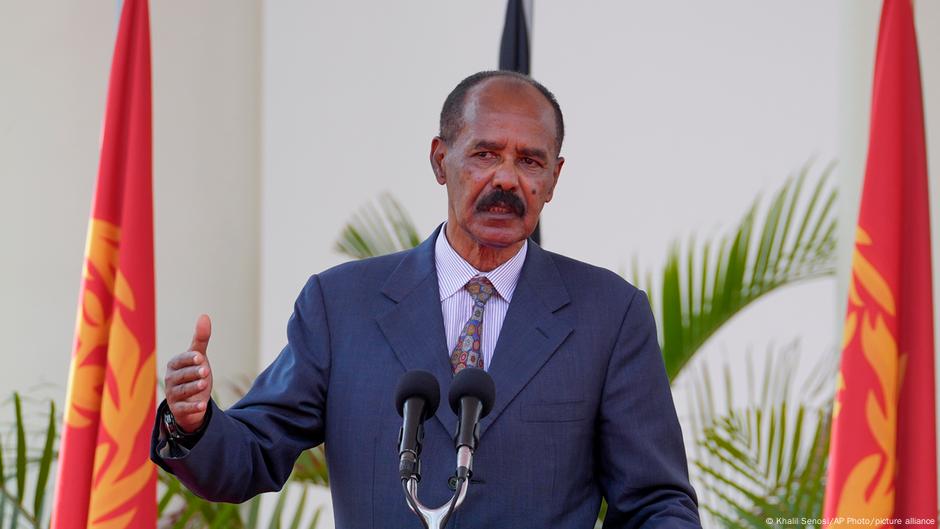
US officials have not described the move as an endorsement of Eritrea, nor has Washington publicly said that it struck a deal with Eritrean President Isaias Afwerki. But it removes a layer of pressure on a government whose strategic importance has grown as security around the Red Sea deteriorates.

For Abdurahman Sayed, director of the Horn of Africa Centre for Regional Integration and a political analyst, the wider geopolitical context is crucial.

"It is happening at a time when the war on Iran is ongoing," he told DW. "The Strait of Hormuz has been blocked for some time, and now the Bab el-Mandeb on the Red Sea, where Eritrea is located — this may give Eritrea some advantage to establish a meaningful relationship with the US."

Why Eritrea matters​

Eritrea controls a long coastline opposite Yemen. Its southern port of Assab lies close to the Bab el-Mandeb Strait, one of the world's most important maritime waterways.

Moses Okello, a senior researcher at the Institute for Security Studies in Addis Ababa, said the regional context has fundamentally changed since the previous Tigray war.

"In 2020, the concern was the TPLF [Tigray People's Liberation Front] versus the Ethiopian National Defense Force [ENDF]," he told DW. "Today, the entire Middle East is up in flames, and now the tensions in the Red Sea. So this changes the strategic value of not just the Eritrean coast, but the entire Red Sea waterway."

For Washington, cooperation — or at least non-hostility — from Eritrea can therefore be strategically valuable.

But the bargain carries risks.

Eritrea is one of the world's most authoritarian states, with no national elections since independence in 1993 and an extensive system of indefinite national service. Eritrean forces also fought alongside Ethiopian federal troops during the 2020-22 Tigray war.

And the economic impact of lifting sanctions may be more limited than the political symbolism suggests. "Lifting the sanctions may not make a huge difference on the ground," said Sayed. "Eritrea is not a trade hub [nor does it have] a well-established trading relationship with the outside world. It's actually a closed country."

Ethiopia heads back toward war​

The latest fighting did not emerge from nowhere.

On September 21, seven Ethiopian armed and political groups announced an alliance aimed at removing Prime Minister Abiy Ahmed's government. The coalition includes the TPLF, the Amhara Fano National Movement and the Oromo Liberation Army. Some members were on opposing sides during the 2020-22 Tigray war.

It remains unclear how closely the alliance's members will coordinate militarily. The alliance brings together groups with very different histories that share opposition to the federal government.

Two days later, fighting escalated in Tigray. Tigrayan forces seized airports and fighting spread into neighboring regions. The TPLF has said federal forces attacked first; Addis Ababa has said the TPLF launched the offensive.

The renewed fighting has raised questions about the durability of the 2022 Pretoria agreement.

Could Eritrea intervene?​

During the previous Tigray war, Eritrean forces fought alongside Ethiopian federal troops. But relations between Afwerki and Abiy have since deteriorated sharply.

One major dispute concerns Ethiopia's demand for reliable access to the Red Sea. Landlocked since Eritrea's independence, Ethiopia regards maritime access as a strategic necessity. Eritrea insists on its sovereignty and has rejected any suggestion that Ethiopia could obtain access through coercion.

The Ethiopian government has accused Eritrea of supporting armed groups in the new conflict. Eritrea has denied such allegations.

There is currently no public evidence that the US sanctions decision was designed to encourage Eritrean military intervention in Ethiopia. Nor is it clear that Eritrea has decided to enter the fighting.

But if the Tigray conflict intensifies, Eritrea could see a direct security interest in intervening. That would transform an Ethiopian conflict into a potentially interstate confrontation.

A regional conflict waiting to spread​

The Horn of Africa is already exceptionally volatile.

Sudan remains at war. Somalia is unstable. Ethiopia and Egypt remain locked in a dispute over the Nile and the Grand Ethiopian Renaissance Dam. Saudi Arabia and the UAE are pursuing their own interests across the Red Sea and Horn of Africa. And the conflict in Yemen is directly connected to the security of the Bab el-Mandeb Strait.

Okello sees the changing Middle East as an additional reason for urgent engagement. "There is no doubt that the conflict in the Middle East now puts a new contextual layer over that primary tension and increases the urgency to engage with both Eritrea and Addis Ababa to try and address this before it becomes a conflagration which makes addressing issues in the Red Sea a lot more difficult," he said.

A new Ethiopia-Eritrea confrontation would therefore not happen in isolation.

A new Ethiopia-Eritrea confrontation would therefore not happen in isolation.

Plaut warned that regional alliances could interact in dangerous ways. "You have the UAE backing the RSF and you have the Saudis backing the Eritreans and the Sudanese Armed Forces," he said. "This could all multiply and you could get one conflict leading into another."

That does not mean a general regional war is inevitable. Most governments involved have strong reasons to prevent an uncontrollable escalation. But the number of links between the region's conflicts is increasing.

Eritrea and shifting regional dynamics​

For Eritrea's President Afwerki, the US decision is an opportunity.

The end of the sanctions removes one source of international pressure and may give Eritrea greater diplomatic room for maneuver. More importantly, Washington's renewed engagement with Asmara underscores the strategic value of Eritrea's Red Sea position.

The more important Eritrea becomes to US and regional security calculations, the greater the danger that strategic interests will overshadow concerns about its authoritarian system and past military interventions.

For Ethiopia, the immediate question is whether the renewed fighting can be stopped before it draws in Eritrea.

For Washington, the challenge is whether Eritrea can be engaged as a Red Sea security partner without giving the country greater freedom to destabilize its neighbors.

Eritrea has spent decades on the margins of international diplomacy, but its location on the Red Sea has long given it strategic significance.

With fighting again raging in Tigray, the Houthis threatening the Red Sea and Washington reopening its channel to Asmara, Eritrea could become one of the key players in the Horn of Africa's next chapter.

Ekinder Firew in Addis Ababa contributed to this report.

Edited by: Keith Walker
 
In just this year South Africa has turned against migrants coming for work and appears to have a serial killer of women. But it's ordinarily high murder rate is escalating as well.


Police hunt gunmen after 2 mass shootings in South Africa leave at least 27 dead​


By GERALD IMRAY
Updated 11:32 AM EDT, September 27, 2026
Leer en español
​
CAPE TOWN, South Africa (AP) — Two separate mass shootings in South African townships within hours of each other have left at least 27 people dead, police said on Sunday.

South Africa has struggled with violent crime for years, but recent shooting incidents have shocked a country used to some of the highest homicide rates in the world.

In the first attack, eight gunmen armed with AK-47 rifles and pistols opened fire at a bar near Johannesburg late on Saturday. The South African Police Service said 17 people were killed at the small venue in Wedela township, southwest of South Africa’s biggest city.

The attackers fired at patrons outside the bar before moving inside and continuing to shoot. The victims included 13 men and four women, with at least 15 other people injured, police said.

The gunmen searched some of the patrons and took their mobile phones before escaping in two vehicles. Two cars were set alight outside the bar during the shooting.

Around four hours later, 10 people were killed and 11 wounded in a shooting at a store linked to what police described as an entertainment venue in Lwandle township, near Cape Town, South Africa’s second biggest city. Police said they were searching for multiple suspects, though they didn’t give an exact number.

No arrests have been made in either case. Police deployed specialized units to both townships and surrounding areas in the hunt for the gunmen.

The attacks came five days after another mass shooting in a township near Durban killed at least 11 people, including a pregnant woman, when multiple gunmen attacked a house party in KwaMakhutha township. Police have not reported any arrests.

South Africa’s gun violence problem​

Wedela resident Siyabonga Nondabula said there had been shootings in the area in the past involving illegal mining gangs, but none of them targeted so many people.

“Seventeen people and (maybe) even more have died, this has never happened here,” he said. “So I feel very sad and traumatized.”

A high rate of killings is a longstanding problem for Africa’s most advanced economy, but the phenomenon of mass shootings is becoming more common, according to experts, with recent killings often being carried out by multiple gunmen.

Gun homicides mostly affect South Africa’s poorest communities in townships and informal settlements made up of shacks and small homes on the edges of many big cities. Police have linked some of the recent shootings, including last week’s house party killings near Durban, to criminal gangs.

Other recent mass shootings include one in June in a poor neighborhood of Johannesburg that killed 12 people, and two in the space of two weeks in December that left a total of 21 people dead.

Soldiers deployed to help police fight crime​

South Africa’s violent crime problem prompted President Cyril Ramaphosa to deploy soldiers on the streets in March in a yearlong operation to combat crime in some of the country’s worst-affected areas. The deployment included high-crime areas around Johannesburg and Cape Town, as well as other areas.

Announcing the deployment, Ramaphosa said crime by organized gangs was the biggest threat to South Africa’s democracy and economic development. Some critics viewed the use of soldiers on the streets as an admission that police were failing.

Soldiers were deployed Sunday to the scene of the bar shooting in Wedela.

South Africa has on average 60 homicides a day​

South Africa recorded 5,427 homicides in the three-months ending June 30, an average of nearly 60 a day, according to police statistics.

Shootings are the most common method of homicide in the country. Police and crime experts have long identified the large number of illegal firearms in circulation as a major problem.

Firearm ownership is legal in South Africa but heavily regulated and subject to strict competency requirements. Estimates from political parties and the country’s national gun owners association suggest that between 2 million and 6 million illegal firearms are in circulation. Those groups say the weapons are used in the vast majority of gun homicides.
 

Ethiopia accuses Eritrea, Sudan of backing Tigray rebels amid clashes​

Africa
Ethiopia’s army chief accused Eritrea and Sudan on Sunday of backing armed groups fighting federal troops, as clashes with Tigrayan rebels intensified. The Tigray People’s Liberation Front said it was waging a “defensive war” and seized airports. A humanitarian source said rebels captured the Afar town of Erebti on Sunday.
Issued on: 28/09/2026 - 01:27Modified: 28/09/2026 - 08:40

3 minReading time
Share
By:
FRANCE 24
The Tigray People's Liberation Front (TPLF) fought a civil war with the federal government in 2020-2022 that killed around 600,000 people
The Tigray People's Liberation Front (TPLF) fought a civil war with the federal government in 2020-2022 that killed around 600,000 people. © Yasuyoshi Chiba, AFP

Ethiopia's army commander on Sunday accused Eritrea and Sudan of backing armed groups fighting its troops in the north of the country.

Heavy clashes have resumed between the Tigray People's Liberation Front (TPLF) and the federal government since Wednesday, raising fears of a return to a 2020-2022 civil war in which an estimated 600,000 people died.

The TPLF has seized airports and launched attacks into the neighbouring states of Afar and Amhara, saying they were engaged in a "defensive war" against the government of Prime Minister Abiy Ahmed.

A humanitarian source said the Afar town of Erebti, near the border with Tigray, fell to the rebels on Sunday after being pounded by heavy artillery.

The TPLF was now advancing towards the town of Afdeera, some 100 kilometres (60 miles) to the east.

The source estimated that at least 150,000 people have been displaced in Afar, but said it was impossible to give precise numbers.

Speaking on the army's YouTube channel, army chief Field Marshal Birhanu Jula said: "We are fighting forces that are organised and allied to serve the interests of external forces.

"Neither Shaebia (Eritrea) nor the TPLF can achieve anything alone, even if they are allied, unless they are backed, supported and supplied by Sudan, Egypt and other external powers," he added.

TV station attack​

The TPLF has allied with seven armed groups around the country, and appears to repeating a strategy from the last war of pushing south through Amhara towards Addis Ababa.

Its offensive in Afar is aimed at cutting supplies from Djibouti, which provides almost all of Ethiopia's international trade cargo, including fuel.

The headquarters of Tigrai TV, seen as the key outlet for the rebel authorities in the Tigrayan capital, Mekelle, was hit by a drone on Sunday.

"We heard a loud bang from a drone strike elsewhere and we fled the building," a journalist from the station told AFP, speaking on condition of anonymity.

The channel has not commented on the incident.

Photos taken by a local journalist showed Tigrai TV building facade damaged and blackened, with numerous windows blown out by the explosion.

Another journalist said the station, which has around 400 employees, was off-air after the attack. No reports of casualties were immediately available.

The federal government in Addis Ababa said on September 21 that Tigrai TV had been suspended "indefinitely", and banned other outlets from broadcasting its reports.

Blockade​

Communications have been limited since Friday when telecoms providers reported major disruption to phone and internet services in Tigray, making reporting on the conflict difficult.

Many in Tigray fear a repeat of a blockade imposed by the federal government during the 2020-2022 conflict when electricity, banking, and almost all aid were cut off.

United Nations chief Antonio Guterres raised the alarm on Friday, his spokesman saying Guterres was "particularly troubled by reports of the use of drones as well as incidents of harm to civilians".

The government has a significant military advantage, with a large arsenal of drones, some 500,000 troops, and support from abroad, notably the United Arab Emirates.

But the conflict could draw in neighbouring Eritrea on the side of the rebels, as it fears landlocked Ethiopia has been planning to invade and seize a direct point of access to the Red Sea.

The TPLF ruled all of Ethiopia from 1991 to 2018 before being sidelined with Abiy's rise to the prime minister's post.

That triggered a civil war marked by widespread war crimes and sexual violence.

The Pretoria Peace Agreement of 2022, brokered by African institutions and Washington, maintained an uneasy calm until last year. But it was never fully implemented, leaving around one million people unable to return to their homes.

Sporadic clashes then resumed, with the federal forces launching multiple drone strikes in Tigray in recent months and massing troops at the border.


Rights groups have accused the TPLF of a campaign of forced recruitment this year as it prepared for renewed conflict.

(FRANCE 24 with AFP)
 

Ethiopian federal forces retake Mekelle airport from Tigrayan fighters, residents say​

An Ethiopian flag is seen in Addis Ababa, Ethiopia, on May 5, 2022. (AP Photo, File)

An Ethiopian flag is seen in Addis Ababa, Ethiopia, on May 5, 2022. (AP Photo, File)

License this photo
By AMIR AMAN KIYARO and KHALED KAZZIHA
Updated 1:21 PM EDT, October 3, 2026
Leer en españo

NAIROBI, Kenya (AP) — Ethiopian federal forces have retaken the airport in Mekelle, the capital of the northern Tigray region, according to people in the city who spoke to The Associated Press on Saturday, reversing a takeover by Tigrayan fighters that prompted the suspension of commercial flights last month.

It wasn’t immediately clear when the federal forces recaptured Alula Aba Nega Airport. Those who provided the information declined to be identified for fear of retribution amid uncertainty over who controlled the city.

Severe disruptions to internet and cellphone networks have made gathering and verifying information from Tigray difficult. Details of how the airport changed hands, including whether fighting took place there, remained unclear.

Neither the Ethiopian government nor the Tigray People’s Liberation Front, or TPLF, had commented on the airport’s reported capture. It wasn’t clear who controlled Mekelle itself. An AP contributor in the city said that residents feared looting amid the uncertainty.

TPLF fighters seized the airport on Sept. 23, prompting Ethiopian Airlines to suspend flights to Mekelle and the Tigrayan cities of Axum and Shire. The African Union urged restraint, warning that renewed tensions threatened the peace agreement signed in 2022.

Federal troops are fighting alongside allied Tigrayan forces against the TPLF. The AP previously reported that the Tigray Peace Force, a breakaway faction of the Tigrayan rebels, was operating alongside federal forces in the neighboring Afar region.

The reported change in control follows a sharp deterioration in relations between Ethiopia and neighboring Eritrea. Ethiopia on Thursday ordered 10 Eritrean diplomats to leave and announced the closure of its embassy in Eritrea. Eritrea said that it would sever diplomatic ties.

Ethiopian authorities have accused Eritrea of supporting the TPLF, an allegation Eritrea has denied.

The fighting has brought renewed hardship to civilians still recovering from the previous 2020-2022 war. Residents of Mekelle told the AP earlier this week that communications, banking and other essential services had been disrupted.


In September, residents described fears of renewed isolation following the suspension of flights. They also reported that roads connecting Tigray and Afar had been closed to civilian traffic, although the AP couldn’t independently verify the closures.

The renewed hostilities have undermined the November 2022 Pretoria peace agreement that ended two years of war between federal forces and the TPLF. Eritrean troops fought alongside Ethiopia’s military during that conflict.


The TPLF has since joined six other opposition groups in an alliance seeking to remove Prime Minister Abiy Ahmed’s government. The extent of their military coordination remains unclear.
 

Ethiopia again demands access to the Red Sea as tensions with neighbors escalate​


Updated 1:20 PM EDT, October 5, 2026
9
​
ADDIS ABABA, Ethiopia (AP) — Ethiopian Prime Minister Abiy Ahmed reiterated on Monday that his landlocked country must have access to the Red Sea, despite neighboring countries saying at a summit Sunday that responsibility for the sea rests with states along its shores and warning of the risk of regional conflict.

Ethiopia lost direct access to the Red Sea in 1993 after Eritrea, formerly a region of Ethiopia, became independent.

Abiy said access to the Red Sea was critical to Ethiopia’s “civilization” and that he would work to ensure the country has a port.

“Based on the principle of give and take, we will work diligently to ensure that Ethiopia has an outlet to the sea,” he said shortly after being sworn in for a third term.

Ethiopia’s relations with its regional neighbors have deteriorated in recent months. The country also faces renewed war with separatist rebels in the northern Tigray region.

Fighters from the Tigray People’s Liberation Front have clashed with federal troops in the Tigray region, where a devastating two-year war ended in 2022. Researchers at Ghent University, in Belgium, estimated that 500,000 civilians died from violence, famine and the collapse of health services.

Eritrean troops fought alongside Ethiopian forces during the war in Tigray, but recently, Ethiopia has accused Eritrea of supporting the rebels and mobilizing support from Egypt and Sudan. Eritrea, in turn, has accused Ethiopia of seeking access to the sea through its territory.

A separate dispute over Ethiopia’s Grand Ethiopian Renaissance Dam on the Nile River has strained relations with Egypt and Sudan, which rely on the river for water.


Representatives of Egypt, Eritrea, Sudan and Somalia met on Sunday in the Egyptian city of New Alamein and called for cooperation on regional issues. They said governance of the Red Sea was the exclusive responsibility of its coastal states and rejected actions that could affect Egypt’s and Sudan’s use of Nile waters.

Ethiopia’s Foreign Ministry said on Monday that discussions about the Nile and Red Sea must account for geographic realities, noting that the Blue Nile originates in Ethiopia and that the country lies close to the Red Sea.

The ministry said Ethiopia remained committed to dialogue and peaceful engagement with its neighbors while defending its sovereignty and national interests.

The latest tensions also follow the expulsion of an Egyptian diplomat, who was declared persona non grata.

The United Nations and the African Union have expressed concern over the rising tensions and called for a peaceful resolution.
 
Top