INTL Sub-Saharan Africa

Plain Jane

Just Plain Jane

At least 700 dead in Tanzania's post-election protests, opposition says​

Africa
Hundreds of people have reportedly been killed in Tanzania after taking to the streets to protest this week’s presidential election, which saw the increasingly authoritarian incumbent, President Samia Suluhu Hassan, run unopposed for another term after her main challengers were jailed or barred from standing.
Issued on: 31/10/2025 - 13:53Modified: 31/10/2025 - 13:57
3 minReading time

By:
FRANCE 24
Riot police walk by a vandalised campaign poster of President Samia Suluhu Hassan, following a post-election protest in Tanzania, on October 30, 2025.
Riot police walk by a vandalised campaign poster of President Samia Suluhu Hassan, following a post-election protest at the Namanga One-Post Border crossing point between Kenya and Tanzania, October 30, 2025. © Thomas Mukoya, Reuters

Some 700 people have been killed in three days of election protests in Tanzania, the main opposition party said Friday, with protesters still on the streets in the midst of an internet blackout.

Advertising

“As we speak the figure for deaths in Dar (es Salaam) is around 350 and for Mwanza it is 200-plus. Added to figures from other places around the country, the overall figure is around 700,” John Kitoka, spokesman from the main opposition party Chadema, said.

“The death toll could be much higher,” he warned, saying killings could be happening during the nighttime curfew.

President Samia Suluhu Hassan, whose government is accused of a campaign of repression, had sought to cement her position and silence critics in her party in the virtually uncontested polls, with the main challengers either jailed or barred from standing.

Wednesday’s election descended into chaos as huge crowds took to the streets of Dar es Salaam and other cities, tearing down her posters and attacking police and polling stations, leading to an internet shutdown and curfew.

With foreign journalists largely banned from covering the election and a communications block entering its third day, information from the ground has been scarce.

Chadema, which was barred from the election, said protesters were marching on the city centre in Dar es Salaam on Friday, met by a heavy police and army presence.

A security source told AFP they were hearing reports of more than 500 dead, “maybe 700-800 in the whole country”, while Amnesty said it had received information of at least 100.

Multiple hospitals and health clinics were too afraid to talk directly to reporters.

Local news sites had not been updated since Wednesday, and Hassan has not commented on the unrest.

The only official statement came from army chief Jacob Mkunda late Thursday who called the protesters “criminals”.

Zanzibar ‘robbed’​

In Zanzibar, a tourist hotspot, Hassan’s ruling party had already been declared winner of the local vote on Thursday.

The opposition party, ACT-Wazalendo, rejected the result, saying: “They have robbed the people of Zanzibar of their voice... The only solution to deliver justice is through a fresh election.”

A senior party official said ballot boxes had been stuffed, people had been allowed to vote multiple times without ID and that their election observers had been kicked out of counting rooms.

The ruling party (Chama Cha Mapinduzi: CCM) was due to give a press conference later in the day.

At a meeting place for opposition supporters on Zanzibar, there was dismay and fear.

“There has never been a credible election since 1995,” said a 70-year-old man, referring to Tanzania’s first multi-party vote.

None of those interviewed gave their names.

“We are afraid of speaking because they might come to our houses and pick us up,” said one.

Crackdown​

Hassan has faced opposition from parts of the army and allies of her iron-fisted predecessor, John Magufuli, since she took over upon his death in 2021, analysts say.

They said she wanted an emphatic victory to cement her position, and the authorities banned the main opposition party, Chadema, and put its leader on trial for treason.

In the run-up to the vote, rights groups condemned a “wave of terror” in the east African nation, including a string of high-profile abductions that escalated in the final days.

Much public anger has been directed at Hassan’s son, Abdul Halim Hafidh Ameir, accused of overseeing the crackdown.


ACT-Wazalendo was allowed to contest the local election in Zanzibar, but its candidate was barred from competing against Hassan on the mainland.

(FRANCE 24 with AFP)
 
Weird story - I mean 700+ dead??? - then again, I haven’t slept in a couple weeks…but in the photo, does the second guy from the right have no head? Or is that the insomnia talking, lol.
 

What to know about a disputed election in Tanzania, where single-party rule is being challenged​

By RODNEY MUHUMUZA
Updated 8:40 AM EST, October 31, 2025

​
KAMPALA, Uganda (AP) — Protests are spreading in Tanzania as electoral authorities count the votes in a disputed presidential election that rights groups, opposition figures and others say was clouded by a climate of fear in the months leading to election day.

The military has been deployed alongside the police to quell riots in major cities since Wednesday’s election. The sight of soldiers patrolling the streets, sporadic gunfire and closed stores is rare in the usually peaceful country that many foreigners visit for its pristine coastal beaches and safari tourism.

That’s partly because Tanzania’s first female leader, who has served as president since 2021, has sparked widespread anger for running virtually unopposed after her two main opponents were blocked or prevented from contesting.

President Samia Suluhu Hassan, who seeks five more years as president, ran against 16 candidates from smaller parties. Critics say that’s a coronation, not a contest. Hassan is now the subject of a range of uncharitable cartoons, posted on social media, derided as a dictator and lampooned as being afraid of competition.

Tundu Lissu, leader of the Chadema opposition group, has been jailed for months, charged with treason after he called for electoral reforms that he said were a prerequisite for free and fair elections. Another opposition figure, Luhaga Mpina of the ACT-Wazalendo group, was barred from standing.

Political maneuvering​

At stake for the ruling Chama cha Mapinduzi party, or CCM, is its decades-long grip on power amid the rise of charismatic opposition figures who hope to lead the country toward political change.

The Armed Conflict Location & Event Data, or ACLED, a nonprofit tracking violence and protest movements around the world, describes CCM as the “last of the hegemonic liberation parties,” trying to cling to power by blocking the opposition “through administrative, legal, and extra-legal means.”

The pattern includes enforced disappearances, arbitrary arrests and extrajudicial killings, according to Amnesty International. In June, a United Nations panel of human rights experts cited more than 200 cases of enforced disappearance since 2019, saying they were “alarmed by reports of a pattern of repression” ahead of elections.

Internet access has been on and off since Wednesday as the nation awaits official results.

Tanzania’s president has “overseen an unprecedented crackdown on political opponents,” the International Crisis Group said in its most recent analysis. “The government has curbed freedom of expression, ranging from a ban on X and restrictions on the Tanzanian digital platform JamiiForums to silencing
critical voices through intimidation or arrest.”
Local police even appeared to be “conducting so-called online patrols,” it said.

The political maneuvering by Tanzanian authorities is unprecedented even in a country where single-party rule has been the norm since the advent of multi-party politics in 1992.

Government critics point out that previous leaders tolerated opposition while maintaining a firm grip on power, whereas Hassan is accused of leading with an authoritarian style that defies youth-led democracy movements elsewhere in the region.

In Uganda, the opposition leader Bobi Wine, whose real name is Kyagulanyi Ssentamu, is the leader of what began as the “People Power” movement, which aims for a break with nearly four decades of the same leader. President Yoweri Museveni took his lowest-ever share of the vote in the 2021 election, marking the 43-year-old Wine as a formidable national leader.

In Kenya, young people have been trying to hold President William Ruto accountable over official corruption and his alleged failure to keep campaign promises. Last year and earlier this year, they held demonstrations in the capital Nairobi that were so large and persistent that Ruto deployed the military to restore order.

In Mozambique a year ago, violence erupted in the streets after the opposition figure Venâncio Mondlane brought his supporters to the streets of the capital Maputo following a disputed election.

In Madagascar earlier in October, protests by mostly young people helped overthrow the government of President Andry Rajoelina, who fled the country after an elite group of the military joined crowds protesting water and electricity cuts.

Tanzania is an outlier​

But Tanzania is different, an outlier in the region.

A version of the governing CCM party, which maintains ties with the Communist Party of China, has ruled Tanzania since independence from Britain in 1961, a remarkable streak that Hassan is trying to extend as opposition leaders try to break CCM’s grip on the country.

CCM is fused with the state, effectively in charge of the security apparatus and structured in such a way that new leaders emerge every five or ten years. Hassan herself was able to rise to the presidency as vice president without incident when her predecessor, John Pombe Magufuli, died suddenly after the start of his second term.

The orderly transition sustained Tanzania’s reputation as an oasis of political stability and relative peace, a major reason for CCM’s considerable support, especially among rural voters.
 
Reading stories like this reminds me why the fathers of our country included the 2nd Amendment in the Bill of Rights. They knew one day the government would fail and the citizens would have no other recourse than to take up arms against it. I thought under the potato head it might come to this, but thank G-d that hoe lost and we have Trump.
 

Tanzania's instability could harm trade in southern Africa​

Privilege Musvanhiri
18 hours ago18 hours ago
The political unrest in Tanzania could potentially disrupt key trade routes and the landlocked economies in southern Africa that rely heavily on the East African country's ports for essential imports.

The closure of Dar es Salaam's port in Tanzania amid election unrest hit Malawi hard as inbound trucks were unable to enter the country for several days.

The Malawi–Tanzania border crossings at Songwe and Kasumulu were shut as protesters and police clashed in the days surrounding the October 29 polls. Mobs ransacked Tanzanian government buildings, destroyed customs offices and disrupted communication networks in Songwe. According to the Transporters Association of Malawi, the unrest paralyzed the cargo sector.

"Pumps are dry here. You can hardly get fuel in Lilongwe and Salima," Sydney Chaima told DW in Lilongwe, Malawi.

Meanwhile, experts warn that continued political instability in Tanzania has repercussions beyond the country.

"We could see a rise in inflation and diminished growth. Farmers are going to be the worst affected. We are at a key moment when fertilizers are needed," Christopher Mbukwa, economist and lecturer at Mzuzu University in Malawi, told DW.

Landlocked countries in southern Africa, like Malawi, Zambia and Zimbabwe , rely heavily on Tanzanian ports for fuel, pharmaceuticals, agricultural inputs, vehicles and textiles.

A broader disruption in Africa​

Tanzania is part of the 16-member Southern African Development Community (SADC) and a key stop on the North-South Corridor (NSC), one of Africa's most important regional trade and transport routes.

The network's ports, roads and railways link the SADC bloc to Africa's Great Lakes region. More than 60% of all SADC trade flows through the corridor. Earlier this year, SADC members Botswana, Democratic Republic of Congo (DRC), Malawi, Mozambique, South Africa, Zambia and Zimbabwe endorsed a plan to develop a "smart corridor" they expect to unlock $16.1 billion in GDP and create 1.6 million jobs.

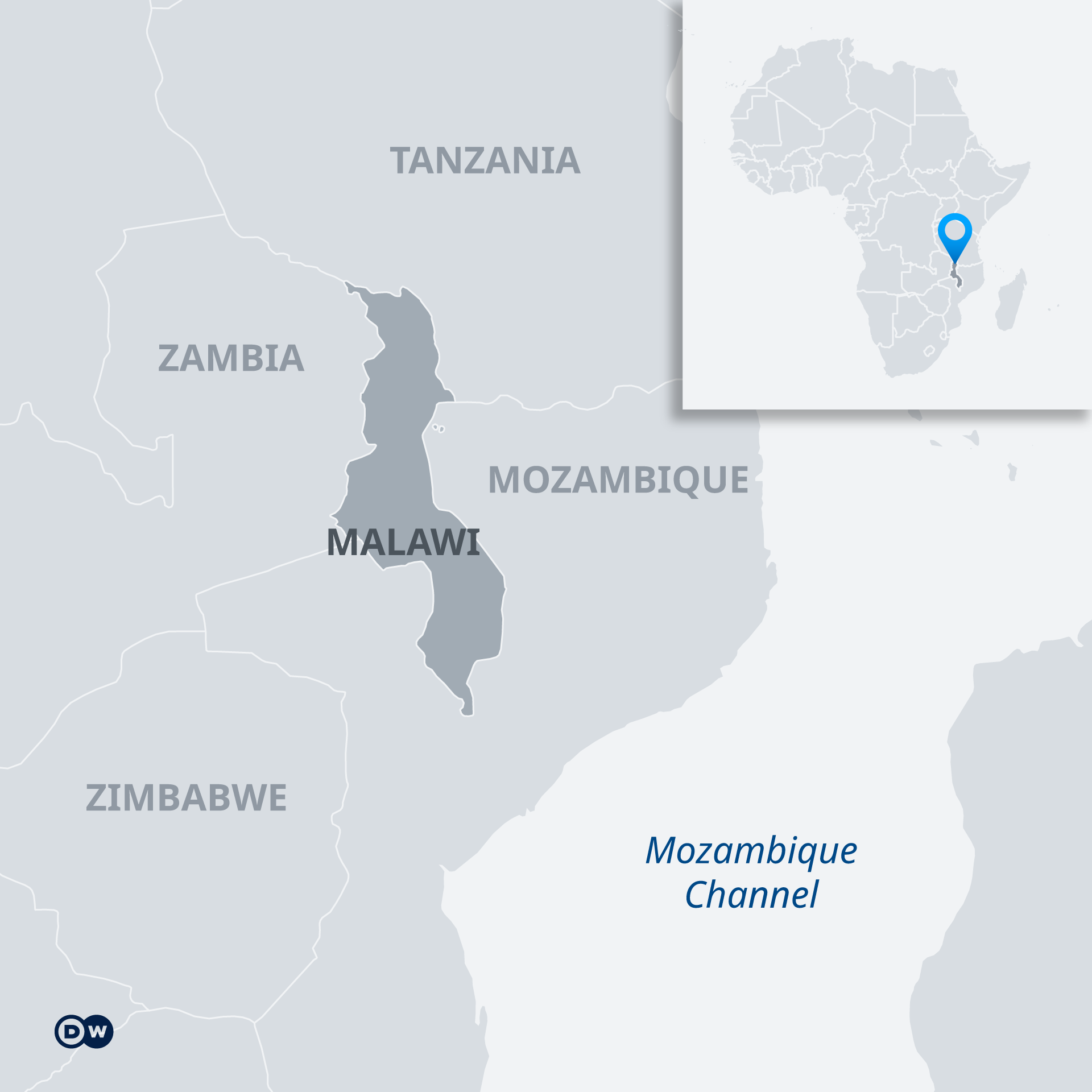
A map showing Malawi in relation to Tanzania, Zambia, Zimbabwe and Mozambique


Tanzania's ports play a critical role in vehicle imports to Zimbabwe, handling about 15,000 units annually.

"The internet blackout in Tanzania was a big problem," Trice Chisamba, a Zimbabwean car importer, told DW. "We couldn't communicate with clearing agents. Some of our vehicles were released and parked outside the port, we feared they could be destroyed in the violence."

Analysts have said importers may need to explore alternative routes through ports in Mozambique or South Africa, although these could be more expensive.

"Players in various industries must act fast to find alternative ports," Mbukwa said.

What SADC election observers said​

The SADC election observer mission to Tanzania condemned the disputed election, saying it failed to meet democratic standards. In its preliminary report, the mission said voters in many areas were unable to freely express their will. It also cited restrictions on opposition activity and reports of ballot stuffing.

"Overall, the 2025 general election in the United Republic of Tanzania fell short of the SADC Principles and Guidelines Governing Democratic Elections," the SADC observers said.

Political analysts warn that President Samia Suluhu Hassan's legitimacy may come under scrutiny following SADC's rare criticism.

"SADC is simply saying there was no election in Tanzania — which is a shared sentiment among Tanzanians," Tito Mugoti, a human rights lawyer in Dar es Salaam, told DW.

"The government she forms is illegitimate. Parliament is illegitimate. The people's interests will not be represented," he added.

Two SADC leaders at Suluhu Hassan's inauguration​

Suluhu Hassan was sworn in on Monday at a private ceremony. Only two leaders from the SADC bloc attended: Presidents Hakainde Hichilema of Zambia and Daniel Chapo of Mozambique.

Some Zambians criticized Hichilema for attending the inauguration, suggesting it amounted to an endorsement of a disputed election.

"Political stance we're pushing for Zambia's presence in Tanzania is the same Kamuzu Banda had in the 1960s," putting trade before freedom, political activist Joseph Kalimbwe wrote on X.

Zimbabwe's President Emmerson Mnangagwa sent his deputy, Constantino Chiwenga. "What has happened in Tanzania is quite disturbing and something that has got to be avoided at all costs," Chiwenga said on state television in Zimbabwe. "I believe Tanzania has come of age and is the mother of all liberation movements. I'm convinced they will iron out their differences and move forward."

Meanwhile, the South African government is yet to comment on the developments in Tanzania. Its president, Cyril Ramaphosa, has just been picked as interim chairperson of SADC. The bloc's 2025 chairperson, Andry Rajoelina, was ousted as president of Madagascar in coup amid political unrest shortly before Tanzania's disputed election.

Edited by: Benita van Eyssen
 

Tanzania accuses scores of 'treason' over election protests​

Saim Dušan Inayatullah with AFP, AP, Reuters
20 hours ago20 hours ago
More than 100 people were accused of "intention to obstruct" an October 29 election in which President Samia Suluhu Hassan ran virtually unopposed. The opposition says hundreds were killed in post-election violence.

A Tanzanian court on Friday charged scores of people with treason following violent protests sparked by a controversial election the opposition alleges was illegitimate.

According to court filings, those indicted were accused of "intention to obstruct" the October 29 election, as well as intimidating the executive and damaging government property.

News agencies Reuters and AFP each reported that well over 100 people were charged, citing legal sources. None of the accused were public figures.

"Some of them they have been beaten, they are sick, they have not received any medical treatment," Paul Kisabo, a lawyer with the Tanzania Human Rights Defenders Coalition told AFP.

Tanzania's election disputed after president wins 98% of vote​

According to according to Tanzania's electoral commission, President Samia Suluhu Hassan won the election with 98% of the vote.

Hassan, who leads the ruling Chama cha Mapinduzi (CCM), ran virtually unopposed — the main opposition party, Chadema, boycotted the election after its leader, Tundu Lissu, was imprisoned on treason charges.

The other main opposition candidate, Luhaga Mpina of the ACT-Wazalendo party, was disqualified by the electoral commission.

The African Union said that its observers had also concluded that the election did not comply with "international obligations and standards for democratic elections."

Amnesty International has accused Tanzania of a broader crackdown on the opposition, including enforced disappearances, arbitrary arrests and extrajudicial killings.

Hundreds killed in protests — opposition​

The disputed election sparked widespread turmoil in the East African country.

Tanzania's main opposition party, Chadema, said that several hundreds of people were killed in a crackdown on the protests.

The government has alleged the figure is exaggerated but has not provided its own death toll.

Tanzania also imposed a six-day internet shutdown and nationwide curfew to curb the protests.

Edited by: Zac Crellin
 

Is Ethiopia aiming to intimidate Eritrea?​

David Ehl
21 hours ago21 hours ago
Ethiopia's dream of a seaside port is fueling fears of war in the Horn of Africa. Some even fear an imminent Ethiopian invasion of neighboring Eritrea.


Ethiopia and Eritrea have experienced quite a few watershed moments in their shared history: After the end of the colonial era, Eritrea was incorporated into the Ethiopian Empire. A war of independence ended in 1993 with the secession of the former province. Since then, two more wars have followed, in which the large landlocked Ethiopia and its small neighbor on the Red Sea encountered each other first as adversaries and later as allies.

Now, relations are so strained again that many residents of the border region live in constant fear of another war.

"The risk of conflict between the two countries remains quite high," said Michael Woldemariam, an associate professor at the University of Maryland School of Public Policy.

"We can say with some confidence that the tension and animosity between the two governments has become much more explicit over the last couple of months and weeks," Woldemariam told DW.

What are the causes of the current tensions?​

The governments of both countries had been allied for a brief period until three years ago. They had joined forces against the Tigray People's Liberation Front (TPLF) in Ethiopia's northern province of Tigray. Depending on the source, between 162,000 and 600,000 people died in this extremely brutal war.

The TPLF is also the common denominator in the past enmity between the two countries: Although its ethnic group constituted only around 6% of the Ethiopian population, the TPLF dominated domestic politics for decades and enforced a harsh policy against Eritrea. TPLF dominance ended in 2018 when Abiy Ahmed, who originates from the two largest ethnic groups, the Oromo and the Amhara. was elected Ethiopian prime minister. Abiy spurred reconciliation with Eritrea; later tapping him for Nobel Peace Prize in 2019.

But the improved relationship since the end of the Tigray War now lies in shambles. The main point of contention is Abiy's increasingly vehement demands for a seaport for Ethiopia, the world's most populous landlocked country with 120 million inhabitants. Ethiopia primarily uses the ports in its small neighbor Djibouti for imports and exports — and, according to experts, pays between $1.5 billion and $2 billion (€1.3 billion and €1.7 billion) annually to do so. Abiy argues that these costs hinder economic growth.

Eritrea fears Abiy could seize the port of Assab by force, located just 75 kilometers across the border. In mid-October, high-ranking Ethiopian officials, intelligence and military representatives visited the border town of Bure, situated on the highway to Assab. Bure saw fierce fighting during the war between 1998 and 2000, and the meeting fueled concerns of renewed fighting.


Unlike Abiy's government and the TPLF, Eritrea was not a party to the 2022 Tigray Peace Agreement in Pretoria. After the deal was closed, powerful TPLF officials came to blows over the concessions made to Abiy, ultimately leading to a split within the TPLF. A breakaway faction distanced itself from the prime minister and reportedly receives support from Eritrea. Since the spring, numerous reports about skirmishes and troop movements in northern Ethiopia have surfaced. When Ethiopia recently accused Eritrea of supporting local militias, Asmara dismissed the claim as a "false charade."

Ethiopia's army stretched by internal conflicts​

Ethiopia's army is currently fighting insurgents in several parts of the country. Abdurahman Sayed, a UK-based expert on the Horn of Africa, said he doubts Ethiopia's military is currently in a position to capture the port of Assab.

"Right now, the fight in the Amhara region has proven to be a very challenging one to the Ethiopian army. So in this kind of circumstances, I think going to war against Eritrea may not be a wise step to be taken", Sayed told DW.


ConflictsEthiopia

Is Ethiopia aiming to intimidate Eritrea?​

David Ehl
21 hours ago21 hours ago
Ethiopia's dream of a seaside port is fueling fears of war in the Horn of Africa. Some even fear an imminent Ethiopian invasion of neighboring Eritrea.

Ethiopia and Eritrea have experienced quite a few watershed moments in their shared history: After the end of the colonial era, Eritrea was incorporated into the Ethiopian Empire. A war of independence ended in 1993 with the secession of the former province. Since then, two more wars have followed, in which the large landlocked Ethiopia and its small neighbor on the Red Sea encountered each other first as adversaries and later as allies.
Now, relations are so strained again that many residents of the border region live in constant fear of another war.

"The risk of conflict between the two countries remains quite high," said Michael Woldemariam, an associate professor at the University of Maryland School of Public Policy.

"We can say with some confidence that the tension and animosity between the two governments has become much more explicit over the last couple of months and weeks," Woldemariam told DW.

What are the causes of the current tensions?​

The governments of both countries had been allied for a brief period until three years ago. They had joined forces against the Tigray People's Liberation Front (TPLF) in Ethiopia's northern province of Tigray. Depending on the source, between 162,000 and 600,000 people died in this extremely brutal war.

The TPLF is also the common denominator in the past enmity between the two countries: Although its ethnic group constituted only around 6% of the Ethiopian population, the TPLF dominated domestic politics for decades and enforced a harsh policy against Eritrea. TPLF dominance ended in 2018 when Abiy Ahmed, who originates from the two largest ethnic groups, the Oromo and the Amhara. was elected Ethiopian prime minister. Abiy spurred reconciliation with Eritrea; later tapping him for Nobel Peace Prize in 2019.
Eritrean soldiers in line, with Eritrean and Ethiopian flags on flagpoles in the backgorund

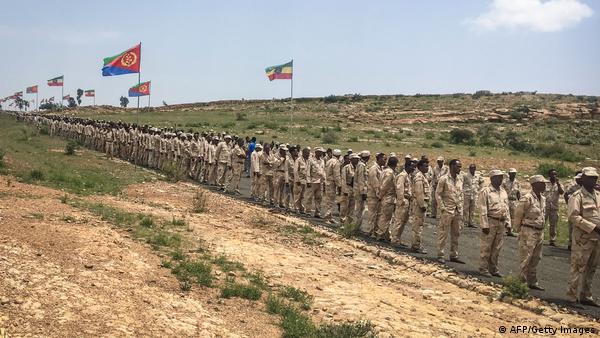
In 2018, two land border crossings between Ethiopia and Eritrea were reopened - the picture shows Eritrean soldiers waiting to attend a border reopening ceremonyImage: AFP/Getty Images

But the improved relationship since the end of the Tigray War now lies in shambles. The main point of contention is Abiy's increasingly vehement demands for a seaport for Ethiopia, the world's most populous landlocked country with 120 million inhabitants. Ethiopia primarily uses the ports in its small neighbor Djibouti for imports and exports — and, according to experts, pays between $1.5 billion and $2 billion (€1.3 billion and €1.7 billion) annually to do so. Abiy argues that these costs hinder economic growth.

Eritrea fears Abiy could seize the port of Assab by force, located just 75 kilometers across the border. In mid-October, high-ranking Ethiopian officials, intelligence and military representatives visited the border town of Bure, situated on the highway to Assab. Bure saw fierce fighting during the war between 1998 and 2000, and the meeting fueled concerns of renewed fighting.

Unlike Abiy's government and the TPLF, Eritrea was not a party to the 2022 Tigray Peace Agreement in Pretoria. After the deal was closed, powerful TPLF officials came to blows over the concessions made to Abiy, ultimately leading to a split within the TPLF. A breakaway faction distanced itself from the prime minister and reportedly receives support from Eritrea. Since the spring, numerous reports about skirmishes and troop movements in northern Ethiopia have surfaced. When Ethiopia recently accused Eritrea of supporting local militias, Asmara dismissed the claim as a "false charade."

Ethiopia's army stretched by internal conflicts​

Ethiopia's army is currently fighting insurgents in several parts of the country. Abdurahman Sayed, a UK-based expert on the Horn of Africa, said he doubts Ethiopia's military is currently in a position to capture the port of Assab.

"Right now, the fight in the Amhara region has proven to be a very challenging one to the Ethiopian army. So in this kind of circumstances, I think going to war against Eritrea may not be a wise step to be taken", Sayed told DW.

This argument is also made by Bayisa Wak-Woya, a former UN diplomat of Ethiopian origin.

"In theory, anything can happen but, personally, I don't think there will be an outright war between Ethiopia and Eritrea beyond the ongoing verbal war for many reasons," Wak-Woya told DW. "I don't really think there is a ground for Ethiopia and Eritrea to go into an all-out war at this stage."
Lawmakers in Ethiopian parliament are listening to Abiy Ahmed's speech

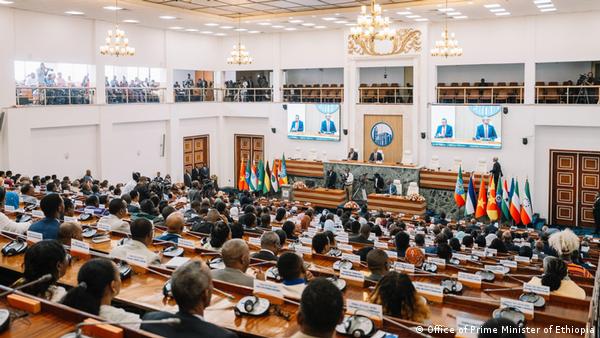
Abiy Ahmed during his remarks before the house of representatives on October 28thImage: Office of Prime Minister of Ethiopia

Speaking before the Ethiopian parliament at the end of October, Abiy reaffirmed Ethiopia's "irreversible demand" for its own access to the sea.

"I am a million times sure that Ethiopia will not remain a landlocked country," he said.

A military takeover of Assab would contravene international law, Wak-Woya said.

"If Ethiopia does that against Eritrea, just to gain access to Assab, it is illegal," he said.

Abiy, however, also told lawmakers a renewed conflict was not his intent.

"We have no intention of going to war (with Eritrea, ed.), rather we firmly believe the issue can be resolved peacefully," he said during his address to parliament.

Abiy Ahmed seeks mediation, but who would get involved?​

He added that he had already discussed his desire for an Ethiopian port with the United States, Russia, China, the African Union, and the European Union.

Security expert Sayed argued that the African Union would be the right place for conflict resolution, but added: "The African Union has always had a chronic problem when it came to addressing issues of conflict within Africa, but also within Ethiopia, too. In 2024, when the Ethiopian prime minister signed a memorandum of understanding with Somaliland, which is a renegade region of Somalia Republic, that was a clear violation of African Union Charter, which calls on respecting boundaries inherited from colonialism."

US-based researcher Woldemariam said he believes the Trump administration could pressure both sides into making concessions since both Ethiopia and Eritrea are interested in improving ties with Washington.

"On the other hand, of course, I think it is difficult for countries in the Horn region to get a read on exactly what is happening in Washington. I think the Trump administration is regarded as a somewhat unpredictable actor at the current moment, not necessarily reliable," Woldemariam said.

Eritrean President Isaias Afwerki has already sought the support of his ally Egypt: In late October, he traveled to Cairo for a five-day working visit. Egypt is already at odds with Ethiopia over the GERD dam located upstream on the Nile.

Sayed stressed Egypt's strong domestic interests in settling the conflict.

"The Red Sea for the Egyptians is as important as the River Nile, because the income they get from the Suez Canal, if there is any problems on the southern entrance of the Bab el-Mandab to the Red Sea, then their income would be affected," Sayed said.

When Yemeni Houthi rebels shelled international cargo ships in the region in what they said was support for Palestinians in Gaza, revenues temporarily fell by 40%.

What role do Ethiopia's looming elections play?​

Abiy's current term is coming to a close as Ethiopians will head to the polls sometime in 2026. Observers offer differing opinions on how much the looming elections could be influencing the escalation in tension between Ethiopia and Eritrea.

Bayisa Wak-Woya believes Abiy can expect to win reelection — and that a new term would buy him considerable time to address the port issue.

The former UN diplomat told DW: "I think the issue of Assab will never disappear from the political arena of both the government and even the most opposition groups, because, first of all, there are many, at least not the current generation, but my generation and so on, we still can't absorb the fact that Eritrea is no more part of Ethiopia."

Edited by Sean Sinico

 

Thousands of Africans returned home through an EU program. Many say they’ve been abandoned​


MONIKA PRONCZUK
Updated 5:57 AM EST, November 11, 2025

​
CONAKRY, Guinea (AP) — When Oumar Bella Diallo boarded a plane home to the West African nation of Guinea in July, the weary 24-year-old thought his migration ordeal was over.

He had spent almost a year trying to reach Europe. He said he was attacked by police and scammed for money as he crossed Mali, Algeria and Niger, at one point limping past corpses in the desert. After seeing fellow migrants die from hunger and exhaustion, he gave up.

He is among tens of thousands of Africans returning home with the help of the International Organization for Migration, as Europe spends millions of dollars to deter migrants before they reach its shores. The European Union-funded IOM program pays for return flights and promises follow-up assistance.

But migrants tell The Associated Press that promises by the United Nations-affiliated organization are not fulfilled, leaving them to face trauma, debt and family shame on their own. Desperation could fuel new migration attempts.
The AP spoke to three returnees in Gambia and four in Guinea, and was shown a WhatsApp group of over 50 members founded around returnees’ frustration with the IOM. They described months of reaching out to the IOM with no reply.

Oumar Bella Diallo, a returnee, opens the door of an auto repair shop where he works in Conakry, Guinea, Sept. 23, 2025. (AP Photo/Misper Apawu)

Oumar Bella Diallo, a returnee, opens the door of an auto repair shop where he works in Conakry, Guinea, Sept. 23, 2025. (AP Photo/Misper Apawu)
Diallo said he told the IOM he wanted to start a small business. But all he has received is a phone number for an IOM counselor and a five-day orientation course on accountability, management and personal development. He said many returnees had trouble grasping it because of low education levels.

“Even yesterday, I called him,” Diallo said. “They said for the moment, we have to wait until they call us. Every time, if I call them, that’s what they tell me.” He said he asked for medical help with a foot injured on his migration attempt but was told it was impossible.

As the oldest child of a single mother, the responsibility for supporting relatives weighs heavily.

“If there’s not so much money, you’re the head of the family too,” he said.

Millions spent but little scrutiny​

The IOM program is financed almost completely by the EU and was launched in 2016. Between 2022 and 2025, it repatriated over 100,000 sub-Saharan migrants from north Africa and Niger.

Of the $380 million budget for that period, 58% is allocated for post-return assistance, the IOM said.

Francois Xavier Ada with the IOM regional office in West Africa told the AP that over 90,000 returnees have started, and 60,000 completed, the reintegration process “tailored to individual needs.” Ada said that can “support anything from housing, medical assistance or psychosocial services to business grants, vocational trainings and job placement.”

Migrants told the AP they had not received any of those.

Ada said the IOM was ”concerned” to learn of people kept waiting and “happy to look into these cases.” He added that delays can occur due to high caseloads or incomplete documentation, and medical assistance is not guaranteed.

Experts said there is little insight into how the EU money helps returnees. The European Court of Auditors, an EU body, audited the program’s first phase between 2016 and 2021 and said it failed to demonstrate sustainable reintegration results, monitoring was “insufficient to prove results” and the EU “could not prove value for money.”

“The EU policy is obsessed with returns,” said Josephine Liebl with the Brussels-based European Council on Refugees and Exiles. “The question of how this support actually helps people in very vulnerable situations receives very little public scrutiny, which is due to the fact that there is such a lack of transparency and accountability of how EU funding works outside the EU.”

The EU did not respond to questions on the details of the budget beyond repeating IOM statements.

Moustapha Darboe, a Gambian journalist who interviewed over 50 returnees for an investigation into the IOM program, said they had to wait a long time, often almost a year, and support they eventually received did not match their skills and ambitions.

“The IOM is donor-based,” he told the AP. “Their primary focus is not to help these people, their primary focus is to tick their box.”

Haunted by shame and stigma​


The IOM program has coincided with Europe’s other efforts to deter migration, including paying some African governments to intercept migrants, an approach denounced by human rights groups that accuse African authorities of being complicit in abuses.

Europe’s efforts appear to be working. In the first eight months of 2025, it recorded 112,000 “irregular” crossings, over 20% less than the same period last year, and a drop of over 50% from two years ago.

Experts say that while the IOM’s return program helps to extract people from inhumane treatment, the promised follow-up support is often impossible to deliver as most migrants’ home countries have poorly functioning state services.

“The major missing piece is the support for the returnees to get reintegrated, have access to social protection and to labor markets,” said Camille Le Coz, director of the Brussels-based Migration Policy Institute.

Kabinet Kante, a 20-year-old from Guinea who dreamed of being a footballer in Germany, spent almost two years trying to reach Europe. He said he was intercepted at sea and dumped in the desert, and still wakes at night screaming.

He returned to Guinea in July with the IOM’s help. He said he wanted to learn how to drive a bulldozer but the IOM has ignored his calls, and when he went to their office, they told him to stop calling.

He set up the WhatsApp group for over 50 other returned and frustrated migrants. He also records TikTok videos warning against the treacherous route to Europe.

But he has no way to pay back his parents, who supported his journey by sending money to pay smugglers and bribe officials.

“Right now, I am doing nothing,” he said, head bowed with embarrassment.

‘Going on an adventure’​


Like many sub-Saharan African countries, Guinea has rich natural resources, including the world’s largest iron ore deposits. But experts say bad governance and exploitation by foreign companies have left most of the population destitute.

Over half of Guinea’s population of 15 million is experiencing “unprecedented levels of poverty,” according to the World Food Program, and cannot read or write. The official monthly minimum wage is less than $65. Most people work in the informal economy and earn even less.

“Those with degrees work as taxi drivers here,” Diallo said. “If there were, like elsewhere, job opportunities in the country, everyone would stay here.

Diallo and Kante said they are not planning on “going on an adventure” any time soon — a term used widely to describe the migration route to Europe.

But that’s mostly because they don’t have money. They dream of working in Europe legally, but the visa process can cost hundreds of dollars, and applicants from sub-Saharan countries have a high rejection rate.

Elhadj Mohamed Diallo, director of the Guinean Organization for the Fight Against Irregular Migration, is a former migrant who reached Libya before turning back. He now works with the IOM on reintegration activities but indicated doubt about their ability to prevent returnees from migrating again.

He said he doesn’t blame them as life at home becomes more difficult.

“We aren’t helping them so that they can stay. We are helping them so they can take control of their lives again,” he said. “Migration is a natural thing. Blocking a person is like blocking the tide. When you block water, the water will find its way.”
 

Central African Republic leader cleared for third term in key vote followed closely by Russia​

Central African President Faustin-Archange Touadera arrives for the 19th Francophonie Summit, at the Elysee Palace, in Paris, Friday, Oct. 4, 2024. (AP Photo/Louise Delmotte, File)

Central African President Faustin-Archange Touadera arrives for the 19th Francophonie Summit, at the Elysee Palace, in Paris, Friday, Oct. 4, 2024. (AP Photo/Louise Delmotte, File)
By JEAN FERNAND KOENA and MARK BANCHEREAU
Updated 10:39 AM EST, November 14, 2025

BANGUI, Central African Republic (AP) — The top court in the Central African Republic on Friday cleared President Faustin Archange Touadera to run in December’s election, a contest that will unfold amid a deepening security crisis and the leader’s growing reliance on Russia for protection.

The Central African Republic’s constitutional court approved Touadera’s candidacy alongside prominent opposition leader Anicet Georges Dologuélé and five other candidates for the Dec. 28 vote.

The court rejected a recent petition that sought to disqualify Touadera on the grounds of not meeting the criteria for running for the presidency.

Touadera, who has led the country since 2016 and was reelected in 2021, is one of Russia’s closest allies in Africa. Central African Republic is one of the first countries in which the Russian mercenary group Wagner established operations with the pledge of fighting rebel groups and restoring peace.

But disagreements around the nature of Russia’s military presence in the country have cast a shadow over the Central African Republic’s relations with Moscow.

In August, state and military officials told The Associated Press that Russia has called on the country to replace the private Wagner mercenary group with Moscow’s state-run Africa Corps and requested payment for further security services.

The Central African Republic’s government has been reluctant to agree to Russia’s demands, because it sees Wagner as more effective and they prefer to pay for services with minerals, not in cash.

For years, Wagner has been protecting Touadera and his government, and helped him win a 2023 constitutional referendum that could extend his power indefinitely. In exchange, they’ve enjoyed access to the country’s rich minerals, including gold.

The Central African Republic has been in conflict since 2013, when predominantly Muslim rebels seized power and forced the president from office. A 2019 peace deal was signed, but six of the 14 armed groups involved in the deal withdrew from it. Wagner is credited for helping prevent the rebels from retaking the capital in 2021.

The validation of Touadera’s candidacy came on the same day the U.N. Security Council extended its peacekeeping mission in the Central African Republic for a year.

____

Banchereau reported from Dakar, Senegal.
 

Congo and M23 rebels sign framework for peace deal in latest bid to end decades-long conflict​

By RUTH ALONGA and MARK BANCHEREAU
Updated 1:42 PM EST, November 15, 2025
Leer en español

​
GOMA, Congo (AP) — Congo and Rwanda -backed rebel group M23 on Saturday signed a framework agreement for a peace deal, the latest step in the so far unsuccessful efforts to end the decades-long conflict in eastern Congo.

Earlier this year, M23 seized Goma and Bukavu, two key cities in eastern Congo, in a major escalation of the conflict.

Backed by neighboring Rwanda, M23 is the most prominent of more than 100 armed groups fighting for control in Congo’s mineral-rich east. With 7 million people displaced, the conflict in Congo has been described by the U.N. as “one of the most protracted, complex, serious humanitarian crises on Earth.”

The agreement signed in Doha on Saturday, following mediation by Qatar and the United States, is not yet a final peace agreement, but rather a framework outlining the measures required to reach one, the head of the M23 delegation, Benjamin Mbonimpa, said in a video posted on X.

“There will be neither any change in the situation on the ground, nor any activity whatsoever, until the measures are debated, negotiated and discussed one by one and a final peace agreement is reached,” Mbonimpa said.

The Congolese government said in a statement the framework agreement signed on Saturday includes eight measures that serve as a basis for a peace deal. Two of the measures — agreements on the release of prisoners and the creation of a ceasefire oversight body — were already signed in September and October.


The six other measures, which in part include the restoration of state authority in rebel-controlled areas, humanitarian access, and the resettlement of refugees, will be subject to discussion and negotiation in the next two weeks, the Congolese government said.

Qatar has hosted multiple rounds of talks since April between the Congo and M23, mainly to set preconditions for a peace deal and agree on confidence-building steps, but both sides still accuse each other of violating peace terms and fighting has continued.

Qatar has hosted multiple rounds of talks since April between the Congo and M23, mainly to set preconditions for a peace deal and agree on confidence-building steps, but both sides still accuse each other of violating peace terms and fighting has continued.

In July, Congo and M23 signed a signed a declaration of principles in Qatar to end the conflict and commit to a comprehensive peace agreement. They agreed to finalize the deal by Aug. 18 but missed the deadline, blaming each other for breaches of the agreement.

Massad Boulos, senior adviser to U.S. President Donald Trump, attended the ceremony in Doha on Saturday and called the framework agreement a “starting point.”

“It is only the beginning, but we know the final outcome will be very fruitful,” he said, calling it a “historic” opportunity.


The Trump administration has also led mediation efforts between Rwanda — which is accused of backing M23 — and Congo, leading to the signing of a peace deal between the two countries in June.

———

Banchereau reported from Dakar, Senegal. Associated Press writer Jean-Yves Kamale in Kinshasa, Congo, contributed to this report.
 
“The IOM is donor-based,” he told the AP. “Their primary focus is not to help these people, their primary focus is to tick their box.”

And right there is the problem with pretty much every "charity " and NGO program. It has NOTHING to do with helping the people whose lives were destroyed by previous unmeant promises, except a few used as window dressing for attracting more suckers.

Its pure money laundering.

May they all rot in Hell!

Summerthyme
 
Last edited:
Activist groups are getting involved with these "Gen Z" protests. My question is how authentic is all of this?


How Kenyan activism is fueling Tanzania's democratic fire​

Mohammed Khelef
18 hours ago18 hours ago
Kenyan Gen-Z activists are trying their utmost to support protestors in neighboring Tanzania. But how much can they actually achieve in the face of mounting government repression and digital blackouts?

Normally, the Namanga One-Stop Border Post is a place of commerce, a busy artery connecting the ports of Mombasa, Kenya, and Dar es Salaam, Tanzania. But in the days following the recent disputed election in Tanzania, it became the flashpoint of a regional democratic crisis.

As protests erupted over the exclusion of opposition candidates in the polls amid allegations of vote-rigging, young activists from neighboring Kenya attempted to cross the border — not with goods, but with a message of solidarity.

That attempt, however, led to a violent stand-off: "Police have shot us with tear gas. They have shot the Kenyans across the border. The day has been bad," one Tanzanian youth protesting in the border area said.

At least two Kenyan nationals meanwhile were reported to have died in the ensuing clashes — on top of hundreds of Tanzanian victims.

Digital solidarity bypasses the blackout​

This physical standoff serves as a powerful metaphor for a new reality in Africa: the struggle for democracy in the civic space in one country can no longer be contained within its territorial limits.

Young protestors not only take inspiration from each other but also join forces in hopes of creating a better future for all.

Tanzanian authorities meanwhile seem to resort to their well-documented playbook for stifling such post-election dissent, throttling internet bandwidth and cutting access to social media giants like WhatsApp, TikTok Live, and Instagram Live, effectively imposing an information blackout.

But even in digital darkness, young protestors manage to seek out and connect with likeminded individuals; in fact, this is where Kenyan civil society and individual digital users stepped in:

Operating from Nairobi, Kenyan media outlets and activists became the external press corps for dissidents in neighboring Tanzania, amplifying suppressed voices and sharing graphic images and videos that the Tanzanian government tried hard to conceal.

Neighbors in the fight for democracy​

Veteran Kenyan journalist Yassin Juma, based in Nairobi, explains the critical role of Kenyan activists as follows:

"While violence was ongoing in Tanzania, Kenyan activists managed to organize themselves in Nairobi where they were meeting to tell the world what was happening in Tanzania, given that media in the country was not speaking about the incidents and the internet was totally blocked."

Kenyan-based amplification was crucial in maintaining global awareness about the goings-on in Tanzania, ensuring that the narrative of alleged human rights abuses — including reports of security forces shooting protesters and concealing their dead bodies — did not vanish into the void of the digital shutdown.

The institutional push for EAC accountability​

This cross-border solidarity is not only felt on the street or social media; it's also reflected at institutional levels.

Kenyan Civil Society Organizations (CSOs), such as the Kenya Human Rights Commission (KHRC), have been relentless in lobbying regional bodies like the African Union (AU) and the East African Community (EAC) to invoke their protocols on good governance and human rights and hold Tanzanian President Samia Suluhu Hassan's government accountable.

This pressure is vital because the EAC treaty explicitly calls for adherence to "universally acceptable principles of good governance, democracy, the rule of law, observance of human rights and social justice" as a key consideration for membership in the bloc.

This type of advocacy work shifts Tanzania's democratic challenges from being a domestic issue to a matter of regional accountability, forcing East African governments to confront those who hold power and control in Dodoma.

Seasoned politician, lawyer and activist Martha Karua has been particularly vocal about the recent developments, denouncing what she calls "an unholy alliance of the East African rulers."

"We are staring at a regional crisis. Not economic crisis. Not a crisis of trade, but of democracy itself. To the leaders of the EAC, you cannot speak of unity while jailing, abducting and torturing your own citizens, and criminalizing free movement of people, who are the very reasons why the Jumuiya (the Community) exists," she stated.

The high cost of cross-border activism​

Still, such acts of cross-border solidarity comes at a high cost, which perhaps is best illustrated by the harrowing accounts of those who dared to venture into Tanzanian territory.

Kenyan activist and photojournalist Boniface Mwangi traveled to Dar es Salaam alongside Ugandan activist Agather Atuhaire to observe the treason trial of opposition leader Tundu Lissu.

They were subsequently detained and allegedly beaten and tortured before being dumped separately at their respective borders.

The allegations they raise against authorities in Tanzania, which include accounts of sexual assault, point to the chilling reality that political repression is equally transnational.

In fact, there are mounting reports and allegations that security agencies are now coordinating repressive operations across borders to silence critics and deter regional solidarity.

Intelligence agencies quelling dissent together​

Kenyan activist Bob Njagi, who was himself abducted in Uganda, shared his experience after returning to Nairobi:

"We realized that the three governments are collaborating between [Ugandan president] Museveni, our president [William] Ruto, and [Tanzanian president] Samia Suluhu. Our arrest was coordinated." Njagi said to DW.

With former Kenyan Chief Justice Willy Mutunga and politician Martha Karua also detained in Tanzania and then deported for attempting to observe a trial, the message from the Tanzanian state is that Kenya is no longer a safe base for its critics.

Even self-exiled Tanzanian activist Maria Sarungi only managed to narrowly escape her abduction in Nairobi by people believed to be from the security apparatus.

A new era of borderless dissent​

The Kenyan response to the Tanzanian crisis also underscores a profound shift in East African politics. The region is witnessing a "democratic re-awakening," driven largely by a young, digitally-native generation that sees human rights violations anywhere in the community as a threat everywhere else.

As Tanzanian Gen-Z protestors plan another mass protest in mid-December, Kenyan activists have already announced their solidarity with them.

Activist Njagi pledged to provide regional support: "On December 9, they have declared it an independence day. We, also, in Kenya are declaring the total shutdown. We are going to stand in solidarity with our brothers in Tanzania. We are going to shut our borders in Kenya with our solidarity with Tanzania."

However, the ultimate question is perhaps whether these forces of solidarity can prevail against coordinated state repression, as this battle for democracy and accountability is bound to define the future not just of Tanzania, but of nations across East Africa and beyond.

Edited by: Sertan Sanderson
 

Africa-Europe summit in Angola: Balancing China and the West​

Guilherme Correia da Silva
7 hours ago7 hours ago
Geopolitical rivalries can come with perks: Just look how many countries are vying for Angola's attention. The capital Luanda is bustling with international delegations coming in and out — but does anyone truly benefit?

On November 24-25, some 47 heads of state and government are due to gather in Angola's capital Luanda for the seventh African Union — European Union Summit, aiming to deepen cooperation.

It comes after German President Frank-Walter Steinmeier paid a visit to Angola just weeks ago to sound out investment opportunities — with Germany seeking to broaden its partnerships in Africa after turning away from Russian oil and gas in the wake of the full-scale invasion of Ukraine.

With Angola being an energy giant and logistics hub, Steinmeier could barely mince any of his words during his trip:

"[Angola] is not only of interest to the world as a supplier of oil and gas, but in recent years, it has also signaled that it wants to diversify its own economy," Steinmeier said during his visit, throwing Germany's proverbial hat in the ring in vying for influence on the African state.

Following Steinmeier's visit to the African nation, high-level visits to Luanda continued, with dignitaries from around the world flying in on November 11 to join Angola's 50th independence anniversary celebrations.

"One of the key priorities of President Joao Lourenco's leadership as acting president of the African Union is infrastructure financing. This is critical," says Angola's transport minister, Ricardo Viegas D'Abreu, pointing at a Angola's need for more cash injections — in return for whatever favors might be tabled by its partners.

Lobito Corridor: Angola's coveted flagship project​

These days, any talk of infrastructure in Angola inevitably turns to the Lobito Corridor, the country's flagship infrastructure project.

The main artery of the transport corridor is a 1,300-kilometer rail link between Angola, the Democratic Republic of Congo, and — in future — Zambia, aiming to connect Africa's mineral-rich interior directly to the Atlantic port city of Lobito.

Trains are already running on the much-coveted corridor, transporting mostly copper from DRC mines to Lobito, from where the cargo is shipped to Europe and the United States; on their return trips into Africa's interior, the train wagons carry sulphur back to the DRC, which is essential for mining operations.

Lobito: Growth at a snail's pace​

At first glance, the railway itself may not look impressive: for the most part, it's run on a single track with no fencing around or other protective structures around.

The freight trains can only run at a maximum speed of 45 kilometers per hour; on some stretches, this is reduced to only 30 kilometers per hour — barely faster than the top speeds of an average bicycle.

But the trains themselves aren't the only lethargic feature of the $1 billion-project: Bureaucratic procedures associated with customs clearance are also causing significant delays in moving goods from one part of the African continent to the next, as observed in an OECD report published on the state of the corridor earlier this year.

The whole Lobito corridor system is rather unassuming from beginning to end; even in places like Huambo and nearby Caala, whose municipalities put together are inching closer to featuring a population of a million people, there are relatively small stations along the way.

Nonetheless, the ambitious project offers a series of significant competitive advantages, notes Anna Hoffmann-Kwanga, head of the Namibia and Angola office of the Konrad Adenauer Stiftung — a political foundation linked to Germany's conservative Christian-Democrats (CDU) party.

"This railway is practically competing with a corridor from the DRC that leads south to Durban," Hoffmann-Kwanga stressed, highlighting that this rivalling railroad needs a full month to move goods and resources from the DRC to the South African port city, "whereas the distance to Lobito would only take eight days in a best-case scenario."

Even with the worst of delays, Hoffmann-Kwanga says that the Lobito pathway is on average at least twice as fast than the alternative route.

Angola's dependence on China​

Many of the infrastructural delays on the railway are due to the fact that it dates back to the early 20th century.

Built during the Portuguese colonial era, the Lobito corridor was heavily damaged during Angola's war of independence and the civil war that followed — a period of conflict and instability that spanned over 40 years starting in the early 1960s.

Destroyed parts of the rail link were later rebuilt — with help from China. In fact, Beijing only agreed to finance the reconstruction of the Lobito project using Angola's oil as collateral.

Applying the same rationale to many other infrastructure projects supported by China after the official end of animosities in 2002, Angola eventually became China's largest borrower in Africa, owing an estimated total of $46 billion, according to data compiled by Boston University.

From China to US to EU: Angola's balancing act​

Now, Angola is trying to balance this over-reliance on China by seeking other partners.

Since taking office in 2017, Angolan President Joao Lourenco has courted Western partners — with considerable success.

Both the European Union and the US have pledged billions to the Lobito Corridor project; the railway itself is now operated by a European consortium, and both partners have shifted their narrative to one of genuine "partnership" rather than a perpetuation of economic dependency, Beijing-style.

"Europe has a very different offer. The Lobito Corridor breaks with the extractive logic of other corridors, both colonial and current," says Anna Hoffmann-Kwanga of the Konrad Adenauer Foundation, emphasizing in particular China's current policy.

The Lobito Corridor project, she explains, will improve living conditions for all communities along the route.

Local communities last to profit​

That vision, however, is still far-removed from today's reality. So far, people living along the corridor only watch on as the trains pass by, remarks Angolan economist Heitor de Carvalho.

The corridor cuts through an area that is predominantly agricultural; locals cannot contribute anything that could even begin to compete with the riches that are being transported on the railway, especially not with their current output levels.

De Carvalho highlights that the region also lacks the infrastructure required to help local farmers sell their products to other regions using the Lobito railway: Road networks need improvement, storage facilities need to be built next to the train stations, business strategies need to be introduced on a massive scale, and production rates need to be ramped up significantly:

"I'm talking about an exponential increase in production — not 3%, but 300%," says de Carvalho.

At the same time, de Carvalho stresses that while a positive trickle-down effect on rural farmers situated along the corridor may take long to truly take root, the overall sense of competition between European and US American state investors is welcome:

"This interest has a lot to do with the fact that Angola's political leadership has opted for a pro-Western approach rather than continuing its traditional ties to Russia and China," de Carvalho summarizes.

What can a summit accomplish?​

Still, Angola continues to rely heavily on its oil sector rather than reaping the full potential of the Lobito project.

Meanwhile, both the public and foreign investors fear that President Lourenco has failed to fully address the nation's corruption problems alongside its performance in democratic governance repeatedly facing challenges as well.

That is why Angolan agribusiness entrepreneur Amílcar Armando does not expect much to come out of the two-day AU-EU summit: "These summits … often feel like begging for money for certain projects and risk feeding corruption. We should focus on building our own infrastructure."

The country, he argues, should do its basic homework, putting people's immediate needs first rather than hosting lavish summits.

Edited by: Sertan Sanderson
 
And right there is the problem with pretty much every "charity " and NGO program. It has NOTHING to do with helping the people whose lives were destroyed by previous unmeant promises, except a few used as window dressing for attracting more suckers.

Its pure money laundering.

May they all rot in Hell!

Summerthyme
Same plan as all the money Hillary and Bill stole concerning Haiti! Hundreds of millions and built 6 houses!
 

As Trump hosts Congo and Rwanda’s leaders for peace deal, here’s what to know about the conflict​


By MARK BANCHEREAU
Updated 2:33 PM EST, December 4, 2025
Leer en español

​
DAKAR, Senegal (AP) — U.S. President Donald Trump is hosting the leaders of the Democratic Republic of Congo and Rwanda on Thursday for a deal-signing aimed at ending the conflict in Congo.

The Central African nation has been battered by decades-long fighting with more than 100 armed groups, the most potent being the Rwanda-backed M23 rebels. In a major escalation earlier this year, M23 seized Goma and Bukavu, two key cities in eastern Congo.

Peace efforts mediated by Qatar and the United States this year have failed to put an end the conflict.

In recent weeks, residents reported pockets of clashes and rebel advances in various localities. Both the M23 and Congolese forces have often accused each other of violating the terms of a ceasefire agreed to earlier this year.

Here is what to know about the conflict:

The origins of the conflict​

Congo and neighboring Rwanda have long accused each other of supporting various rival armed groups in eastern Congo, a mineral-rich region and major hub for humanitarian aid.

The conflict in Congo can be traced to the aftermath of the 1994 genocide in Rwanda, where Hutu militias killed between 500,000 and 1 million ethnic Tutsi, as well as moderate Hutus and Twa, Indigenous people.

When Tutsi-led forces fought back, nearly 2 million Hutus crossed into Congo, fearing reprisals. Tensions between Hutus and Tutsis have repeatedly flared in Congo since then.

Rwandan authorities have accused the Hutus who fled of participating in the genocide and alleged that elements of the Congolese army protected them. They have argued that the militias formed by a small fraction of the Hutus are a threat to Rwanda’s Tutsi population.

The M23 group is made up primarily of ethnic Tutsis who failed to integrate into the Congolese army and led a failed insurgency against the Congolese government in 2012. It was then dormant for a decade, until its resurgence in 2022.

M23 claims to defend Tutsi and Congolese of Rwandan origin from discrimination. Critics say it’s a pretext for Rwanda to obtain economic and political influence over eastern Congo.

Congo, the United States and U.N. experts accuse Rwanda of backing the M23, which had hundreds of members in 2021. Now, according to the U.N., the group has around 6,500 fighters.

While Rwanda denies that claim, it acknowledged last year that it has troops and missile systems in eastern Congo, allegedly to safeguard its security. U.N. experts estimate there are up to 4,000 Rwandan forces in Congo.

A mineral-rich region​

Access to Congo’s critical minerals used in electronics has played a central role in the fighting. The country is the world’s largest producer of cobalt, a metal essential for lithium-ion batteries that power electric vehicles, smartphones and other devices.

Congo is also a leading supplier of coltan, the mineral used to make tantalum, which is an essential component in fighter jets, laptops and other electronics. The country produced about 40% of the world’s coltan in 2023, according to the U.S. Geological Survey. Australia, Canada and Brazil are among the other major producers.

Although Rwanda says its involvement in Congo is to protect its territory and punish those connected to the 1994 genocide, its interests are also tied to the valuable minerals.

A team of U.N. experts said in a report in July that Rwanda was benefiting from minerals “fraudulently” exported from areas under the control of the M23 group. Rwanda denied this.

China and the United States also have financial interests in Congolese mines.

Critical minerals are of interest to Trump as Washington looks for ways to circumvent China to acquire rare earth elements. China accounts for nearly 70% of the world’s rare earth mining and controls roughly 90% of global rare earths processing.


Little of the region’s wealth has trickled down to Congolese citizens, with 60% out of its 100 million residents living below the poverty line. Instead, fighting over natural resources has destabilized the country.
 

Bomb explosion kills over 30 in eastern Congo after army clashes with pro-government militia​


By JUSTIN KABUMBA and MONIKA PRONCZUK
Updated 1:53 PM EST, December 8, 2025

GOMA, Congo (AP) — A bomb explosion killed more than 30 people and wounded 20 others in eastern Congo following a dispute between the Congolese army and a pro-government militia, despite a deal signed in Washington and touted as a major step toward peace in the country.

Residents and civil society leaders told The Associated Press that the FARDC, the Congolese army’s acronym, and Wazalendo, which has been helping the army combat the insurgents, clashed before they felt the blast in the town of Sange in South Kivu Sunday evening.

More than 100 armed groups vie for a foothold in mineral-rich eastern Congo near the border with Rwanda, most prominently the Rwanda-backed M23 group. The conflict has created one of the world’s most significant humanitarian crises with more than 7 million people displaced, officials say.

The explosion came less than a week after a U.S.-brokered peace agreement was finalized in an attempt to stop the ongoing war between the Congolese armed forces and the Rwanda-backed M23 rebel group in the eastern part of Congo. But the fighting continues, according to residents, civil society and analysts.

“FARDC soldiers were coming from the front lines and wanted to reach the city of Uvira,” said Faraja Mahano Robert, a civil society leader in Sange. “Once in Sange, they were ordered not to proceed, but some disagreed. That’s when they started shooting at each other, and then a bomb exploded, killing many people.”

Many residents have fled for safety, mainly in the direction of Burundi, eyewitnesses said Monday.

“This morning, we woke up a little better, but people are still leaving the Sange area,” said Amani Safari, a resident. “To the east of the town, there were clashes between the Wazalendo and the FARDC; two FARDC soldiers were killed around 7:30 AM.”

Another resident, David Kaserore, said: “It’s difficult to distinguish between the enemy and the FARDC, as they are killing all the civilians. We demand that the government end this war. We are tired.”

The army did not immediately reply to a request for comment.

Meanwhile, Congolese President Felix Tshisekedi accused Rwanda in a speech in parliament on Monday of violating the peace agreement and “organizing the plundering of our natural resources and destabilizing our institutions.”

Tshisekedi and his Rwandan counterpart, Paul Kagame, met U.S. President Donald Trump in Washington last week to sign the peace deal. Lauded by the White House as a “historic” agreement, the pact followed monthslong peace efforts. The agreement finalized a deal signed in June.

“The very next day after the signing, units of the Rwandan Defence Forces conducted and supported heavy weapons attacks launched from the Rwandan town of Bugarama, causing significant human and material damage,” he said, calling the incident an “aggression by proxy” and refuting claims of internal rebellion.

Edouard Bizimana, the foreign minister of Burundi, accused Rwanda on Monday of “playing a double game. (Rwanda) claims to be negotiating and signing agreements, but in the meantime, it is intensifying attacks on the civilian population with kamikaze drones that kill instinctively.”

Burundian forces fight alongside the Congolese army to combat the M23 armed group.

Bizimana accused Rwanda of “indiscriminate attacks” on the civilians and troops, calling them “a provocation that Burundi cannot tolerate.”

He added his country has formally warned Kigali and “if this is repeated, Burundi has the right to prosecute those who have attacked Burundi.”

There was no immediate comment from Rwandan authorities.

Last week, residents said the fighting had intensified in South Kivu despite the deal. M23 and Congolese forces have repeatedly accused each other of violating the terms of the ceasefire agreed on earlier this year.

Earlier this year, M23 seized Goma and Bukavu, two key cities in eastern Congo, in a major escalation of the conflict.

The rebels in Congo are supported by about 4,000 troops from neighboring Rwanda, according to U.N. experts, and at times have vowed to march as far as Congo’s capital, Kinshasa, about 1,600 kilometers (1,000 miles) to the east.

__


Associated Press writers Saleh Mwanamilongo in Bonn, Germany, Jean-Yves Kamale in Kinshasa, Congo, and Renovat Ndabashinze in Bujumbura, Burundi contributed to this report.
 

Rwandan-backed rebels push toward strategic town in new offensive in eastern Congo​

By RUTH ALONGA, JUSTIN KABUMBA and WILSON MCMAKIN
Updated 5:12 PM EST, December 9, 2025

​
GOMA, Congo (AP) — Rwandan-backed rebels pushed into the outskirts of the strategic city of Uvira in eastern Congo on Tuesday, local authorities said, as part of a new offensive that the U.N. says has displaced more than 200,000 residents in recent days.

The latest offensive by the Rwandan-backed M23 rebel group comes despite a U.S.-mediated peace agreement signed last week by the Congolese and Rwandan presidents in Washington. The accord did not include the rebels, who are negotiating separately with the Congo and agreed earlier this year to a ceasefire that both sides accuse the other of violating, but it obliges Rwanda to halt support for armed groups and work to end hostilities.

Marafiki Masimango, a representative of Uvira civil society, said rebels were pushing south into the South Kivu province city late Tuesday and that some of government soldiers protecting the city had fled. He said residents were panicked and that he himself fled before sundown.

If the remaining soldiers put up much resistance, then “there’s a risk of a massacre, and many people will perish,” Masimango said.

John Kashwinze, secretary to the mayor of Uvira, denied reports that M23 rebels were in the city late Tuesday night.

However, a senior Congolese army officer said soldiers were fleeing the rebel offensive and heading south and east toward the border with Burundi. The officer spoke on condition of anonymity because they were not authorized to speak publicly about the sensitive operation.

More than 100 armed groups are vying for a foothold in mineral-rich eastern Congo near the border with Rwanda, most prominently the Rwanda-backed M23 group. The conflict has created one of the world’s most significant humanitarian crises, with more than 7 million people displaced, officials say.

In a statement on Tuesday night, the International Contact Group for the Great Lakes (ICG) an informal monitoring group, made up of several countries including the U.S. and the EU, expressed concern about the renewed offensive and the proximity of the fighting to the Burundian border, which “risks destabilizing the whole region.”

Last week, residents said the fighting had intensified in South Kivu despite the deal signed in Washington with U.S. President Donald Trump in attendance. M23 and Congolese forces have repeatedly accused each other of violating the terms of the ceasefire agreed on earlier this year.

Local UN partners report that more than 200,000 people have been displaced across the province since Dec. 2, with more than 70 killed. Civilians also have crossed into Burundi, and there have been reports of shells falling in the town of Rugombo, on the Burundian side of the border, raising concerns about the conflict spilling over into Burundian territory.

Congo Communications Minister Patrick Muyaya, in comments Tuesday, blamed Rwanda for the most recent rebel offensive in South Kivu and called it a violation of the Washington agreement. His Rwandan counterpart, Yolande Makolo, blamed the Congo in a post on X.

The rebels in Congo are supported by about 4,000 troops from neighboring Rwanda, according to U.N. experts, and at times have vowed to march as far as Congo’s capital, Kinshasa, about 1,600 kilometers (1,000 miles) to the east.

Earlier this year, M23 seized Goma and Bukavu, two key cities in eastern Congo, in a major escalation of the years long conflict.

TPTB in Rwanda are betting on "plausible deniability" to get what they want, in many ways akin to Russia and its history of "frozen conflicts".
 

US accuses Rwanda of violating the peace deal as M23 rebels seize a key eastern Congo city​

EDITH M. LEDERER and MARK BANCHEREAU
Updated 6:24 PM EST, December 12, 2025

​
UNITED NATIONS (AP) — The United States accused Rwanda on Friday of violating a U.S.-brokered peace agreement by backing a deadly new rebel offensive in the mineral-rich eastern Congo, and warned that the Trump administration will take action against “spoilers” of the deal.

The remarks by U.S. Ambassador to the United Nations Mike Waltz came as more than 400 civilians have been killed since the Rwanda-backed M23 rebels escalated their offensive in eastern Congo’s South Kivu province, according to regional officials who also say that Rwandan special forces were in the strategic city of Uvira.

Waltz told the U.N. Security Council that the U.S. is “profoundly concerned and incredibly disappointed with the renewed outbreak of violence” by M23.

“Rwanda is leading the region towards increased instability and war,” Waltz warned. “We will use the tools at our disposal to hold to account spoilers to peace.”

He called on Rwanda to respect Congo’s right to defend its territory and invite friendly forces from neighboring Burundi to fight alongside Congolese forces. He also said the U.S. is engaging with all sides “to urge restraint and to avoid further escalation.”

M23’s latest push​

The rebels’ latest offensive comes despite a U.S.-mediated peace agreement signed last week by the Congolese and Rwandan presidents in Washington.

The accord didn’t include the rebel group, which is negotiating separately with Congo and agreed earlier this year to a ceasefire that both sides accuse the other of violating. However, it obliges Rwanda to halt support for armed groups like M23 and work to end hostilities.

The rebels’ advance pushed the conflict to the doorstep of neighboring Burundi, which has maintained troops in eastern Congo for years, heightening fears of a broader regional spillover.

Congo’s ministry of communication confirmed in a statement Friday that M23 has seized the strategic port city of Uvira in eastern Congo, on the northern tip of Lake Tanganyika and directly across from Burundi’s largest city, Bujumbura.

Uvira was Congo’s government’s last major foothold in South Kivu after the provincial capital of Bukavu fell to the rebels in February. Its capture allows the rebels to consolidate a broad corridor of influence across the east.

M23 said it had taken control of Uvira on Wednesday afternoon, following a rapid offensive since the start of the month. Along with the more than 400 killed, about 200,000 have been displaced, regional officials say.

Concerns over an escalation​

Civilians fleeing eastern Congo have also crossed into Burundi, and there have been reports of shells falling in the town of Rugombo, on the Burundian side of the border, raising concerns about the conflict spilling over into Burundian territory.

More than 100 armed groups are vying for a foothold in mineral-rich eastern Congo, near the border with Rwanda, most prominently M23. The conflict has created one of the world’s most significant humanitarian crises, with more than 7 million people displaced, according to the U.N. agency for refugees.

Congo, the U.S. and U.N. experts accuse Rwanda of backing M23, which has grown from hundreds of members in 2021 to around 6,500 fighters, according to the U.N.

Waltz said Rwandan forces have provided “logistics and training support to M23” and are fighting alongside the rebels in eastern Congo, with “roughly 5,000 to 7,000 troops as of early December.”

Congo calls for more pressure on Rwanda​

Congo’s Foreign Minister Thérèse Kayikwamba Wagner accused Rwanda of trampling on the peace agreement, which she described as bringing “hope of a historic turning point.”

She warned, however, that the “entire process … is at stake,” and urged the Security Council to impose sanctions against military and political leaders responsible for the attacks, ban mineral exports from Rwanda and prohibit it from contributing troops to U.N. peacekeeping missions.

“Rwanda continues to benefit, especially financially but also in terms of reputation, from its status as a troop-contributing country to peacekeeping missions,” Wagner told The Associated Press.

Rwanda currently is one of the largest contributors of U.N. peacekeepers, with nearly 6,000 Rwandan troops.

Wagner also said economic agreements signed with the Trump administration as part of the peace deal will hinge on stability. “We have told our American partners that we cannot envision any path toward shared economic prosperity without peace,” she told the AP.

Eastern Congo, rich in critical minerals, has been of interest to Trump as Washington looks for ways to circumvent China to acquire rare earths, essential to manufacturing fighter jets, cell phones and more.

Wagner said the economic partnership is still at an early stage.

“Everything will start to take shape and become much more tangible once the joint governance mechanisms are put in place,” she said. “What we want is a win-win partnership ... far beyond the single issue of minerals and their transfer,” she added.

Rwanda accuses Congo of ceasefire violations​

Rwanda’s Ambassador to the U.N. Karoli Martin Ngoga accused Congo of repeatedly breaking the ceasefire. He also accused the Congolese government of supporting the mostly Hutu Democratic Forces for the Liberation of Rwanda, which “threatens the very existence of Rwanda and its people.”

Nearly 2 million Hutus from Rwanda fled to Congo after the 1994 Rwandan genocide that killed 800,000 Tutsi, moderate Hutus and others. Rwandan authorities have accused Hutus who fled of participating in the genocide, alleging that the Congolese army protected them.

“Rwanda reiterates its full commitment to implement its part of the agreement,” Ngoga told the Security Council.


While Rwanda denies the claim that it backs M23, it acknowledged last year that it has troops and missile systems in eastern Congo, allegedly to safeguard its security. U.N. experts estimate there are up to 4,000 Rwandan forces in Congo.

___

Banchereau reported from Dakar, Senegal. Associated Press writer Jean-Yves Kamale in Kinshasa, Congo, contributed to this report.
 

What to know about the Central African Republic ahead of its election​


By JEAN-FERNAND KOENA and MARK BANCHEREAU
Updated 12:14 AM EST, December 24, 2025

​
BANGUI, Central African Republic (AP) — Central African Republic on Dec. 28 will hold presidential and legislative elections as concerns over armed groups have led to a growing reliance on Russia for security.

President Faustin Archange Touadera has led the country since 2016 and is seen as likely to win a third term after a constitutional referendum in 2023 removed term limits. His decision to run again sparked a street protest by thousands of people earlier this year.

Touadera is one of Russia’s closest allies in Africa, but tensions have grown this year over Moscow’s demand to replace the private Wagner mercenary group with the Russian military unit Africa Corps.

Meanwhile, rights groups have raised concerns about repression ahead of the vote’s first round, while a major opposition group vows to boycott it.

Here is what to know about Central African Republic.

Conflict with armed groups​

The landlocked country of around 5.5 million people has been plagued by fighting between pro-government forces and armed groups.

In 2013, predominantly Muslim rebels seized power and forced the president from office. A 2019 peace deal was signed, but six of the 14 armed groups involved later withdrew.

Central African Republic’s government has signed peace agreements with armed groups in recent months that have created conditions for stability not seen in years, according to Human Rights Watch.

“Because of the peace deals, United Nations peacekeeping efforts and security support from Wagner and from the Rwandans, the country is in a more secure place than it was during the last electoral cycle in 2020,” said Lewis Mudge, the rights group’s Central Africa director.

The peacekeeping mission, MINUSCA, has been present since 2014. It currently has around 14,000 military personnel and 3,000 police members, and they will help guard election sites.

Last month, the U.N. Security Council extended the force’s mission for a year but said its presence would scale down due to budget constraints. MINUSCA spokesperson Florence Marchal told The Associated Press it was unclear how many peacekeepers will leave before the election but asserted that the reduction will not compromise its security.

Tensions with Russia​

Central African Republic is one of the first countries where Wagner established operations, with a pledge to fight rebel groups and restore peace. But disagreements around the nature of Russia’s military presence have cast a shadow over relations with Moscow.

In August, local government and military officials told the AP that Russia has called on the country to replace Wagner with Africa Corps and wants payment for further security services.

The government has been reluctant to agree to Russia’s demands because it sees Wagner as more effective and prefers to pay for services with minerals, not in cash, local officials told the AP earlier this year. They spoke on condition of anonymity as they were not allowed to publicly discuss the matter.

Wagner has been protecting Touadera and his government and helped him win the constitutional referendum that removed presidential term limits. In exchange, the mercenary group has enjoyed access to the country’s rich minerals, including gold.

Rwanda also influential​

Regional powerhouse Rwanda also has an important military presence. Aside from taking part in the U.N. peacekeeping mission, 1,000 special forces were deployed following a rebel attack on the capital, Bangui, in 2021.

Their presence in is part of Rwanda’s “military diplomacy,” said Charles Bouëssel, a Central Africa analyst with the International Crisis Group.

In 2021, the countries signed agreements in which Rwanda, a densely populated country, got access to farmland and mining concessions in exchange for military support against armed groups.

“For Rwanda, the Central African Republic is seen as a potential backup to their mining interests in (neighboring) eastern Congo,” which have created tensions with Congo’s government, Bouëssel said.

Congo, the U.S. and U.N. experts accuse Rwanda of backing the M23 rebel group, which recently launched a deadly new offensive in eastern Congo. Rwanda has denied it.

Concerns about electoral irregularities​

Last month, Human Rights Watch warned that the election’s credibility is at risk, pointing to incomplete voter lists and insufficiently trained polling staff, particularly outside Bangui.

The rights group also documented what it described as a pattern of administrative tactics that have disproportionately hindered opposition candidates.

Two of the country’s most prominent political figures, former prime ministers Anicet Georges Dologuélé and Henri-Marie Dondra, were barred from entering the race until Nov. 14, when the Constitutional Council decided to allow them to run as candidates for president.

The main opposition coalition, the Republican Bloc for the Defense of the Constitution, announced in October it will boycott the election, denouncing what it called an unequal political environment. Neither Dologuélé nor Dondra are part of it.

Analysts say the boycott, and the limited window for campaigning by Dologuélé and Dondra, likely will pave the way for a Touadera victory and a parliament dominated by the governing party.

___

Banchereau reported from Dakar, Senegal.
 

Central African Republic’s incumbent president, a Russian ally, eyes a third term in key elections​

By JEAN-FERNAND KOENA
Updated 4:49 AM EST, December 28, 2025

​
BANGUI, Central African Republic (AP) — Voters in the Central African Republic are electing a new president and federal lawmakers Sunday, with incumbent President Faustin Archange Touadéra seen as likely to win a third term after trying to stabilize the country with the help of Russian mercenaries.

Touadéra is one of Russia’s closest allies in Africa and analysts say a third term win for him would likely consolidate Russia’s security and economic interests in the country even as Moscow faces growing scrutiny over its mercenaries’ roles in Africa.

The Central African Republic was among the first in Africa to welcome Russia-backed forces, with Moscow seeking to help protect authorities and fight armed groups. Tensions, though, have grown this year over Moscow’s demand to replace the private Wagner mercenary group with the Russian military unit Africa Corps.

Some 2.4 million voters are registered to vote in Sunday’s national elections, which is unprecedented in scope as it combines the presidential, legislative, regional and municipal ballots.

There were initial delays with voting starting an hour late in some polling stations mostly in outlying districts of the capital, Bangui. Some voters also said they couldn’t find their names on the electoral rolls, or where they are to vote.

“When we arrived, no one was ready. With these delays, we risk voting until 8 p.m.,” said Barthélemy Wadenguende, a voter in Bangui.


Provisional results are expected in a week’s time. A runoff will be held if no presidential candidate gets more than 50% of the votes cast.

Touadéra faces challenges from six candidates, including prominent opposition figures Anicet-Georges Dologuélé and Henri-Marie Dondra, both former prime ministers. The election is being held without the main opposition coalition, the Republican Bloc for the Defense of the Constitution, which said in October that it will boycott the election after denouncing what it called an unequal political environment. Neither Dologuélé nor Dondra are part of it.

Analysts say Touadéra is a clear favorite after consolidating his control of state institutions in recent years, and due to the absence of strong opposition.

Backed by Russia, he has hinged his campaign on efforts to achieve peace, stability and economic recovery in the country of about 5.5 million people, long battered by conflict.

The landlocked country has been plagued by fighting between pro-government forces and armed groups, particularly since 2013 when predominantly Muslim rebels seized power and forced then President François Bozizé from office. A 2019 peace deal only partially lessened the fighting, and some of the 14 armed groups that signed it later withdrew from the agreement and continued their fighting.

“Our country has suffered greatly from brutal regime changes, a cycle that repeats itself every ten years. I call on the people of the Central African Republic to choose the stability of institutions and a prosperous Central African Republic,” Touadéra told The Associated Press in a recent interview.

Touadéra’s closest challenger is believed to be Dologuélé, a candidate in the 2016 and 2020 elections who has promised in his campaigns to “restore a damaged Central African Republic.” His priorities include sustained peace and economic recovery based on agriculture and other key sectors.

“President Touadéra destroyed everything. Our programme is a solid summary to get the country out of poverty. What country is this that produces nothing and exports almost nothing, except beer? We must revive the economy,” he said in a recent interview.

Analysts say the most important factor for voters is the country’s security situation.

The United Nations peacekeeping mission, MINUSCA, present in the country since 2014, has been crucial with election logistics in the past. It currently has around 14,000 military personnel and 3,000 police members who will help guard election sites.

The vast but sparsely populated nation is crisscrossed by dense forests, rivers and bad roads, and the electoral body faced challenges getting election materials to some hard-to-reach communities.

In November, the U.N. Security Council extended the mission by a year but said its presence would scale down due to budget constraints.


“Because of the peace deals, United Nations peacekeeping efforts and security support from Wagner and from the Rwandans, the country is in a more secure place than it was during the last electoral cycle in 2020,” said Lewis Mudge, the Central Africa director at Human Rights Watch.
 

Ugandan voters face soldiers in the street and an internet shutdown before presidential election​


By RODNEY MUHUMUZA
Updated 3:07 AM EST, January 14, 2026

​
KAMPALA, Uganda (AP) — Ugandans are set to vote Thursday in an election that is likely to extend the rule of the long-term president while raising concerns about transparency, hereditary rule, military interference and an opposition strategy to prevent vote tampering at polling stations.

President Yoweri Museveni, who has held power since 1986, seeks a seventh term that would bring him closer to five decades in power. But he faces a strong challenge from the musician-turned-politician best known as Bobi Wine, a 43-year-old who represents those yearning for political change.

Six other candidates are running for president in the East African nation of roughly 45 million people. Electoral authorities say there are 21.6 million registered voters.

Analysts say Museveni will almost certainly retain power, but at 81 he has become even more reliant on the nation’s security forces to enforce his authority. His son and presumptive heir, Gen. Muhoozi Kainerugaba, is the top commander of the military, which Wine accuses of interfering in the electoral process.

Here is what to know about the issues dominating the election.

Internet shutdown is a blow to activists​

On Tuesday, less than 48 hours before the start of voting, the Uganda Communications Commission directed internet service providers to temporarily suspend the general public’s access to the internet, as well as the sale and registration of new SIM cards.

The government agency said the measure was “necessary to mitigate the rapid spread of online misinformation, disinformation, electoral fraud, and related risks.” It also cited a risk to national security stemming from possible violence.

The internet shutdown was a blow to pro-democracy activists and others who use the internet to share information about alleged electoral malpractices including ballot stuffing and other offenses that routinely plague Uganda’s elections.

‘Protecting the vote’ strategy​

Wine’s party, the National Unity Platform, has urged followers to stay near polling stations and remain watchful after voting as part of an effort to prevent rigging.

Ugandan law allows voters to gather 20 meters (65 feet) from polling stations. Electoral officials are urging Ugandans to cast a ballot and then go home, perhaps returning later to witness vote counting.

The argument over whether voters should stay at polling stations as witnesses has animated public commentary and raised fears that the election could turn violent if security forces choose to enforce the electoral body’s guidance.

“The first step is for all of us to stay at the polling stations (while observing the 20-metre distance) and ensure that nothing criminal happens,” Wine wrote Tuesday on X. “We implore everyone
to use their cameras and record anything irregular.”

Soldiers deployed in the streets​

In a New Year’s Eve address, the president said he recommended security forces use tear gas to break up crowds of what he called “the criminal opposition.”

Wine faced similar setbacks when he first ran for president in 2021. He often was roughed up by the police, clothes ripped from his body, and dozens of his supporters were jailed.

Wine told The Associated Press in a recent interview that at least three of his supporters have been killed in violent campaign events, claiming “the military has largely taken over the election.”

The Office of the United Nations High Commissioner for Human Rights in Geneva has cited “widespread repression,” including the abduction and disappearance of opposition supporters.

Ugandan authorities say the presidential campaigns have been mostly peaceful. Ugandan authorities began deploying troops on Saturday in parts of the capital, Kampala, with armored trucks spreading into different parts of the city and soldiers patrolling the streets.

Military spokesman Col. Chris Magezi said the deployment was meant to deter violence, rejecting concerns that the mobilization was anti-democratic.

Son’s ambition raises hereditary rule concerns​

Museveni has ruled Uganda for nearly 40 years by repeatedly rewriting the rules to stay in power. Term and age limits have been scrapped and rivals jailed or sidelined. But he has no recognizable successor in the upper ranks of the ruling party, the National Resistance Movement.

Kainerugaba, the president’s son, has asserted a wish to succeed his father, raising fears of hereditary rule.


Kainerugaba is a four-star general who sparked controversy by writing social media messages widely seen as offensive including comments about beheading Wine. He also wrote about hanging Kizza Besigye, an opposition figure who has been jailed over treason charges that he says are politically motivated.
 

Uganda braces for tense election as Museveni seeks win​

Isaac Mugabi
21 hours ago21 hours ago
President Museveni's supporters expect victory for the National Resistance Movement. Meanwhile, a youthful base frustrated by unemployment hopes whoever wins will heed their wishes for a better future.

Ugandans head to the polls on January 15 in one of the most closely watched elections in recent years. Incumbent President Yoweri Museveni, who has ruled since 1986, seeks a seventh term, and his biggest challenger is musician-turned-politician Robert Kyagulanyi Sentamu, also known as Bobi Wine.

Many observers expect a predetermined outcome, while opposition figures warn that the process will not be free and fair. On the streets of Uganda, daily life carries on. For many, the ballot is not about slogans or rallies, but survival.

Daily struggles beyond the campaign trail​

On a bustling street corner in Kampala, Sarah flips chapatis, a local delicacy, on a sizzling pan, her stall framed by the aroma of fried dough and the chatter of customers.

"People talk about big promises," she says, wiping sweat from her brow. "But for me, it's simple: I want a government that makes life affordable. Flour prices keep going up, and every day I wonder if I'll make enough to feed my children."

Nearby, James, a motorcycle taxi rider — known locally as a boda boda — adjusts his helmet and checks his fuel gauge.

"Fuel is killing us," he says with a laugh that hides frustration. "Every time the price goes up, my profit disappears. Politicians say they'll fix roads and reduce costs, but we've heard that before. This election — maybe it's time they listen."

Their stories echo the concerns of millions powering Uganda's informal economy. Rising living costs, poor infrastructure and limited job opportunities dominate conversations far from campaign podiums. For Sarah and James, the vote is about whether some of these pressures can be alleviated.

Gen Z demands meet expanding security crackdown​

Uganda's Gen Z — which includes many first‑time voters — has emerged as a vocal force demanding transparency, jobs and an end to entrenched corruption. Its political activity has grown steadily over the past two years, inspired in part by youth‑led movements across East Africa.

Some activists have been detained for participating in peaceful demonstrations, with several recounting harsh treatment in custody.

Supporters of Uganda's incumbent president and National Resistance Movement (NRM) presidential candidate Yoweri Museveni cheer during the party's closing campaign rally ahead of the 2026 Ugandan general elections, in Kampala

There is still widespread support for Museveni's National Resistance Movement (NRM) across Uganda after 40 years in powerImage: AFP

Sharon Atukunda, a student at Victoria University in Kampala, told DW she is alarmed by the increased police and military presence in many parts of the capital.

"First of all, they are holding guns, and a gun is never friendly. So, given that sometimes we have been facing violent times in Uganda, you get scared once you see them."

Maria Byarugaba, a first-time voter and business owner in Kampala, also told DW there is a mix of excitement and fear among first-time voters.

"I'm excited that we're going to vote for our next leader for the next five years, but at the same time, seeing so many police and soldiers on the streets is unsettling. You never know what will happen next."

Byarugaba wants the next government to end corruption.

"Corruption is one thing that is dragging Uganda back. Even infrastructure development is largely affected by corruption," she said.

Museveni defends use of tear gas​

As election day approaches, the Ugandan government says a sweeping show of force is needed to enforce public order. In his New Year message, Museveni warned security agencies against beating opposition supporters and instead advised them to use teargas and water cannons.

"Using tear gas for rioters is both legal and non-lethal. It doesn't kill. It is much better than using live bullets," Museveni said, adding that the police should be "methodical" before they fire the teargas at rowdy crowds.

Uganda opposition leader and National Unity Platform (NUP) presidential candidate Robert Kyagulanyi Ssentamu, popularly known as Bobi Wine (C), waves a flag from atop a car as supporters cheer during his arrival to the party's final campaign rally ahead of the 2026 general elections, in Kampala

Bobi Wine, center, is hoping for an upset win over the established National Resistance Movement despite efforts to suppress his campaignImage: Luis Tato/AFP/Getty Images

Civil society raises concerns​

Human rights organizations have recorded a pattern of arrests, beatings, and disruptions targeting Bobi Wine's National Unity Party. Videos circulating online show security forces firing tear gas and rubber bullets at crowds, often during routine campaign stops.

Charity Ahimbisibwe Kalebo, an elections specialist and Executive Director of the Electoral Laws Institute (ELI), told DW: "There's not been very good voter education throughout because the donors pulled out, and most civil society organizations did not carry out the voter education that they were required to do."

She says this affects how "the first-time voter will show up and what they will do on the ballot paper."

"During the campaigns, there's been a lot of violence. We've also had people being eliminated from election positions. That is unprecedented — it has never happened before," Kalebo told DW.

As the countdown continues, all eyes are on the January 15 vote. With the outcome likely to shape Uganda's political landscape for years to come, citizens, observers and the international community hope for a peaceful and credible process that reflects the people's will.

Edited by Cai Nebe
 

Uganda’s president leads in tense election marred by internet shutdown and voting interference​


Updated 5:11 AM EST, January 16, 2026

​
KAMPALA, Uganda (AP) — Uganda’s President Yoweri Museveni, who has ruled the country for 40 years, had an early lead Friday in a tense presidential election marred by an internet shutdown, voting delays and opposition allegations of “massive ballot stuffing” and detentions by security forces.

Provisional results from half of the polling stations tallied so far showed Museveni with more than 70% of the vote while his main challenger, opposition leader Robert Kyagulanyi, a musician-turned-politician best known as Bobi Wine, was said to have 19%.

The 81-year-old Museveni has served the third-longest tenure of any African leader and is seeking to extend his rule into a fifth decade. The aging president’s authority has become increasingly dependent on the military, which is led by his son, Muhoozi Kainerugaba.

Wine, who is calling for political change, said he was unable to leave his house to vote in Thursday’s election and that his polling agents in rural areas were abducted before the voting started, undermining his efforts to prevent electoral offenses such as ballot stuffing.

Wine was hoping to end Museveni’s four-decade rule in an election during which the military was deployed and heavy security was posted outside Wine’s house near Kampala, the Ugandan capital, after the vote.

“He is a person of interest. He is a contestant,” police spokesman Kituuma Rusoke told local broadcaster NBS, suggesting heavy security deployment around Wine’s home was for his own security.


The security forces were also a constant presence throughout the election campaign, and Wine said authorities followed him and harassed his supporters, using tear gas against them. He campaigned in a flak jacket and helmet due to his security fears.

Wine wrote Thursday on X that a senior official in his party in charge of Uganda’s western region had been arrested. He charged that there was “massive ballot stuffing everywhere.”

Rural Uganda, especially the western part of the country, is a ruling-party stronghold, and the opposition would be disadvantaged by not having polling agents present during vote counting.

To try to improve his chances of winning, Wine had urged his supporters to “protect the vote” by having witnesses document alleged offenses at polling stations, in addition to deploying official polling agents.

Wine faced similar setbacks when he first ran for president five years ago. Museveni took 58% of the vote, while Wine got 35%, according to official results then. Wine said at the time that the election had been rigged in favor of Museveni, who has spoken disparagingly of his rival.

Museveni, after voting on Thursday, said the opposition had infiltrated the 2021 election and defended the use of biometric machines as a way of securing the vote in this election.

Uganda has not witnessed a peaceful transfer of presidential power since independence from British colonial rule in 1962.
 

Ugandan opposition denounces army raid on party leader Bobi Wine​

Africa
The party of Uganda's main opposition leader Bobi Wine denounced a raid by security forces on his home on Friday amid reports Wine has been cut off from all communication. The raid comes just before the announcement of the results of the presidential election expected on Saturday.
Issued on: 17/01/2026 - 08:21
2 minReading time

By:
FRANCE 24
A supporter of Uganda opposition presidential candidate Robert Kyagulanyi Ssentamu, known as Bobi Wine, holds onto a campaign poster in Kampala, Uganda, on January 13, 2026.
A supporter of Uganda opposition presidential candidate Robert Kyagulanyi Ssentamu, known as Bobi Wine, holds onto a campaign poster in Kampala, Uganda, on January 13, 2026. © Samson Otieno, AP

The Ugandan army on Saturday rejected claims that it had seized opposition leader Bobi Wine as the final stretch of the presidential vote count was under way. Wine said Friday he had been placed under house arrest, with his party later saying that he had been “forcibly taken” from his home in an army helicopter.

Uganda’s January 15 election has been marred by reports of at least 10 deaths amid an internet blackout.

President Yoweri Museveni, 81, looked set to be declared winner and extend his 40-year rule later on Saturday, with a commanding lead against Wine, a former singer turned politician.

Wine said Friday that he was under house arrest, and his party later wrote on X that he had been “forcibly taken” by an army helicopter from his compound.

The army denied that claim.

“The rumours of his so-called arrest are baseless and unfounded,” army spokesman Chris Magezi told AFP.

“They are designed to incite his supporters into acts of violence,” he added.

AFP journalists said the situation was calm outside Wine’s residence early Saturday, but they were unable to contact members of the party due to continued communications interruptions.

A nearby stall-owner, 29-year-old Prince Jerard, said he heard a drone and helicopter at the home the previous night, with a heavy security presence.

“Many people have left (the area),” he said. “We have a lot of fear.”

With more than 80 percent of votes counted on Friday, Museveni was leading on 73.7 percent to Wine’s 22.7, the Electoral Commission said.

Wine, 43, whose real name is Robert Kyagulanyi, has emerged as the main challenger to Museveni in recent years, styling himself the “ghetto president” after the slum areas where he grew up in the capital, Kampala.

He has accused the government of “massive ballot stuffing” and attacking several of his party officials under cover of the internet blackout, which was imposed ahead of Thursday’s polls and remained in place on Saturday.

His claims could not be independently verified, but the United Nations rights office said last week that the elections were taking place in an environment marked by “widespread repression and intimidation” against the opposition.

Reports of violence​

Analysts have long viewed the election as a formality.

Museveni, a former guerrilla fighter who seized power in 1986, has total control over the state and security apparatus, and has ruthlessly crushed any challenger during his rule.

Election day was marred by significant technical problems after biometric machines—used to confirm voters’ identities—malfunctioned and ballot papers were undelivered for several hours in many areas.

There were reports of violence against the opposition in other parts of the country.

Muwanga Kivumbi, member of parliament for Wine’s party in the Butambala area of central Uganda, told AFP’s Nairobi office by phone that security forces had killed 10 of his campaign agents after storming his home.

(FRANCE 24 with AFP)
 

Attorney fears for safety of Ugandan opposition figure Bobi Wine after army chief threats​


KAMPALA, Uganda (AP) — An attorney for Ugandan opposition figure Bobi Wine on Friday urged the international community “to demand immediate, verifiable guarantees” of Wine’s safety after repeated threats by the army chief.

Robert Amsterdam said in a statement emailed to The Associated Press that Wine, whose real name is Kyagulanyi Ssentamu, feels threatened by the “reckless statements” of Gen. Muhoozi Kainerugaba, the Ugandan president’s son and presumptive heir.

Wine is the most prominent of seven candidates who ran against President Yoweri Museveni in last week’s election. Museveni took 71.6% of the vote while Wine, his closest challenger who leads the National Unity Platform (NUP) party, took 24.7%, according to official results that Wine rejected as fake.

In a televised speech on Sunday, Museveni accused the opposition of trying to foment violence during voting.

His son Kainerugaba often tweets wildly and usually offensively, and Wine has been a target in recent days. He has called Wine a “baboon” and a “terrorist” in recent posts on social platform X.

On Thursday, he said over 2,000 of Wine’s supporters had been detained.

Kainerugaba, who has served as Uganda’s army chief since 2024, often deletes many of his posts, leading many Ugandans to question his judgment. Others wonder if he is to be taken seriously at all.

But his recent attacks on Wine are alarming because the opposition figure says he is in hiding, fearing for his safety.


“So far we have killed 30 NUP terrorists,” Kainerugaba tweeted on Thursday, without giving details of how and where those people were killed. “My orders stand with the force of the Commander-in-Chief of the State.”

Ugandan police on Thursday detained one of Wine’s key allies, accusing him of participating in bouts of violence in a remote part of central Uganda during and after voting.

Muwanga Kivumbi, a lawmaker who is a deputy president of Wine’s party, was charged with terrorism on Friday for his alleged role in violence in his constituency that left seven people dead. He denies the charges.

While police say Wine has not committed a crime and is not wanted, multiple tweets by Kainerugaba suggest the military is looking for him. “Most NUP terrorist leaders are in hiding. We shall get them all,” Kainerugaba tweeted on Friday.

In his statement, attorney Amsterdam said Kainerugaba should be taken seriously because he’s Uganda’s top military officer.

“His statements therefore carry the weight of state power and have operational significance, and they materially elevate the risk of unlawful harm,” he said. “Under international law, such threats trigger immediate obligations on the part of the Ugandan government to prevent violence, protect life and ensure the safety of those at risk.”

He urged the international community, including the United Nations, to seek assurances from the Ugandan government that Wine will not be harmed.

United Nations Secretary-General António Guterres has urged “restraint by all actors and respect for the rule of law and Uganda’s international human rights obligations.”

Uganda’s election was marred by a dayslong internet shutdown and the failure of biometric voter identification machines that caused delays in the start of voting in areas including Kampala, the capital. Wine has also alleged that ballot boxes were stuffed in some areas seen as Museveni’s strongholds.

The security forces were a constant presence throughout the campaign. Wine said that authorities followed him and harassed his supporters, often using tear gas against them. He campaigned in a flak jacket and helmet because of security fears.

Museveni, 81, will now serve a seventh term that would bring him closer to five decades in power.


His supporters credit him for the relative peace and stability that makes Uganda home to hundreds of thousands fleeing violence elsewhere in the region. But he hasn’t said when he will retire, and he has no rivals in the upper ranks of his party, known as the National Resistance Movement.
 

Somalia moves to buy 24 Pakistan JF-17 fighter jets in $900m deal months after Israel recognised Somaliland​


Olamilekan Okebiorun
23 February 2026 05:55 AM


Somalia, ranked among the world’s weakest militaries, is negotiating with Pakistan to acquire up to 24 JF-17 Thunder Block III fighter jets in what could mark its most significant defence investment in decades, according to Defence Security Asia.
Somalia moves to secure $900m Pakistan deal for 24 JF-17 fighter jets months after Israel recognised Somaliland

Somalia moves to secure $900m Pakistan deal for 24 JF-17 fighter jets months after Israel recognised Somaliland


  • Somalia is negotiating with Pakistan to purchase up to 24 JF-17 fighter jets, marking its largest defence investment in decades.
  • The move comes amid heightened geopolitical tension following Israel’s recognition of Somaliland and debate over airspace control in the Horn of Africa.
  • Somalia, ranked among the world’s weakest militaries, aims to rebuild its air force as it continues to battle Al-Shabaab insurgents.
  • These negotiations reflect shifting regional alliances, with Somalia moving closer to Saudi Arabia and away from the UAE, while still receiving military support from the US and Turkey.
The negotiations come at a sensitive geopolitical moment. On December 26, 2025, Israel formally recognised Somaliland, a breakaway region of Somalia, becoming the first United Nations member state to do so.

The move heightened diplomatic tensions in the Horn of Africa and added strain to an already fragile regional balance.

The planned acquisition would mark a significant shift for Somalia, which Global Firepower’s 2026 Military Strength Index ranks 137th out of 145 countries globally and fifth among Africa’s weakest armed forces.


The country has lacked a functioning fixed-wing combat capability since 1991, constraining its ability to secure its airspace against emerging threats as regional alliances evolve.

Security pressures from Al-Shabaab​

Meanwhile, the push to rebuild airpower comes as Somalia continues to battle Al-Shabaab, the Al-Qaeda-linked insurgent group that controls large rural areas in southern and central regions. The group frequently launches attacks in Mogadishu and surrounding towns.

According to the Council on Foreign Relations, 37% of Somalia’s population requires humanitarian assistance and millions are internally displaced. Al-Shabaab has also been accused of forcibly recruiting fighters, including children.

Amid these security pressures, Somali Air Force Commander Mohamud Sheikh Ali visited Islamabad in February 2026, accelerating discussions over the potential purchase.


"Our airspace must be protected by Somali hands," a Somali defence ministry official said, describing the acquisition as both a statement of sovereignty and an effort to rebuild state institutions.

Cost, capability and strategic calculus​

Pakistan has presented the JF-17 as a cost-effective alternative to Western aircraft. Pakistani Defence Production Minister Raza Hayat Harraj said, "While some Western options may be more technologically advanced, they cost more than three times as much as an approximately $30 million to $40 million JF-17."

An Islamabad-based analyst said, "The JF-17's appeal is less about headline performance than the overall package, which includes lower price, flexible weapons integration, training, spares and generally fewer Western political strings."

Former Pakistan Air Force Air Commodore Adil Sultan added, "The PAF demonstrated superior performance against much more expensive Western and Russian systems, which has made these aircraft an attractive option for several air forces."


The potential deal, valued at roughly $900 million, would represent Somalia’s largest defence investment since the Cold War, according to Somali Guardian.

Shifting regional and international alignments​

The negotiations also come amid a broader recalibration of alliances across the Horn of Africa and the Gulf.

Israel’s recognition of Somaliland has intensified sensitivities around sovereignty and territorial integrity, increasing the strategic importance of airspace control.


In parallel, Mogadishu has moved closer to Saudi Arabia, a regional heavyweight and long-standing military partner of Pakistan, while its relationship with the United Arab Emirates has cooled compared with previous years, signalling a shift in diplomatic and security priorities.

Internationally, U.S. President Donald Trump has previously criticised instability in Somalia and questioned sustained American engagement there, including in the wake of the high-profile daycare fraud case in Minneapolis involving Somali-American defendants, which drew national political attention in the United States.

However, the United States and Turkey continue to provide military support and limited airpower assistance to Mogadishu, as Washington seeks to stabilise the Horn of Africa given Somalia’s strategic position along key maritime routes in the Red Sea and Gulf of Aden
 
Top