CORP/BIZ Silver and Gold...The General Precious Metals Thread

View: https://x.com/dc_italy/status/2093414373108666570?s=61


Let's be honest, they had to crash gold today to give Warsh speech credibility. This is pure desperation, don't get bamboozled by short term noise.
I agree. Warsh's comments made perfect sense to hold (continue to prop up) the dollar. When they realize that they can't keep the illusion going is when the real moonshot comes.

Now the next question is, when do I get out, and where do I go.

This is the best part of the entire equation. And after reading several books, I think I have the answer.

One of several books I read was Manias, Panics, and crashes by Charles Kindenberger.

The mania phase is when the traders get in for pure profit and speculation. This is where we are now. The panic is when everybody tries to get in but it's too late. Then the crash happens and everybody gets' their asses handed to them.

All this being said; these episodes usually last 3-4 years. The original research I did for this was BTC which I have considerable of, and now 13 years. BTC is not a bubble or Mania. It's just digits on a screen and in a hard drive but many .govs want to move to this method of finance.

All of that being said, the best move to retain value of money and hedge against inflation is to buy more silver and gold.
 
September 1st, 2026 - new Texas Law goes into effect:

Texas House Bill 1056:

A BILL TO BE ENTITLED

AN ACT

relating to the recognition of gold and silver specie as legal
tender and the establishment of a transactional currency based on
gold and silver; authorizing a fee.

What This Bill Does​

This Texas bill establishes a state-backed gold and silver currency system, allowing Texans to purchase, hold, and trade currency directly backed by physical gold and silver specie held in a state-managed depository account. The currency can be used as legal tender, exchanged electronically, and redeemed for either US dollars or physical gold/silver at current market rates, with the comptroller managing the program and potentially contracting with private vendors to implement the system. The legislation aims to provide Texans with an alternative currency option that is directly tied to precious metal values, with the first implementation planned for September 1, 2025.


Explanation from this link

What is House Bill 1056 (HB 1056)?​

At its core, HB 1056 says this: Gold and silver can now be used as legal tender in Texas.

HB 1056, authored by State Rep. Mark Dorazio (R-San Antonio), defines “specie” as certain forms of bullion stamped with their weight and purity. It doesn’t have to be minted by the government, but it can’t look like official U.S. currency either. And no one is required to accept it. Businesses and individuals can choose whether they want to use it, just like they choose whether to accept cryptocurrency or checks.

But the real innovation in the bill is what it asks the Texas Comptroller to do. Under HB 1056, the state will build a digital payments platform that lets people store their precious metals and spend them just like cash. The system will convert the value of gold or silver into dollars at the point of sale, using real-time market prices. Texans will be able to swipe or tap a card, or possibly use a mobile app, to buy groceries, fill up their gas tank, or shop online, while their account draws from their gold or silver holdings instead of a checking account.

The law gives the Comptroller the power to contract with vendors (preferably Texas-based ones) to build and run the system. It also requires safeguards for data security and sets rules for how transactions are priced and processed. Certain restrictions apply to prevent the system from being used by foreign adversaries. The legal tender recognition takes effect in May 2026, and the payment system is expected to launch that fall.


What This Means for Texans​

For most people, the idea of spending gold might sound like a throwback to another era. But HB 1056 is anything but nostalgic. It’s a practical response to a growing concern: that our current financial system isn’t as stable as it used to be.

Supporters say the new system gives Texans a way to protect themselves from inflation, economic instability, and federal monetary policies that seem increasingly disconnected from reality. If you don’t trust the Federal Reserve or the long-term value of the dollar, this bill gives you a legal and functional way to opt out, without going off the grid.

In testimony supporting the bill, Chuck DeVore of the Texas Public Policy Foundation described it as part of a larger strategy to protect the state in case of disaster. He pointed to rising national debt, cyberattacks, and geopolitical conflict as reasons to build a backup plan. In his view, a currency backed by precious metals isn’t just a financial tool; it’s a form of civil defense.

He also argued that Texas is well-positioned to lead. The Texas Bullion Depository, created in 2015, already has the infrastructure to store large amounts of gold and silver. Adding a transactional system to it just makes sense.

From a practical standpoint, this also opens the door to innovation. The state will be working with private companies to build out the system. That could mean new jobs, new business opportunities, and even interest from people and investors outside of Texas who are looking for a more stable place to park their money.

Throughout the legislative process, several bankers pushed back. They warned that letting people move assets into gold might pull money out of traditional accounts. But DeVore and others countered that most Texans will still use their banks for everyday finances. The new system is more likely to serve as a supplement, not a replacement. And if banks are smart, they’ll find ways to participate in it, offering services that connect their customers to the new currency options instead of competing against them.


Conclusion: Sound Money, Sovereign Future​

House Bill 1056 stands out as a rare example of a state using its constitutional authority to strengthen financial resilience and restore economic choice. It offers Texans a parallel system rooted in physical assets, one that can operate outside the vulnerabilities of the traditional banking sector. By transforming gold and silver into a functional, spendable medium of exchange, Texas is delivering more than symbolic reform. It is building an infrastructure of trust, transparency, and long-term value.

Chuck DeVore summarized the bill’s importance succinctly. He called it a constitutional triumph, a practical safeguard against financial threats, and an economic advantage for Texas. In his words, HB 1056 ensures that Texans can weather any storm, whether economic, geopolitical, or technological. With this law, Texas has chosen not just to preserve liberty, but to make it spendable.
 
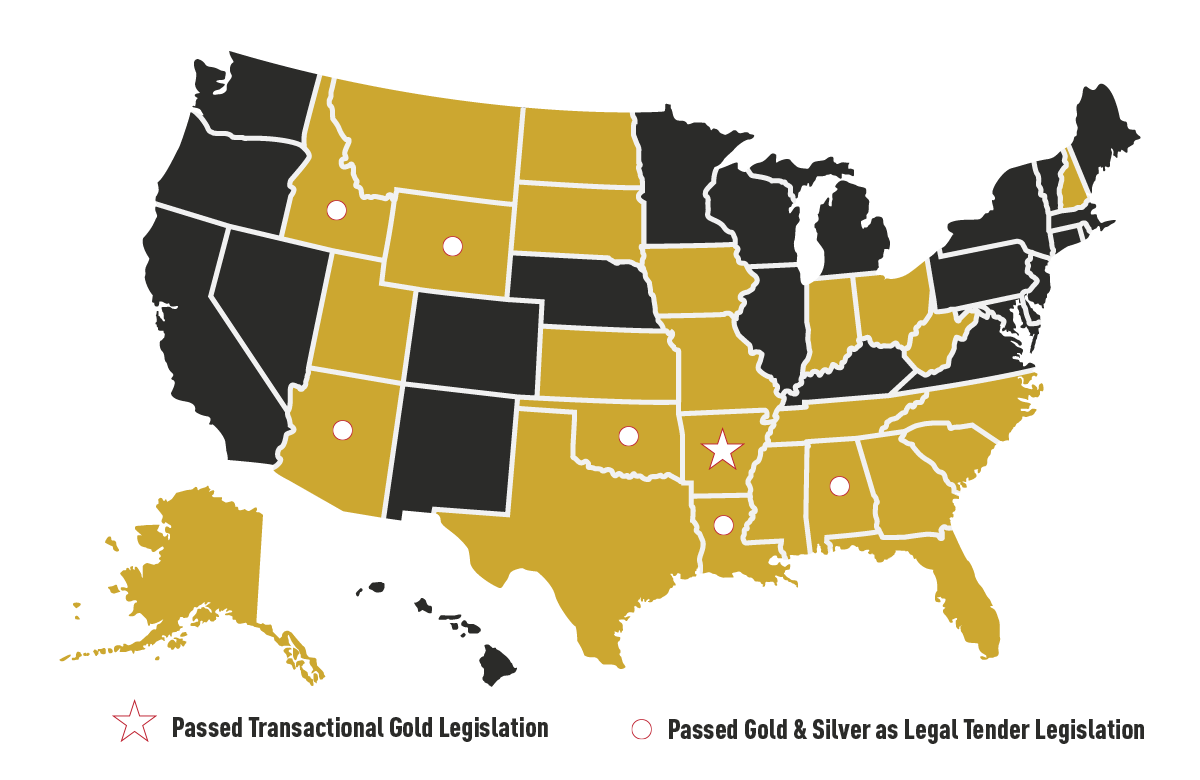
Oklahoma has done similar years ago, as has Utah and other states.


Gold-States-Map-05012025.png


Did not know these existed....

 
Last edited:
This Texas bill establishes a state-backed gold and silver currency system, allowing Texans to purchase, hold, and trade currency directly backed by physical gold and silver specie held in a state-managed depository account. The currency can be used as legal tender, exchanged electronically, and redeemed for either US dollars or physical gold/silver at current market rates, with the comptroller managing the program and potentially contracting with private vendors to implement the system.


In a "state-managed depository account?" So if the system goes down in some major event, you have just lost of yours whatever they are holding?

"The currency can be used as legal tender?" Just like FRNs?
 
In a "state-managed depository account?" So if the system goes down in some major event, you have just lost of yours whatever they are holding?

"The currency can be used as legal tender?" Just like FRNs?
The PMs are deposited into a safekeeping account. Your deposit value moves with the market closing price daily. You have a "debit" card that is funded - just like your FRN equivalents on deposit.

The use of this system is not mandatory. It is being created as a bridge to allow you to easily translate PM holdings into a fungible "currency". There is no mandate for any person or vendor to accept specie, so this just cuts out the middleman (LCS, Kitco, TPM, etc.). It will be quite some time before the use of PMs becomes as common as it was when those metals were used to represent "money". The exchange works for both ends of the transaction too; as a vendor you are able to deposit any specie received from a transaction into this account, and then pay your overhead costs from that. The larger companies such as your utilities providers and insurance agency, or wholesaler might not be ready to adapt to the use of specie as currency.

Could you lose your balance in some event? Sure. But under the proposed arrangement your physical deposit held in trust is auditable (unlike crypto or any direct deposit). As such, your printed statement is essence becomes a passbook. During the depression of the 1930's, bank savings passbooks were fungible. They were sold and traded freely.

Again, it's not mandatory for you to use this depository account. It is an aid to get the system rolling. You would never put all of your (PM) eggs in one basket anyway, would you?
 
View: https://x.com/davidbateman/status/2093892274992410883?s=61


I bought silver to prepare for a systemic collapse of the global monetary and financial system, not to profit from a short squeeze.

This is why I don’t care how the banks manipulate the silver price between now and when that occurs, and why I exited my positions in silver mining stocks in February.

I pass my time enjoying my life as much as possible, trying to protect friends, family, and community from toxic vaccines and food, and am learning to play the guitar.

It feels like best of times and worst of times.

The wise are preparing physically, mentally, spiritually, and are building community.

The misled are injecting mRNA, eating poisoned food, and finding other sub groups to fight with.

I’m no longer afraid. All this insanity is teaching me to stare down the devil with a grin on my face. What is it teaching you?

Agree with this outlook. At the crux silver and gold are not a ‘trade’ to earn fiat currency. The are physical metals held in your possession to help you keep assets out of the system which could go down at any point. If the aim is to trade and make fiat even the detractors would agree there are more lucrative trades out there than the paper metal sphere.

If one already has sufficient physical and wants to gamble/speculate on metal prices you can do that of course but that shouldn’t be the primary reason to acquire them.
 
Golden words.

And they belong to the great late Jim Sinclair who I learned them from. Over 20 years ago he was teaching us his GOTS philosophy. Get Out of The System. He was from the Seligman banking family (connected of the connected) and knew for years they were intending to take down the system and take the assets. Jim didn’t want anything to do with it and chose a different path.
 
And they belong to the great late Jim Sinclair who I learned them from. Over 20 years ago he was teaching us his GOTS philosophy. Get Out of The System. He was from the Seligman banking family (connected of the connected) and knew for years they were intending to take down the system and take the assets. Jim didn’t want anything to do with it and chose a different path.
Yea, that. Jim Sinclair. An investing deity.
Learned from the best, almost otherworldly.
 

A yen for gold​

Sep 4, 2026·Alasdair Macleod


The yen carry trade is blowing up, driving up global bond yields. Investors are slowly learning that the only safe havens are to be found in gold, silver, and storable commodities.

image.png


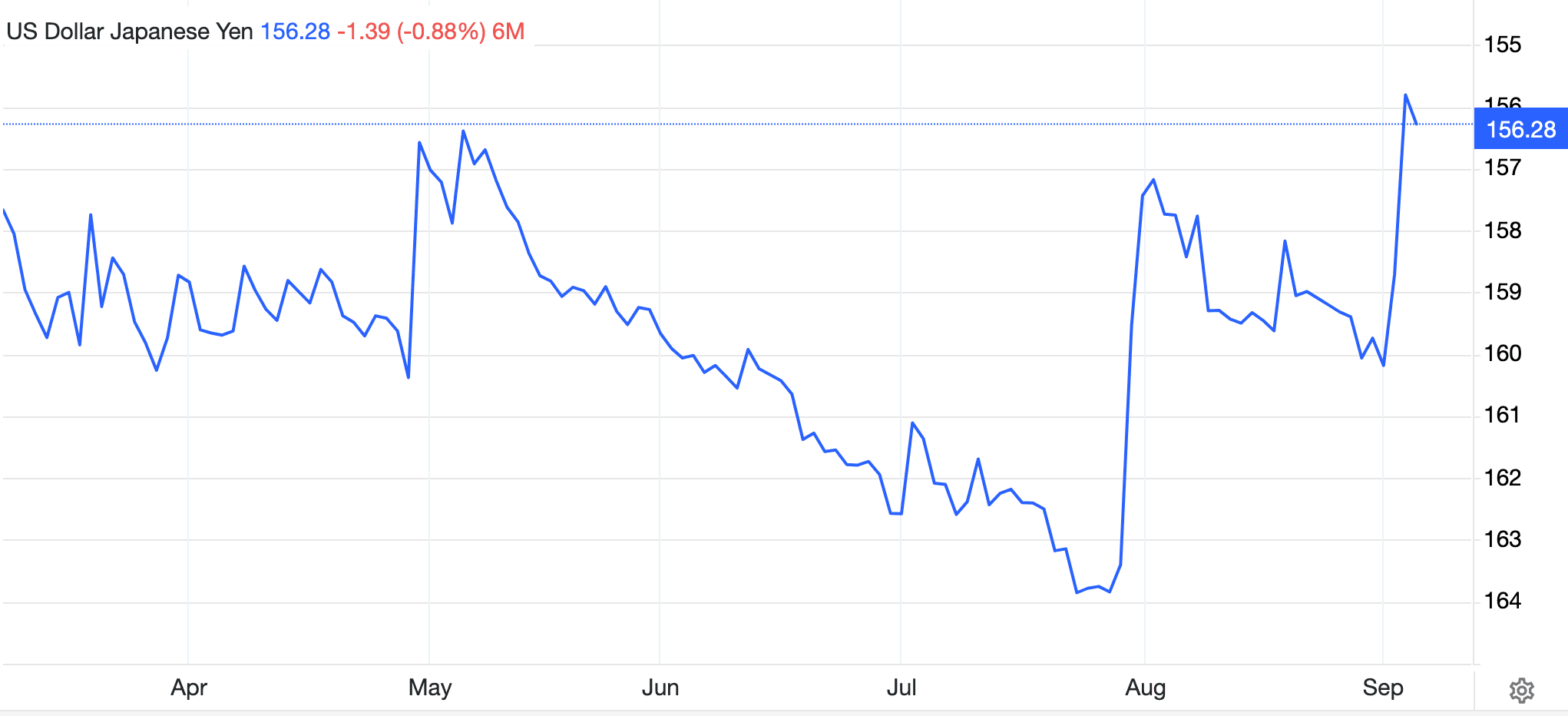
It started with Scott Bessent at the US Treasury intervening in the JPY rate doing a favour for Japan’s finance ministry in late-July. As the chart above shows (scale inverted) the yen rallied sharply, did little for a month and this week suddenly rose again. Over the period of a month, the yen has rallied 5% against the dollar. Not only will Japan’s institutions be reviewing foreign bond and equity investments, but the carry-traders buying US treasury bills could become forced sellers to cover their yen shorts.

This matters, because the only way in which T-bill demand can be maintained is for the Fed to raise its fund rate to maintain an interest rate differential across global markets. Effectively, the competition to attract global investment funds is on. But we are getting ahead of ourselves, with respect to the consequences for the gold price which is our central theme.

image.png


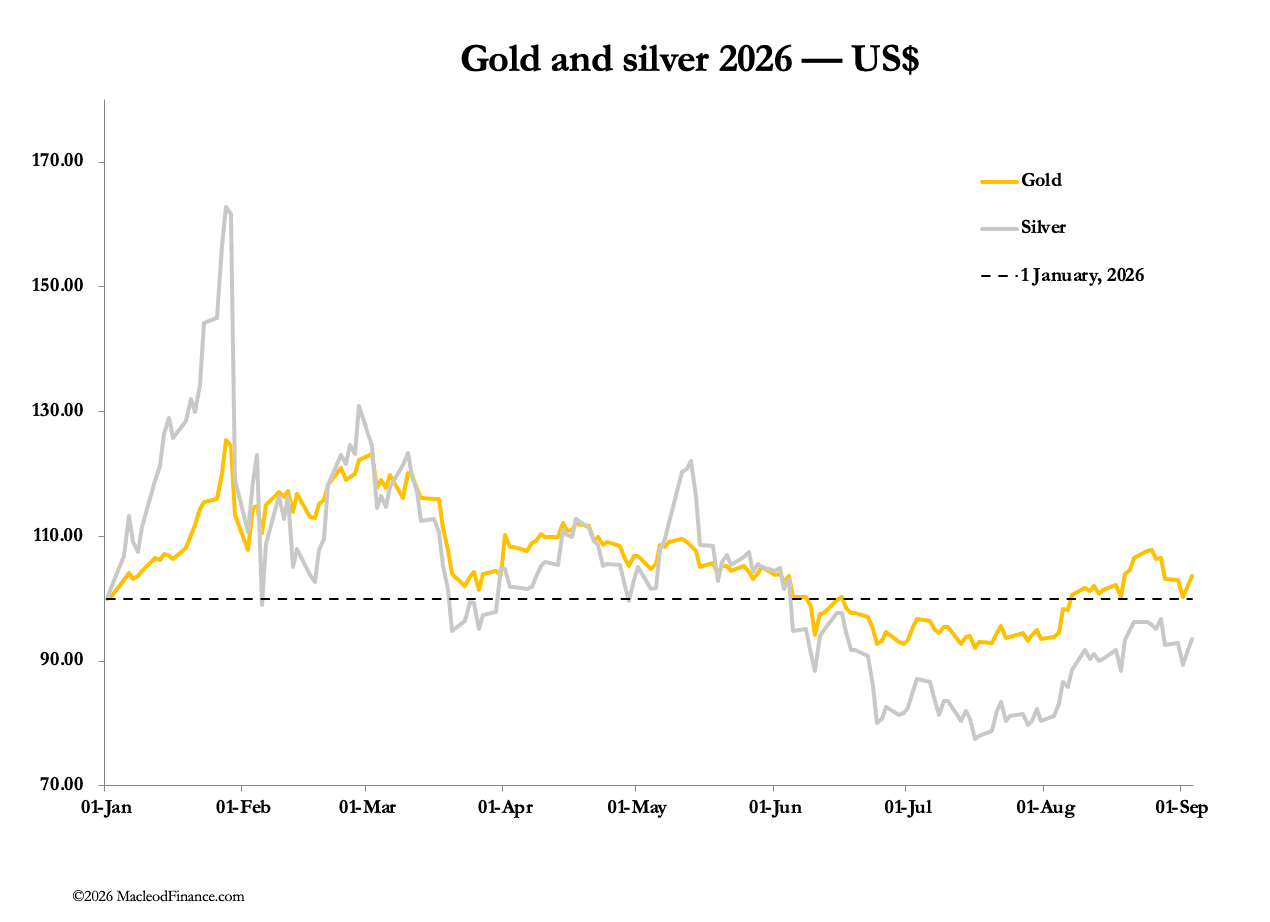
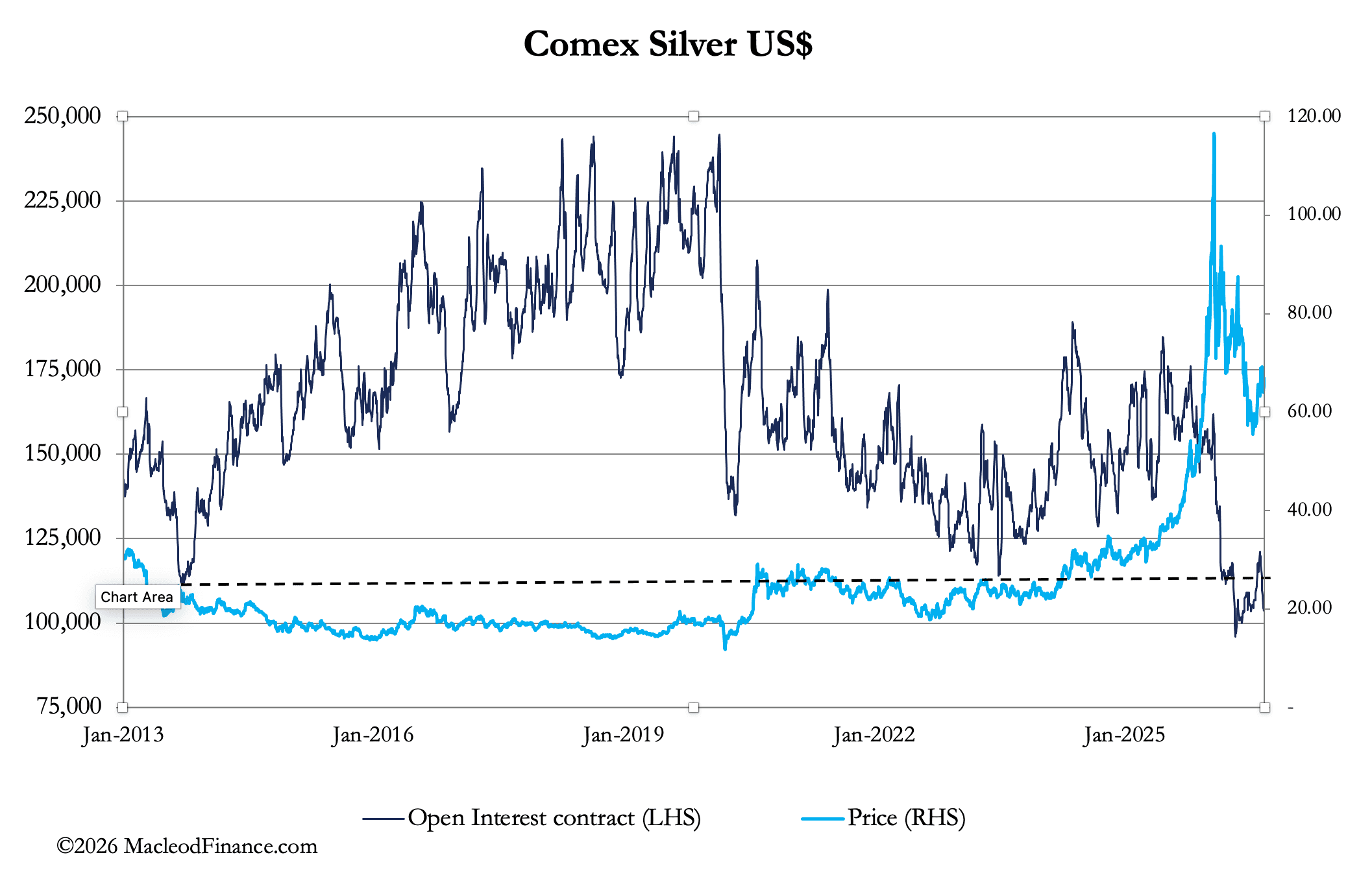
Gold and silver steadied this week, following the expiry of September futures contracts to end little changed in early trade this morning. The sharp declines over that event reflected the unwinding of some minor speculative longs which had accumulated during August, particularly noticeable in the silver contract where open interest on Comex declined by 17,532 contracts from the mid-month peak:

image.png


Open interest is now at its lowest levels for over 20 years, even as the silver price has rallied as the chart demonstrates. This tells us that the conditions for a bear squeeze on the establishment shorts have returned, because the only way for open interest is up.

Admittedly, part of the decline in silver’s open interest was due to deliveries totalling 5,274 contracts representing a massive 820 tonnes giving a total this year so far of 8,403 tonnes. Gold deliveries were remarkably similar at 5,227 contracts since mid-August representing 16.26 tonnes, giving a total for this year of 559.76 tonnes.

Comex is truly the largest gold and silver mine on the planet. Demand drives these deliveries, but it is not reflected in investor interest which on the basis of open interest in both contracts remains exceptionally low. Investors are still dithering as to whether increasing prospects for a rise in interest rates will be bad for monetary metals, because conventional wisdom says that it is so.

There is evidence that this is changing, because the oil price has risen sharply over the last month, forcing analysts to increase their inflation forecasts:

Only a few months ago, gold and silver fell when gold rose, so this is a notable change. Oil prices rising indicated higher inflation down the line and therefore higher interest rates. This was said to disadvantage gold because you would earn more by holding dollars. This argument assumes that the dollar represents safety and gold risk. That oil is now rising at the same time as gold tells us that markets are having second thoughts and that gold is safety and the dollar risk.

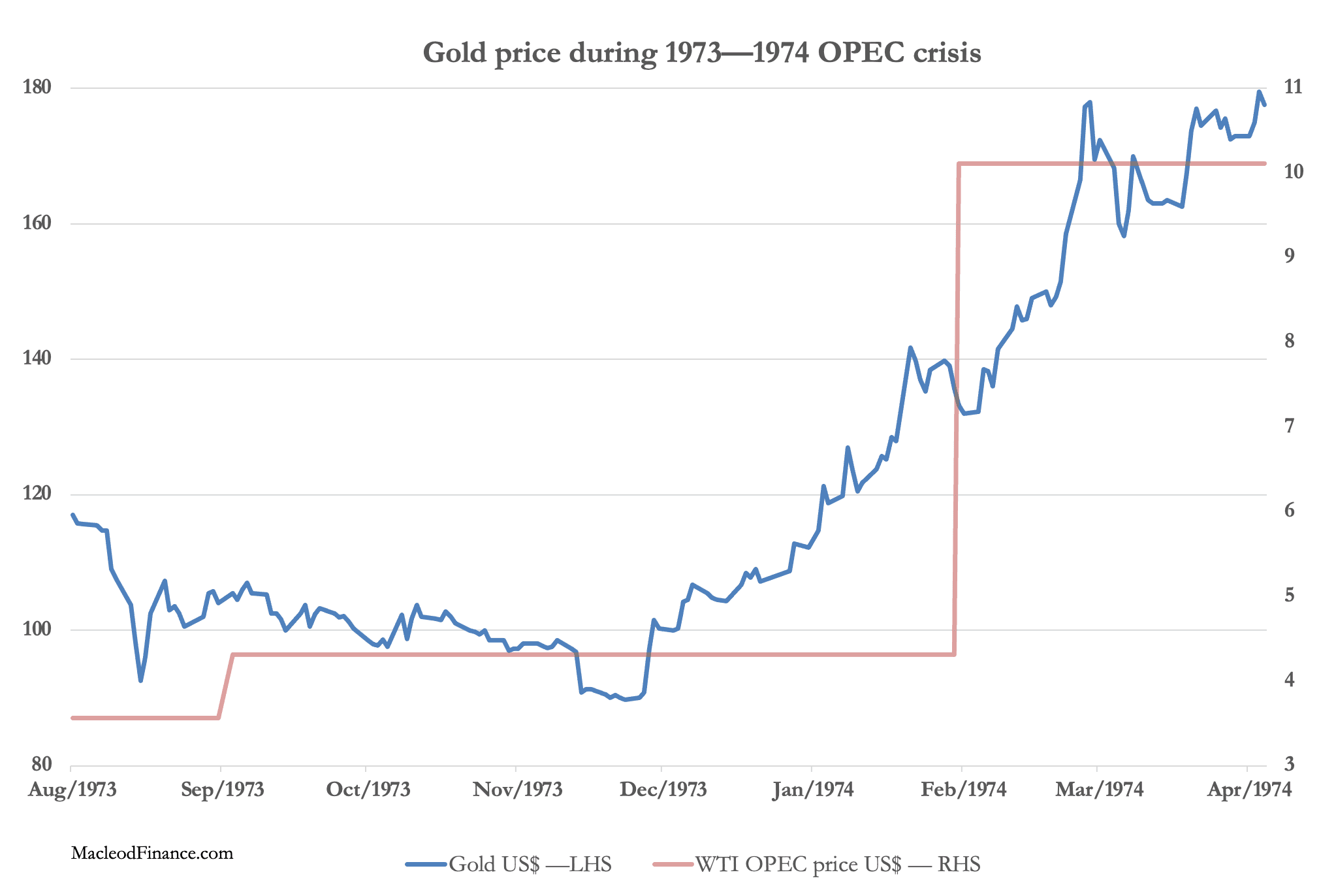
We saw this happen in 1973—74 when OPEC raised its reference prices in two steps, leading gold to first decline and then double over only three months, the classic double-take:

image.png


Today, the oil price is rising because US strategic reserves have effectively run dry, so the price suppression which was the object of the exercise has ended. As a major oil importer from the Middle East ,Japan will be very badly hit with inflation certain to rise sharply along with interest rates.

We appear to be undergoing a similar revelation to that of the ‘seventies. The collapse of the carry trade, admittedly in its early stages and therefore far from certain, is an added factor destabilising government and other finances, even leading to competition between borrowers for international funds.

If the 1973—74 experience is our guide, then based on risk reassessment gold should swing sharply higher as investors do their double take and the establishment shorts rush to protect their positions.


Anyone got any intel as to why copper enjoying a light blood bath this morning ?
I will not have time to read the latest base Miners news. Today.

But seems to me the correction is vary mild, if it holds above $6 a pound I would muse we are still in a bullish market.

Did watch Ron Pauls latest interview at Kitco, this morning. Most excellent interview again and I'm mostly happy to see him appear in good health. Good man.

Got a link to that interview ?
 
They held my earlier in the week premium, yesterday !!

Sold them 2005# bare bright….

:chg:

I've told this story previously, but I think it bears repeating. Some of you may be able to benefit from the concept.

Many years ago I did frequent business with an old, Jewish scrapyard owner. I rarely sold him anything. Most of our business was me buying things from him. We had an excellent relationship. He trusted me enough to let me walk through his yard and inspect things I was interested in. Very few scrapyards allow that anymore - or then - because of liability concerns. If you know what you're doing, this can be very lucrative as people and businesses discard valuable items all the time, not appreciating their worth. The scrapyards go through so much material that they'll often let the items go for pennies on the dollar...especially if you are on good personal terms with the owner.

Scrap guys are experts at extracting money from their 'junk.' His was a family business. His wife kept the books and did admin. His son was a driver, buyer and yard hand and his daughter was a metals expert. I was there one afternoon when she, using a tiny torch, was melting off the silver contacts from some large industrial electrical relays.

The owner had several large buildings on his property, including a big warehouse. He, often, would accumulate the more valuable metals in the warehouse, waiting for prices to climb before selling. He also had a modest smelting operation on site, which he used to smelt copper and cast it into rather large bars. These ingots weighed around 100 pounds each.

One wall of his warehouse was covered in the bars, stacked nearly a third of the way up to the roof. The lower rows were several bars deep. One day he noticed me looking at the bars. "That's my retirement," he said. How much was there? I quickly estimated that it was between $500,000 and $1,000,000.

If any of our members have the space to do it, collecting and smelting base metals can not only make you a few bucks, but exactly like my scrapyard guy can represent non cash savings accounts. It's something to think about.

Best
Doc
 
But the Congress and President, circa 1913….

No holds barred !!!

:cmpcf:
I'm not sure, but I think the key, today, is that the FRNs (not gold or silver certificates) leave out the words "in payment".

Therefore, it appears that everyone is not making a tender (offer) in payment of debts, they're just forwarding the debt to the next sucker. If the banks ever demand back their notes (extremely unlikely, now), I wouldn't want to be holding any of them.
 
I've told this story previously, but I think it bears repeating. Some of you may be able to benefit from the concept.

Many years ago I did frequent business with an old, Jewish scrapyard owner. I rarely sold him anything. Most of our business was me buying things from him. We had an excellent relationship. He trusted me enough to let me walk through his yard and inspect things I was interested in. Very few scrapyards allow that anymore - or then - because of liability concerns. If you know what you're doing, this can be very lucrative as people and businesses discard valuable items all the time, not appreciating their worth. The scrapyards go through so much material that they'll often let the items go for pennies on the dollar...especially if you are on good personal terms with the owner.

Scrap guys are experts at extracting money from their 'junk.' His was a family business. His wife kept the books and did admin. His son was a driver, buyer and yard hand and his daughter was a metals expert. I was there one afternoon when she, using a tiny torch, was melting off the silver contacts from some large industrial electrical relays.

The owner had several large buildings on his property, including a big warehouse. He, often, would accumulate the more valuable metals in the warehouse, waiting for prices to climb before selling. He also had a modest smelting operation on site, which he used to smelt copper and cast it into rather large bars. These ingots weighed around 100 pounds each.

One wall of his warehouse was covered in the bars, stacked nearly a third of the way up to the roof. The lower rows were several bars deep. One day he noticed me looking at the bars. "That's my retirement," he said. How much was there? I quickly estimated that it was between $500,000 and $1,000,000.

If any of our members have the space to do it, collecting and smelting base metals can not only make you a few bucks, but exactly like my scrapyard guy can represent non cash savings accounts. It's something to think about.

Best
Doc

The first half of your accounting describes, exactly, save the daughter, the old Jewish family yard that gave me my huge boost into the realm of profitable scrapping.

Aaron was the patriarch, and he took me in like a son when I was about 22.

When he passed, his wife completely changed the narrative for me….his son was sorry to see me go, and a family friend whom
I’d gone to “church” with for some time invited me up scale to the large corporate yard for which he was he was account manager….
Now I small time in the big league.

Incidentally, copper is energy-prohibitive to melt, but lead and zinc make fine ingots, and aluminum with a little refining of the heating
system.

Barrels and 275 gallon totes were made for brass and copper.
 
I'm not sure, but I think the key, today, is that the FRNs (not gold or silver certificates) leave out the words "in payment".

Therefore, it appears that everyone is not making a tender (offer) in payment of debts, they're just forwarding the debt to the next sucker. If the banks ever demand back their notes (extremely unlikely, now), I wouldn't want to be holding any of them.

You’re very close.

As of 1995, they began to eliminate the notes carrying the seal that was binding internationally, and they replaced them with the current design, un-backed and known in law as a “hologram”.

Bon appetit
 

Samsung Plans Battery Breakthrough in 2027: Is a “Silver Shock” on the Horizon?​


Published: Sep 17, 2026 02:01

Samsung SDI, the battery division of South Korea’s Samsung Group, is vigorously advancing the development of the so-called all-solid-state battery (ASB). This is a solid-state battery—that is, a battery with a solid electrolyte rather than a liquid one.

With this move, the company is positioning itself ahead of its Chinese competitors as one of the first manufacturers worldwide to produce this technology on an industrial scale. In addition to the technical properties of the new cells, attention is increasingly turning to a raw material that has traditionally been associated with jewelry and photovoltaics: silver.

How It Works: Solid Electrolyte and an Anode-Free Design​

Conventional lithium-ion batteries use a liquid, flammable electrolyte to transport lithium ions between the anode and cathode. Samsung’s ASB replaces this liquid with a sulfide-based solid-state electrolyte. Since solid materials cannot leak or catch fire, this design is considered fundamentally safer than previous battery types.

The second technological feature is a so-called anode-free design: Instead of a thick, bulky anode made of graphite or silicon, Samsung uses a composite layer of silver and carbon (Ag-C) that is only about five micrometers thick. During charging, lithium deposits directly onto this wafer-thin silver-carbon layer, making a separate anode largely unnecessary.

This saves space, increases the usable energy density, and simultaneously suppresses the formation of lithium dendrites—needle-like deposits that can cause dangerous short circuits in conventional batteries. According to Samsung, this combination achieves a volumetric energy density of approximately 900 watt-hours per liter, an increase of about 40 percent compared to current NMC cells.

An Overview of the New Battery’s Advantages and Disadvantages​

One of the key advantages is safety: The solid electrolyte significantly reduces the risk of fire, thereby addressing a well-known problem with today’s electric vehicle batteries. Added to this is the significantly higher energy density, which enables longer ranges or a lighter battery weight while requiring the same amount of space.

Samsung also promises improvements in charging speed: A separately developed ion-transport structure is designed to allow charging from 8 to 80 percent in about nine minutes. In addition, the company is aiming for a service life of up to 20 years, which could significantly increase the resale value of electric vehicles.

However, these advantages are offset by noticeable disadvantages. Sulfide-based solid-state electrolytes are chemically sensitive and complex to manufacture, in part due to a production process called hot isostatic pressing, which is designed to ensure perfect contact between the solid layers. This complexity is likely to initially result in high production costs, which is why industry observers expect a significantly higher price per kilowatt-hour than that of established lithium iron phosphate cells.

The use of silver as an anode material is also a double-edged sword: while it improves conductivity and cell stability, it also makes the battery dependent on the availability and price of a precious metal whose supply is not only limited but also cannot be significantly increased in the short term.

Mass Production to Begin in 2027 in Ulsan​

Samsung SDI has refined its roadmap on several occasions. Originally, the company avoided making specific statements about mass production readiness; however, since the InterBattery 2024 trade show, it has consistently cited 2027 as the target year for mass production. According to the latest information from August 2026, mass production is scheduled to begin in the second half of 2027 at the company’s Ulsan plant in South Korea.

To this end, the company is investing a total of approximately 25 trillion won—equivalent to about 17 billion U.S. dollars—in its Ulsan and Cheonan facilities between 2026 and 2040. Of this investment, 16 trillion won alone is earmarked for the expansion of solid-state battery production in Ulsan. A pilot plant at the Suwon research site, known as the S-Line, is already validating the complex manufacturing steps and delivering the first prototype cells.

Beyond electric mobility, Samsung SDI aims to tap into additional application areas with this technology: At InterBattery 2026 in March, the company unveiled for the first time a pouch cell prototype for humanoid robots and other “Physical AI” applications that require compact, high-performance, and exceptionally safe cells. In addition, Samsung SDI has been collaborating with BMW and the U.S. battery manufacturer Solid Power on an independent ASSB development line since November 2025, although this partnership does not pursue a specific mass-production goal.

Sales Figures and Market Share: Ambition Without an Official Target​

Samsung SDI has not yet publicly commented on specific sales figures or a target market share for the solid-state battery itself. CEO Choi Yoon-ho merely articulated the strategic goal of assuming the global leadership position in the battery market with “unrivaled Super-Gap” technology.

Only related business areas have been more specific so far: In the field of stationary backup batteries for AI data centers (BBU), market observers estimate that Samsung SDI already holds a global market share of around 50 percent, and capacity figures in the range of several gigawatt-hours are already available for U.S. production with Tesla as well as a new factory with partner Forge Nano in North Carolina.

For the solid-state cell itself, however, financial analyses primarily feature third-party scenarios rather than confirmed company data: If the performance figures cited by Samsung are confirmed, some market observers consider a market share of 80 percent or more among newly registered electric vehicles conceivable over the next several years.

However, this assessment is a projection by individual analysts and not a target figure communicated by Samsung itself. It should therefore be viewed with appropriate caution. The studies do, however, reveal the significant consequences a successful market launch would have, particularly for the silver market.

Impact on the Silver Market​

Because the silver-carbon anode contains silver instead of graphite, a widespread market launch of the technology would create a new, as yet largely undeveloped source of industrial demand for the precious metal. Market analyses offer varying estimates of the exact amount of silver per battery: While one industry commentary assumes approximately one kilogram of silver per vehicle battery with a capacity of 100 kilowatt-hours, another source estimates the silver content at about five grams per battery cell, which, depending on the number of cells, amounts to a similar order of magnitude per vehicle battery pack.

Projections by individual market observers—based, for example, on a study published by the Silver Academy in August 2024—estimate an additional silver demand of around 900 million ounces, assuming a market penetration rate of 80 percent of the approximately 32 million electric vehicles projected to be sold by 2027. Other calculations, based on lower penetration assumptions, arrive at an additional annual demand of approximately 16,000 metric tons of silver. But even that represents an order of magnitude that would correspond to a significant portion of global annual mine production, which ranges from about 25,000 to 27,000 metric tons.

These figures are explicitly model calculations by individual analysts and investment commentators and are not confirmed forecasts from Samsung or independent commodities institutes. They depend heavily on how quickly and to what extent solid-state batteries actually gain traction over lithium-ion cells.

Another demand shock for the tight silver market?​

Regardless of the exact scale of market penetration, the silver-carbon technology—a new source of demand from the electric vehicle sector—is entering a silver market that is already considered tight today. Industrial demand from the solar sector, particularly from China and India, has been rising steadily for years, while supply from mining production is limited and cannot keep pace with the increase in demand.

In mid-September 2026, the price of silver stood at around 66 to 68 U.S. dollars per troy ounce, well above the levels of previous years. Should solid-state batteries indeed become the standard technology in electric mobility, this could exacerbate the already existing supply deficit in the silver market and drive up prices.

Whether this will actually happen, however, depends largely on whether Samsung meets its 2027 deadline, whether production costs can be reduced enough to make the technology price-competitive, and how quickly automakers actually integrate the new cells into their production vehicles.

Source: Samsung Plans Battery Breakthrough in 2027: Is a “Silver Shock” on the Horizon? | GOLDINVEST

 
The PMs are deposited into a safekeeping account. Your deposit value moves with the market closing price daily. You have a "debit" card that is funded - just like your FRN equivalents on deposit.

The use of this system is not mandatory. It is being created as a bridge to allow you to easily translate PM holdings into a fungible "currency". There is no mandate for any person or vendor to accept specie, so this just cuts out the middleman (LCS, Kitco, TPM, etc.). It will be quite some time before the use of PMs becomes as common as it was when those metals were used to represent "money". The exchange works for both ends of the transaction too; as a vendor you are able to deposit any specie received from a transaction into this account, and then pay your overhead costs from that. The larger companies such as your utilities providers and insurance agency, or wholesaler might not be ready to adapt to the use of specie as currency.

Could you lose your balance in some event? Sure. But under the proposed arrangement your physical deposit held in trust is auditable (unlike crypto or any direct deposit). As such, your printed statement is essence becomes a passbook. During the depression of the 1930's, bank savings passbooks were fungible. They were sold and traded freely.

Again, it's not mandatory for you to use this depository account. It is an aid to get the system rolling. You would never put all of your (PM) eggs in one basket anyway, would you?
And the bank takes three percent on every transaction? Another slow but sure way to own it all.
 
No, but history does repeat....they won't do it, unless they get a cut.....don't you think?
Of course, just like a credit card or PM Vault - but nowhere (yet) does it specify that the fee will be paid in specie.

Bottom line: There will be a transaction or service fee under the new gold‑backed system, but the exact amount will be set by the Texas Comptroller when the program launches, and will be based on the law’s explicit authorization for such fees
 
Look up Bullion Reserve of North America and the massive fraud perpetrated by them 'holding your PMs for safety '.

I looked that up and it happened back in the 1980s and CEO killed him self and it was found that less than $1million dollars in gold was in the safe. There was supposed to be $60 million dollars worth of gold. From a quick read at the time they had not found where the gold went. I will leave it to someone else to figure out how much it may be worth today.
 
I love this thread, but somehow, it's time to move on. I've been messing around with AU at first then later into AG. I caught very close to the bottom in AU in 2003 and bought my first 5oz. at about $337. I realize that during an inflationary crises AG would move faster than AU. Bought my first Monster Box in '07.

Time goes on and I kept accumulating at a slow pace which is fine. I discovered BTC around 2015 and just bought a $100 here, $200 there. Then the max I could get at a Coinstar machine ($600) 2 days in a row when I knew it was going to pop later. Then they changed the rules of how you could add the script to your BTC wallet. I would need a pic of my DL front and back, pic of my SS card front and back, Id, pay slip, etc. So, I said screw it, I'll just wait and maybe they will change it back someday.

Six years and two months later they did. I put in the code and password and just like that $1200 turned into just a hair over $20,000 for me doing nothing. Of course, BTC was trading for about $120k then. Friends told me that I'm a great investor, I said no; I'm a speculator.

What I'm getting at is that AG can go way up then come right back down, same with BTC. I've been messing with both for a very long time and really have a clue. But I'm tired of waiting.

I had a nice conversation with a retired guy and his wife recently and they are pretty well set up so I asked some hard questions and got hard answers.

They were telling me that you don't look for that great investment once you retire, it's all about sustaining income to stay ahead of inflation.

I'm involved with an investment club on the Campus and found out about a bond fund paying 12%.

I'm beginning to get out of BTC and AG to get into something more stable that will provide income in retirement.

They all say to just wait because AG is going to take a Moon shot, and it did for 1 day and now back at $54. BTC went to $120k now back at $80. They keep saying it's going to $100k by the end of the year and it goes to 86k, then back to $80. That's happened 3 times now.

I'm starting to move out of BTC and AG into a less volatile investment strategy for retirement purposes.

I would love to read comments from everyone that has contributed to this thread.
 
Top