WAR Iran/ US/mideast war thread - 2/28/26 Open Hostilities (Thread for Off Topic discussion started, see post #13,751, page 344)

Bizarre crossover: Anthropic reveals Iran used its AI to plan attacks on US Navy

We disrupted every operation in the report, and used the lessons from them to strengthen our safeguards. Where appropriate, we also shared what we found with authorities and other AI companies.

These cases are not typical: we’re highlighting some of the most sophisticated misuse we’ve seen. But they’re especially important to discuss, because they show us where AI misuse is headed, where our safeguards work, and where they need to improve.

We’re publishing this report so others can spot the same activity on their own platforms, and so we can give the public a clearer view of how emerging threats develop. Read the report:


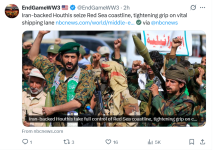
Iran-backed Houthi rebels take strategic port city in Yemen, raising threat to Red Sea shipping​

The Iran-backed Houthi rebel group on Thursday took over Yemen’s port city of Mokha, an area vital to controlling shipping through the Red Sea, Houthi and Yemeni officials said.

The takeover gives Iran another potential point of leverage in its war with the U.S., analysts said, if the Houthis use their presence in Mokha to ramp up threats or attacks on shipping in the Red Sea.

Mokha is about 80 kilometers (50 miles) from the Bab el-Mandeb Strait, a waterway that connects the Red Sea and the Gulf of Aden and through which about 12% of the world’s goods are typically shipped.

The Bab el-Mandeb’s importance to global oil supplies has grown since shipping through the nearby Strait of Hormuz has been impeded by Iran during its war with the United States and Israel.

The Houthis kept mostly to the sidelines when the Iran war began, but over the summer the rebels increased attacks against Yemen’s internationally recognized government and declared a blockade on Saudi Arabia, which supports it. While the Houthis have their own reasons for fighting the Saudis, the conflict also serves Iran’s interests by ramping up pressure on the American-allied oil producer as Tehran seeks leverage against the U.S.

The Houthis’ takeover of Mokha was confirmed to The Associated Press by Ahmed Baash, a commander with the National Resistance Forces allied with Yemen’s government, and Hazam al-Assad, a member of the Houthis’ political bureau.

Mokha represents the Houthis’ biggest territorial gain since a truce was signed in 2022 to end a civil war that began more than a decade ago. A return to full-scale civil war would be devastating for the Yemeni people and potentially for world energy supplies.

The Houthis have been at war with Yemen’s government since 2014, when the rebels swept down from their mountainous heartland and seized much of northern and central Yemen. Saudi Arabia entered the war the following year on behalf of the government.

Residents of Mokha told AP that Houthi forces could be seen throughout the city Thursday and that markets were shuttered. Mokha was long held by forces aligned with Yemen’s internationally recognized government.

Mokha resident Amin al-Mohammdi said roads from the west coast leading to Mokha were closed and shops were shuttered. Resident Mohamed Salem said he saw vehicles belonging to Houthi forces in the streets.

Three doctors told the AP they fled a Mokha hospital after it was seized by the Houthis. The doctors spoke on condition of anonymity, citing fears for their safety. They said other residents were fleeing south, toward the city of Aden, which is controlled by the Saudi-backed forces.

The Houthis recently made advances in the western province of Taiz, where Mokha is located, according to Ahmed al-Mawazi, a trooper with the Yemeni armed forces, and Abdel Kader al-Sharabi, a member of the Saudi-backed forces supporting the Yemeni government.

Both said the rebels had seized control of the al-Shaqira area in Taiz, an important supply route for Yemeni government forces in south Hodeida.

The mountainous terrain around Taiz gives the Houthis a strategic area overlooking Yemen’s west coast, said Baraa Shiban, an associate fellow at the Royal United Services Institute in London. The Houthis could potentially make shipping in the Red Sea more hazardous by laying mines in the water, similar to what Iran’s Revolutionary Guard did in the Strait of Hormuz, Shiban said.

The Houthis’ advance on Mokha potentially gives Iran leverage in its negotiations with the U.S., said Farea al-Muslimi, a research fellow at Chatham House specializing in Yemen and the Gulf.

Shipping through the Bab al Mandeb has fallen by about 60% since the Houthis began attacking ships there in late 2023, prompting many companies to abandon the route. It briefly increased this year as Saudi Arabia sought alternatives to Hormuz; Saudi oil shipments were redirected via pipeline to the Red Sea port at Yanbu, but “renewed Houthi threats have curtailed” that activity, according to Lloyd’s List Intelligence.

“This renewed war should alarm us all,” the U.N. special envoy for Yemen warned at an emergency meeting of the U.N. Security Council on Thursday.

“It effectively marks the end of the relative calm that Yemen has experienced for over four years since the U.N.-brokered truce,” said the envoy, Hans Grundberg. He called on the international community to address this “new and more dangerous phase – one whose consequences, if left unchecked, will not stay within Yemen’s borders.”

Yemen’s U.N. Ambassador Abdullah Al-Saadi said a single Yemen state with a monopoly on weapons that has sovereignty throughout the country which the government is seeking is “a fundamental guarantee” for security for Yemen, Sandia Arabia and the region.

He called on the Security Council to condemn the Houthis’ military escalation and to implement measures “prohibiting the supply of arms, components, technology, and military expertise to the militia” which are fueling the conflict.

Saudi U.N. Ambassador Abdulaziz Alwasil said that the kingdom remains supportive of peace in Yemen but that it would “take all measures necessary to deter Houthi attacks.”

Alwasil warned that “the kingdom’s commitment to de-escalation and to supporting a political solution must not be allowed to become an opportunity that this militia exploits to continue its attacks and to threaten the security of the kingdom and the region.”

At the U.N. meeting, U.S. Minister Counselor Jenifer Neidhart warned that those who enable the escalation of Houthi attacks “bear responsibility for its consequences.” Neidhart called for stronger implementation of U.N. sanctions against the militants to cut off “the resources that sustain their acts of terrorism.”

Yemeni government forces have launched airstrikes targeting Houthi reinforcements west of Taiz, several residents of Mokha said, and the Yemeni government military has urged civilians to avoid roads between Taiz and Mokha.

Houthi-controlled Al-Masirah TV claimed that Saudi-backed forces launched 40 airstrikes in recent hours in Taiz, Jawf, Hodeida and Marib provinces. The AP couldn’t independently verify the claim. There was no immediate comment from the government forces.


--------

Houthis seize key Yemen port as Iranian strikes damage US fighter jets​

Iran-aligned Houthis have seized Yemen's port city of Mocha and advanced towards strategic islands overlooking the Bab el-Mandeb Strait, as Iranian strikes have damaged US fighter aircraft at a base in Jordan.

The developments marked an escalation on two fronts of the Iran war on Thursday, hours after US President Donald Trump said he expected the conflict to end after the US midterm elections.

Yemeni government military sources said the Houthis had gained further leverage over the Bab el-Mandeb Strait, one of the world's most important shipping routes, and had reached the Hanish Islands.

If the Houthis gain control of the waterway, on the opposite side of the Arabian Peninsula from the Strait of Hormuz, it could give their backer Iran leverage over a second major transit corridor and further disrupt global energy supplies.

It could also complicate Mr Trump's efforts to find an exit from a war that has hurt his Republican Party's electoral prospects ahead of the November midterms.

Members of the Saudi-backed Yemeni government forces react during what they say to be clashes with Iran-aligned Houthis in Al-Hazm, Yemen. (Reuters: Media Centre of the Yemeni Armed Forces)
Yemen's Houthi-run humanitarian operations coordination centre said Red Sea navigation was safe for all shipping companies except Saudi vessels.

Saudi Arabia, the world's largest oil exporter, has relied heavily on the Red Sea route since the Iran conflict effectively closed Hormuz, through which about one-fifth of global oil supplies previously flowed.

Yemeni government forces and their allies are relocating south along the Red Sea coast to Dhubab on the Bab el-Mandeb Strait, across from Perim Island, government military sources said. Control of Dhubab and the island is key to gaining hold of the strait, they said.

UN Special Envoy for Yemen Hans Grundberg told the Security Council on Thursday that the international community must act to address "a new and more dangerous phase" in the Yemen war.

The Houthis' capture of Mocha gave them "a direct presence on the approaches to one of the world's most vital straits", raising serious concerns about freedom of navigation, he said.

Jenifer Neidhart de Ortiz, the US representative at the meeting, accused the Houthis of acting as "agents and tools of Iran".

"This escalation is unacceptable, and those who enable it bear responsibility for its consequences," she said.

Yemeni government, Iranian and regional sources told Reuters the Houthi advance down the coast this week came with direct guidance from Iran's Revolutionary Guard Corps.

Houthi spokesperson Mohammed Abdulsalam said, without elaborating, that the group's operations were defensive and would stop once attacks on Yemen stopped.

Brent crude rose as much as 4 per cent on Thursday to above $US105 a barrel as traders weighed the threat to another major shipping route.

The US national average diesel price also surpassed $US6 a gallon for the first time, according to price tracker GasBuddy.

After joining the war with an attack on Israel in March, the Houthis declared a naval blockade against Saudi Arabia in July and escalated attacks this month.

Saudi civil defence authorities issued emergency alerts in the south-western city of Khamis Mushait for the fourth time in 24 hours as the Houthis attacked.

Pakistan has delivered a Saudi warning to Iran to rein in the Houthis in an effort to prevent the crisis from spiralling, Saudi, Pakistani and Iranian sources said.

A senior Iranian official said Tehran's response was: "Iran does not control the Houthis".

The fighting comes during the biggest declared wave of US-Iran tit-for-tat attacks on Gulf shipping since the war began in late February.

Iranian strikes on Muwaffaq Salti Air Base in Jordan damaged several US military aircraft this week, a US official told Reuters.

One A-10 Thunderbolt II, known as the Warthog, lost a wing in Tuesday's attack, while about eight F-15 fighter jets sustained light damage and were returned to service, according to the official, who spoke on condition of anonymity.

The losses add to mounting damage to US military assets since the war began.

A May report from the Congressional Research Service said 42 US military aircraft had already been lost or damaged in the conflict, including more than two dozen drones.

Eighteen US service members have been killed and more than 800 injured since the war began in February.

The attack on the Jordan base came after US forces said they destroyed five Iranian crude oil carriers. Washington said the strikes were retaliation for Iran's Islamic Revolutionary Guard Corps twice targeting a US Navy warship with ballistic missiles over the previous two days.

US forces fired about 30 Patriot interceptors to counter the Iranian missiles, the US official said, amid growing concern about US stocks of air defence missiles.

While inventory numbers are classified, the Center for Strategic and International Studies estimated about 65 per cent of US Patriot interceptors were expended between February and July, leaving fewer than 850 on hand compared with 2,330 before the war.

Iran has also struck the US Navy's Fifth Fleet headquarters at Naval Support Activity Bahrain.

Acting US Navy Secretary Hung Cao described the extent of the damage in an interview with the Epoch Times, saying Iran had "blew the hell out of Bahrain".

The war and higher fuel prices have helped drive Mr Trump's popularity to record lows, according to polls.

He accused Iran of trying to influence the midterm elections, which will determine whether Republicans retain control of Congress.

"I think war is going to end immediately after the election because they can't hold out any longer. They're desperate to try and affect the election," Mr Trump told reporters on Wednesday.

The US president has previously set other deadlines for the war to end.

In recent weeks, Washington had cited increasing success guiding tankers through the Strait of Hormuz.

But renewed fighting this month appears to have set back efforts to reopen the waterway.

Just seven vessels transited the strait on Wednesday, about half the 10-day average, preliminary ship-tracking data showed.

Iranian state media said on Thursday the Revolutionary Guards Navy had struck a US unmanned vessel at the entrance to Hormuz.


----------

Iran deploys hundreds of IRGC officers to Yemen to target Bab al-Mandab Strait​

US officials believe hundreds of officers from Iran’s Islamic Revolutionary Guard Corps (IRGC), are currently operating in Yemen alongside the Iran-backed Houthi movement, helping coordinate operations aimed ultimately at shutting the strategic Bab al-Mandab Strait, CNN reported, citing a US official.
The deployment comes as the Houthis have dramatically expanded their position along Yemen’s Red Sea coast.

IRGC is designated by the EU as a terrorist group.
On Thursday, the Houthis seized Mokha, a strategic port roughly 80 km from Bab al-Mandab, after days of fighting with Saudi-backed Yemeni government forces. Houthi forces have also moved toward the strategically important Hanish Islands, according to military sources cited by Reuters.

The developments raise the prospect of a second major maritime chokepoint being brought under pressure at the same time that the Strait of Hormuz is severely disrupted by the US-Iran war.

A second chokepoint under threat​

Bab al-Mandab connects the Red Sea with the Gulf of Aden and provides the maritime gateway to the Suez Canal.

Control or effective closure of the strait could force ships between Asia and Europe to take the much longer route around Africa.
The Houthis' capture of Mokha gives them a direct presence near one of the world's most important shipping corridors.
UN Yemen envoy Hans Grundberg warned that the advance represented a “new and more dangerous phase” in the conflict.
The timing is particularly serious because Hormuz is already compromised. Shipping through the Persian Gulf chokepoint has plunged amid US-Iran attacks on tankers and threats against commercial vessels.

Iran's role is under scrutiny​

The US assessment that hundreds of IRGC personnel are in Yemen would indicate a potentially significant escalation in Tehran's direct involvement.
Reuters reported separately that Yemeni government, Iranian and regional sources said the Houthi coastal offensive was being carried out with direct guidance from Iran's Revolutionary Guard Corps.
Iran denies controlling the Houthis, while the group maintains that its military decisions are its own.
The distinction matters. Iran has long provided the Houthis with weapons, technology and military expertise, but a large-scale deployment of IRGC personnel would represent a much more direct Iranian role in operations threatening international shipping.

Shipping squeeze​

A simultaneous squeeze on Hormuz and Bab al-Mandab could create an unprecedented energy and shipping shock.
Hormuz is the principal export route for Gulf oil and gas, while Bab al-Mandab is critical for shipping between the Indian Ocean, Red Sea and Suez Canal.
With both routes under pressure, shipping companies could be forced into longer and more expensive journeys, while insurers raise war-risk premiums.
The immediate market reaction is already visible: Brent crude rose above $107 a barrel after the Houthi advance and growing fears over Saudi oil exports.
The strategic danger is bigger than Yemen: Iran could potentially gain leverage over two maritime chokepoints on opposite sides of the Arabian Peninsula, threatening energy supplies and global trade at the same time.

 

Iran deploys hundreds of IRGC officers to Yemen to target Bab al-Mandab Strait​

US officials believe hundreds of officers from Iran’s Islamic Revolutionary Guard Corps (IRGC), are currently operating in Yemen alongside the Iran-backed Houthi movement, helping coordinate operations aimed ultimately at shutting the strategic Bab al-Mandab Strait, CNN reported, citing a US official.
The deployment comes as the Houthis have dramatically expanded their position along Yemen’s Red Sea coast.

IRGC is designated by the EU as a terrorist group.
On Thursday, the Houthis seized Mokha, a strategic port roughly 80 km from Bab al-Mandab, after days of fighting with Saudi-backed Yemeni government forces. Houthi forces have also moved toward the strategically important Hanish Islands, according to military sources cited by Reuters.

The developments raise the prospect of a second major maritime chokepoint being brought under pressure at the same time that the Strait of Hormuz is severely disrupted by the US-Iran war.

A second chokepoint under threat​

Bab al-Mandab connects the Red Sea with the Gulf of Aden and provides the maritime gateway to the Suez Canal.

Control or effective closure of the strait could force ships between Asia and Europe to take the much longer route around Africa.
The Houthis' capture of Mokha gives them a direct presence near one of the world's most important shipping corridors.
UN Yemen envoy Hans Grundberg warned that the advance represented a “new and more dangerous phase” in the conflict.
The timing is particularly serious because Hormuz is already compromised. Shipping through the Persian Gulf chokepoint has plunged amid US-Iran attacks on tankers and threats against commercial vessels.

Iran's role is under scrutiny​

The US assessment that hundreds of IRGC personnel are in Yemen would indicate a potentially significant escalation in Tehran's direct involvement.
Reuters reported separately that Yemeni government, Iranian and regional sources said the Houthi coastal offensive was being carried out with direct guidance from Iran's Revolutionary Guard Corps.
Iran denies controlling the Houthis, while the group maintains that its military decisions are its own.
The distinction matters. Iran has long provided the Houthis with weapons, technology and military expertise, but a large-scale deployment of IRGC personnel would represent a much more direct Iranian role in operations threatening international shipping.

Shipping squeeze​

A simultaneous squeeze on Hormuz and Bab al-Mandab could create an unprecedented energy and shipping shock.
Hormuz is the principal export route for Gulf oil and gas, while Bab al-Mandab is critical for shipping between the Indian Ocean, Red Sea and Suez Canal.
With both routes under pressure, shipping companies could be forced into longer and more expensive journeys, while insurers raise war-risk premiums.
The immediate market reaction is already visible: Brent crude rose above $107 a barrel after the Houthi advance and growing fears over Saudi oil exports.
The strategic danger is bigger than Yemen: Iran could potentially gain leverage over two maritime chokepoints on opposite sides of the Arabian Peninsula, threatening energy supplies and global trade at the same time.



------

Iranian Arms and Advice Helped Yemen's Houthis Seize Key Red Sea City, Sources Say​

DUBAI/ADEN/RIYADH, Sept 10 (Reuters) - The lightning Houthi advance down Yemen's Red Sea ⁠coast ⁠this week came with direct guidance from Iran's Revolutionary Guards ⁠seeking to open a new front in Iran's war with the U.S., according to Yemeni government, Iranian and regional sources.

By seizing the southwestern port city of Mocha, the Houthis have strengthened their chokehold on the Bab el-Mandeb Strait, a key waterway whose disruption further constricts global energy supplies after Iran's blockade of the Strait of Hormuz.

Six months into the ‌wider regional conflict between the Houthis' Iranian allies and ‌the United States, the group now looks focused on consolidating that grip on the strait even as opposing government forces backed by Saudi Arabia focus on an offensive in the north.

Iran told the Houthis last ⁠week to escalate their ⁠attacks on Saudi Arabia, a close U.S. ally, and promised more funding, weapons and senior officers to help them do so, two Iranian sources said.

While Iran describes the Houthis as an ally, it publicly denies giving them military direction, saying they are "not a proxy".

Several senior Revolutionary Guards commanders had already travelled to Yemen to oversee and command Houthi attacks directed against Saudi Arabia after weeks of discussions over military strategy, a regional diplomat briefed by Tehran said.

A third Iranian source, an official, said Iran had held several meetings with allies including the Houthis and that the move on Mocha was a Houthi rather than Iranian decision. However, it had helped Iran by putting upward pressure on oil prices and hurting the United States and ⁠Saudi ⁠Arabia, the official added.

Inside Yemen, five military sources ⁠from the Saudi-backed and internationally recognised government said the Revolutionary Guards had directed the new Houthi campaign along the Red Sea coast, a flat, narrow plain known as the Tihama, starting with a blitz of rocket fire.

Citing communications intercepts and the accounts of captured ⁠Houthi prisoners, the Yemeni military sources said they believed the Iranian effort was being directed by Abdolreza Shahlaei, a top Revolutionary Guards commander.

Iranian sources were not immediately able to confirm that, though they had previously described Shahlaei, who is in the Guards' specialist Qods Force unit, as having spent time in Yemen in recent years.

The Guards were still able to move weapons and personnel in and out of Yemen despite an aerial and maritime blockade of Houthi areas, the Iranian sources said without elaborating on how they did so.

"If we look at their offensive on the west coast, it's not something prepared just last week ⁠or last month," said Ahmed Nagi, Yemen analyst at International Crisis Group, describing the seizure of Mocha as a significant milestone in the war.

"The ⁠evolution of the Houthis was basically because of the new weapons they gained, either through the Iranians directly or through the different smuggling networks that they are counting on," Nagi said, pointing specifically at their use of drones in the latest offensive.

UNCERTAIN MILITARY SITUATION

As the Houthis began an advance towards Mocha last week, Yemen's government requested more air support and other help from the Saudis, two more Yemeni officials said.

It was seeking a Saudi air campaign against Houthi targets in the Houthi heartland including Sanaa and key strategic assets such as oil depots, they said.

However, the kingdom stuck to providing logistical, armament and intelligence support with only limited air strikes that were focused on northern battlefronts in Jawf and Marib provinces, areas the government regarded as less important.

The officials' own assessment was that Riyadh was anxious to avoid a major escalation with the Houthis for fear of provoking heavier drone strikes on Saudi territory.

Saudi officials did not immediately respond to Reuters requests for comment on Riyadh's military focus on the northern front rather than the Red Sea ⁠coast and other big Houthi targets.

The overall military situation in Yemen is hard to gauge after a years-long pause in major warfare since a ceasefire was agreed in 2022. Both Iran and Saudi Arabia have invested in forces they back there. But the pro-government coalition has suffered from internal splits.

Although previous rounds of warfare in the Tihama had produced sudden advances and retreats, it remains unclear if Saudi-backed forces can easily dislodge the Houthis this time, Nagi said.

"Maybe we can see some advances from the government if they get the necessary support from the Saudis. But that could be a bit difficult this time," he said.

 
Last edited:

Houthis advance along Yemeni coast, threaten Saudi oil exports in the Red Sea​

CAIRO/WASHINGTON/DUBAI, Sept 10 (Reuters) - Iran-aligned Houthis seized control of Yemen's port city of Mocha on Thursday and advanced down the Red Sea coast to strategic islands, military sources said, hours after President Donald Trump said he expected the Iran war to end after the U.S. midterm elections.

Yemeni government military sources said the Houthis had gained further leverage over the Bab el-Mandeb Strait, the southern ‌outlet of the Red Sea and one of the world's most important shipping routes, and had reached the islands of Hanish.

If the Houthis were to gain control of the waterway on the opposite side of the Arabian Peninsula from the Strait of Hormuz, it could give their backer Iran a critical advantage in the war with the United States, reducing supplies through a second major transit corridor and sending oil prices surging.

It could also make it harder for Trump to find an exit from a war that has hurt his Republican Party's electoral prospects ahead of the November midterms.

Yemen's Houthi-run humanitarian operations coordination centre said in a statement that Red Sea navigation is safe for all shipping companies except for Saudi vessels.

Saudi Arabia, the world's largest oil exporter, has relied on the Red Sea route since the Iran conflict effectively closed Hormuz, through which a fifth of global oil used ⁠to flow.

Yemeni government forces and their allies are relocating south along the Red Sea coast to Dhubab on the Bab el-Mandeb Strait, across from Perim Island, government military sources said. Control of Dhubab and the island is key to gaining hold of the strait, they said.

U.N. Special Envoy for Yemen Hans Grundberg told a U.N. Security Council meeting about Yemen on Thursday that the international community must act to address "a new and more dangerous phase" in the Yemen war.

The Houthis' gaining control of Mocha gave them "a direct presence on the approaches to one of the world’s most vital straits," raising serious concerns about freedom of navigation, he said.

Jenifer Neidhart de Ortiz, the U.S. representative at the meeting, accused the Houthis of acting as "agents and tools of Iran."

"This escalation is unacceptable, and those who enable it bear responsibility for its consequences," she said.
Iran's foreign ministry said in a statement that the Yemen conflict could not be solved by blockade or military action against the Houthis and called for dialogue, without addressing Iran's own role.

Yemeni government, Iranian and regional sources told Reuters the Houthi advance down the coast this week came with direct guidance from Iran's Revolutionary Guard Corps.

Houthi spokesperson Mohammed Abdulsalam said, without elaborating, that the group's operations were defensive and would stop once attacks on Yemen stopped.

OIL PRICES JUMP​

Brent crude prices jumped as much as 4% on Thursday above $105 a barrel on concern over disruption to supply routes, and the ‌U.S. national ⁠average price of diesel surpassed $6 a gallon for the first time ever, according to price tracker GasBuddy.

After joining the war with an attack on Israel in March, the Houthis declared a naval blockade against Saudi Arabia in July and escalated attacks this month.

Tensions in the region remained high, with Saudi civil defence authorities issuing emergency alerts in the southwestern city of Khamis Mushait for the fourth time in 24 hours, as the Houthis attacked.

Pakistan has delivered a Saudi warning to Iran to rein in the Houthis to try to prevent the crisis from spiralling, Saudi, Pakistani and Iranian sources said. A senior Iranian official said Tehran's response was: "Iran does not control the Houthis".

The fighting comes during the biggest declared wave of U.S.-Iran tit-for-tat attacks on Gulf shipping since the war began in late ⁠February.

The U.S. Treasury Department on Thursday announced new sanctions against firms and individuals aiding Hezbollah and other Iranian proxies as part of "Operation Economic Outcast," which aims to cut off Tehran's war funding.

TRUMP SEES WAR ENDING AFTER MIDTERMS​

The war and subsequent increase in fuel prices have helped drive Trump's popularity to record lows, according to polls. He said Iran was trying to influence the midterm elections, which will determine whether his Republican Party retains control of Congress.

"I don't believe in the word 'regret.' You can always question yourself a little bit," Trump ⁠said in an interview with Fox News host Laura Ingraham broadcast on Thursday, when asked if he regretted the Iran war due to the impact it may have on the elections. "If I had it do again, I would do exactly as I did," he added.

Trump also reiterated his thinking that the war will end immediately after the midterm election, a comment he also made on Wednesday.

In recent weeks Washington had cited increasing success guiding tankers through the Strait of Hormuz, ⁠which carried about a fifth of global oil supplies before the war.

But a resumption of fighting this month appears to have set back any such gradual reopening. Just seven vessels transited the strait on Wednesday, half the 10-day average, preliminary ship-tracking data showed.

Iranian state media said on Thursday the Revolutionary Guards Navy had struck a U.S. unmanned vessel at the entrance to Hormuz.

 
Something big must be going on behind the scenes. Previously reported was that Pakistan was starting to charge outrageous fees Iran can’t pay to truck oil to China. So the trucks are just sitting there. Tousi announced this evening that Turkey has now closed their border to Iranian ground traffic of all kinds. It should be noted that the area between Iran and Turkey is part of what used to be Kurdistan. That might have something to do with it.

At the start of the war the regime would hold large rallies with thousands and thousands of people. A video of a recent rally was a bit different. The entire venue was filled with nothing but empty chairs.

Another video shows just how bad the fuel situation is becoming. Someone poured some ‘gas’ out on the ground. Using a lighter at maximum setting they could get flames for a brief moment, and then it went out. A second attempt in a different area had much the same result, due to watering down the gas to make it go further.

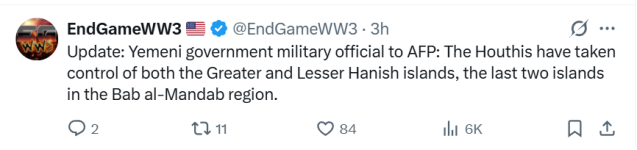
While the Houthi’s have taken some cities in western Yemen, that part of the country always was dominated by them. However, the Yemen gov. has taken control of two islands not too far offshore from them, in the Red Sea. That would make things like air strikes possible from multiple points, east, west, and north.
 
Last edited:
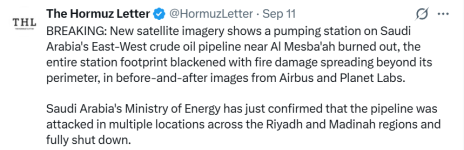
BREAKING: First ground-level image of the massive 100 km black smoke column rising from Saudi Arabia's East-West crude pipeline, captured ~6h ago, after Yemen's Houthis struck the pipeline on multiple points, the same plume seen on Sentinel-3 satellite imagery.

HORMUZletter on x
Big trouble a brewing-10 dollar diesel here we come;-(
 

Huge Fire Along Saudi 'Hormuz Bypass' East-West Oil Pipeline After Alleged Houthi Strikes​

Zero Hedge
by Tyler Durden
Thursday, Sep 10, 2026 - 06:15 PM

Update(1815 ET): While unconfirmed, this would mark a huge escalation of the Houthi entry into what's been creeping all summer into a regional war:

Yemen's armed forces targeted Saudi Arabia's East-West oil pipeline; satellite data shows fires at six points along the route that transports crude oil from the Persian Gulf to the Red Sea. (IRIB News)
Reports earlier in the day revealed Houthi attacks on southern areas of the kingdom, but made no mention of the Iran-aligned group targeting the further north East-West oil pipeline - which has become vital as an alternative bypass to the contested Strait of Hormuz. Earlier today: Houthis Seize Yemeni Port Of Mocha, Gaining Greater Leverage Over Bab Al Mandab Strait

And now an extremely alarming situation for global energy flows:


Analysts remain cautious about speaking in certainties at this early point...

"I want to stress that there is NOT YET concrete evidence to support that the Saudi East-West Pipeline has been hit. There is satellite imagery from multiple satellites that clearly indicate SOMETHING is going on, but there is not yet confirmation that it ACTUALLY has significant/catastrophic damage."

Large smoke plumes south of Medina, as Iranian state media is quick to frame it as the result of a significant Houthi attack and escalation against the kingdom...


Map (via S&P Global Commodity Insights):


* * *

Update(1735ET): It looks like that Iranians have fired on more international vessels in the Strait of Hormuz on Thursday, with the United Kingdom Maritime Trade Operations (UKMTO) Centre within the last couple hours monitoring the below developing situation:

UKMTO says it has received a report of two vessels involved in a security incident 4nm West of Khasab Oman

The master of the vessel reports seeing four unknown projectiles hit two unknown vessels, causing fire on one vessel, and unsure of the status of the second vessel, 6nm north of his position.
Meanwhile...

WTI Crude back to $104
The IRGC taking shots at tankers 'violating' Iran's passage protocol has of late become a nightly and daily reality. As Washington tries to find an offramp, and ratchets the 'Economic D-day' sanctions, this is Tehran squeezing back and saying not so fast, seeking to impose a deep political and economic cost on the Trump administration.

There could also be another 'military answer' on Iran from the US side as soon as tonight. The Pentagon had launched sporadic attacks on southern Iran earlier this week. But the US also seems hesitant and fearful over the prospect of runway escalation and inescapable quagmire.


* * *

Brent crude futures traded above $102 a barrel Thursday morning after Iran threatened to intensify attacks, renewing concerns over tanker flows through the Hormuz maritime chokepoint. The supply risk extends well beyond crude to mounting shortages of refined products, particularly diesel, as the US diesel crack spread trades around $102 a barrel.


President Trump's indication yesterday that the conflict could continue beyond November's midterm elections suggests limited near-term fuel pump relief for working-class folks, with the US national gasoline average above the politically sensitive $4-a-gallon threshold and diesel at a record high. Trump also announced overnight a proposal for a $5,000 "Trump dividend" check for every American adult if Republicans retain control of both chambers of Congress.

Following Goldman, HSBC raised its 2026 average Brent crude forecast to $90 a barrel from $80, citing continued disruptions to shipping through the critical Gulf waterway that are expected to keep global oil balances tighter for longer.

With Hormuz flows running at roughly 30% of pre-conflict levels, HSBC analysts see the market adjusting to a prolonged period of depressed tanker transit through the chokepoint. That outlook suggests sustained supply constraints through year-end.

"The key indicator to watch is whether this will put an end to the heavy shuttling of oil through the Strait of Hormuz," said Arne Lohmann Rasmussen, chief analyst at Global Risk Management in Copenhagen. "It may not come to a complete halt, but combined with the more aggressive Houthis in the Red Sea and higher Chinese crude oil imports, the global oil market balance appears to be deteriorating again."

Earlier this week, Vitol Group CEO Russell Hardy said about 10 million barrels a day have been crossing the waterway, roughly half of pre-war levels. He added that an exact figure is hard to quantify and that volumes aren't guaranteed daily.

Goldman commodities strategist Yulia Zhestkova Grigsby sharply revised tanker-flow estimates through the Hormuz chokepoint to between 15 million and 16 million barrels per day, roughly two-thirds of pre-war levels. That's mainly because the market is not counting ships that turn off their automatic identification systems to avoid detection by Iran.

Goldman's Daan Struyven also noted one upside scenario this week that could push Brent to $120 if the conflict persists...


"The fundamental picture for products remains bullish with global inventories and reserves deteriorating," said Darrell Fletcher, managing director for commodities at Bannockburn Capital Markets. Before 'Operation Epic Furry', about a fifth of the world's oil and liquefied natural gas passed through Hormuz to global customers, mainly in Asia. The ongoing disruptions have sent NatGas prices in Europe above 81 euros on Thursday.

Beyond energy, a broad-based commodity rally has pushed agricultural products and metals higher, sending the Bloomberg Commodity Index to levels last seen in 2012. HSBC analysts spot a commodities cycle developing into a "super squeeze," which suggests the move could be sustained.
 

US Officials Confirm Saudi East-West Pipeline Attacked By Drones, Badly Damaged​

Zero Hedge
by Tyler Durden
Friday, Sep 11, 2026 - 12:53 PM

Summary​

  • Saudi oil pipeline attacked: US officials confirmed strikes on Saudi pumping stations, with drones likely launch from Iraq.
  • Houthis expand in Yemen: Houthi forces are gaining control along the Red Sea coast, threatening key shipping routes.
  • Oil and diesel prices rising: Russia's damaged refining capacity & shipping disruptions are also tightening fuel markets.
  • Stagflation risk grows: Higher energy and shipping costs could push inflation higher while weakening global economic growth.

US Officials Confirm East-West Pipeline Was Attacked​

Open source satellite imaging has shown the crucial 'Hormuz bypass' East-West oil pipeline that cuts straight across Saudi Arabia has been on fire. A some 80km to 100km giant smoke plume has been observed. The damaged section is said to be located near the town of Al Mesba'ah.

Amid speculation that this is probably the result of a major Houthi attack out of Yemen, CNN in a new Friday report cites two US officials who've given confirmation that the pipeline was struck by projectiles on Thursday. Iraq was named as possible attack origin point. According to the report:

An early analysis found that pump stations, which are located next to the pipeline itself, were hit, one of the US officials said. A satellite image taken Friday appears to show extensive fire damage at one pumping station, and an image of a different pumping station, taken Thursday, showed a small fire sending up plumes of thick, black smoke.
It could have been the result of a drone attack by paramilitaries operating out of Iraq. "It was not immediately clear who was responsible for the strikes or if sections of the pipeline itself were damaged but one of the officials said it was struck by drones originating from Iraq," CNN reports. "It was also not immediately clear how long it would take to repair the damage, sources said."

On Sept. 10, via EUMETSAT/CNN
News on Saudi oil has gone from worse to worse, as in Yemen the Houthis have reportedly taken over the entire Red Sea coastline. They have renewed the threats to attack all Saudi (as well as Israeli) shipping, but have also sought to assure transit is 'safe' for other international vessels.

Threats Rapidly Converge​

Three converging threats to watch are intensifying pressure on global energy markets: damage to Russian refining capacity, ongoing disruption at Hormuz, and new, expanding Houthi threats to Red Sea shipping. The resulting physical market squeeze extends well beyond the Gulf area. Record-high diesel prices in the US and other markets, such as China's return to buying crude, raise the risk that oil markets will remain exceptionally tight into the Northern Hemisphere winter.

What we know so far is that the Russia-Ukraine war has knocked out a whole bunch of refining capacity and halted exports of critical fuels from Russia. The Gulf area has seen an escalation in fighting this week as the Hormuz chokepoint remains open with tanker transits but still limited and far from pre-war levels.

Couple this all with the chokepoint madness still being disrupted and new developments overnight: Iran-backed Houthi forces advanced toward a strategic port near the southern entrance to the Red Sea, threatening to tighten control on a second critical shipping corridor.

Houthis Take Yemen's Red Sea Coast
Bloomberg reported that Houthi rebels have gained ground around Mokha, with some geopolitical analysts reporting that the Yemeni port city has fallen.

Its fall would give the Houthis another coastal stronghold alongside Hodeida and the ability to control more of the Bab el-Mandeb Strait, suggesting commercial traffic could begin to drop and transits would be rerouted around the Cape of Good Hope, increasing shipping time and freight costs.


Alternative Route: Cape of Good Hope


On top of this, China has returned to global oil markets, and ex-Goldman Commodities head Jeff Currie warned Thursday that this is the real driver of soaring crude prices.

Saudi Key East-West Pipeline on Fire​

Also overnight, Saudi Arabia's East-West oil pipeline appears to have been struck by Houthi forces, which the pipeline served as an oil escape route, effectively bypassing the Hormuz chokepoint to the Red Sea.

Andrew Farrand, a political-risk analyst at Horizon Engage, described the rapid Houthi advance as a major setback for Saudi efforts in Yemen, warning that it could bring the Houthis closer to territory overlooking the waterway's narrowest section.

Simultaneous disruption of Bab el-Mandeb Strait and Strait of Hormuz creates a two-sided squeeze: less energy can leave the Gulf, while tankers that can move face longer, more expensive journeys. It also threatens Saudi Arabia's Red Sea terminal.

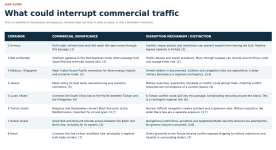
Beyond Hormuz and Bab el-Mandeb, these are the main straits to watch:

Global Maritime Chokepoints


Where the routes narrow


What could interrupt commercial traffic

1789147419619.png


Stage Set for Stagflationary Squeeze?​

The twin disruptions threaten shipping corridors that carried roughly a quarter of global seaborne oil trade through Hormuz and through Bab el-Mandeb, while jeopardizing a Red Sea shipping route central to trade between Asia and Europe and risking ignition of a stagflationary squeeze as diesel prices soar to new highs that eventually feed into supply chains, freight costs, and ultimately, at a lag, higher prices on store shelves.

 
Last edited:
UPDATE: It seems The Crown Prince is asking the people to do to the regime what they did to his father. The idea being not just a general strike, but if you work with any kind of automated machinery, turn it off when you walk out.

We all know that cars break down. If you drive you know at least one mechanic. If the parts they need are blockaded, the cars stay broke. Also the further breakdown of all things gas powered is accelerating due to watered down gas. Now, since this is caused by the regime and they can’t fix it, before the car stops running park it in the street to block easy movement by the regime forces. Turn off the car, take the keys and walk away. They are circulating an animated short showing that arch they have in Tehran surrounded by parked cars as far as you can see. Then everyone tunes in the radio station that is playing music favorable to the Shah.

In Yemen the advancing Houthi’s have now gotten possession of American vehicles and weapons abandoned by retreating Yemen troops. IRGC advisors are assisting them. ON THE SAUDI SIDE, it’s been reported that Trump has refused boots on the ground to fight the Houthi’s. However, there are now reported to be up to 200 American advisors in S.A. With the loss of two pumping stations to the Houthi’s they have to do more that just making air strikes.
 
Last edited:
Posted for fair use.......


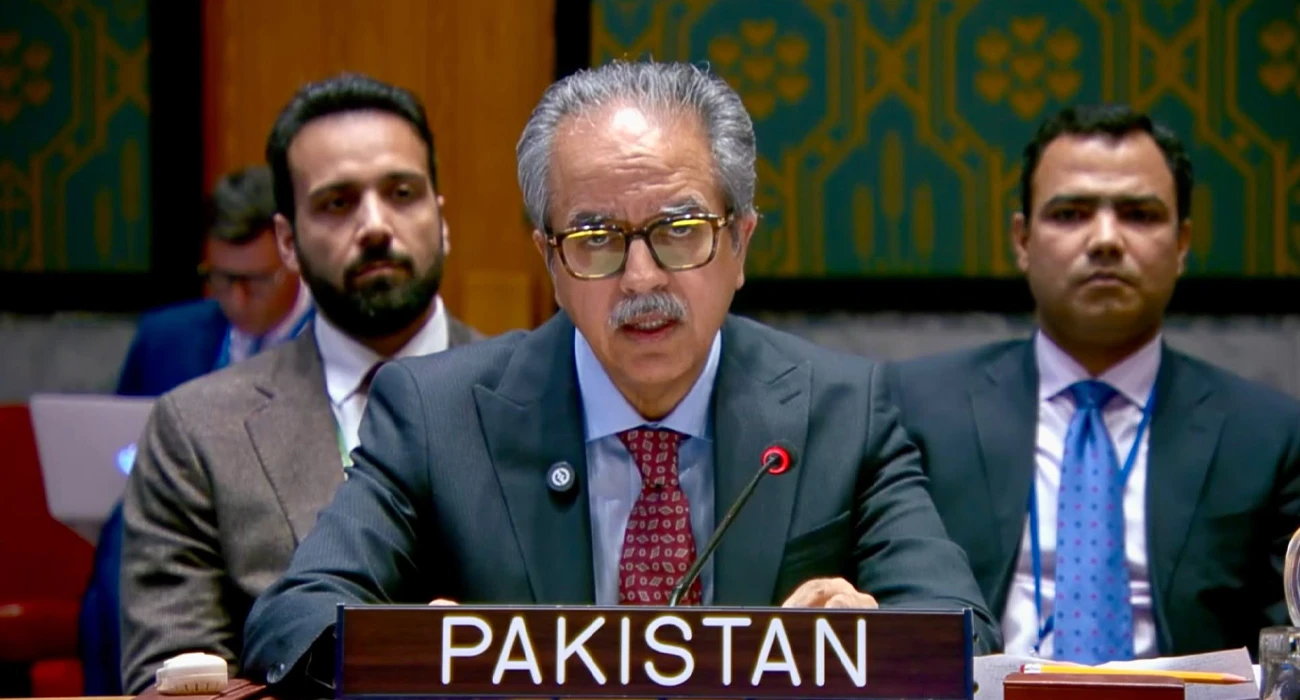
Pakistan Backs Saudi Self-Defense at Emergency UNSC Yemen Meeting​


New York (TDI): Pakistan told the emergency United Nations Security Council (UNSC) meeting on Yemen that Saudi Arabia has every right to defend itself against Houthi attacks, on the same day its Foreign Office said no military response under the Makkah defense pact was under discussion.

Pakistan’s Permanent Representative to the United Nations, Asim Iftikhar Ahmad, addressed the Council on Thursday. “The situation in Yemen has entered a deeply alarming and dangerous phase,” he cautioned.

Ahmad, named Pakistan’s next foreign secretary this week, said Pakistan stands in complete solidarity with Saudi Arabia.

He condemned the strikes as “a flagrant violation” of sovereignty and reiterated Pakistan’s position as “We fully support the Kingdom’s legitimate right to take all necessary measures to defend its territory, protect its citizens and residents, and safeguard its national assets against any threat.”

View: https://x.com/PakistanUN_NY/status/2098197066644349246?ref_src=twsrc%5Etfw%7Ctwcamp%5Etweetembed%7Ctwterm%5E2098197066644349246%7Ctwgr%5E921a5d51c81f1129ab6ae6da23f35cd9f56d5635%7Ctwcon%5Es1_&ref_url=https%3A%2F%2Fthediplomaticinsight.com%2Fpakistan-backs-saudi-self-defense-unsc-yemen%2F


"Statement by Ambassador Asim Iftikhar Ahmad,Permanent Representative of Pakistan to the UN,At the UN Security Council Emergency Meeting on Yemen(10 September 2026)****President,We would like to join colleagues in thanking Special Envoy Hans Grundberg for his briefing. Let me also welcome the participation of distinguished Permanent Representatives of the Kingdom of Saudi Arabia and Yemen in the meeting.

2. Pakistan condemns, in the strongest terms, the reprehensible attacks carried out by the Houthis against civilian and economic targets in Abha, Khamis Mushait, Jazan and Najran in the Kingdom of Saudi Arabia. These attacks constitute a flagrant violation of the sovereignty and territorial integrity of the Kingdom and undermine efforts for a peaceful and durable resolution of the conflict in Yemen. As the Prime Minister of Pakistan has underscored “such dastardly attacks threaten innocent lives as well as regional peace and security”.

3. Pakistan reiterates its unwavering support for the sovereignty, territorial integrity, security and prosperity of the Kingdom of Saudi Arabia and stands in complete solidarity with its leadership, Government and brotherly people. Consistent with the UN Charter and international law, we fully support the Kingdom’s legitimate right to take all necessary measures to defend its territory, protect its citizens and residents, and safeguard its national assets against any threat.President,

4. The situation in Yemen has entered a deeply alarming and dangerous phase. Sharp escalation of hostilities across multiple frontlines, continued Houthi attacks against commercial shipping in the Red Sea, attacks against civilian and economic targets in the Kingdom of Saudi Arabia, and the deteriorating humanitarian situation are a matter of grave concern. These developments, with potentially far-reaching consequences for Yemen and the wider region, also underscore the urgent need to prevent further escalation and preserve the space for diplomacy.

5. It is worth recalling that the relative calm maintained since 2022 was the result of painstaking diplomatic efforts. It must not be allowed to unravel. A return to hostilities would further compound the suffering of the Yemeni people and risk drawing the country deeper into wider regional tensions. The immediate priority must therefore be de-escalation and restoration of credible political process.

6. Pakistan, therefore, supports an inclusive, Yemeni-led and Yemeni-owned political process under United Nations auspices. We commend the Special Envoy for his continued engagement with the parties and regional stakeholders.

7. Yemen’s acute humanitarian crisis also requires sustained international attention. Humanitarian operations must be adequately funded, and humanitarian personnel must be afforded the necessary safety and access to carry out their work.

8. Pakistan also reiterates its condemnation of the continued arbitrary detention by the Houthis, of UN and humanitarian personnel and diplomatic staff. We reiterate the demand for their immediate, unconditional and safe release.

9. Pakistan will continue to support all sincere efforts aimed at de-escalation, dialogue and a comprehensive political settlement that can bring lasting peace, stability and prosperity to Yemen and the wider region. We urge the Council and the international community to remain united in support of these objectives.I thank you.

4:48 PM · Sep 10, 2026
596Views"


UN Special Envoy for Yemen, Hans Grundberg, warned that the war’s consequences “will not remain within Yemen’s borders.”

In Islamabad, Foreign Office spokesperson, Sajjad Haider Khan, told the weekly briefing on Thursday that a military response under the pact is not being discussed for now. He said more time is needed to implement the agreement, and that Pakistani forces are in Saudi Arabia for training.

Two days earlier, Defense Minister Khawaja Asif had said in an interview on Geo News that the pact would become operational if the Yemen war spilled over into Saudi Arabia. He added, “We are bound by the terms and conditions of this pact.”

Pakistan, Saudi Arabia and Türkiye signed the Makkah agreement on August 7. According to the pact, an attack on any one of the three is considered an attack on all.

It followed the Strategic Mutual Defense Agreement (SMDA) that Pakistan and Saudi Arabia signed in Riyadh in September 2025.

Read More: Saudi Arabia Halts East-West Oil Pipeline After Drone Attack as Houthis Advance Along Red Sea

The Houthis launched dozens of ballistic missiles and drones at Abha, Khamis Mushait, Jazan and Najran on September 8. Coalition spokesman Turki al-Maliki reported that 73 civilians were wounded, including women and children.

The Houthis claimed they were responding to more than 120 Saudi air strikes on Yemen in the previous three days. On Thursday, Houthi fighters captured the Red Sea port of Mokha, close to the Bab al-Mandab Strait. Saudi forces carried out around 40 air strikes on Taiz, Hodeidah, Al-Jawf and Marib the same day, according to Al Jazeera.

The war in Yemen started in 2014, when the Houthis took over the capital, Sanaa. The Houthis, officially called Ansar Allah, are an Iran-backed Zaidi Shia armed group from northern Yemen, named after their founder Hussein Badreddin al-Houthi.

A Saudi-led coalition entered the conflict in 2015, after the Houthis ousted President Abd-Rabbu Mansour Hadi. The intervention sparked a heated debate in Pakistan, which had no SMDA or Makkah pact at the time. Saudi Arabia had asked Islamabad for warships, fighter jets and ground troops.

Read More: Trump Rejects Saudi Crown Prince’s Request for US Strikes on Houthis: Report

On April 10, 2015, a joint session of Parliament unanimously passed a resolution calling for Pakistan to stay neutral so it could play a “proactive diplomatic role” in ending the crisis.

Presented by Ishaq Dar, then finance minister, the resolution also pledged that Pakistan would “stand shoulder to shoulder” with Saudi Arabia if its territorial integrity or holy sites came under threat.

In April 2022, the UN brokered a truce. The deal officially expired that October, but Saudi Arabia and the Houthis largely stopped attacking each other anyway. This informal peace lasted about four years.

Tensions returned in July when Yemen’s internationally recognised government struck Sanaa airport to stop an Iranian plane, carrying a Houthi delegation, from landing.

The Houthis responded with an attack on Abha airport in Saudi Arabia, and on July 20 they announced a blockade of Red Sea shipping.
 
Posted for fair use......

International

Iraq confirms attacks on Saudi pipeline originated from Iraqi territory and other Mideast news​


by: The Associated Press


Posted: Sep 12, 2026 / 02:59 AM EDT


Updated: Sep 12, 2026 / 02:59 AM EDT


Attacks on a key Saudi oil pipeline were launched from Iraqi territory, said Iraq’s government Saturday, pledging to probe further.

Iraq closed two key border crossings with Iran, halting all passenger and commercial traffic until further notice, Iran’s state-run media reported Saturday.

Meanwhile, fears mount that gas and oil prices may rise and international shipping could be further disrupted after Yemen’s Iran-backed Houthis seized a key island and captured a Red Sea port.

Here’s a look at the latest news in the Middle East. Full coverage can be found here.

Iraq dismisses commander over attacks launched at Saudi Arabia​


Prime Minister Ali al-Zaidi ordered an investigation into the operations command in Maysan province and dismissed its commander after authorities determined that attacks targeting Saudi Arabia were launched from a site in the province, the Iraqi government said in a statement early Saturday.

Saudi Arabia shut down the major, cross-country oil pipeline on Friday, saying it was a “precautionary measure.”

The Saudi Foreign Ministry blamed the attacks on several drones that came from Iraq and, in a statement, said the kingdom would not retaliate to give the Iraqi government “an opportunity to take the necessary measures.”

The East-West pipeline has been vital to Saudi Arabia’s continued oil exports in the months since the Iran war disrupted shipping in the Strait of Hormuz. According to the International Energy Agency, Saudi oil exports through the Red Sea port at the pipeline’s end have more than doubled since the Iran war erupted.

Tehran-backed Iraqi militias have launched attacks on U.S.-linked targets both inside and outside of Iraq since the U.S. and Israel attacked Iran on Feb. 28 and have coordinated with Yemen’s Houthi rebels to attack Saudi Arabia.

Crude prices this week soared again above $100 a barrel, giving Tehran more leverage in any talks. Analysts worry that the Houthis’ seizure of Yemen’s port city of Mokha may create further complications for shipping on the Red Sea and raise oil prices.

Iraq closes two border crossings with Iran​


Valiollah Hayati, the deputy governor of Iran’s southwestern Khuzestan province, said Iraqi officials had announced the closure of the Shalamcheh and Chazabeh crossings.

Hayati urged traders, drivers and travelers not to approach the crossings until further notice. He said relevant authorities would release additional information.

Shalamcheh and Chazabeh are among the main official border crossings between Iran and Iraq.

This report will be updated throughout the day as new developments emerge.
 
Reuters
Follow

Houthi advance in Yemen puts U.S. in a new bind​

By Humeyra Pamuk, Simon Lewis and Matt Spetalnick
Updated Sat, September 12, 2026 at 9:18 AM EDT
5 min read


Houthi advance in Yemen puts U.S. in a new bind

Houthi supporters shout slogans as they celebrate advances made by Houthi forces in fighting with government forces along Yemen's Red Sea coast, in Sanaa, Yemen, September 11, 2026. Picture taken with a mobile phone. REUTERS/Adel Al Khader

Houthi supporters celebrate advances in Red Sea coastline

Houthi supporters shout slogans as they celebrate advances made by Houthi forces in fighting with government forces along Yemen's Red Sea coast, in Sanaa, Yemen, September 11, 2026. Picture taken with a mobile phone. REUTERS/Adel Al Khader

Houthi advance in Yemen puts U.S. in a new bind​

1 of 2
Houthi supporters shout slogans as they celebrate advances made by Houthi forces in fighting with government forces along Yemen's Red Sea coast, in Sanaa, Yemen, September 11, 2026. Picture taken with a mobile phone. REUTERS/Adel Al Khader
More
By Humeyra Pamuk, Simon Lewis and Matt Spetalnick

WASHINGTON, Sept 12 (Reuters) - A lightning offensive by the Iran-aligned Houthis has put the militants in a position to control a crucial Middle East waterway, creating a major new problem for U.S. President Donald Trump as his war with Iran grinds on in its seventh month.

Widening the Middle East conflict, Houthi fighters have advanced south along Yemen's coast, increasing their ‌ability to choke off the Bab el-Mandeb Strait — the "Gate of Tears" at the mouth of the Red Sea — giving Tehran potential leverage over both of the region's main oil-shipping corridors.


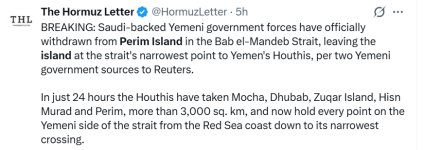
The militants reached the island of ‌Perim on Friday, in the middle of the strait between Yemen and Africa. That is bad news for Saudi Arabia, which has been shipping much of its oil from Red Sea ports since the war effectively closed the Strait of Hormuz, on the opposite side of the Arabian Peninsula.


It also comes at a difficult time for Trump, who is already grappling with record-low approval ratings and searching for a way out of the conflict, most recently by announcing an economic pressure campaign designed to force concessions from Iran's government.

High U.S. gasoline prices driven by the conflict have jeopardized his Republican Party's chances of keeping control of Congress in the November midterm elections. Iran remains defiant despite being hurt militarily and economically.

"Just weeks ago, Trump adopted a strategy of squeezing Iran's economy while keeping military conflict at levels too low to squeeze the American economy," said Stephen Wertheim, a senior fellow at Carnegie Endowment for International Peace. "The Houthis have shattered Trump's plan."


DANGER OF JOINING THE FIGHT

The U.S. administration can't afford to have the Houthis close the strait, driving up ‌energy prices and disrupting global trade.

But at the same time, entering a fight with ⁠a foe that has withstood previous attacks by Saudi Arabia and the U.S. would be a dangerous new mission for a U.S. military already stretched by the fighting in Iran.

Saudi Arabia's de facto ruler, Crown Prince Mohammed bin Salman, phoned Trump on Thursday and asked for U.S. military help fighting the Houthis, three sources told Reuters. He was told Washington would not intervene ⁠directly for now but would help with intelligence, the sources said.


Trump confirmed on Saturday that he had spoken to the crown prince, and said the Houthis had also phoned his administration and asked for Washington not to become directly involved in the conflict.


A senior Trump administration official declined to address specific questions, but said the U.S. is focused on national security interests such as ensuring freedom of navigation in the Red Sea "while empowering our regional partners to take the lead in managing and resolving regional security challenges".

Saudi Arabia, Iran and the Houthis did not respond to a request for comment. Iran's foreign ministry said in a statement on Thursday that the Yemen conflict could not be solved by blockade or military action against the Houthis and called for ‌dialogue, without addressing Iran's own role.

A SECOND KEY STRAIT


Iran responded to U.S. and Israeli attacks earlier this year by disrupting the Strait of Hormuz, the outlet to the Gulf through which around a fifth of global oil supplies flowed before the war.

If the Houthis close the Bab el-Mandeb, that would deal another economic blow, constraining another 7% of global petroleum supplies and about 12% of global trade.

"This was always the worst-case scenario, that the Iranians exert control not only of Strait of Hormuz but Bab el-Mandeb, two of the leading energy choke points in the world," said David Schenker, who served as Assistant Secretary of State for Near East Affairs during Trump's first term and is now at the Washington Institute for Near East Policy, a think tank.

"It's an enormous amount of leverage that [the Iranians] have in hand."


Analysts and former officials say Trump now faces a choice: devote U.S. forces and scarce air-defense munitions to pushing back the Houthis, or leave Saudi Arabia and its allies, ‌a Yemeni government based in the south, to confront them alone.

The Houthis seized Yemen's capital 12 years ago, and a Saudi-led military intervention has failed to dislodge them since.

Taking on the Houthis would effectively end a deal Trump struck last year in which the U.S. would stop bombing the group in exchange for a halt to strikes on Red Sea shipping. That would be likely to expose U.S. forces to missile attacks from Yemen.

A STRETCHED U.S. MILITARY


It would also be another burden for the U.S. military.

U.S. officials say a fight with the Houthis could require significant ‌naval and aerial resources and divert U.S. intelligence assets, given the need to pinpoint Houthi positions that have changed since last year.

If U.S. Navy vessels and aircraft have to start shooting down Houthi drones and missiles, it could also worsen diminished stockpiles of U.S. munitions and air-defense interceptors.

The senior administration official denied that the U.S. was concerned about its resources being stretched. "The United States Military has more than enough munitions, ammo, and stockpiles to serve all of the Commander-in-Chief's strategic goals and beyond," the official said.


Tim Lenderking, who served as U.S. special envoy on Yemen under former President Joe Biden and is now a principal at law firm Squire Patton Boggs, said that ‌with Trump signaling an unwillingness to get directly involved militarily against the Houthis, the U.S. needs to do more to share intelligence with the Saudis for their air campaign and step up diplomatic and material support for Yemen's internationally recognized government.

"This administration came in asking the question, 'What can Yemen do for us?'" Lenderking said during a webcast sponsored by the Middle East Institute think-tank in Washington. "Well, Yemen can spoil our day."

(Reporting by Humeyra Pamuk, Simon Lewis and Matt Spetalnick; additional reporting by Idrees Ali, Jonathan Landay and Timour Azheri)
 

"Riyadh In Difficult Position": Saudis Shutter Critical East-West Pipeline After Drone Attacks​

by Tyler Durden
Zero Hedge
Saturday, Sep 12, 2026 - 09:55 AM
Saudi Arabia temporarily shut its 7 million-barrel-a-day East-West pipeline following multiple drone attacks, exposing a massive vulnerability in a critical export route used to bypass the Strait of Hormuz during more than six months of US-Iran conflict.


The closure puts new pressure on Saudi oil exports as the pipeline designed to bypass the Hormuz chokepoint becomes a target. The Energy Ministry described the shutdown as precautionary while emergency crews secured the pipeline and assessed its safety.

The oil pumping station on the Saudi East-West pipeline was completely destroyed during yesterday’s attack, according to satellite imagery released today.

This is incredibly important news, as the East-West pipeline can transport up to approximately 210 million barrels of crude… Open Source Intel (@Osint613) on X pic.twitter.com/YggT4Lwzwm

— Open Source Intel (@Osint613) September 11, 2026
Here's the ministry's statement:

An official source at the Ministry of Energy stated that the East-West Pipeline in the Riyadh and Madinah regions was subjected to multiple attacks on the morning of Thursday, 10 September 2026. The pipeline was shut down as a precautionary measure. The attacks resulted in a number of injuries, and medical care was provided to those affected.

The source said emergency and specialised technical teams responded immediately following the attacks, taking the necessary measures to secure the pipeline and assess its safety in line with approved safety procedures and emergency response plans, in coordination with the relevant authorities. Any further developments will be announced in due course.
The shutdown deepens an already severe export squeeze on the kingdom. Saudi oil shipments fell to about 3 million barrels a day in August, the lowest level on record since early 2017.

Iran-backed Houthis seized the strategic island of Mayun in the Bab al-Mandeb Strait last week, tightening pressure on the kingdom's Red Sea export hub. With Hormuz already disrupted, ongoing threats to both maritime chokepoints are narrowing the kingdom's options for moving crude to global markets.


"Riyadh is in a difficult position," said Rapidan Energy Group analyst Fernando Ferreira. "As the US maintains the blockade and succeeds in escorting more tankers out of the region, Iran will pivot toward increased attacks on Gulf energy facilities."

 
Tousi is reporting armed attacks in the SE of Iran. Resistance groups seem to be well on their way in taking a city called Sararvan. Fighting ongoing, casualties unknown. An explosion in a market more centrally located. Isfahan I believe, or near there.

Here I get to have fun. Tousi is all in for Reza Pahlavi. Mrs. late hates that idea almost as much as she hates the regime. Tousi reported Turkey and Iraq have both closed their borders with Iran. Showed videos of both people and vehicles on both sides of the Turkish border lined up wanting to cross, but not allowed. I told Mrs. late. She assured me that couldn’t be true. One of her friends or family members would have told her. She went to one of her sources. It was reported that Turkey has stopped daily traffic. Commercial may still continue. I asked her,

“What commerce? Iran doesn’t have anything to sell and no money to buy anything.”

So vegetable trucks can’t cross, but non-existing cargo carriers can. Tourism has just ended. But it wasn’t closed. O.K. Suddenly she didn’t want to talk about it anymore.

Tousi read an update from the IRGC. They said two important things. First the ‘terrorists’ that have ALSO suffered casualties. Meaning they took a few hits as well. Secondly they admitted outbreaks of attacks against their positions in at least three cities. BUT they are inflicting losses. They don’t say the fighting has ended, they haven’t said they are winning. Just inflicting casualties.

UPDATE, Watched the remaining of Tousi. Some vid’s supposedly from the areas where the fighting is going on. You see a city, you hear gunfire in one town smoke in the distance, but honestly you see nothing that could ID anything unless you lived there.

One other vid. A senior P.D. official who is doing his best to be officer friendly and ‘let’s get through this hard time together. We are all suffering.’ After 47 years of oppression his plea isn’t going over very well.
 
Last edited:
Here's an article outlining why the US has declined to assist Saudi Arabia.

Houthis Rally, Seize Mocha As Yemen Coalition Splits and Trump Declines Saudi Strike Plea​

streiff 12:23 PM on September 12, 2026
(For links and and photos of original sources, go to the link.)

Houthis Rally, Seize Mocha As Yemen Coalition Splits and Trump Declines Saudi Strike Plea

My, what a difference a few days makes.​

On Wednesday, it looked like a surprise offensive by Yemeni government forces had knocked Iran's proxies, the Houthis, back on their heels. In just a day of hard fighting, the Houthis had been routed from several strongholds and Yemeni Deputy Defense Minister Samir al-Sabri declared that “the decision has been made to retake Sanaa.”

This looked like another case of Iran throwing one of its proxy armies to the wolves in an attempt to save its own hide; see Iran Burns Another Proxy: Houthis Nearing Panic After Tehran-Ordered Offensive Fails – RedState.

By Thursday, the story had changed. Not only had the Houthis rallied and stopped the government advances, but they were also pushing their way down the Red Sea coastline toward the Bab al-Mendeb Strait, a maritime chokepoint more critical than the Strait of Hormuz because it controls access to the Suez Canal; see New: Iran-Backed Houthis Seize Vital Yemeni Port - Possibly a New Threat to Shipping – RedState.

Let's take a look at what all of this may and may not mean.

Finger-pointing has started

CNN has a decent roundup of reactions to events. It isn't just some purple-haired, nose-ringed harpy screeching "OrangeManBad," so you could be forgiven for doubting it was produced by that outlet. It is aptly titled: ‘"A f***-up of epic proportions’: Blame game begins after Houthis’ lightning advance down Red Sea coast."

Here are the high points:
  • Saudi Crown Prince Mohammed bin Sultan called Trump twice, asking him to strike the Houthis. But Trump said no.
  • Yemeni battalions were hollow, filled with "ghost soldiers." Many units were at 20 percent real strength. This is a perpetual problem in Third World armies. Unit rosters are full of names of men who don't exist because that lets the unit commander draw their salaries.
  • The UAE and Saudi Arabia fell out in December. The UAE pulled out, and Saudi Arabia never replaced them. This substantially weakened the Yemeni ground forces.
  • "It's a Saudi-American f**k-up of epic proportions," a regional source told CNN, which is a narrative we will hear a lot of.
  • "The air support never came. And Mocha has now fallen." — senior Yemeni military source.
  • "They don't need advanced weapons to close Bab al-Mandeb. They can just use a cannon on a car," opined Southern Transition Council — an anti-Houthi, UAE-sponsored faction — official Amr Al-Bidh.
  • According to the article, Iran now faces pressure on both Hormuz and Bab el-Mandeb simultaneously.
  • An adviser to Iran's supreme leader called it a "clear victory" and crowed, "The American people and Washington’s allies are paying the price for the economic crisis and Trump’s ambitions.”
What went wrong?

In simple terms, Yemen's reach exceeded its grasp by quite a margin. The Houthis have a single chain of command and a belief system that unifies them. They had professional IRGC advisers available to help unscrew the mess that was developing on Wednesday. The Yemeni government forces are fragmented. There is a Yemeni Army, but it is a partner in a coalition, and most of its partners are advised and paid by the UAE.
  • Southern Transitional Council (STC): A political and military separatist organization aiming for an independent southern Yemen.
  • Giants Brigades (Al-Amaliqa): A prominent UAE-trained and armed military force active on southern front lines.
  • Security Belt Forces: Paramilitary units deployed across southern governorates like Aden.
  • National Resistance Forces: Led by Tareq Saleh, operating largely along the western coast and aligned within the broader anti-Houthi coalition.
As the UAE has largely extracted itself from this war, the quality and enthusiasm of these forces are anyone's guess.

Whatever cooperation existed between those components is likely over.

While the government forces running out of steam and collapsing was never outside the realm of possibilities probably the biggest mystery is why Saudi Arabia stood by and let its client state get curb-stomped, though that does seem to be the Middle Eastern way of war.

Saudi oil at risk


I've posted before on the massive shift of oil from the Persian Gulf to safer routes because of Iran's aggressiveness; see Tehran’s Hormuz Blockade Looks Like History’s Dumbest Trade Own-Goal – RedState. One of the key parts of this move is Saudi oil moving by pipeline to the Saudi Red Sea port of Yanbu.

That is now in jeopardy as the Houthis are in a better position to attack Saudi shipping than they were a few days ago. Friday, the Saudi pipeline was hit by a drone attack which heavily damaged a pumping station. For now, tankers are still filling up with Saudi oil from storage tanks, but it underscored the vulnerability of the pipeline and the entire strategy of avoiding the Strait of Hormuz.

Yemen anti-Houthi coalition splits

The defeat on Thursday resulted in the UAE-sponsored STC blocking the retreat of Yemen government forces and leaving them trapped by the Houthis. This is a huge change in the regional alignment of forces. Whether this is the STC acting out of frustration or a sign that the government coalition is over is something to watch.

Houthis: free agents or proxies?

It is hard to tell if the Houthis are acting as free agents or if they are acting as Iranian proxies. The Houthis announced a blockade of Saudi Arabia in July even as Iran was calling for them to totally block Bab al-Mandeb; see New: Iran Now Calling on Houthis to Block Red Sea Gateway – RedState. Since then, their attacks on Red Sea shipping have been limited to Saudi-related vessels. According to reports, the Houthis called President Trump and asked him not to interfere in the conflict. It looks like they got the message he sent in July; see President Trump Puts Iran on Notice: Rein in the Houthis Now or Else – RedState

If the Houthis refrain from attacking non-Saudi shipping, then this becomes a back-burner crisis that we can kick down the road a bit.

Is Iran getting cold feet?

The drone attack on the Saudi pipeline pumping station caused a couple of unexpected things to happen. First, Iran, via its Iraqi proxy force, immediately denied any involvement in the episode. This is very much unlike the Iran before Operation Epic Fury which scabbed credit for things it didn't do.

The Iraqi government showed an immediate reaction. It immediately closed the main border crossings with Iran.

It also fired a military commander responsible for border security.

The fact that neither Iran nor its Iraqi proxy have claimed credit is a sign that someone may be tapping the brakes.

U.S. involvement on the horizon?

There are two parts to this.

First and foremost, if the Houthis limit their shipping attack to vessels carrying Saudi cargo, that makes this a Saudi problem. The Saudis were unable or unwilling to lift a finger to help the Yemen government so, in my view, there is no reason for us to do so.

The second part is that we are engaged in a crucial strategic conflict with Iran. If we back down from our stated victory conditions and especially if we allow Iran to control the Strait of Hormuz, then we have lost credibility worldwide. If Trump expands the war to include Yemen, which might have to be done eventually, before the midterms, he will be politically punished. Plus the spectacle of Saudi Arabia asking for the U.S. to fight a war for it on the anniversary of 9/11 was sort of obscene.

Bottom line

The Houthis controlling access to the Red Sea is not a good thing. In fact, it is a bad thing that we may have to deal with later. Right now, we can't afford to take our eye off the main event, the war with Iran, unless the Houthis start acting ignorant.

This is also a lesson for the Saudis. For too long, the Saudis have skated with the U.S. providing its security while it acted like a regional power. To paraphrase the words to the immortal Harry Callahan: "If they want to play lumberjack, they have to learn to handle their end of the log."

This could end up being a null set, once the queasiness of the world markets settle down. If Suez traffic is uninterrupted and the Saudis care enough to keep their shipping safe, then its Houthi offensive isn't a world or American problem. That could change overnight, just like it did Wednesday.
 

Yemen Blame Game Begins: "Saudi-American F**k Up Of Epic Proportions"​

by Tyler Durden
Sunday, Sep 13, 2026 - 11:05 AM
An official affiliated with Saudi-backed militias in Yemen told CNN that the Houthis "committed everything they had – waves upon waves of fighters... along with their available ballistic missiles and weapons."

"But the air support never came," the source said in reference to the fact that the Saudi-backed side rapidly folded and retreated in just days last week. "And Mocha has now fallen." The blame game has begun after a mere 36 hours has seen the Saudi coalition fracture on the ground, and the finger-pointing is likely to go on in the halls of government, now as Saudi territory continues coming under direct missile and drone threat.

Handout via Reuters
Another regional source told CNN on Thursday that "The failure this time is not with the Yemenis" but that "it's a disaster made in DC and Riyadh."

According to some further key lines and expletives:

The regional source told CNN that it was "a complete failure of political leadership" amid fierce squabbling and delayed decision-making in Riyadh.

"There was not one air strike throughout the day yesterday (by Saudi support forces), although there were minute-by-minute updates," the regional source added. "It’s a Saudi-American f**k up of epic proportions."
There are at the same time widespread reports that the Iran-backed Houthis have seized US made M-ATVs and MRAP armored vehicles.

Dudes in sandals breaking the coalition with lighting speed...

View: https://x.com/History__Speaks/status/2098423572406383004?ref_


Amr Al-Bidh, the top official of Yemen’s Southern Transitional Council (STC), has also been quoted in the CNN report, explaining that the Houthis "don’t need to use advanced weapons to close Bab al-Mandeb. They can just use a cannon on a car."

He added "It’s a leverage that they have without using advanced weapons. And they will keep it."

All of this has further emboldened the Houthis to take the fight directly to Saudi territory, amid the ongoing "siege for siege" policy. Riyadh has long sought to impose a brutal blockade on Houthi-controlled ports. The group has so far indicated it intends to allow most international vessels to traverse the Red Sea, but will attack Saudi or Israeli-linked shipping.

There are fresh Sunday reports of another ballistic missile attack on a Saudi base:

Yemen's Houthi group on Sunday claimed that it had launched a ballistic missile and drone attack on a Saudi military base, as fighting between the group and Riyadh-backed Yemeni government forces intensified.

Houthi military spokesperson Yahya Saree said the attack targeted the Sharurah base in southern Saudi Arabia, including “weapons depots and command and control centers that are managing the aggression against our nation and people”.
Saree declared that the strikes had hit their targets and threatened further bigger strikes deeper inside the kingdom if the Saudis keep up their military operations in Yemen.

View: https://x.com/luke_metro/status/2098918040163561912?ref_


Saudi coalition aerial assets have been belatedly at work: "On Sunday, the Yemeni military said its air force had conducted three strikes against Houthi positions and barracks in the Taiz region," MEE reports.

Al Jazeera writes: Analysts are calling the Iran-backed Houthi group’s victories the most significant regional development since the start of the US-Israel war on Iran. The offensives could be particularly damaging for Saudi Arabia and its oil exports.


The Yemeni military announced on X, "Air force of the armed forces targeted positions and barracks of the terrorist Houthi group with three air strikes" in the Taiz region.


Meanwhile, President Trump has said the Houthis are in contact with him and have pledged to let ships through the Bab Al-Mandab Strait. He said to reporters Saturday while meeting with Irish Prime Minister Micheal Martin, "The Houthis called us, and they don't want to fight with us. They don’t want us to go after them." He further explained that "they would much prefer not having us involved:" and so "they are letting most ships go through." The president did acknowledged they do have a ban on Saudi vessels, however. But the Houthi threat of closing the energy transit chokepoint lingers heavily.
 
First of all, my thanks to Ragnarok for finding this video. As reported yesterday, you just about have to live on or near these streets to really know where they are. There are shots, people seen running away from the sound of gunfire, and smoke rising in the distance. Not much else.

View: https://x.com/IranIntl_En/status/2098683321311969605


There are some still shots here that are worth a look.

View: https://x.com/IranIntl_En/status/2098964106535428464


Tonight, Tousi announced something I don't want to think about. The IRGC and the Parliament are discussing having the first necessary tests to build a nuke. They haven't started yet. The IRGC is all in favor, of course. But many of the politicians are thinking about what Israel would do and comparing that to breathing. They aren't so sure this is a good idea.

Iran has launched at shipping again. At the time of the report the launch was minutes old. No word on target and success or failure. There are continuing reports of heavy fighting either in or near a number of southeastern cities in Iran. And as a final humorous note, Tousi showed a clip of a recent pro-gov. rally. One mullah standing in the street, waving the regime flag. The drivers don't even slow down.
 

Trump Hints At Iran Invasion & Oil Raid! Trump Announces Venezuela-Like War Plan For Iran​

Iran war explodes! US President Donald Trump has dropped a bombshell statement on the Middle East conflict, suggesting that the United States could stay in Iran and 'keep the oil.' Trump said 'We'll ultimately get out of Iran, unless we decide to stay and keep the oil like Venezuela,' adding that US revenue from Venezuelan oil has 'paid for the war many times.' The statement comes as global oil markets remain on edge due to the ongoing war in the Middle East. Is Trump hinting at a full US occupation of Iran to seize its massive oil reserves?

Rt 3:41

View: https://www.youtube.com/watch?v=E2lW7E7oIxk
 

Trump Loses the Other Strait​


Trump Loses the Other Strait

As recently as last week, the Iran war appeared to be turning in America’s favor. The Houthis—the Yemen-based militia that is Iran’s most formidable remaining ally in the Middle East—were under pressure from their local rivals, and the Saudi air force was pounding them with air strikes. The president of Yemen’s internationally recognized government issued a triumphant statement declaring that the Houthis’ miscalculations “will open the door to their complete collapse.” The next step was easy to imagine: With their Houthi partners wounded, Iran’s leaders would be forced to back down and agree to Donald Trump’s terms.

Yesterday morning, those delusions drifted away like smoke as Houthi forces broke through their enemies’ defenses and seized the towns and islands around the Bab al-Mandab Strait, one of the most important maritime choke points in the world.

That loss leaves Trump, who had been hoping to win back control of the Strait of Hormuz from Iran, with a bitter surprise. His enemies now control both of the two important straits in the Middle East, through which a combined total of about a third of the world’s oil shipments pass every day.

It also underscores a stubborn fact: For all the setbacks suffered by Iran’s “Axis of Resistance” over the past year or two, its forces retain an ideological fervor and an esprit de corps that is sorely lacking on the other side. The Gulf states’ failure to work together against the Houthis has been catastrophic, and it echoes Trump’s own failure to devise a plausible or coordinated strategy against Iran.

Although the Houthis already had the ability to threaten shipping in the Red Sea, the capture of the Bab al-Mandab “means you can literally sit on the coast and fire at passing ships,” April Longley Alley, a Yemen expert at the Washington Institute on Near East Policy and the former political adviser to the United Nations special envoy for Yemen, told me. “It makes it easier and cheaper, and it solidifies, from a military and political point of view, that they have a stranglehold on the strait.”

The United States might not be able to do much about this, even if the Pentagon launches a new round of air strikes on the Houthis. (The Saudi leader, Crown Prince Mohammad bin Salman, called Trump twice yesterday urging him to strike the Houthis, Axios reported.) Bombs and missiles would achieve little without a ground force to take advantage of them, and America’s Yemeni allies are now battered and divided. The Trump administration waged a seven-week war against the group last year, and although it succeeded in killing some Houthi commanders, it did not dislodge the group or alter its ability to wage war, as Trump had promised.
The Houthi advance is even worse news for Saudi Arabia. For many years, the Saudis have been struggling to tamp down the Houthi threat on its border. Now the Houthis have inherited a great deal of Saudi and Emirati supplies left behind by the official Yemeni government’s retreating forces. A video circulated yesterday of Mohammad Ali al-Houthi, one of the group’s top commanders and a cousin of its supreme leader, Abdul-Malik al-Houthi, riding though Mokha in an Emirati armored vehicle.

The mess that Saudi Arabia faces in Yemen is partly of its own making. The Houthis were born three decades ago in reaction to Saudi meddling in Yemen’s religious and political sphere. In December, tensions between the Saudi and Emirati leadership led Riyadh to demand that the Emiratis—their nominal allies—withdraw from Yemen, leaving the Saudis in charge of a patchwork of militias with divided loyalties. The various Yemeni factions continued to squabble among themselves even as their Houthi enemies were at the gates.

“There was no coordination between commanders, between the intelligence and the drones, between the coast guard and the army—nothing,” Farea Al-Muslimi, a Yemen specialist at the think tank Chatham House, told me.

The Houthis have clearly benefited from the Gulf’s disunity. “Last time the Houthis made a breakthrough at Marib in 2022, the United Arab Emirates and Saudi Arabia were able to jointly support a devastatingly effective Yemeni-government counterattack,” Michael Knights, the head of research at the consultancy Horizon Engage, told me.

The Houthis, meanwhile, were disciplined and focused. “They sacrificed hundreds if not thousands of fighters,” a member of Yemen’s officially recognized government, who asked not to be identified for fear of repercussions, told me. “Our bullshit activists were putting out fake news about victories, while the Houthis were working in silence.”

With the momentum on their side, the Houthis could now go on to seize more terrain in other parts of Yemen, including Marib province, where much of Yemen’s oil is located. They could also extend their power bloodlessly, by cutting deals with tribal and regional leaders in the south and east. All of this would further consolidate their power and strengthen their Iranian patrons.

The Houthi victories have already put into doubt the value of the Mecca Alliance, the mutual-defense pact formed in August by Saudi Arabia, Pakistan, and Turkey. Islamabad and Ankara have shown no inclination to help the Saudis, despite a rash of recent Houthi strikes on targets in southern Saudi Arabia.

Iran’s vaunted Axis of Resistance is not a bulletproof covenant either. The Houthis were absent earlier this year when the United States and Israel started bombing Iran.

But unlike their enemies, the Houthis and the Iranians have a deep ideological bond, one that their soldiers willingly die for. And the Houthis do not need to win every battle. As long as they can sink an occasional oil tanker, they will hold a whip hand over their Saudi neighbors, and over the rest of the world too.
 
Top