INTL Europe - October 2026

Plain Jane

Just Plain Jane

Spain’s government dealt blow after parliament rejects housing measures. Early election speculated​


By JOSEPH WILSON and IAIN SULLIVAN
Updated 1:39 PM EDT, October 2, 2026
Leer en español
27
​
MADRID (AP) — Spain’s progressive government was dealt a costly legislative defeat on Friday when lawmakers rejected a package of emergency measures aimed at tackling the nation’s housing affordability crisis, as protesters gathered outside Parliament demanding help for renters.

The setback sparked speculation in Spanish media that Prime Minister Pedro Sánchez could consider bringing forward elections from next year. His office did not immediately respond to questions from The Associated Press regarding a possible snap election.

Sánchez spoke at the end of a five-hour parliamentary debate, making a last-gasp appeal to lawmakers to vote for the measures that he called “necessary.”

“What is behind these decrees is the desire to instill order and a sense of humanity in a market that if we do not rein it in will destroy our society,” Sánchez told the other 349 members.

“Do the right thing, or history will judge you, and sooner than you think,” Sánchez concluded before each lawmaker voted by roll call.

His plea fell on deaf ears. The Catalan separatist party Junts carried out its announcement made hours before that it would vote against both decrees. That doomed the measures when combined with the “No” from the center-right Popular Party and far-right Vox.

The votes were loudly jeered by protesters who had gathered nearby, while people seated in the public tribune of the chamber shouted “Vulture funds govern the congress!”

Oriol Bartomeus, a professor of political science at the Autonomous University of Barcelona, said that uncertainty now overhangs Spanish politics because Sánchez has good reasons to both call elections in two months time, as well as to hang on until next year.


Sánchez, while a popular progressive leader internationally, has been surrounded by a series of legal cases against his Socialist party and even his family, which all deny any wrongdoing. His government has also been harshly criticized for a migration crisis in Ceuta.

“It is clear that the issue of housing is more favorable than corruption,” Bartomeus told the AP. “But if he calls elections now, he has to wait 54 days to hold them, and in that time absolutely anything can happen.”

The decrees followed public uproar over the eviction of an elderly woman​

The first of the rejected decrees included a package of measures the government said would stop evictions of vulnerable people, make real estate speculation harder and provide tax incentives to encourage renting. The second decree was intended to make residential leases automatically renewable by tenants.


The main protest group, the renters association Sindicato de Inquilinas, said it was calling for more protests on Saturday and pushing for a general strike.

The government decrees were intended to quell a public uproar following the televised eviction of an 87-year-old woman last week in Madrid that sparked protests and a camp-in that has occupied Madrid’s most important square ever since.

Outside the parliament, protesters held up homemade signs with images of vultures on them, denouncing the real estate speculators they blame for driving up prices.

Protester Carla Cremonte, a 34-year-old office worker, lamented that the right-wing parties had united to “vote against the interests of the majority of people who are here, of the workers of Spain.”


“I don’t know what might happen, whether elections will be called, but in the streets we will continue fighting and the atmosphere is one of a general strike,” she said.

The average rent in Spain has almost doubled in the past 10 years. The average price per square meter has risen from 8.20 euros in 2016 to 15.1 euros ($17.15) this year, according to the real estate website Idealista.

The elderly woman whose eviction sparked the protests, Maricarmen Abascal, has become a symbol for the fight for lower housing costs in the southern European country, where many people are priced out of buying a home and are being squeezed by a small rental market.

The company that evicted her finally caved under immense public and political pressure this week and said that she can return to the apartment. Abascal is currently in a hospital since being removed from her home on a stretcher, but her lawyer said she is happy to know she will be going home.

It is unclear where the government will go from here. It could work on fresh legislation — unless, of course, Sánchez pulls the trigger on an election.


Catalan separatists scuttle housing decrees​

Junts is one of a group of small parties that Sánchez needed to woo when he formed a new government in 2023. It has proven to be a prickly political partner ever since. Its leader, the separatist Carles Puigdemont, has resided in Belgium since fleeing Spain after leading a failed bid to make northeastern Catalonia an independent nation in 2017.

Spain’s Housing Minister, Isabel Rodríguez, appealed to Junts from the lectern, saying that her ministry had “incorporated 90% of your proposals. Vote for the decrees or at least abstain.”


But Míriam Nogueras of Junts said that the decrees would only lead to owners removing their properties from the rental market, and thus driving up prices even further.

“These decrees still allow speculators to buy property and to evict people,” Nogueras said.

Junts urged the government to negotiate amendments. The government refused.

“This is not a failure of all of us,” Juan Bravo of the Popular Party told Rodríguez. “This is your failure and that of Sánchez’s entire government.”


The center-right Basque party and the tiny Coalición Canaria, whose support the government also needed, also voted against the second decree after backing the first one. They both criticized the government for rushing to act via decree instead of crafting legislation with other parties.

Wilson reported from Barcelona, Spain.

*******

This issue is being tracked from this post on another thread.


Latvians vote for a new parliament as fears of Russian hybrid attacks loom​


By KOSTYA MANENKOV
Updated 7:04 AM EDT, October 3, 2026
Leer en español

​
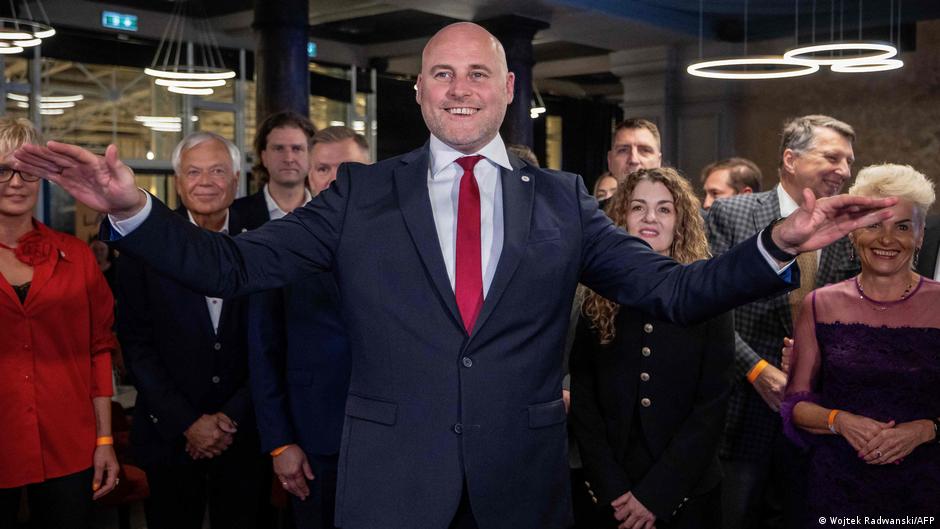
RIGA, Latvia (AP) — Latvians are electing a new parliament on Saturday as pro-Ukraine Prime Minister Andris Kulbergs seeks a full term. The vote comes as the small republic on NATO’s eastern flank contends with growing concern about potential Russian aggression.

A political crisis in May over the handling of stray drones suspected to be from Ukraine brought down the governing coalition that had been under strain due to multiple other issues. The parliament, or Saeima, then approved a four-party coalition led by Kulbergs of the centrist United List party, previously in opposition.

Latvia, like its Baltic neighbors Lithuania and Estonia, strongly supports Ukraine in its fight against Moscow’s invasion. It borders both Russia and Moscow-allied Belarus.

Kulbergs, 47, is now seeking his own mandate from voters.

“I hope we get a good result. This would give us an opportunity to make changes, put Latvia on the right track for defense and economy,” he said outside a polling station in Riga after casting his ballot.

“A strong economy can only bring strong defense, so that is the mission for the next four years if I’m given the right to lead the country,” he added. “Our party is ready to make changes.”

A multiparty coalition will almost certainly be needed to govern in a splintered political landscape. Parties must take at least 5% of the vote to win parliamentary seats.

“What I want to see is just democracy in action, just people actually going to vote and voicing their opinions on who they want to govern the country for the next term,” said Jānis Artis Briedis, who voted in Riga.


Nearly 1.56 million people in the nation of more than 1.8 million are entitled to choose the 100 members of the single-chamber Saeima for a four-year term.

“It’s obviously a very decisive election, and I expect that we’ll vote for parties that will be making nationally correct decisions for the defense and the economy, so I think the coalition will be maybe not ideal, but it will be still OK and we’ll be moving in the right direction,” Reinholds Pirags said after voting.

Concern about potential Russian hybrid attacks — a term used for non-conventional hostile acts such as sabotage, cyberattacks, disinformation and an array of other methods — has been mounting across parts of Europe in recent months; Latvia, among other nations on NATO’s eastern edge, is particularly exposed.

NATO has reinforced its protection of Latvian airspace for the election period, with Germany sending four Eurofighter jets to Latvia for about a week.


The Latvian State Security Service said last week that it hadn’t yet detected any significant or systematic efforts by Russia or others to influence the election in favor of any party or candidate, the LETA news agency reported.

Polls are expected to close at 1700 GMT.

___

Associated Press writer Geir Moulson in Berlin contributed to this report.
 

What to know as France school protests morph into unrest and the streets are seething​


By JOHN LEICESTER and SAMUEL PETREQUIN
Updated 9:59 AM EDT, October 2, 2026
18
​
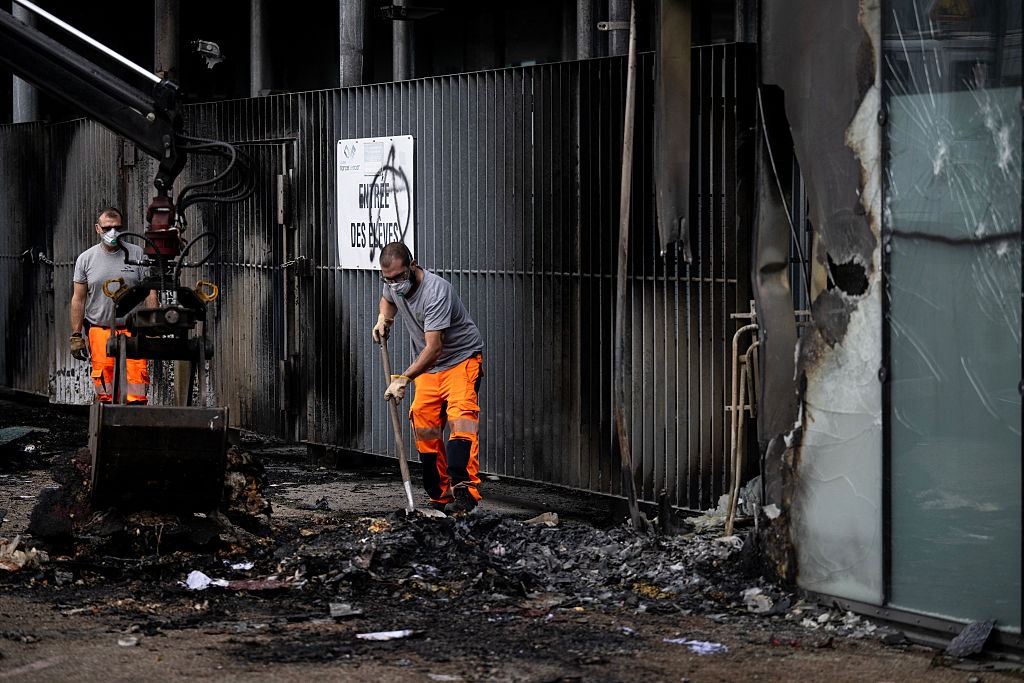
PARIS (AP) — Thousands of arrests, hundreds of injuries, schools set on fire in France. When the summer vacation ended and the new term started just a month ago, few could have imagined that the academic year would so quickly descend into nationwide student protests — and turmoil.

In a country beset by crises — both foreign and domestic — the eruption and rapid spread of protests by unhappy teenage high schoolers caught France off guard.

Friday brought more of the scenes that have dominated streets this week: vandalism, garbage fires, teens confronting and taunting police. Officers charging, firing tear gas and making more arrests. By early afternoon, the education ministry reported protests impacting 560 schools.

Taking grievances to France’s streets has long been a rite of passage in the country that spawned the French Revolution of 1789. To name just a few, there were the student protests in 1968, weeks of suburban unrest in 2005 and demonstrations in 2023 against pension reforms.

The students now barricading high-school gates and demonstrating with placards have shown the know-how of veterans — down to wearing masks and goggles against police tear gas.

The timing of these protests — with France engaged in a presidential election race — sets them apart. Candidates campaigning to succeed President Emmanuel Macron in May have seized on the demonstrations as a hot political issue.

And although constitutionally barred from seeking a third consecutive term, Macron also joined the fray, speaking out against protest violence and political manipulation of the young demonstrators.

Here is what you need to know:


The demonstrations started in the Paris region​

Protests first erupted last week in the Paris region and spread nationwide like wildfire, even to smaller towns.

High schoolers are expressing broad grievances — mainly, schools are under-resourced, with dilapidated facilities and insufficient staff. Still, spending on education is one of the costliest items in the state budget that Macron’s government proposed this week, with 65.5 billion euros ($74 billion) set aside for schools in the next year. That’s more than the proposed 63.4 billion euros for defense.

Students also complain that school days, which often start at 8 a.m., are too exhausting and the university entrance system too complex. Some university students also joined the protests this week.

Government says it’s becoming rioting, not legitimate protests​

Macron’s government has repeatedly said that it respects the right to peaceful protest. But it also issued written orders for police to break up protests that block access to schools and to rapidly put a stop to violence and vandalism.

Riot police have liberally used tear gas, wielded their batons and made arrests to disperse crowds.


Police and school staff have been targeted with explosive fireworks and other injury-causing projectiles. The interior ministry says acid has been hurled in some cases, and that those intent on destruction and looting have grafted themselves onto the high schoolers’ movement and behaved like “criminals and vandals,” instead of “young people legitimately voicing their demands.”

Police made more than 1,900 arrests on Thursday, when 305 officers were hurt, the ministry said.

The protests and confrontations continued Friday, and unrest also spread to neighboring Belgium where about a dozen schools closed in Liege, a day after violence in the city and six arrests there.


The protests come against a backdrop of broader school concerns​

There have been broader concerns in France that the schooling system is losing ground to those in other countries and failing in its mission to enable children from disadvantaged backgrounds to move up the social ladder.

Performance gaps are growing between highly advantaged and highly disadvantaged students, and overall scores in reading comprehension and mathematics have plunged, according to the latest PISA report, which evaluates students worldwide.

The government banned smartphones from high schools when the school year started in September, with officials arguing that banishing screens will improve learning. France this year also became the first country in the European Union to ban social media platforms for children under 15, but the country’s top court struck down that measure.

The protests are impacting the presidential election campaign​

The unrest is sharpening political battle lines between presidential candidates.

Far-left candidate Jean-Luc Mélenchon has positioned himself firmly on the side of the students and has decried police actions as “savagery” and repressive. Police crowd-control projectiles are suspected in some of the injuries that protesters have suffered.

Mélenchon’s critics are accusing his France Unbowed party of stoking violence and seeking to score political points from the protests.


Far-right leader Marine Le Pen has called for broader police powers against rioters. Conservative former Prime Minister Edouard Philippe, one of Le Pen’s main challengers for the presidency, has condemned those who “break things, burn things, or assault people.”

Associated Press writer Lorne Cook in Brussels contributed to this report.

*****

A thread about these protests and the role of immigration is here.


Seventeen EU leaders press Irish presidency to protect farm funding in next budget​

Wheat field


Copyright AP Photo
By Fortunato Pinto
Published on 03/10/2026 - 14:13 GMT+2
Add Euronews on Google

With Giorgia Meloni and Nicușor Dan as first signatories, the group also wants cohesion funding preserved, national rebates scrapped and NextGenerationEU loan repaid more slowly to free up fiscal space.​

The leaders of 17 European Union countries have sent a letter to Taoiseach Micheál Martin, in his capacity as current president-in-office of the Council of the European Union, calling for agriculture to be given priority ahead of the revision of the Negotiating Box, the document drawn up by the presidency to steer and progressively narrow down negotiations on the EU's long-term budget.


As negotiations on the 2028-2034 Multiannual Financial Framework (MFF) enter a decisive phase, the leaders of Bulgaria, Cyprus, Croatia, Estonia, Greece, Italy, Latvia, Lithuania, Malta, Poland, Portugal, the Czech Republic, Romania, Slovakia, Slovenia, Spain and Hungary have sent "some reflections ahead of the forthcoming revision of the Negotiating Box".

"We fully recognise that the European Union is facing an evolving strategic environment, which brings with it new challenges but also new opportunities for joint European action," reads the letter, whose first signatories are Italian Prime Minister Giorgia Meloni and Romanian President Nicușor Dan.


"The next MFF must enable Europe to seize these opportunities while at the same time responding to growing challenges, including security and defence, competitiveness, connectivity, energy security and resilience. At the same time, this must not come at the expense of treaty-based policies, which remain the backbone of European integration and themselves help to address these new challenges," the European leaders write.


"Therefore, the overall volume set out in the Negotiating Box of the Cypriot presidency remains the relevant basis for dealing effectively with all these financing needs. This is not the time for Europe to lower its ambitions," the heads of state and government add.

The leaders go on to stress that cohesion policy and the Common Agricultural Policy (CAP) are long-standing policies, but that their objectives are more relevant than ever. "They promote convergence between member states and regions, strengthen the single market and support rural and less developed areas. They also contribute to Europe's competitiveness and food security, while providing tangible support to millions of European citizens and demonstrating the added value of common European spending."


In their view, both policies have repeatedly adapted to new economic and social realities while remaining true to their treaty objectives. They also generate direct and indirect benefits for the economies of the entire European Union.

"We therefore believe that overall funding for cohesion policy and the CAP should be preserved in the next MFF. As underlined in our Joint Declaration of 26 May, these policies are already facing real-terms cuts under the Commission's proposal, despite the overall increase in the size of the MFF. A further reduction would not modernise the EU budget; it would merely weaken it and risk undermining public support for the European project. Moreover, the new MFF already entails a fundamental transformation of its structure, programming and spending approach," they explain.

The leaders also argue that Europe's new priorities require appropriate additional resources, while funding for agriculture and cohesion must be safeguarded.

They also say they are ready to work constructively on the revenue side, including on proposals for new own resources that would ease the direct pressure on national budgets. "Such resources should be genuine, fair, simple and non-regressive, in line with our May declaration. We will carefully assess the adjustments to the proposals that the Commission has committed to present," the letter continues.

According to the leaders of the 17 signatory countries, options that should be considered include a more gradual repayment of NextGenerationEU, which could create additional fiscal space in the next MFF, subject to an assessment of its impact on the overall cost of repayment, as well as limited and targeted European debt instruments for clearly identified strategic priorities, in line with the May declaration.


For the leaders, the current system of rebates should have no place in the next MFF. The rebates were intended to address an excessive burden on the contributions of certain member states. The circumstances that originally justified these corrections, they argue, have fundamentally changed. When assessing national contributions, account should be taken not only of their absolute level but also of the differing levels of prosperity of the member states and the relative effort required of each of them, the leaders conclude, saying they remain open to working with the Council presidency.

https://www.timebomb2000.com/xf/javascript:void(0)
 

Bosnia votes as pro-Russian politician looms large over the race and ethnic tensions simmer​


By ELDAR EMRIC
Updated 3:03 AM EDT, October 4, 2026
Leer en español
1
​
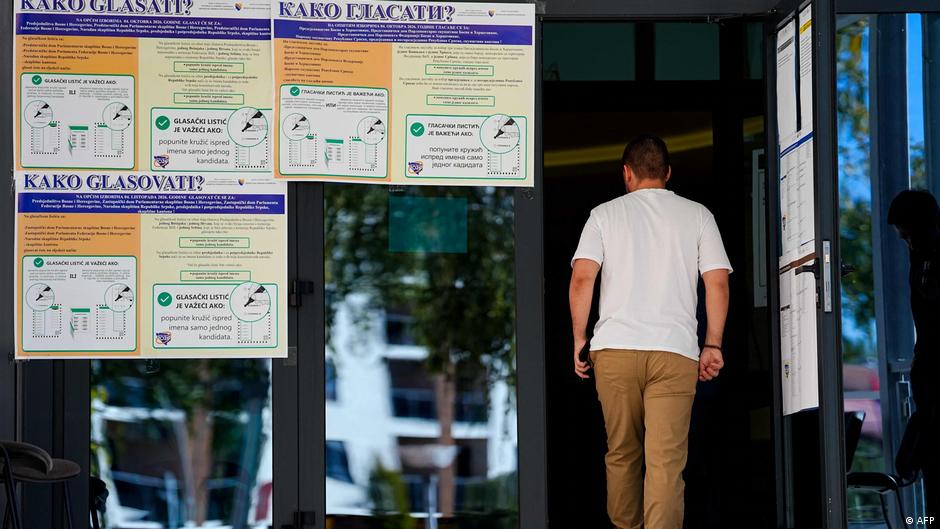
SARAJEVO, Bosnia-Herzegovina (AP) — Polls opened Sunday morning in Bosnia for a general election in which most citizens of the multi-ethnic Balkan nation are focused on everyday problems, while some mainstream politicians are whipping up war-era tensions that have kept the country divided since its brutal 1992-95 conflict.

Around 3.4 million voters in Bosnia are choosing the three members of the country’s multi-ethnic presidency, lawmakers for the national Parliament, and heads of institutions for the country’s two entities: the Muslim-majority Federation of Bosnia and Herzegovina, and Republika Srpska, which is dominated by ethnic Serbs.

Bosnia has a complex web of governing institutions that were created by a U.S.-brokered peace agreement in 1995 in an effort to manage the ethnic divisions between Muslim Bosniaks, Orthodox Serbs and Catholic Croats that gave rise to the war.

On Sunday morning, Associated Press journalists reported seeing multiple polling places where voting could not begin on time due to difficulties with new digital voting technology, a measure introduced to address earlier concerns over vote tampering.


Pro-Russian Dodik wields influence despite not being on ballot​

Taking center stage in the contest is a staunchly pro-Russian politician who, despite not appearing on the ballot, has dominated the campaign and inflamed divisions that have sparked fears of renewed instability.

Milorad Dodik, the separatist and nationalist former president of the Serb-majority Republika Srpska, has been banned from holding public office after being convicted of defying decisions by the international envoy overseeing the 1995 peace agreement.

Just back from a trip to Moscow where he met with Russian President Vladimir Putin, Dodik’s party, the Alliance of Independent Social Democrats, is likely to win the election in Republika Srpska.

At his party’s final election rally Friday night in Banja Luka, Republika Srpska’s administrative capital, Dodik told supporters that Bosnia “is dead.”


“It is an impossible country. It doesn’t make any sense,” Dodik said at the rally, which was also attended by the Russian ambassador to Bosnia and Herzegovina, Igor Khalabukov.

Dragan Bursac, an analyst, said despite Dodik not appearing on the ballot for the first time in nearly 30 years, he “is still in command. He is everywhere.”

“He is all over the media, not only in the entity of Republika Srpska, but in all of Bosnia and Herzegovina. It is obvious that these measures to ban him from political life are not working, and he is using them,” Bursac said.

Vote takes place as ethnic tensions rise​

While Bosnia has been peaceful in recent years, its politicians have kept alive the divisions between the country’s Bosniaks, who are mainly Muslim, and its Serbs and Croats. Bosnian Serb leaders like Dodik have pushed for the separation of their entity from the rest of Bosnia, which has led to concerns among Western countries that tensions could once again spill over.

One of the poorest countries in Europe, Bosnia is still struggling to recover decades after the war that started in 1992 after Bosnia declared independence from the Serb-led former Yugoslavia and ethnic Serbs took up arms to carve out their own state and join Serbia.


The conflict killed more than 100,000 people and displaced millions.

Bosnia is formally seeking to join the European Union, but progress toward membership has been stalled despite EU efforts to encourage Bosnia’s divided leaders to work together for reform.

Ahead of Election Day, Durak Miler, a resident of the Bosnian capital of Sarajevo, said governing politicians “just poison people when they talk.”

Ahead of Election Day, Durak Miler, a resident of the Bosnian capital of Sarajevo, said governing politicians “just poison people when they talk.”

“We should change the old faces,” he said. “They have been governing for 35 years ... I think whoever comes next will work better for retired people and the poor.”
The country’s wartime wounds were recently revived by a public homage in Serbia and among Bosnian Serbs to the wartime army commander Ratko Mladic, who died in late August while serving a life sentence for genocide and other war crimes.

Bosnian Serbs view Mladic as a hero despite his conviction by a U.N. court over the massacre of more than 8,000 Muslim men and boys in Srebrenica in 1995, and other atrocities.

Key Bosnian Serb officials attended the funeral service for Mladic in Belgrade that sparked harsh EU criticism and angered Bosniak politicians.

Electronic election security introduced​

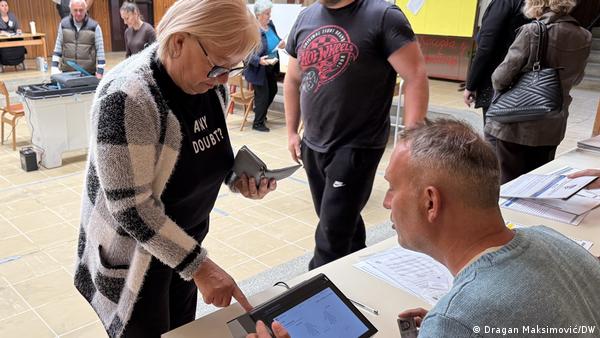
Authorities are for the first time using electronic identification of voters and ballot scanners to prevent irregularities or organized voter manipulation, which have cast doubt on the fairness of previous elections.

On Sunday, some voters in Banja Luka expressed concern that the new digital systems could confuse older voters. Republika Srpska’s interior ministry said in a press release that of 1,957 polling stations in the entity, there had been delays at 201.

But voter Radomir Vukelic said the experience of casting his ballot “was great.”

“This is why I expect the results to be correct. You’ve got a scanner, you’ve got a paper, you’ve got it all,” he said.

Most of Bosnia’s 75 political parties running in the election are organized along ethnic lines in the country’s Serb-controlled Republika Srpska and the Bosniak-Croat Federation of Bosnia-Herzegovina. The two entities are bound together by the central presidency and Parliament.

The Bosniak nationalist Party of Democratic Action has focused its campaign on efforts to keep Bosnia united against Serb separatism. Bosnian Croats, too, largely support their ethnic parties, including the Bosnian branch of Croatia’s ruling conservative Croatian Democratic Union.

Polls will close at 7 p.m. local time.

Many disillusioned citizens say politicians are using nationalism to avoid solving important problems such as poor living standards and an exodus of youth from the country.


Ivan Silic, from the southern town of Mostar, said ahead of the election: “I don’t see that anything is getting better, from the moment I started to vote.”

“We all know who lives well,” he said. “It is better for (politicians), and for the rest of us everything is the same.”
 

Latvia: PM's party wins biggest vote since independence​

Zac Crellin | Matt Ford with Reuters, dpa
Published 10/03/2026Published October 3, 2026last updated 17 minutes agolast updated 17 minutes ago
Latvia's prime minister, Andris Kulbergs, looks set to retain power after his party appeared to score the country's biggest election victory since independence.

Latvian Prime Minister Andris Kulbergs appeared set to remain in power on Sunday after his centrist United List secured 35.3% of the vote in the country's parliamentary election.

The result gives United List 42 of 100 seats and puts Kulbergs in a strong position to form another pro-Ukraine coalition.

What do the results show?​

With 97% of ballots counted, United List had secured the country's biggest parliamentary election victory since Latvia regained independence from the Soviet Union in 1991.

The party could secure a parliamentary majority with either the nationalist National Alliance or the left-leaning Progressives, political scientist Roberts Kits said.

Kulbergs, a 47-year-old businessman and amateur rally driver, only came to power in May after the previous coalition collapsed over its handling of incidents involving stray Ukrainian military drones.

Latvia vote shaped by Russia fears​

Russia's ongoing invasion of Ukraine is seen as a direct threat to national security in Latvia which, like Ukraine, is a former Soviet state with a sizeable ethnic Russian and Russian-speaking minority.

Unlike Ukraine, however, Latvia is a member of both the European Union and NATO.

Riga is one of Kyiv's closest partners and supporters, having committed itself by law to spending at least 5% of GDP on defense – leaving less room for spending elsewhere.

Many Latvians complain of high prices and low wages, the economy is sluggish, the health system is under strain, and emigration and an ageing population remain persistent challenges.

Populist movements such as the Sovereign Power/Young Latvians Alliance and the Latvia First party have attempted to exploit discontent by taking a less stringent line towards Moscow and arguing that a complete economic decoupling from Russia is damaging.

German Eurofighter jets in Latvian airspace​

Nevertheless, no parties proposed any major deviation from Latvia's clear foreign policy alignment with the EU and NATO.

Indeed, four German Eurofighter jets were deployed to protect Latvian airspace during the election in response to a request from Riga.
 
Drumcree impasse continues week after parade due to start
Updated / Sunday, 4 Oct 2026 08:39

People attend a community event in support of the Garvaghy Road residents
Rallies were held by both sides in the dispute yesterday
A standoff over the contentious Drumcree parade continues a week on from when the march was originally supposed to go ahead.

A major policing operation has been put in place for the weekend with both sides in the dispute organising rallies yesterday to bolster support, with positions entrenched in the run-up to a further legal challenge.

Northern Ireland's Parades Commission has given the green light for the Orange Order - backed by the DUP and TUV - to march through Garvaghy Road for the first time in 30 years.

Residents in the largely nationalist area around the road - backed by Sinn Féin, the SDLP and People Before Profit - are opposed to the parade, which was due to start last Sunday morning, and unsuccessfully fought the decision in court.

Several of the residents then protested by blocking the 35-man contingent of the Portadown District Orange Order from progressing through Garvaghy Road, resulting in the PSNI refusing to give the Orange Order the go-ahead to proceed.

Under parading laws in Northern Ireland, protests must be notified to, and approved by, the Parades Commission adjudication body.

Police have confirmed the protest was unnotified to the commission and therefore unlawful.

Several high-profile politicians, including Northern Ireland First Minister and Sinn Féin deputy leader Michelle O’Neill, participated in the unnotified protest.

Read More: Drumcree parade highlights divide in Northern Ireland

Now entering the eighth day of a standoff, the Orangemen have tried numerous times to begin the march but the road remains blocked by residents.

A fresh legal bid against the march is to be heard at the Court of Appeal in Belfast tomorrow, with lawyers for the Garvaghy Road Residents Coalition arguing that the Parades Commission had "materially misdirected itself" on the police assessment of the potential for disorder and had not given an "accurate representation of the evidence received from PSNI" in its decision.

From left to right stand mary lou mcdonald, breandan mac cionnaith, michelle o'neill and catherine nelson
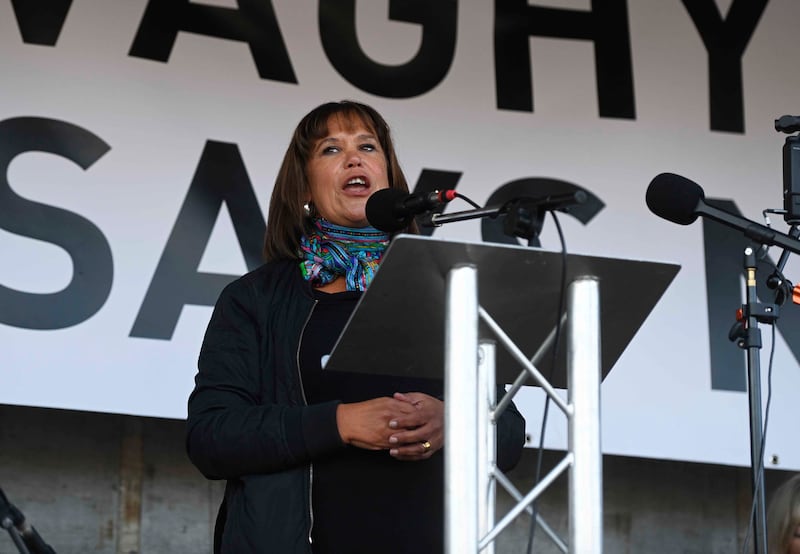
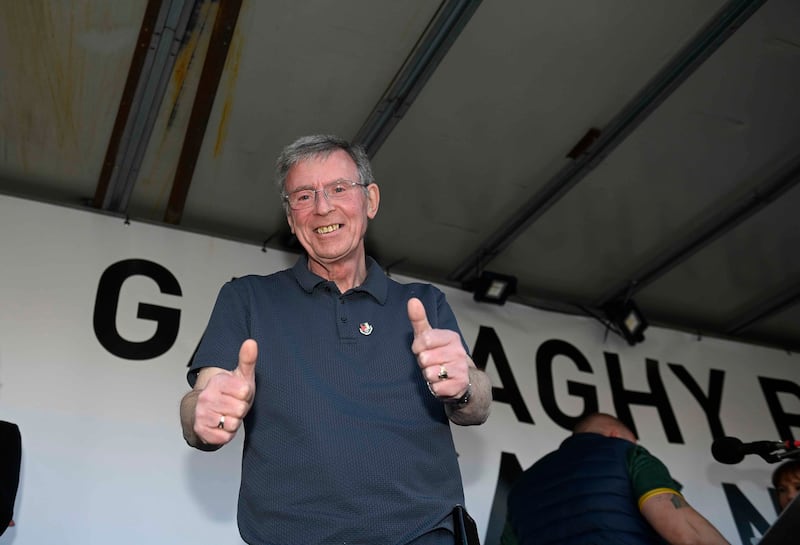
(L-R) Mary Lou McDonald, Breandan Mac Cionnaith, Michelle O'Neill and Catherine Nelson at the rally on the Garvaghay Road
Northern Ireland Secretary Chris Bryant appealed for calm in the run-up to the weekend, stating that he had "hope people can still find further compromise" despite chairing talks during the week which ended without agreement.

His description of the impasse as being between "a rock and a hard place" was described as "nonsense" by Ms O’Neill.

Speaking to reporters yesterday as thousands of people gathered in support of the residents, she said: "The Secretary of State is tone deaf to the needs of Garvaghy Road. He has a superficial understanding of the needs of this community and we’re not going to tolerate it."

Deputy First Minister and DUP MLA Emma Little-Pengelly described the rally as "electioneering" as she criticised Ms O'Neill and Sinn Féin for a "complete abdication of leadership".

Ulster Unionist Party leader Jon Burrows, a former senior police officer, also described the large-scale gathering as a "carnival of law-breaking and triumphalism" as well as a "serious failure of political leadership" by Sinn Féin.

Mr Bryant, who chaired talks with both sides during the week which were unsuccessful at reaching an agreement, said a prolonged stand-off in Portadown is "ultimately in nobody’s interests".

He appealed for the public to ignore "unhelpful" calls for more people to come to the area "at this time of tension", as he said he was working to find a "mutually acceptable solution".

Ms O'Neill said the right outcome "includes no march down this road" as Sinn Féin called on Mr Bryant to use his powers to prohibit the march.

However, at a rival gathering at the loyalist Edgarstown Estate, backers of the Orangemen argued that the permission for the parade is still live and needs to go ahead.

Portadown District master Nigel Dawson said: "We’re still waiting for the chief constable to do his job and put the parade down the road as per our legal determination and backed up by a High Court judge."

Mr Boutcher and the British government were criticised by several speakers at the 'Let Them Home' community gathering, including loyalist activist and legal adviser to the Orangemen, Jamie Bryson, and TUV leader Jim Allister.

People at the Let Them Home Festival in Edgarstown Estate, Portadown
People gathered for a 'Let them Home' rally in Portadown
Both men argued that either the parade should be allowed to go ahead or the Northern Ireland Executive should be collapsed.

Mr Allister said there was a "fundamental challenge to political unionism" and particularly the DUP, stating: "It is either the Portadown Orangemen come home or the Executive is gone."

The TUV leader also accused the chief constable of a "gross abdication of duty" over not allowing the parade to go ahead thus far, adding that the NI Secretary is "dithering and doesn’t want to do his job".

DUP Upper Bann MP Carla Lockhart, whose party is in power-sharing with Sinn Féin in the Executive, told the gathering: "We stand in Northern Ireland at a crossroads for the PSNI and the British government.

"They either accept mob rule or the rule of law - and I can tell you now if mob rule wins there’s no going back for the chief constable."

After the rally in support of the residents yesterday, PSNI Assistant Chief Constable Anthony McNally said anyone blocking the Garvaghy Road will still be treated as "participating in an unnotified and therefore illegal protest".

He said evidence gathering remains ongoing and anyone found to have broken the law "will face criminal justice consequences".

Mr Bryson previously said Orangemen will accept the determination of the courts tomorrow, challenging Garvaghy Road residents to do the same.

In a speech yesterday, Breandán Mac Cionnaith, of the Garvaghy Road Residents’ Coalition, said there was "no logical reason" why the Orange march should proceed "through the heart of this community", contending an alternative route "back the way they came" was available.

"Garvaghy Road was solved in 1998, it does not need to be solved again."

Mr Mac Cionnaith said: "Westminster thinks we must make concessions - we have nothing left to concede."

He added: "Only one decision that’ll be acceptable: There should be no Orange march - none at all."
 

Thousands attend rallies as Drumcree stand-off enters seventh day​

‘There will be no Orange march down this road, not now and not ever,’ Mary Lou McDonald tells Garvaghy Road rally​

Expand
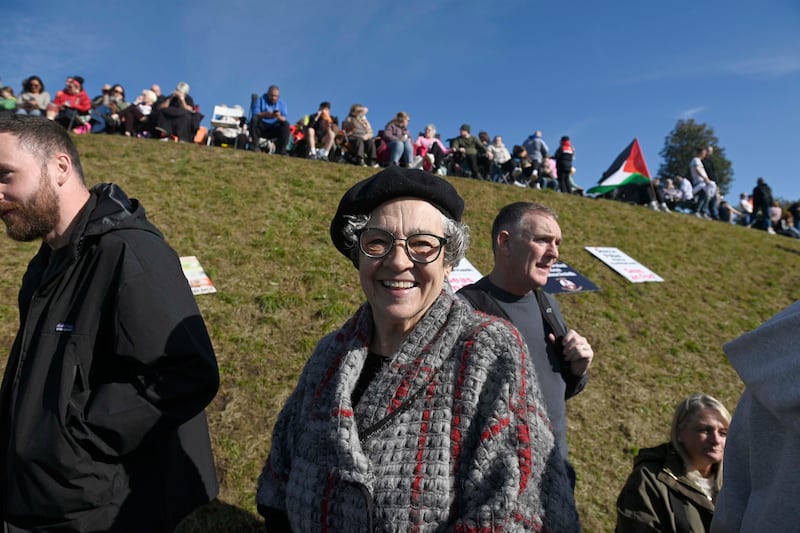
Thousands of people attended a rally in support of the Garvaghy Road residents on Saturday. Photo: Mark Marlow/PA Wire

Thousands of people attended a rally in support of the Garvaghy Road residents on Saturday. Photo: Mark Marlow/PA Wire
Órla Ryan
Sat Oct 03 2026 - 17:03•4 MIN READ

Thousands of people attended rallies related to the Drumcree dispute in Portadown, Co Armagh on Saturday as a stand-off between the Orange Order and Garvaghy Road residents entered its seventh day.

A large crowd gathered at a demonstration in support of residents.

View: https://x.com/sinnfeinireland/status/2106392423735902229?ref_


First Minister Michelle O’Neill, Sinn Féin leader Mary Lou McDonald and former party leader Gerry Adams were among those in attendance.

There will be no Orange march down this road, not now and not ever, Sinn Féin leader Mary Lou McDonald told the Garvaghy Road rally. Photo: Mark Marlow/PA Wire

"There will be no Orange march down this road, not now and not ever," Sinn Féin leader Mary Lou McDonald told the Garvaghy Road rally. Photo: Mark Marlow/PA Wire

“I thank you on behalf of people everywhere for having the courage to make this stand,” McDonald told the crowd.

“You make a difference for us all, and we shall overcome. And there will be no Orange march down this road, not now and not ever.”

Breandán Mac Cionnaith, chairperson of the Garvaghy Road residents’ coalition, addressed the crowd on Saturday. Photo: Mark Marlow/PA Wire

Breandán Mac Cionnaith, chairperson of the Garvaghy Road residents’ coalition, addressed the crowd on Saturday. Photo: Mark Marlow/PA Wire

Breandán Mac Cionnaith, chairperson of the Garvaghy Road residents’ coalition, also addressed the crowd.

“There’s only one decision that will be acceptable to the men, women and children in this community, and that is that there should be no Orange march, none at all,” he said.

The impasse has been ongoing since the Parades Commission gave the green light for the first time in almost 30 years for the Portadown District of the unionist Orange Order to complete its traditional route along the Garvaghy Road.

Marches in Drumcree in the 1990s were often linked to violence, with 21 deaths related to the standoff.

A coalition of residents in the largely nationalist Garvaghy Road area is opposed to the march going ahead this year and took legal action, which failed, before starting a protest to prevent the parade from taking place.

A fresh legal appeal by the residents is set to be heard in the Court of Appeal on Monday.

[ From local row to peace-process shambles: How the Drumcree standoff developedOpens in new window ]

The Police Service of Northern Ireland (PSNI) said a major public safety operation will continue in Portadown over the weekend.

Secretary of State for Northern Ireland Chris Bryant said he would “especially urge calm this weekend”.


Bryant said a prolonged standoff in Portadown is “ultimately in nobody’s interests”.

“I have been working with all those involved to find a mutually acceptable solution,” he said in a post on social media.

“I’m grateful to all those who have been and are engaging in dialogue. This is a crucial time for Northern Ireland and I hope people can still find further compromise.

“Leadership is never easy at moments like this but I commend all those who are trying to get to a solution.”

Bryant, who chaired talks with both sides during the week that were unsuccessful in reaching an agreement, said his door remains open for further engagement.

Sinn Féin politicians had been encouraging people from across the island to attend the demonstration on Garvaghy Road, which has been dubbed the “No Going Back” rally.

People attending a community event in support of the Garvaghy Road residents on Saturday. Photo: Mark Marlow/PA Wire

People attending a community event in support of the Garvaghy Road residents on Saturday. Photo: Mark Marlow/PA Wire
A crowd also gathered in the Edgarstown area in support of the Orange Order.

Portadown District master Nigel Dawson told the Press Association: “We’re still waiting for the Chief Constable to do his job and put the parade down the road as per our legal determination and backed up by a high court judge.”

Jamie Bryson, a loyalist activist and legal adviser to Portadown District Orangemen, was among speakers who criticised Chief Constable Jon Boutcher’s handling of the dispute.

“If you can’t police Northern Ireland, wave the white flag and say it – stop dancing around it,” he said. “If you wave the white flag, that’s not our problem. We won, we have the legal entitlement [to march down Garvaghy Road].”

Bryson and TUV leader Jim Allister argued that either the parade should be allowed to go ahead or the Northern Ireland Executive should be collapsed.


Allister said there was a “fundamental challenge to political unionism” and particularly the DUP, stating: “It is either the Portadown Orangemen come home or the Executive is gone.”

Dawson also criticised the police road management around the Garvaghy Road demonstration. Ulster Unionist Party leader Jon Burrows described that gathering as a “carnival of law-breaking and triumphalism” as well as a “serious failure of political leadership” by Sinn Féin.

He added: “The law applies to everyone, from the First Minister down.”

The Portadown district of the Orange Order released a statement on Saturday clarifying reports that John Larkin, Northern Ireland’s former attorney general, had withdrawn from its legal team.

“Mr Larkin KC was not available for the listed hearing date which necessitated a replacement to step in for that upcoming hearing ... There is no grand conspiracy.”
Nigel Dawson, district master of the Orange Order in Portadown, (left) and Jamie Bryson, legal advisor to the Orange Order, outside Drumcree Church on Friday. Photo: Mark Marlow/PA Wire
Nigel Dawson, district master of the Orange Order in Portadown, (left) and Jamie Bryson, legal advisor to the Orange Order, outside Drumcree Church on Friday. Photo: Mark Marlow/PA Wire

The statement said the legal firm changed after informing the court that “they and their staff have felt threatened and they couldn’t safely continue”.


“Our junior barrister in the case has also been threatened and has required police protection. She has refused to be bullied and remains in place.”

Jamie Bryson, who is a legal adviser to the district, has also been threatened but remains on the case, the statement added.

“We look forward to Monday’s Court of Appeal case, and once again urge everyone to abide by the law.”

[ ‘It’s like going back in time’ – after 28 years, communities stand off on Garvaghy RoadOpens in new window ]

Minister for Foreign Affairs Helen McEntee said she was “keenly aware of the strain that the events of the past week place on the communities most directly impacted and indeed on the PSNI”.

“I want to acknowledge and commend all those who are working hard to ensure the situation remains peaceful and that everyone remains safe,” she said in a statement.

McEntee added that she was “in close contact” with Bryant on the matter.

– Additional reporting from PA

(More tweets at the link.)
 
Here's my proposal to settle this thing in Northern Ireland. Both sides get a win. The parade is not permitted to go forward and some political people who allowed it in the first place, lose their positions. Is such a thing possible?

From across the pond, both sides seem to be standing on principle. The photos of the ordinary people don't look like angry mobs. Yet.

I hope that the court doesn't tie things up so bad that anger becomes dominant.
 

France: A Sick Country on a Sick Continent​

by Guy Millière
The Gatestone Institute
October 4, 2026 at 5:00 am

"The French Left has waged war on schools while building an alliance with Islamist leaders who hope to radically transform them. For both, the fight starts with the schools. 'Clearly, religious and politico-religious organizations "work on" these pupils, sometimes from primary school, as well as their family, their social milieu and their neighborhood, and some try to set them against the school,' the Education Ministry inspectorate's June 2004 report on religion in schools said." — Michael Shellenberger, October 2, 2026.
  • "What brings Islamists and the revolutionary left together is their intention to tear down Western civilization. The French Interior Ministry's May 2025 report on the Muslim Brotherhood described the movement's project in France as 'a long process of political conquest' with 'systematically priority investment at the local level.'" — Michael Shellenberger, October 2, 2026.
  • [W]hen thousands of French citizens said they could no longer afford both the fuel to travel to work and the food to feed their families, [French President Emmanuel] Macron replied that while some people might struggle with money, he must take care of something more important: "the risk of facing the end of the world".
  • Deindustrialization continues full-on. Punitive regulations have caused factories to close. They are replaced not by other businesses but by an increasingly costly welfare system, which now accounts for more than 40% of total public spending.
  • uccessive French governments have pumped up spending without restraint.... This enormous difference means that the French government continues to spend far more than it raises in revenue.... Interest payments on the debt have been devouring an increasingly large share of the country's annual budget and, as in the United States, now exceed the national defense budget. The difference is that the US may still be able to grow its way out of such a hole -- $40 trillion, with interest at $7.1 billion a day -- whereas France, crushed by overregulation, cannot.
  • On another front, while Macron, in 2020, denounced "Islamist separatism," he has done nothing to prevent, or even slow down, the Islamist conquest of France. For a decade, the full-powered Islamization of the country has stormed on. Millions of people from the Muslim world have settled in France, both legally and illegally.
  • Most Muslims in France do not assimilate, and a growing proportion -- roughly 38% -- place Islamic sharia law above the laws of the Republic....
  • No-go zones, where radical imams and Muslim gangs hold sway, have grown since 2016. They now featured in the suburbs of the major cities of France. Muslim gang members raid and go looting several times a year,
  • In recent years, Macron has also been increasingly targeting freedom of expression, making use of Arcom — an institution he created in 2022 to regulate and control French audiovisual media — to do so.... CNews was fined twice in 2026: once because a guest stated that anthropogenic global warming does not exist; another time because a guest stated that "history shows that Islam is still a religion of conquest."
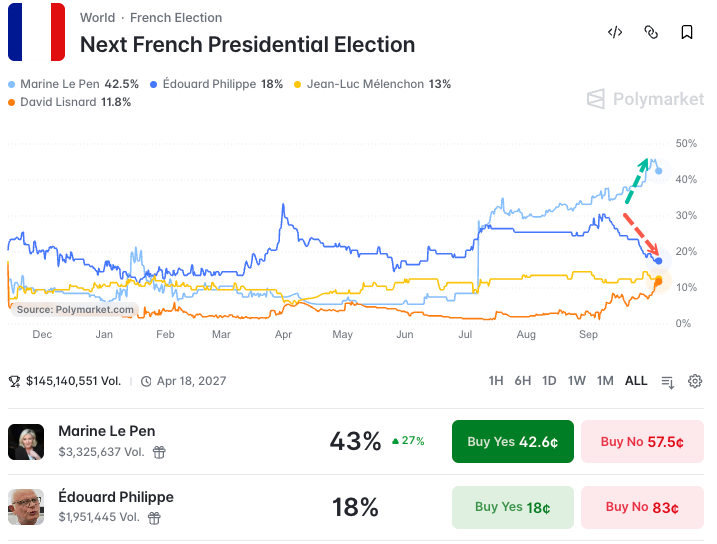
  • Macron might want a successor who would continue his programs, such as they are, but that does not seem about to happen. Marine Le Pen, for the first time in her political career, leads in polls, which indicate that in 2027 she could win.... All of her legal troubles, however, appear to have had no effect on her voters, who appear to understand that justice in France has now been politicized.
  • If Le Pen is elected president in the spring, the shockwaves will be heard across Europe. A Le Pen presidency would mean a victory for a political party that champions Western civilizational values — a party that every incumbent leader in Western Europe -- except Italy's Giorgia Meloni — seeks to keep out of power by any means necessary.
  • The situation in France differs little from the general situation in Western Europe.
  • Many other Europeans are just as dissatisfied with their leaders as are the French. They all see the economic destruction, the ongoing Islamization of their countries, the threat from China to undercut their automobile industries, and the growing impossibility of discussing certain subjects without being demonized or put on trial.
  • Many Europeans see Islamization gaining ground in their countries and enjoying support from Marxists: each thinks the other will bring it to power. They see their leaders doing nothing to remedy a situation that has become increasingly alarming. They appear to prefer having their Western civilization protected and saved.
"Who didn't see that coming? Oh yeah ....the politicians," noted "The Great Gats" on X.

The French government was reportedly "taken by surprise" when students began rioting roughly two weeks ago to protest conditions — overcrowded classes, dilapidated buildings, vermin and rats, lack of heating and air-conditioning, shortage of teachers — in their schools.

"But," American journalist Michael Shellenberger writes, " French schools have more money per pupil today than at any earlier time.... The French government spends 4.5% of gross domestic product on educational institutions, and Germany spends 3.7%.

The violent riots, which started on Paris's Ile de France and spread throughout the country, appear, according to investigations, to have been instigated by the French political party La France Insoumise (France Unbowed) headed by Jean Luc Melenchon, a far-left candidate in the French presidential elections scheduled for the spring of 2027. La France Insoumise denies the charges; however, according to Shellenberger, "the evidence clearly shows that La France insoumise (LFI)... instigated and led the protests."

"The protest had 'the involvement from the start of elected officials of La France insoumise and ultra-left collectives,' an anonymous security official told Le Point. A readout of the prime minister's October 1 crisis meeting, given to Reuters by a person close to him, described the movement as 'an operation organised by LFI (France Unbowed) and its proxies on the far left' in the 'shared assessment' of the intelligence services....

"'Parents, Insoumis [party] activists, mobilize to interpose yourselves against police savagery,' said Mélenchon, blaming the police, not the students, for the violence....

"In Marseille, hundreds of young people forced firefighters to flee their truck outside a lycée and then set it alight. In Paris, about ten protesters chased a trainee police lieutenant, threw her to the ground and kicked her amid cries of 'Kill her!....'

"'We're not entirely sure that they are even high-school students themselves,' said the French Justice Minister of the people arrested...."

"The French Left has waged war on schools while building an alliance with Islamist leaders who hope to radically transform them. For both, the fight starts with the schools. 'Clearly, religious and politico-religious organizations "work on" these pupils, sometimes from primary school, as well as their family, their social milieu and their neighborhood, and some try to set them against the school,' the Education Ministry inspectorate's June 2004 report on religion in schools said.

"What brings Islamists and the revolutionary left together is their intention to tear down Western civilization. The French Interior Ministry's May 2025 report on the Muslim Brotherhood described the movement's project in France as 'a long process of political conquest' with 'systematically priority investment at the local level.'

"The children of Muslim immigrants are often more radical than their parents. 'There is first of all a generational revolt,' wrote Olivier Roy, a French scholar of Islam, in 2015 of French jihadists...."

"LFI openly courts Muslim voters, and a parliamentary inquiry said that made it a target for Islamist networks....

"'LFI's commitment to a clientelist strategy toward the Muslim electorate may have made this movement a privileged target,' said Matthieu Bloch, rapporteur of a National Assembly inquiry into parties and Islamist networks, in December 2025....

"Polls 'all show [Mélenchon] losing massively in a run-off against Le Pen,' noted the BBC."
So far, around 2,000 students have been arrested and more than 1,000 schools affected. The violence has included "schools set on fire and teachers beaten and doused in petrol."

French President Emmanuel Macron, who is serving his second term of office and cannot run again, is ending his presidency facing widespread rejection from the public. According to a recent poll, only 21% support his policies, although up from 19% a few months ago.

Macron's numbers are not surprising. He has repeatedly shown contempt for the poorest members of French society.

A few weeks into his first term, which began in May 2017, he spoke of "those who made it" and "those who are nothing." Less than a year and a half later, in November 2018, while citing anthropogenic climate change, he raised France's already exorbitant gasoline taxes, a move that immediately triggered the "Yellow Vests" movement, when thousands of French citizens said they could no longer afford both the fuel to travel to work and the food to feed their families. Macron replied that while some people might struggle with money, he must take care of something more important: "the risk of facing the end of the world".

The Yellow Vests movement lasted more than a year — subsiding only in January 2020 with the onset of the COVID-19 pandemic. Throughout, Macron remained contemptuous, responding to the grievances of nonviolent protestors with police crackdowns inflicting deaths and mutilations. Meanwhile, he permitted left-wing agitators who had infiltrated the movement to riot and commit arson without asking the police to intervene. Many in France saw that Macron could be pitiless toward people expressing their distress, but lenient toward criminals so long as they were of his preferred political bent.

During the pandemic, Macron initiated some of the most authoritarian measures in Europe. The French were ordered to stay indoors and leave their homes for only one hour a day — within a half-mile radius — provided they filled out a form stating their name, address, and time of departure. The police, omnipresent, arrested thousands and fined them heavily simply for venturing slightly beyond the permitted distance or lingering a bit longer than one hour. All conversations outdoors were strictly prohibited.

The Macron years were additionally marked by a profound economic decline in France and a severe drop in the standard of living. For the past decade, France's per capita wealth has fallen below the EU average and now trails behind that of Cyprus. Ten years ago, in 2016, France's GDP per capita was globally ranked at 23; today, it ranks at 33. The unemployment rate, now at 8.3% , is increasing. For people between the ages of 15 and 24, it is an extremely high 21.1%.

Deindustrialization continues full-on. Punitive regulations have caused factories to close. They are replaced not by other businesses but by an increasingly costly welfare system, which now accounts for more than 40% of total public spending. In 2025, the poverty rate in France climbed to 15.4%, representing 9.8 million people living below 60% of the national median income and struggling every month just to meet their basic needs.

At the same time, successive French governments have pumped up spending without restraint. While the GDP growth in France from 2016 through 2026 was 13.17% in total, the increase in public spending in the same period was 35.6%. This enormous difference means that the government continues to spend far more than it raises in revenue. The national debt, which has grown continuously, reached 117.5% of GDP in January 2026, and will reach 119.3% by the end of the year. Interest payments on the debt have been devouring an increasingly large share of the country's annual budget and, as in the United States, now exceed the national defense budget. The difference is that the US may still be able to grow its way out of such a hole -- $40 trillion, with interest at $7.1 billion a day -- whereas France, crushed by overregulation, cannot.
 
Last edited:
Part 2

On another front, while Macron, in 2020, denounced "Islamist separatism," he has done nothing to prevent, or even slow down, the Islamist conquest of France. For a decade, the full-powered Islamization of the country has stormed on. Millions of people from the Muslim world have settled in France, both legally and illegally. Around 2016, the approximate number of Muslim citizens and foreign Muslims living in France was 5.7 million (8.8%); now, officially, it is estimated at possibly 7 million out of a population of roughly 67 million, but the real figures are undoubtedly higher. Most Muslims in France do not assimilate, and a growing proportion -- roughly 38% -- place Islamic sharia law above the laws of the Republic (the figure is higher among Muslims aged 15 to 24: 57%).

Laws against illegal immigration are not enforced. Every year, only 7% of illegal aliens in France who were notified by the police to leave -- by the OQTF (Obligation to Leave French Territory) -- are expelled. This laxity means that more than 93% remain in the country. Many are criminals. Some of the most sickening murders in France during the Macron years have been committed by illegal aliens who had ignored their OQTF. Lola Daviet, age 12, for instance, was raped, tortured, and murdered in a Paris apartment by an Algerian thief and occasional prostitute, Dahbia Benkired. On August 21, 2022, Benkired had been arrested, issued an OQTF, and then released. Two months later, on October 14, she murdered the child.

No-go zones, where radical imams and Muslim gangs hold sway, have grown since 2016. They now featured in the suburbs of the major cities of France. Muslim gang members raid and go looting several times a year, especially when there is sports match with a French soccer team, and recently during the 2025 World Cup. The police have orders to intervene only minimally. If they hurt or kill a Muslim criminal, they have seen that their careers and lives can be destroyed. On June 27, 2023, Nahel Merzouk, a young Muslim criminal, refused to obey to a police officer, who then shot him by accident. Riots, which erupted all over the country, only began to calm when the police officer, Florian M., was placed in pre-trial custody and charged with first-degree murder. He now faces up to 20 years in prison.

"Right-wing" anti-Semitism has largely vanished, and it has been replaced by an exceptionally venomous Islamic and left-wing anti-Semitism.

After Hamas's October 7, 2023 massacre in Israel, Islamic and leftist protests in support of Hamas and "Palestinian resistance" were organized within days. La France Insoumise described the October 7 massacre as an "armed offensive by Palestinian forces" without ever mentioning that Hamas is a terrorist movement. One of the leaders of LFI, Rima Hassan, a French citizen, defines herself as "French-Palestinian", not French. She constantly falsely accuses Israel of "genocide" and claims that that "Hamas's actions are legitimate."

The massive surge of antisemitic assaults, threats, and insults has lasted until today.

In recent years, Macron has also been increasingly targeting freedom of expression, making use of Arcom — an institution he created in 2022 to regulate and control French audiovisual media — to do so. In 2025, Arcom shut down the television channel C8: the stated reason was a "lack of pluralism," and that too many conservatives had been invited to speak. On June 15, 2026, another television channel, CNews, received a formal notice from Arcom, also accusing it of a "lack of pluralism". CNews could soon shut down as well. It is the last major television channel in France that still invites right-of-center commentators whom other channels no longer invite. CNews was fined twice in 2026: once because a guest stated that anthropogenic global warming does not exist; another time because a guest stated that "history shows that Islam is still a religion of conquest."

In December 2025, France requested that two commentators — Jacques Baud and Xavier Moreau — be sanctioned by the European Union for their "pro-Russian remarks." Their bank accounts and assets within the EU were frozen, and their credit cards cancelled. They are no longer permitted to travel within the EU. Any financial assistance provided to them by anyone would be subject to sanctions. These measures are extrajudicial, but there is no avenue of appeal or recourse.

In May 2024, Macron's political party, Renaissance, lost the European Parliament elections. While France's main right-wing party, Rassemblement National (National Rally), received 31.37% of the vote, Macron's received only 14.6%. He spoke angrily about the result, dissolved the National Assembly and called for snap legislative elections. In the first round, the National Rally received more than 33% of the votes and was about to win a majority of the seats in the second round. Macron quickly created an alliance of all other political parties aimed at defeating the National Rally. He spoke of a "republican front," and implied that the National Rally is a danger to the republic. Voters supporting centrist or moderate-right candidates were encouraged to vote for a left-wing candidate if that candidate was best positioned to win. Voters supporting left-wing candidates were encouraged to vote for a centrist or moderate-right for the same reason. The result was that the National Rally secured the largest share of votes, but the "republican front" parties received the largest number of seats in the National Assembly, which was fragmented into multiple parties, none of which could form a coherent majority. Since then, the country has had several powerless governments, and no important decisions could be made. Macron made the country ungovernable.
 
Last edited:
Part 3

Macron might want a successor who would continue his programs, such as they are, but that does not seem about to happen. Marine Le Pen, for the first time in her political career, leads in polls, which indicate that in 2027 she could win. Other candidates belong to parties that are now associated with the disaster into which France has plunged.

Le Pen was even prosecuted for allegedly allowing parliamentary assistants of Members of the European Parliament (MEPs) from her party to work in Paris for the MEPs who employed them. When centrist candidate François Bayrou and left-leaning Jean-Luc Mélenchon were accused of the same offense, the charges against both were dropped. Not for Le Pen. On March 31, 2025, she was sentenced to four years in prison and a five-year ban from holding public office, presumably to prevent her from becoming a candidate.

After she appealed the verdict, on July 7, 2026, her sentence was reduced to three years in prison -- one year of which was to be served under house arrest, wearing an electronic monitoring tag -- and a 45-month ban from holding public office, 30 months of which were suspended. The new ruling enables her to run for office. She has lodged an appeal with France's highest court and execution of the judgment has been suspended. She will not have to wear the monitoring tag during the election campaign. The court is scheduled to issue its ruling on her appeal before the election and could reverse its decision. Le Pen would then be required to wear a monitoring tag during the final days of her campaign and, should she be elected, at the Élysée Palace upon taking office.

All of her legal troubles, however, appear to have had no effect on her voters, who appear to understand that justice in France has now been politicized.

If Le Pen is elected president in the spring, the shockwaves will be heard across Europe. A Le Pen presidency would mean a victory for a political party that champions Western civilizational values — a party that every incumbent leader in Western Europe -- except Italy's Giorgia Meloni — seeks to keep out of power by any means necessary.

The economic, financial and social situation Le Pen would face in the event of her victory would be harsh. All available data indicate that France is almost bankrupt at almost every level. A recovery will be highly complex and difficult.

Most leaders of LFI have already declared that they would refuse to accept a Le Pen victory: if she wins, they would call for an insurrection. Several political analysts think that in such an event, widespread riots involving leftist groups and Islamist gangs might break out across the country.

Several other French politicians attempting to stoke panic will do so with increasing intensity right up until the election. It is not at all certain that these obstructions would be enough to defeat Le Pen.

A recent poll commissioned by the center-right Foundation for Political Innovation shows that 78% of voters believe that "the French way of life, its traditions, and its lifestyle habits are under threat." Available data indicate that, unfortunately, this is true. Another recent poll shows that 85% of voters think France is in decline. They are quite right. France is in sharp decline and large majority of the French see it.

The situation in France differs little from the general situation elsewhere in Western Europe. The policies pursued in most other Western European countries do not fundamentally differ from those adopted by Macron -- and lead to the same results.

Many other Europeans are just as dissatisfied with their leaders as are the French. They all see the economic destruction, the ongoing Islamization of their countries, the threat from China to undercut their automobile industries, and the growing impossibility of discussing certain subjects without being demonized or put on trial.

Many Europeans see Islamization gaining ground in their countries and enjoying support from Marxists: each thinks the other will bring it to power. They see their leaders doing nothing to remedy a situation that has become increasingly alarming. They appear to prefer having their Western civilization protected and saved.

Political parties in Western Europe with platforms close to that of Le Pen's National Rally, such as Germany's Alternative für Deutschland (AfD), are gaining momentum despite attempts by leaders in power and the media to demonize them.

On September 6, 2026, in a state-level election in Germany's Saxony-Anhalt, the AfD won 43.8% of the vote -- twice as much as five years earlier. In May 2025, German Chancellor Friedrich Merz came to power at the head of a grand coalition united solely by the desire to halt the rise of the AfD. His coalition did nothing to combat Germany's deep industrial slowdown and the growing non-integration of Muslims living in the country. The situation is now worse. Merz is currently more unpopular in Germany than Macron is in France (only 14% of Germans consider him worthy of holding the office of Chancellor). The AfD is now the most popular party nationwide in Germany. A recent poll puts its support at a record 30%.

In the UK, in May 2026, the Reform Party won many local and municipal elections, inflicting heavy defeats on both the ruling Labour Party and the Conservative Party. Recent polls indicate that if an election for Parliament were held today, it would secure the highest number of seats.

A political groundswell in Western Europe is taking shape. Most mainstream media commentators dismissively label it "populist."

"What they call populism," wrote Éric Zemmour, former columnist and president of the right-wing Reconquest party, "is the cry of people who do not want to die."

Dr. Guy Millière, a professor at the University of Paris, is the author of 27 books on France and Europe.

 
Last edited:

Spanish PM Sanchez calls snap election as pressure mounts over housing crisis​

Europe
Spanish Prime Minister Pedro Sanchez on Monday called an early election ‌for ‌November 29. Facing the electorate now could be risky, as Sanchez's Socialist Party is trailing in opinion polls.
Issued on: 05/10/2026 - 09:18Modified: 05/10/2026 - 09:31

2 minReading time
Share
By:
FRANCE 24


Spanish Prime Minister Pedro Sanchez said Monday he would call an early election on November 29, after parliament rejected housing relief measures proposed by his government.


"To do more, we need to renew and broaden the support of the people," Sanchez, in office since 2018, said in a televised address, adding his aim was "to secure a much broader, progressive majority in parliament".

In recent weeks, Spanish residents have demanded solutions from the government over housing affordability, holding protests in cities across the country after public outrage grew over the televised eviction of an 87-year-old woman in Madrid last month.

Right-wing opposition parties joined forces to scuttle two emergency decrees in Parliament that included measures to reduce evictions and real estate speculation.

The setback sparked wide speculation that Sanchez could consider moving up a national election from next year.

Sanchez has been Spain’s prime minister since 2018, making him one of Europe’s longest-standing leaders.

Sanchez has stood out globally for taking a strong stance on progressive issues from Palestinian statehood to defending multilateral institutions and cracking down on "tech oligarchs", even as a series of setbacks and scandals weakened his position at home.

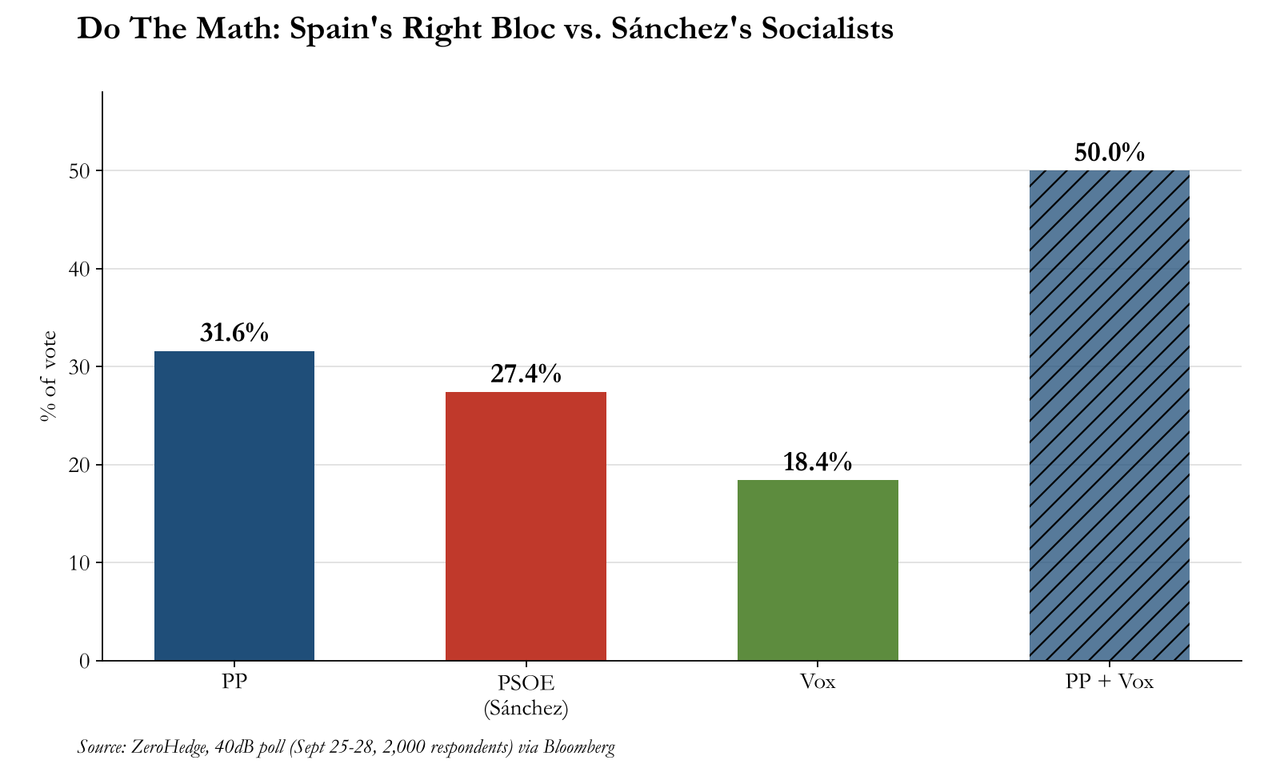
Facing the electorate now is a risky move as Sanchez's Socialist Party is trailing in opinion polls.

An election defeat would spell the end of one of Europe's last few left-leaning governments at ⁠a time when the far-right is making unprecedented gains across the region as a growing swathe of European voters desert the centre ground.

Opinion polls suggest a coalition led by the conservative People's Party (PP) with the support of Vox ‌is the most likely outcome in Spain, ushering a far-right party into central government for the first time since the return of ⁠democracy after the death of dictator Francisco Franco.

Still, Sanchez, a wily political operator, has proven time and again his ability to surprise those who had long written him off.

Despite never winning enough votes to form a majority government, he has cobbled together a series of fragile and seemingly impossible coalitions including voices from the far-left to the separatist right to remain in power for three successive terms lasting eight ‌years.


But growing fragmentation among his partners has meant the government has passed little in the way of legislation in its third term and failed to pass a budget since 2023, even as Spain's economy has continued to be one of the best performing in the developed world.

(FRANCE 24 with AP, AFP and Reuters)
 

Serb separatist Dodik declares victory in Bosnia vote as ethnic tensions and EU hopes collide​


By ELDAR EMRIC
Updated 4:54 PM EDT, October 4, 2026
Leer en español
4
​
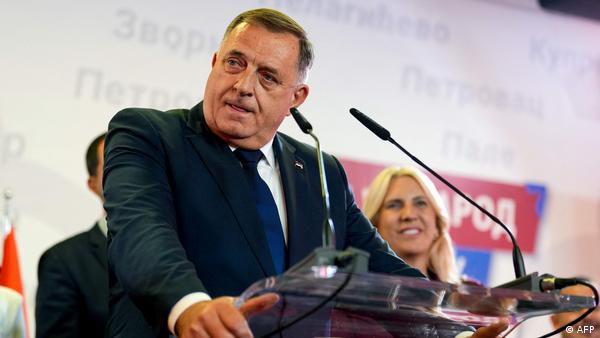
SARAJEVO, Bosnia-Herzegovina (AP) — Bosnian Serb nationalist politician Milorad Dodik has declared victory for his party in an election in Bosnia on Sunday that was shaped by economic pressures, the prospect of the Balkan nation joining the European Union, and ethnic tensions that have divided the country since its brutal 1992-95 war.

Dodik is a staunchly pro-Russia politician who, despite not appearing on the ballot, has dominated the campaign and inflamed divisions with separatist rhetoric that have sparked fears of renewed instability in Bosnia.

Formerly the president of the country’s Serb-majority entity of Republika Srpska, Dodik was banned from holding public office after being convicted last year of defying decisions by the international envoy overseeing the 1995 peace agreement that ended the war.

With nearly 90% of votes counted, Dodik’s ally Zeljka Cvijanovic of the right-wing Alliance of Independent Social Democrats had more than 55% of votes to take one of the three seats in the country’s tripartite presidency, leading her nearest opponent by around 30 percentage points.

Speaking at a news conference late Sunday, Dodik said his nationalist party would also hold a “vast majority” in Republika Srpska’s assembly, and credited U.S. President Donald Trump’s “magnificent victory” in 2024 and Russian President Vladimir Putin’s support for the election win.

“No one should ask us to change our politics,” Dodik said. “We will not give up, but continue for our people ... I cannot believe that we smashed it like this.”


Election marked by low turnout​

Around 3.4 million voters were eligible to choose the three members of the country’s multi-ethnic presidency, lawmakers for the national parliament, and heads of institutions for the country’s two entities: the Muslim-majority Federation of Bosnia-Herzegovina, and Republika Srpska, which is dominated by ethnic Serbs.

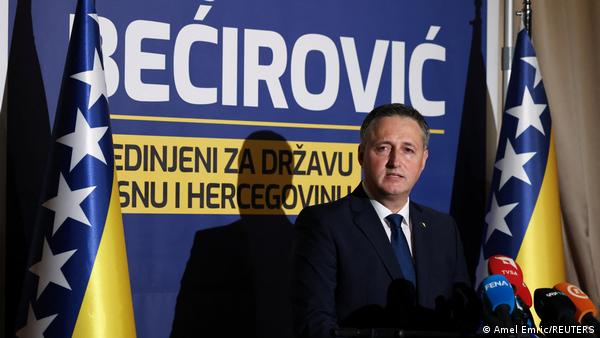
With over 94% of votes counted on Sunday, Darijana Filipovic of the nationalist Croatian Democratic Union of Bosnia and Herzegovina held a commanding lead for the Croat seat on the presidency, while incumbent Bosniak member of the presidency Denis Becirovic of the Social Democratic Party led his nearest opponent, Bakir Izetbegovic, by fewer than three percentage points.

Both Filipovic and Becirovic declared victory in their races late Sunday before all votes were counted.


Bosnia’s Central Election Commission said that 1,432,269 votes were cast in total, a turnout of 42% that was down by around 8% from Bosnia’s last election in 2022.

Bosnia has a complex web of governing institutions that were created by a U.S.-brokered peace agreement in 1995 in an effort to manage the ethnic divisions between Muslim Bosniaks, Orthodox Serbs and Catholic Croats that gave rise to the war.


Yet Dodik has consistently tested those limits, openly defying Bosnia’s national government in the capital Sarajevo and making moves for Republika Srpska to separate from the country.

At his party’s final election rally Friday night in Banja Luka, Republika Srpska’s administrative capital, Dodik told supporters that Bosnia “is dead.”

“It is an impossible country. It doesn’t make any sense,” Dodik said at the rally, which was also attended by Russian Ambassador Igor Khalabukov.

Such political and ethnic divisions — in which the country’s Bosniaks, Serbs and Croats largely vote along ethnic lines — have blocked Bosnia’s progress toward joining the EU despite the bloc’s efforts to encourage the country’s divided leaders to work together for reform.

Dragan Bursac, an analyst, said that despite Dodik not appearing on the ballot for the first time in nearly 30 years, he “is still in command. He is everywhere.”

“It is obvious that these measures to ban him from political life are not working, and he is using them,” Bursac said.

Vote took place as ethnic tensions simmer​

One of the poorest countries in Europe, Bosnia is still struggling to recover decades after the war that started in 1992, after the country declared independence from the Serb-led former Yugoslavia and ethnic Serbs took up arms to carve out their own state and join Serbia. The conflict killed more than 100,000 people and displaced millions.

Bosnia’s wartime wounds were recently revived by a public homage in Serbia and among Bosnian Serbs to the wartime army commander Ratko Mladic, who died in late August while serving a life sentence for genocide and other war crimes.

Bosnian Serbs view Mladic as a hero despite his conviction by a U.N. court over the massacre of more than 8,000 Muslim men and boys in Srebrenica in 1995, and other atrocities.

Electronic election security introduced​

Sunday’s election was the first time Bosnia used electronic identification of voters and ballot scanners to prevent irregularities or organized voter manipulation, which have cast doubt on the fairness of previous elections.

On Sunday morning, Associated Press journalists reported seeing multiple polling places where voting couldn’t begin on time because of difficulties with the new digital technology. Bosnia’s election commission announced late Sunday that some polling stations that had experienced disruptions earlier in the day would be permitted to remain open past the 7 p.m. cutoff.

On Sunday, some voters in Banja Luka expressed concern that the new digital systems could confuse older voters. Republika Srpska’s interior ministry said in a statement that of 1,957 polling stations in the entity, there had been delays at 201.
 

Spanish PM Sanchez calls snap election as pressure mounts over housing crisis​

Europe
Spanish Prime Minister Pedro Sanchez on Monday called an early election ‌for ‌November 29. Facing the electorate now could be risky, as Sanchez's Socialist Party is trailing in opinion polls.
Issued on: 05/10/2026 - 09:18Modified: 05/10/2026 - 09:31

2 minReading time
Share
By:
FRANCE 24


Spanish Prime Minister Pedro Sanchez said Monday he would call an early election on November 29, after parliament rejected housing relief measures proposed by his government.


"To do more, we need to renew and broaden the support of the people," Sanchez, in office since 2018, said in a televised address, adding his aim was "to secure a much broader, progressive majority in parliament".

In recent weeks, Spanish residents have demanded solutions from the government over housing affordability, holding protests in cities across the country after public outrage grew over the televised eviction of an 87-year-old woman in Madrid last month.

Right-wing opposition parties joined forces to scuttle two emergency decrees in Parliament that included measures to reduce evictions and real estate speculation.

The setback sparked wide speculation that Sanchez could consider moving up a national election from next year.

Sanchez has been Spain’s prime minister since 2018, making him one of Europe’s longest-standing leaders.

Sanchez has stood out globally for taking a strong stance on progressive issues from Palestinian statehood to defending multilateral institutions and cracking down on "tech oligarchs", even as a series of setbacks and scandals weakened his position at home.

Facing the electorate now is a risky move as Sanchez's Socialist Party is trailing in opinion polls.

An election defeat would spell the end of one of Europe's last few left-leaning governments at ⁠a time when the far-right is making unprecedented gains across the region as a growing swathe of European voters desert the centre ground.

Opinion polls suggest a coalition led by the conservative People's Party (PP) with the support of Vox ‌is the most likely outcome in Spain, ushering a far-right party into central government for the first time since the return of ⁠democracy after the death of dictator Francisco Franco.

Still, Sanchez, a wily political operator, has proven time and again his ability to surprise those who had long written him off.

Despite never winning enough votes to form a majority government, he has cobbled together a series of fragile and seemingly impossible coalitions including voices from the far-left to the separatist right to remain in power for three successive terms lasting eight ‌years.


But growing fragmentation among his partners has meant the government has passed little in the way of legislation in its third term and failed to pass a budget since 2023, even as Spain's economy has continued to be one of the best performing in the developed world.

(FRANCE 24 with AP, AFP and Reuters)
Why Spanish PM Sanchez called a snap election is beyond understanding in view of the immigrate crisis.
 
Why Spanish PM Sanchez called a snap election is beyond understanding in view of the immigrate crisis.
The legislation that he proposed to solve the housing crisis didn't pass because the Catalon wing of his coalition wouldn't support it. His government always faced this threat because the Catalon wing is hard right. He took them in because it was the only way to stay in power. I think it was Vox that actually won the last election.

The Catalons are a separatist government and one of their members is incarcerated somewhere. The deal was that Sanchez would help get this guy out. I don't know if that happened.
 

Spain Joins The Party: Snap Election Adds Madrid To Europe's "Red October" Bond Crisis​

by Tyler Durden
Monday, Oct 05, 2026 - 09:20 AM
For the past week, the only question that mattered in European fixed income was whether France's fiscal meltdown would stay French. On Monday morning, Madrid volunteered an answer, or at least a new variable.

Spanish Prime Minister Pedro Sánchez called a snap general election for November 29, roughly eight months before his term was due to expire, after a fragmented parliament killed his emergency housing decrees on Friday. It's a high-stakes gamble for a Socialist leader who trails in nearly every poll, and it lands in a eurozone where the OAT-Bund spread just touched levels last seen in the 2011 debt crisis and EURUSD is sliding to a 17-month low.


Goldman trader Rich Privorotsky summed up the Street's first read in his morning note (available to pro subs):

"EUR getting hit. Potential Spain snap election risk is another political wobble, but France is still the bigger issue. OAT/Bund spread acceleration and fiscal anxiety is clearly bleeding into the currency. Spain itself isn't a huge tail, but it adds to the broader sense of political instability."
In other words, Spain isn't the fire, it's more dry kindling next to one.

Below we break down why Sánchez pulled the trigger, how markets (barely) reacted, and why Goldman thinks Spain is precisely the kind of country the ECB would rush to protect... as long as nobody confuses it with France.

The Gamble: Housing Fails, Sánchez Folds... Forward​


The proximate cause for the Sanchez announcement was housing. As Bloomberg reports, Sánchez's emergency package sought to freeze rents, make rental contracts indefinite, ban evictions of vulnerable tenants and regulate short-term tourist apartments. Nationwide protests boiled over after an 87-year-old disabled woman was evicted from her apartment. Then on Friday the package died in parliament, with Catalan separatists Junts, the same party that put Sánchez back in office in 2023, arguing that more intervention in the housing market would only make the problem worse.

"We need to renew people's support," Sánchez said in a televised address, per Reuters, while conceding he had "made mistakes" and fallen short of campaign promises. Translation: the minority government that hasn't passed a budget since 2023 has run out of road, and would rather fight now on housing (a rare issue where the left can mobilize) than in 2027, when the migrant crisis in Ceuta and the corruption cases swirling around his party and his family return to centre stage. As Freemarket's Lorenzo Bernaldo de Quiros told Reuters: "If he does not call elections fast, (those topics) will return to center stage."

Regular readers are familiar with those topics, from the 500,000-person migrant amnesty (Feb 7) to the chaos in Ceuta, where roughly 80,000 undocumented migrants arrived this summer ("Spain Gasses Its Own People; Police Probe Migrant/Soros NGO Acid Buys In Ceuta", Sep 4). And as we discussed earlier today in "Left Under Pressure", Sánchez is hardly the only left-wing incumbent having a rough Monday.

The opposition was, to put it mildly, ready. The People's Party posted "AT LAST" on X, and leader Alberto Núñez Feijóo said: "Finally! What's at stake is no longer merely a change of government, but the urgent need to undertake a process of national reconstruction." The math explains the enthusiasm: the latest 40dB poll (Sept 25-28) has the PP at 31.6%, Vox at 18.4% and Sánchez's PSOE at 27.4%. Feijóo has signalled he could govern with Vox, which would put a far-right party in Spain's central government for the first time since Franco.


That said, Vox leader Santiago Abascal is wisely not counting chickens: "Surveys said the same thing in 2023 and Sanchez managed to form a majority with all his accomplices." Sánchez has spent eight years assembling coalitions that weren't supposed to exist, so we wouldn't write the obituary just yet.

"Spain Itself Isn't A Huge Tail"... But The Timing Is​

Spanish assets, for their part, took it in stride. The IBEX was flat after the announcement, benchmark 10Y Bonos were little changed at 4.08%, and the spread over Bunds widened a modest 3bps to 65bps, per Bloomberg. JPMorgan's Andrew Tyler even noted that among major European markets, "Spain [is] leading and France lagging" this morning, while Goldman's Spain Domestics basket (GSXEESDO) was up 40bps.

The reason for the shrug: the Street has been pricing a change of government for months. Goldman's EMEA execution desk wrote that "feedback on Friday was supportive on elections given PP leading in the poll," before adding a dose of humility courtesy of Sunday's Brazil shock: "perhaps what we have learned from Brazil is the fact that polls are not always accurate. So perhaps it creates a bit of volatility in Spain to start with."

The problem isn't Spain, it's the calendar. Here is Goldman's FX desk (Matt Atherton) on why the euro broke below 1.12:

"Speculation that Spanish government officials were preparing for an early election – now confirmed. This development follows the defeat of two emergency housing bills in Parliament last week – a core issue for their supporters. Our view is that both of these issues independently would not be a cause for concern nor trigger any real EUR depreciation, but the timing is much more the issue amid broader European stress."
Goldman's Jonathan Lightowler listed the full rap sheet behind EURUSD's slide from 1.1260 to a 1.1161 low overnight: "talk of EUR selling from Asia investors selling European FI Friday; plus ongoing French fiscal focus; plus headlines around a snap election in Spain which has now been called; plus Italy's Friday fiscal revisions."


So four separate catalysts, and all in one direction. Diversification at its finest.

Patient Zero Is In Paris​

For context on just how "broad" the broader European stress is: last week the Franco-German 10Y spread widened 32bps to 141bps, which Deutsche Bank's Jim Reid called "the biggest weekly widening in available Bloomberg data back to 1990, the year of German reunification." At one point on Friday it hit 160bps, "so we were on the edge of a mini panic." Italy's 10Y spread widened 23bps to 114bps, the biggest weekly jump since April 2020.

Regular readers saw it coming in real time. As we wrote on Thursday in "Debt Crisis Back? European Bond Markets Crash, CDS Explode Amid France Budget Panic Contagion" (Oct 1), "It's starting to smell awful sovereigny crisisy in Europe all over again." Or, as we put it on X that afternoon:


The key question for Spain is whether French stress stays French. Goldman's FX strategist Mike Cahill says it rarely does, and that's exactly when the euro starts to care. In his framework, "contagion is the trigger - idiosyncratic stress, especially in smaller member states, barely moves FX until it infects regional risk sentiment (best proxied by GDP- or market-weighted spreads...)." His second principle is the one to tape to the screen:

"Second, the beta jumps when credit is in focus: the Euro depreciates roughly 4-5% per 100bp of spread widening on average, but in practice the response is near zero most of the time and spikes only in acute stress - spreads don't matter for the currency until they're the only thing that matters."
And the GDP-weighted spread is now moving. Goldman's chart below shows the broad EGB-Bund spread, which drifted lower for most of 2025-26, finally turning higher alongside the OAT vertical:


Zoom into the front end and you see the spillover more clearly: Spain's 2Y spread to Germany, which spent August and September hugging single digits, has jumped to roughly 20bps alongside Portugal, while France and Italy lead the charge. Spain is no longer immune, it's just less sick.


The "Innocent Bystander" Clause​

Which brings us to what may be the most important line of Goldman research for Bonos holders this week. In their Sunday note, "ECB—Potential Implications of Rising Sovereign Stress" (available to pro subs), Goldman economists Sven Jari Stehn and Alexandre Stott walk through the ECB's likely reaction function and draw an explicit line between Madrid and Paris:

"TPI activation would likely require significantly more intense and broad-based sovereign stress, especially with inflation well above target. That said, the bar for TPI purchases to protect 'innocent bystanders' from contagion (such as Spain) seems much lower than intervention in markets where current fiscal policies are inconsistent with the stabilisation of public debt (such as France). The TPI could possibly be used temporarily under disorderly market conditions to buy time for a policy adjustment (in a parallel to the mini-budget episode in the UK). But addressing fundamental sovereign risk requires a fiscal rather than an ECB solution."
Put differently: if Spain gets dragged into France's mess, the ECB's cavalry may show up. If France keeps digging, it's on its own. That's a powerful distinction, and it helps explain why Spain's 10Y spread sits at less than half of France's.


There is a catch, however. Goldman notes the euro area FCI "has tightened by nearly 40bp since the start of July, potentially substituting for one 25bp ECB rate hike," but the bank still keeps its call for a third and final hike in December, with euro area September CPI at 3.8%. Before reaching for anti-fragmentation tools, Goldman sees the balance sheet (slowing QT) as "the more likely first lever," calling TPI "the last resort, not the next step." Translation: the ECB is trying to tighten financial conditions while simultaneously being asked to loosen them for half the periphery. As we tweeted on Friday:


Who Gets Hurt: Data Centers And CaixaBank​

Beyond the macro, the snap vote throws a wrench into some very specific trades. Goldman's real estate team (Jonathan Kownator, Maria Grego Llacer) flagged that Madrid had planned to approve a new data-centre Royal Decree during October, a key swing factor for Merlin Properties (MRL.MC):

"While it is too early to assess the ultimate impact on the legislation, the election introduces additional uncertainty around both timing and final content. This comes against a backdrop of rising opposition to the current proposal with the PP publicly criticising the draft decree, while recent opinion polls point to a potential PP-Vox parliamentary majority."
Goldman nonetheless remains Buy rated with c.48% upside to its €17.9 price target, which is either conviction, or a reminder that price targets tend to be the last thing to update.

On the banks, Goldman's EU Financials specialist Gaelle Jarrousse is going the other way, pitching a short in CaixaBank into Q3 on numbers that sit 2% below consensus NII for both Q3 and FY26, adding that "Spanish elections can create a bit of volatility even if the PP is leading the polls and seens as more business friendly." She also flagged hedge funds as sellers of Caixa this morning, while BBVA saw one of the biggest week-over-week increases in short interest on Goldman's stock lending desk.

And for those wondering why any of this matters for the broader European tape, Goldman's Sharon Bell has the rule of thumb: "Each 10bp widening in the average spread of OATs and BTPs to Bunds takes 0.9% from Europe's PE." Spain isn't in that formula... yet.

Bottom Line​

On its own, Spain's snap election is a mostly domestic affair. Bloomberg Economics put it bluntly: "The near-term economic impact should be limited. Spain was already mired in policy paralysis." And Spain's economy remains the fastest-growing among Europe's majors, with unemployment at its lowest since the financial crisis. A PP-led government would likely be seen as more market-friendly, which is why Friday's desk feedback was "supportive."

But markets don't trade countries in isolation when spreads are blowing out, and Goldman's own framework says contagion, not fundamentals, is what moves the euro. Spain heads into seven weeks of campaigning just as France debates its budget (RN's counter-budget lands Tuesday, plenary debates start Oct 13), Italy revises its deficit targets higher and the ECB keeps hiking into 3.8% inflation. Goldman thinks Spain qualifies for "innocent bystander" status. We agree it does today. But as anyone who has ever stood next to a sovereign debt crisis knows, bystanders tend to get hit first and rescued last, especially when the rescuer is busy fighting inflation. The far more likely path is that Bonos trade with French headlines, not Spanish polls, for the next seven weeks.

Then again, Sánchez has made a career out of surviving elections everyone said he'd lose. We'll check back after Spain's September PMIs (due today) and France's budget debate kicks off on October 13.

Much more in the full Goldman "ECB—Potential Implications of Rising Sovereign Stress" note and the "Merlin Properties: Spain calls snap elections" note, both available to pro subs.
 

PoliticsBosnia and Herzegovina

Bosnia: Tougher on fraud, nationalist parties still win​

Dragan Maksimovic in Banja Luka, Bosnia and Herzegovina
24 hours ago24 hours ago
New technology has stopped votes being cast on behalf of dead or absent voters, and turnout has fallen to a record low. But it was a case of deja vu in Bosnia's elections with the same parties winning.


Bosnia and Herzegovina went to the polls on October 4 with new technology that was meant to end years of vote-rigging.

Chief among the abuses was the casting of ballots in the name of deceased voters who had lingered for years on outdated voter rolls.

At just over 40%, turnout was the lowest since the Bosnian War ended in 1995, in part because the old tricks no longer worked.

In earlier elections, allegations kept surfacing that votes were being cast in the name of people who had died or long since moved abroad. Others said voters cast their ballot multiple times or that blank ballots were added after polls closed to make the turnout look higher.

A woman points at an electronic device as a man looks on. In the background are people and what looks like a large ballot box. Knezica, Bosnia and Herzegovina, October 4, 2026

New technology was introduced in these elections in an attempt to stop vote-riggingImage: Dragan Maksimović/DW

The voter registry, packed with names of people who had passed away or left the country, was the perfect tool for all of this.

New technology, same old politics​

This time, however, every polling station used biometric fingerprint checks.

This represented a clear step forward in making voter identification far harder to manipulate.

Still, the biggest story of this election is not technical. Three nationalist parties won, each within its own community: the SNSD among Serbs, the SDA among Bosniaks and the HDZ BiH among Croats.

The dead may have been struck from the voter rolls, but political trends have not shifted.

For readers who know Bosnia only vaguely, a little background helps: The 1995 Dayton Peace Agreement ended the war, but it also split the country into two entities: Republika Srpska, which has a Serb majority, and the Federation of Bosnia and Herzegovina, which has a Bosniak-Croat majority.


A three-member presidency runs the state, and each of the three peoples elects its own member.

swept the board in Republika Srpska.

Savo Minic became president of Republika Srpska, and Zeljka Cvijanovic kept the Serb seat in the presidency. Both are members of the SNSD.

The party also did very well in the entity's parliament. Neither the sanctions nor Dodik's conviction and the loss of his mandate hurt the party. Voters were not choosing an individual. They were choosing their "side."

A man (Milorad Dodik) grips a lectern as he speaks. Banja Luka, Republika Srpska, Bosnia and Herzegovina, October 4, 2026

Milorad Dodik, the former President of Republika Srpska, says his party has retained power in the majority-Serb entity and its seat on the shared presidency at national levelImage: AFP

Dodik lost no time in declaring what comes next.

He announced a return to what he refers to as the "original Dayton." In practice, that means undoing the powers the state has gained since 1995 — from the judiciary to the army. To an outside observer, that sounds like a technical phrase. In reality, it is a program for dismantling the state step by step.

"That means we are returning the army to Republika Srpska, the border police, the intelligence service and everything that the high representatives once took away," said Dodik.

A deal between Serbs and Croats?​

The opposition offered no serious resistance. It was divided and had no convincing message.

Voters who did not want Dodik had nowhere to turn, so most stayed home. Low turnout favored the side with the most disciplined party machine.

That raises a question that will shape what happens in Bosnia in the coming year. Dodik's conviction kept him out of the direct race in these elections. But for months, there has been talk of a way out.

If representatives of the SNSD and the HDZ BiH enter the presidency, they could pardon him — whatever the third member decides. Bosnian media have reported that this was a pre-election deal between Dodik and the HDZ BiH leader, Dragan Covic. Dodik could then return as prime minister of Republika Srpska, a post he has held before.

Federation of Bosnia and Herzegovina: Troika defeated​

The picture in the Federation of Bosnia and Herzegovina is different, but the outcome is the same.

A man (Denis Becirovic) standing in front of a blue-and yellow backdrop bearing his name and between two Bosnian flags, addresses the press in Sarajevo, Bosnia and Herzegovina, October 4, 2026

'The future of our region lies not in adopting the Russian model but the European one. The message to the EU: Help Bosnia,' said Denis Becirovic of the Social Democrats after the preliminary results were announcedImage: Amel Emric/REUTERS

The parties of the so-called "Troika," a multi-ethnic liberal political alliance, suffered a defeat. They came to power at this level after the international high representative, a foreigner with the authority to impose laws, changed the election law.

Voters saw no benefit from that experiment. The SDA, the largest Bosniak nationalist party, won the most seats and did well.

The paradox is that SDA president Bakir Izetbegovic lost the race for the presidency. He is the son of Alija Izetbegovic, Bosnia's first president and one of the signatories of the Dayton agreement. The winner was Denis Becirovic of the Social Democrats (SDP), who kept the Bosniak seat.

So, the party won the election, but its leader lost. The son of the man who signed Dayton is now shut out of the institution Dayton created.

"The future of our region lies not in adopting the Russian model but the European one. The message to the EU: Help Bosnia. Let the will of the people be the law of the land," Becirovic said as he declared victory.
 
I guess the court is hoping both sides give up.


Court of Appeal reserves judgment in residents' bid to challenge Drumcree parade​


5 October 2026
Give way sign and big banner that reads Garvaghy Road says no

Advertisement

Summary​

  • We've ended our live coverage - for more information, head over to our news story
  • Court of Appeal in Belfast reserves judgement on a bid by Garvaghy Road residents to challenge the decision to allow an Orange Order parade to proceed down the mainly nationalist road
  • Judges listened to four hours of legal arguments on Monday inside a packed court room
  • Northern Ireland Lady Chief Justice Siobhan Keegan said they would work to a "swift time frame" but could not give a date for a decision
  • It comes after eight days of deadlock over the parade down Portadown's Garvaghy Road since it was decided it could proceed, a decision that reopened what was once Northern Ireland's most bitter parading disputes
  • Residents and protesters have periodically blocked the road and maintained a presence there for more than a week
  • Meanwhile Orangemen have repeatedly attempted to complete the march but been have been turned back by police due to it being unsafe to proceed
  • In the mid-to-late 1990s, the dispute about the parade from Drumcree Church down the Garvaghy Road created yearly stand-offs, accompanied with riots, roadblock and killings - read more about the history of the dispute
  • With hundreds of people on the street, and rival groups not far apart, there's huge relief nobody has yet been hurt but the challenge is in making sure it stays that way, writes BBC News NI communities correspondent Mark Simpson
 

French Bonds Rally As Le Pen Unveils Shadow Budget To Pull France Back From Fiscal Brink​

by Tyler Durden
Tuesday, Oct 06, 2026 - 07:45 AM
European bond and currency markets are signaling growing investor unease over France's political crisis and deteriorating fiscal position, as growing budget deficits under President Emmanuel Macron undermine confidence in the government's ability to stabilize public finances.

French bond yields rose Monday before reversing sharply on Tuesday, with the 10-year yield falling to around 4.75% after right-wing presidential candidate Marine Le Pen proposed steep deficit cuts.


The bond market reaction suggests investors welcomed the prospect of common-sense fiscal discipline, though austerity never ends well, as far-left riots already plague the streets over school budget constraints.

Le Pen's plan would shrink the deficit to 3.7% of economic output next year, well below the government's 5% target, before bringing it to 2.2% by 2032. Savings would come largely from spending cuts, lower transfers to the EU and reduced migrant spending.

The proposals come as political uncertainty clouds the political landscape and deteriorating public finances drive up France's borrowing costs.

View: https://x.com/zerohedge/status/2105661789451247904?ref_


The premium investors demand to hold French 10-year debt over German equivalents has finally narrowed.


Le Pen has received a notable boost in her odds of winning next year's first-round vote on Polymarket, as the social unrest involving far-left radical kids who burned down schools and torched buses was merely seen as a political gift. It only reaffirms her stance that the country's trajectory under globalist control has been nothing more than nation-killing.


UBS markets analyst Nana Antiedu told clients that "French bonds continue outperformance after Le Pen's shadow budget release."

Antiedu added:

French bonds continue their gains, with the 10y OAT down 12bp to 4.74% after RN leader Marine Le Pen unveiled her budget proposal to reduce France's deficit. The proposal includes plans for the deficit to be below 5% from 2027 and cut spending by more than EUR140 bn, bring the deficit below 3% by 2032 at the latest. She said France could face default if Macron's policy continues. Le Pen also said the ECB should intervene to lower euro-area borrowing costs.

Note that this is a shadow budget, so in effect what she would propose if her party was in power. However, assuming Le Pen's party were to win the 2027 presidential election and go through the legal process of changing the budget, a deficit of 3% by 2032 is quite ambitious, and would require her to gain agreement from the other parties.
Goldman Sachs one-delta desk-head, Rich Privorotsky, told clients:

Le Pen presents the RN shadow budget today and OATs have already done an enormous amount for an election still months away, so the bar for a positive surprise feels low. The realistic upside is just credibility. More than €25bn a year of clearly identified domestic spending cuts, less reliance on dubious savings from Brussels/immigration, slower phasing of tax cuts, conservative growth assumptions and a genuinely binding fiscal rule would all help. Anything that credibly accelerates that path toward 2029 would be meaningfully OAT positive. Showing an executable path to stabilize debt without touching electorally sensitive pension promises could be more fiscally credible than the market expects.

The caveat is EUR… if more domestic restraint ultimately means less willingness to fund Brussels, that raises a different question around European cohesion.

Tactically, I like the chance of a positive surprise in Europe, banks and French risk today
.


Far-left rival Jean-Luc Mélenchon criticized Le Pen's budget plan as an attempt to appease financial markets, claiming the cuts would weaken the economy and worsen public finances.

The euro's latest declines against the dollar and other major peers "point to a larger risk premium going into the euro on the back of fiscal woes," said ING Bank NV's head of G10 FX strategy.

As we conveniently pointed out on Monday, the political crisis, whether in France or Spain, has culminated in a "Red October" bond crisis across the continent, which is also facing an energy crisis this coming winter.
 
Top