DISASTER Drinking Water - Can you get it then Filter or Purify it? Store it?

1911user

Veteran Member
This thread is simply a reminder for people to consider drinking water if your normal source stops working. Such as what has happened in Venezuela due to the country-wide blackout.
It's easy to take the kitchen faucet for granted and assume an endless supply of clean, safe water.
Life can get hard, quickly when the water is turned off or is declared unsafe to drink.
Remember the axiom about 3 minutes without air, 3 days without water, 3 weeks without food... They're at day 5 of the blackout in Venezuela today.

To read/see what desperate people will do for water, start on page 27 of the big Venezuela thread here: http://www.timebomb2000.com/vb/show...ntering-Day-Six-Little-Relief-Expected/page27
and this one as well: http://www.timebomb2000.com/vb/show...uelans-swarm-sewage-drains-in-search-of-water

If you want to discuss water filters, water treatment, and other options. I suspect there are some very knowledgeable people on TB2K. If you have questions, ask.
I'll post a bit on what I have done, more as a conversation starter than anything.

When I travel, I take 2 water filters along with other just-in-case supplies. There are many good, portable choices, but what I have now is a Sawyer Mini filter and a Katadyn Hiker Pro. They don't weigh much or take much space and are cheap insurance. Why 2? One could break, clog, lose a part, or just one to share with a co-worker.

At home I have some stored water in 6 gallon jugs.
I have a few 30-50 gallon water barrels in storage (not doing much good in storage while empty)

I have a Katadyn Combi filter with an attachment for a kitchen faucet with a spare ceramic filter. It's a ceramic, pump-based filter designed for small group camping/hiking with the option of charcoal filtering.
If there is municipal water pressure, no pumping required :) If I only have time to grab one filter, this is it. Katadyn ceramic filters are legendary for use in bad situations.

I'm looking into ceramic filter candles for a homemade Berkey-type water filter/dispenser. I'll try to find plans and add them to the thread. ADDED Post#23

I have a few older Polar Pure iodine-based water treatment bottles (hard to get anymore since they use pure iodine crystals; war on drugs...).

Due to recent walmart clearance sales, I have a few Lifestraw water bottle adapters (turns a Nalgene or similar plastic bottle into a Lifestraw water filter).
These are in the same category as the Sawyer Mini water filters; have a few of those as well.

I have some high concentration "pool shock" (powdered bleach) for bulk chlorine-based water treatment (25-100 gallons at a time). It was less than $20 for 3 pounds on amazon.
The challenge is storage. Keep it tightly sealed in a sturdy plastic container and away from any metal or liquid fuel.

Make sure you have water options.
 
Last edited:
Good topic. I rethink my water situation from time to time. I have two of the Katadyn microfilter water bottles, Life straw filters, a case of pool shock, water purifier tablets and a big berkey with extra filters (although I can't stand the taste of the water from it). There is a stream in the woods across the road from me that I can go to, my great grandmother use to keep food in it that needed to be cold. I bought a farm wagon with big wheels that I can pull some containers of water from the stream. And I have various kinds of containers for storing water. I feel like I'm in decent shape for water in a survival situation. Oh, and DH has several rain barrels full of water, it rains around here so its replinishable.

I'd lover to hear what other folks have.

PS I forgot that I have a large supply of coffee filters for pre-filtering
 
Last edited:
I did the homemade Berkey with plastic foodgrade buckets & ceramic filters, worked out grand so i did a 2nd one too, I have a good stock of chlorine tablets too,

No shortage of rivers and lakes here, as well as the rain , non stop rain ...

I must look into a diy desalination rig, that'd be great
 
One thing many people forget to have in packs and such is some kind of metal cooking pot. It does not have to be big but you should have a way to boil water (and use for cooking).
 
PWGAZETTE has lost/changed his domain to http://www.purewaterproducts.com/ so you can look there for filter candles (from Doulton) which aren't egregiously expensive, and for other purification options. Their filter candles render water MICROBIOLOGICALLY pure but don't do anything for dissolved chemicals. Their activated charcoal filters handle the chems MOSTLY (YMMV. closed course, professional driver, don't try this at home, always do your DUE DILIGENCE and READ THE TECH INSERTS!!)


I've done biz with them on and off for 20 years......
 
I forgot to mention boiling to purify. oops

One thing that helps water filters last longer between cleaning or replacement is to pre-filter the dirty water if possible.
A common method is using a coffee filter (rubber band holds in place) that covers the water inlet into the filter.
Another common method is to collect dirty water in a container, skim off any floating trash, then let it settle until clear and only draw water from the top.

Any pre-filtering also helps chemical-based purification.

Chuck, I was looking for this link: http://www.purewaterproducts.com/
Saved me some time.
They also sell the filter candles with with a siphon tube attached; add 2 containers and you're filtering water.
http://www.purewaterproducts.com/emergency-siphon-filters

sk101_1_306.jpg
 
Last edited:
Besides having a Big Berkey, several Katadyn Hiker Pro's, several First Need portable water purifiers, a SteriPen UV water purifier, plus a handful of drinking straw filters. We're on a well, we also have over 3000 gallons of water in an above ground pool, plus a 1200 gallon poly water storage tank in the garden and a half dozen 5 gallon GI water Jerry cans. Plus plenty of back up ceramic candles and other filters stored.

As we currently sit, we could easily go a year or more even if our well went dry or became contaminated. We also have several creeks, streams, lakes, ponds and the Sacramento River are nearby. I also know how to build a Sand/Charcoal passive water filter system.


Regarding power for our well pump, currently our solar electric system is Intertied, however we're planning on upgrading our system to totally stand-alone by adding a battery bank as soon as we can afford the batteries. We also have two portable generators that can power our well pump should we lose main grid power backup, which acts as the battery bank for our solar electric system.
 
Last edited:
Good timing on this topic. We have a Big Berkey and a Katadyn Combi, and plenty of water sources here on the ranch. We just ordered a Big Berkey for one of our kids (all of whom have a Katadyn Combi, too). We're finding that the Big Berkeys and the replacement black filters seem to be a bit back-ordered on some sites.
 
In terms of storage, I'm pretty sure the formulae for Clorox for storage is down in the prep pages.

Yes you DO NEED TO CHLORINATE your stored water...or brominate it.


Oh and as forpool shock be REALLY REALLY REALLY ANALLY SURE that you get the shock with ONLY HYPOCHLORITE in it. No floculants,, or buffers or acids etc!!!!

I'd copy the above 2 more times but it should be sufficient if I say "I TELL YOU THREE TIMES..." (Yes it's a Heinlein night in the Driver house)
 
There's no reason I can see that drinking water can't be canned in a water bath canner. The water would have to be boiled before use or other wise purified, after opening the jar, because water has a neutral or close to neutral PH. High acid levels in water bath canned foods (pickles, jellies, jams etc.) help to keep it safe for consumption without heating.
 
Good to bring attention to this matter!

I've got much the same as you mentioned, except for the iodine bottles, which is a new (old) option for me.

I also have a few indoor water barrels, and a dozen or so ibc totes for outdoor collection, as soon as that project folder reaches the top of the stack. Another folder in the do-due pile involves redirecting the drive way run off into a pond (and digging said pond), training my bucks to the cart so they can tote water from the old town well if the need ever arises, and the plans for hand drilling a well, just in case. Adding swales is in that pile too, but it sounds too much like real work for me to be enthused.

There are other options too, because water, as we'll be seeing shortly, is literally the difference between life and death.:bwl:
 
We have a swampy creek in our yard, with 3 water filters. There are 2 nice clear pond a half mile away and I have a cart. I also store bottled water.
 
In terms of storage, I'm pretty sure the formulae for Clorox for storage is down in the prep pages.

Yes you DO NEED TO CHLORINATE your stored water...
The problem with using Clorox to purify water is that Clorox bleach can only be used for water purification for about 5 months after it's date of manufacture, not the date of sale. Also specific quantities of bleach to water have to be used as bleach is very, very toxic. The water can't be drunk immediately after treatment. Only regular plain bleach without any additives should used for purification. This information was buried deep on the Clorox web site. No I'm not going to look it up again.

If you plan to do this I suggest you get detailed instructions on how to do it safely from a reputable source.

We have a well and plenty of springs on the property. If the SHTF there's an brand spanking new old fashion hand pump from Lehman's Hardware out in the barn.
 
The problem with using Clorox to purify water is that Clorox bleach can only be used for water purification for about 5 months after it's date of manufacture, not the date of sale. This information was buried deep on the Clorox web site. No I'm not going to look it up again.

I just gave away 2 gallons of bleach for this very reason, about a year or so old and I don't use if for anything else.

Judy
 
In terms of storage, I'm pretty sure the formulae for Clorox for storage is down in the prep pages.

Yes you DO NEED TO CHLORINATE your stored water...or brominate it.


Oh and as forpool shock be REALLY REALLY REALLY ANALLY SURE that you get the shock with ONLY HYPOCHLORITE in it. No floculants,, or buffers or acids etc!!!!

I'd copy the above 2 more times but it should be sufficient if I say "I TELL YOU THREE TIMES..." (Yes it's a Heinlein night in the Driver house)

This is what I ordered: https://www.amazon.com/gp/product/B01N976Q2J/ ($23 for 3 pounds of pure Calcium Hypochlorite, 68% Chlorine) <------------------ strong powdered bleach
 
We still have our wind pump on its own well. And a solar pump in the shop. Plus a well bucket.

Also have a few hundred empty plastic Gatorade bottles.
 
One thing many people forget to have in packs and such is some kind of metal cooking pot. It does not have to be big but you should have a way to boil water (and use for cooking).

I use the British crusader system, waterbottle, cooker, metal mug /pot , plastic mug, all fits together in the waterbottle pouch.

BCB-Crusader-MK2-Cooking-Set-210616-1.JPG


https://www.youtube.com/watch?v=bewANiC-Rew&app=desktop


I keep a Trangia in my bergen but the crusader goes in the water bottle pouch of the webbing or assault vest so you always have it with you.
 
Water can be disinfected with just sunlight. Fill glass or plastic bottles with water (personally, I'd probably run anything questionable through charcoal and cloth first, to remove any chemicals and sediment). Put them in full sun, and leave thrm for 6 hours.

https://www.sodis.ch/methode/index_EN

Because of our artesian well, long term water preps have been *way* down on my list for preps. A good water filter would be nice, but I've never been able to justify the investment. I do have a couple of "Life Straws" in the bugout bags, but as l9ng as we are on this farm, we're unlikely to ever run out of pure water.

But, since I'm crazy, I've researched other methods of purification... just in case.

Summerthyme
 
This is what I ordered: https://www.amazon.com/gp/product/B01N976Q2J/ ($23 for 3 pounds of pure Calcium Hypochlorite, 68% Chlorine) <------------------ strong powdered bleach

Chlorine is highly toxic and corrosive.

That's why I store the Calcium Hypochlorite in the original 1 pound plastic bottles which are placed in sealed plastic bags which are placed in a plastic bucket.
This is just pure pool shock that was shipped via ground. Keep it sealed, don't store it in metal containers, and it's fine.


The story on Bleach and water purification:
Clorox (or chlorine bleach) is simply a small specific amount of calcium hypochlorite dissolved in water. In water, the calcium hypochlorite realeases chlorine gas. That chlorine gas permeates through the plastic bleach jug and escapes into the air over time. That is why bleach isn't very strong after a year and why it must be used within a certain period after manufacture so they know the chlorine content is above a certain level. The chlorine gas is what actually purifies dirty water. After purifying the water with a specific amount of fresh bleach, the container is unsealed and the chlorine gas is given an hour or 2 to dissipate from the treated water into the air. Aeration or agitation may speed the process.

Powdered bleach (aka calcium hypochlorite) doesn't lose chlorine if it is within a sealed, non-metal container. It can be stored for years without bad effects or reduction in potency for treating drinking water, or a pool.
I tried to find pool shock for water treatment locally, but it all had fillers or other chemicals making it unsuitable for water treatment. That is why I ordered the 3 pounds from amazon. I didn't really need 3 pounds, but it had a nice price break there and I could give a pound with instructions to a cluster of relatives in a small area.


Boiling water, sun light or adding bleach to water will not remove all possible toxins/contaminants like heavy metals.

You can also run the water through a charcoal filter if chemical contamination is suspected.
 
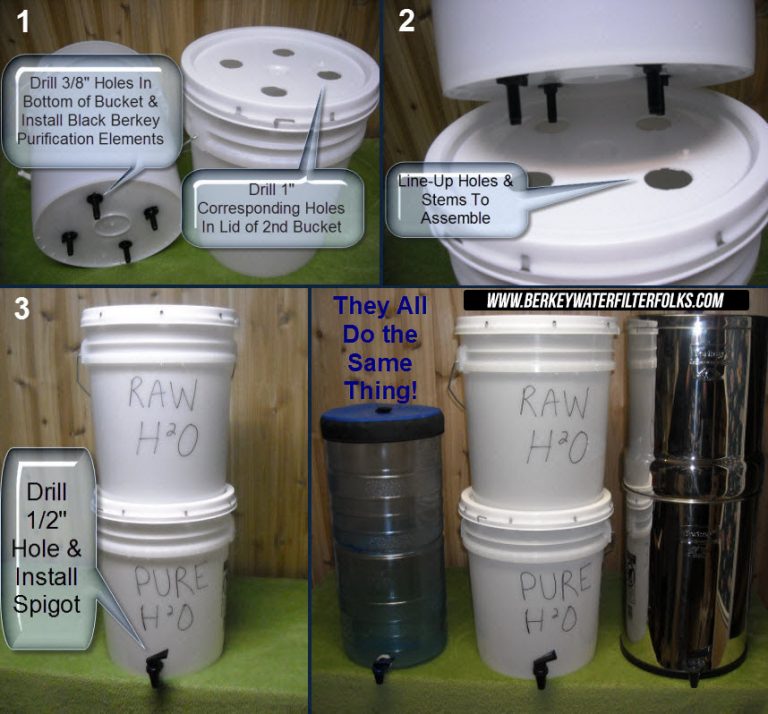
This is instructions for the homemade Berkey-style filter and dispenser. This is actually from a Berkey dealer website (hint: they want to sell you the candle filters).
--------------------------------------------------------------------------------------------------------------------------------------------------------------------------------------------------
https://berkeywaterfilterfolks.com/resources-links/home-made-water-purifier/

Homemade Water Purifier
Make Your Own Homemade Water Purifier
Yes, This is an Emergency Water Purifier” not a “pretty one” ; – )

OK, here it is folks…although the Berkey Water Purifiers are great; what makes them great is the “Black Berkey Water Purification Elements.” That’s right…the systems are really just containers for the Purification Elements. It’s nice that they have lids and spigots etc., but in the end it is all about the purification elements.

The genuine Berkey Water Purifiers also have a much better seal between the top and bottom chambers than the homemade bucket system does. If you make your own “bucket purifier” you’ll want to use some food grade sealant or some other method to keep air-born debris from getting between the two buckets and possibly contaminating the pure water in the bottom bucket. The Best Water Purifier is still the large stainless steel system on my right on the home page (if you’re asking me ; – )
All that said; if I were on a really tight budget, or just wanted an (ugly, but practical emergency system) I would buy:


( 2 ) Large Food Grade Buckets (Buy at local stores or get used from restaurants or bakeries.)
( 1 ) Spigot, and
( 2 to 8 ) Black Berkey Purification Elements (The More You Buy The Cheaper They Are!)

HomemadeWaterPurificationSystem-BWFF-768x714.jpg


We also wanted to provide you with a PDF that has the above instructions AND the top methods of filtering or purifying water. You can print it out and keep it in your emergency supplies so you always have a little “cheat sheet” for this crucial part of survival. We would suggest printing a copy on thick cardstock and putting it in your supplies. Please feel free to share this with your friends and family! It’s one more thing we can do to be prepared for any situation that may come in the future.


-----------------------------------------------------------------------------------------------------------------------------------------
Another source for candle filters: http://www.purewaterproducts.com/emergency-siphon-filters
Provided by Night Driver in Post #6.

Picture of a candle style filter. The white part is located in the top (raw water) bucket. You'd want 2-4 depending on how fast you want to filter water.
The top bucket is filled with raw water. The raw water touches the outer white part of the candle filters.
Gravity provides the water pressure to press water through the ceramic into the middle of the filter.
From there it drops out of the black nipple on the bottom into the clean water bucket below.

fc701_306.jpg
 
Last edited:
We have a well, with a 3,000 gal reservoir. I still, as a back up keep several gatoraide, OceanSpray jugs setting in the pantry, as a back up. If ever need to use those jugs, I realize that to drink them would need to air-orate them. Or as is use to flush toilets, or wash hands etc. I even thought about filling up some empty laundry detergent jugs, just for washing hands. They have a handy push button spout, and will already have soap.
 
I did the homemade Berkey with plastic foodgrade buckets & ceramic filters, worked out grand so i did a 2nd one too, I have a good stock of chlorine tablets too,

No shortage of rivers and lakes here, as well as the rain , non stop rain ...

I must look into a diy desalination rig, that'd be great

Under nuclear fallout conditions I'd dig a hole next to the shore until I hit water, allow it to settle some and draw from that source. Radioactive dust will settle on the surface waters of lakes and streams.
 
Chlorine is highly toxic and corrosive.

Chlorine is an oxidizer....

Mix oil, gasoline, diesel or other highly combustible material into hypochlorite and you will have an explosion....

Decades ago, there was a "U" shaped motel in west Texas where the maintenance guy finished mowing and put the gas can that had a small leak on top of a container of hypochlorite in the pump room at the pool that was located in the middle of the "U".... The resultant explosion leveled the motel....

Be careful how and where you store powdered chlorine and concentrated liquid chlorine....

Texican....
 
Under nuclear fallout conditions I'd dig a hole next to the shore until I hit water, allow it to settle some and draw from that source. Radioactive dust will settle on the surface waters of lakes and streams.

Fallout isn't much of a risk here as the only target for a nuke was Shannon airport being a transit hub for US military flights,
No targets close by for a terrorist dirty bomb,
Ireland has no nuclear power plants and the wind blows the other way for the UK ones .
Although I have the nukalert & KI pills JIC

Good advice though, even something as simple as a sock or tshirt, arm of a shirt , tied at one end and filled with gravel , sand & charcoal from your fire will make water safer than drinking straight from the source and if you can boil it even better,

I carry a plastic bag in my survival tin (that lives in my pocket) for putting over foliage to collect water vapour in a survival situation,

Rule of 3's, main kit in the bergen, secondary kit in the webbing and back up kit in pockets,
I keep a packed bergen ready, along with a packed PLCE webbing rig, and a packed SAS smock & pants.

Even if you lose your webbing and your bergen you can survive with whats in your pockets.
 
Last edited:
I have loads of filters of all kinds thanks to the reviews I do on prep and survival gear as well as many 55 gallon drums full of water, also keep some 5 gallon jugs full as well (those clear plastic ones) but perhaps the most interesting thing I got for review on my YouTube channel was a distiller. Its not a still, its a plug in distiller, and was fairly inexpensive too (under 80 bucks). It removes pretty much anything bad from water (there are some limitations) and works good, but slow. I also just got a new filter in from Lifestraw, Its a Lifestraw Flex, and supposedly removes heavy metals as well as all the other stuff a normal lifestraw will remove. I will test it out and see how that goes.

Lifestraw Flex is here: https://www.lifestraw.com/products/lifestraw-flex
The distiller I have is here: https://www.amazon.com/Happy-Habor-Effective-Distiller-Stainless/
 
exe, if you have reviewed water filters and the like, post more links and/or your youtube channel in general. It's nice when we can trust the reviewer.

Texican, that is good info on fuel reactivity with the hypochlorite. They must have stored hundreds of pounds of it at that hotel.
 
exe, if you have reviewed water filters and the like, post more links and/or your youtube channel in general. It's nice when we can trust the reviewer.

Texican, that is good info on fuel reactivity with the hypochlorite. They must have stored hundreds of pounds of it at that hotel.

Awe, man! NOW yer askin G to uncloak.


And one need only see what half a teaspoon of suntan lotion does in a pint or so of pool hypochlorite to GET RELIGION about pool chems.
 
Awe, man! NOW yer askin G to uncloak. (snip)

He's posted reviews about different things on TB in the past. I would not ask anyone on TB to "uncloak".

I'm glad you respect pool chemicals. Their potency is what makes them work so well to kill all the little nasties in raw water.
Store them safely and they could be handy in the future.

What type of water filters/purification did you see used on your foreign travels?
 
There's no reason I can see that drinking water can't be canned in a water bath canner. The water would have to be boiled before use or other wise purified, after opening the jar, because water has a neutral or close to neutral PH. High acid levels in water bath canned foods (pickles, jellies, jams etc.) help to keep it safe for consumption without heating.

This is how I keep my not-in-use half-gallon canning jars. My quarts and smaller get rotated too fast to be worth the time and utility bill. But the larger ones are great to store this way. I have some old gallon jars I inherited from various family members along the way and since they aren't good for much else than pickled items this is what I use them for. It is also how I resuse my canning lids. First use is for food, second use is for water, third use if for dry goods storage.

Just remember that big jars of water can be cumbersome to pour (and store) so make sure your shelves are sturdy and stable.
 
In 2011 I purchased property that has a large fresh water creek flowing through it....and yet it is far enough outside of Portland that I am not worried about the Zombies coming to get me....LOL

Of course I purchased multiple Filters from the great folks at SAFECASTLE, so I am ready for whatever comes.

Make sure you folks have multiple clean 5 gallon buckets.
 
I'd forgotten that sunshine was able to disinfect water, good reminder.

There were other things in my better halfs' files, involving creating distilling units, collecting condensation and using soil sand plants and gravel to set up a purifying system.
 
Top