TRANS 16 American trucking companies file for bankruptcy from rising diesel costs

Cardinal

Chickministrator
_______________

More than a dozen American trucking companies have sought bankruptcy protection in the past month as diesel prices climb to record highs and other operating costs keep rising.

Sixteen firms, representing more than 250 jobs, have filed Chapter 7 or Chapter 11 cases, FreightWaves reported earlier this month. Diesel, the industry’s lifeblood, averaged a record $6.53 a gallon on September 22 amid President Donald Trump’s war with Iran. AAA said the fuel has jumped $2.76 over the past year.


Two of the larger names, Xoco Transport and Globemaster, are using Chapter 11, staying open while they work out repayment plans with creditors under court supervision. Neither company spelled out what triggered the filings in federal court papers. The Independent said it had sought comment from both.


Higher pump prices do not stay at the pump. Logistics firm ASM Group, in a December 2025 industry analysis, said the shock hits the rest of the business. “When fuel costs go up, the trucking companies face a sudden increase in their operational cost and are forced to increase freight rates to avoid going in loss,” the group wrote.


Raising rates is not enough. ASM said carriers typically cut workers and sell equipment to survive, shrinking capacity and the chance to earn more.

Fuel is only one pressure. A July analysis by consultancy Deloitte found other costs stacking up at the same time. “Labor, insurance, maintenance, and regulatory compliance costs continue to escalate,” Deloitte wrote.

Freight work also swings between busy and slow seasons. In the quiet months, Deloitte said, revenue may not cover those rising bills.

Of the 16 companies in FreightWaves’ tally, eight are seeking Chapter 11 reorganization. Seven are liquidating under Chapter 7 and shutting down. The remaining carriers sit in a market where diesel is at a historic high, insurance and parts keep climbing, and the trucks that move America’s goods are disappearing from the road one filing at a time.
 
Some likely have fixed rate contracts.
Some are afraid to drastically raise rates when it could mean they lose a lot of their business. Especially if they thought the high fuel costs were very temporary.
There are many reasons not to raise rates. Always first on that list is loss of customers.
 
I am concerned that this is just the canary in the coal mine. Families will be in a hard place with things like this. I wonder how Europe is taking this... probably much worse there.
From where I sit, most people are still in grumbling-and-waiting mode, but probably not for much longer. People in Ireland are waiting to see what provisions the new budget, coming out next week (for the next year), proposes to help both households and businesses with the insane rise in energy costs (on the eve of Winter).

Things are more dire in some parts of Europe than in others; obviously, truckers are among the first to face serious pain and disruptions. While the press has kept rather quiet about the situation (probably on the orders of various governments) I think most sane people know that they will start striking sooner rather than later.

The only question, as I said in a previous thread, is whether or not that strike will be voluntary or involuntary. Or will this be a planned strike on XYZ day, or will truckers simply park their trucks when they get home (or their home base), leave their trucks, and not come back?

I am also expecting what happened a couple of times in the past, when companies went bankrupt and stranded drivers had to be rescued by family, friends, and even embassies in order to return home (without the truck).
 
So in many trucking companies (like the smaller mom and pops), the prices are set by the customer "I need X things trucked over x miles for $X a mile". There just arent enough good paying hauls on the job boards to take. They lose money if they take the lower ones, and there arent enough of the well paying ones to make ends meet month to month.

My SIL sold her trucking business last year for this reason. They were consistently having to take $4/mile hauls when she needed $6/mile to break even. They dont account for just fuel, they have wages, overhead, tolls, lodging/etc to pay for as well
 
Saw this situation play out back when I was trucking. Fuel prices went from around $2.50/gal to near $4.00 and lots of smaller companies (100 trucks range) went under due to fuel costs.

The larger companies like the one I drove for went into "Insane fuel use restrictions mode", with one major carrier authorizing which truck could move on a day-by-day basis to control fuel costs. It got so bad for them that the company I drove for loaned them $43 million to replenish their fuel fund.

Because if a 10,000-truck day went bankrupt and shut down, the ripple effect would overwhelm the rest of the trucking industry.
 
The Federal Motor Carrier Safety Administration (FMCSA) typically grants 4,000 to 5,500 new for-hire operating authorities every single month (translating to roughly 48,000 to 65,000 new entrants a year)

Those numbers are skewed.

I'll give an example.

There's a fellow I know that is a crappy owner operator. When he gets maxed out on violations, he essentially creates a new business and registers it with a new DOT number and via the FMCSA. I'd like to know how many of those are the same people, but people that gaming the system. There was at one point, he made essentially three new trucking companies in a year due to gross violations.
Oh im sure but even if we account for some error, it still buries 16
 
Probably the same percentage of meat packing plants whose business model is finally exposed after decades of relying on illegal labor to keep going. Including that of minor children. Now suddenly, "waahhhh, we can't process your food, whaaaah."
 
Thousands of U.S. trucking companies go out of business or surrender their operating authority every year, with 5,000 to 8,000+ carriers shutting down annually during recent freight downturns.
This.


From an AI search the OP article affects just over 250 jobs with these 16 filings.

Note of the name of website with this article.
Clickbait ?!?!?!
 
So why didn't they raise their rates to compensate for the increased fuel cost?
Agreed.
I am not familiar with the trucking business model, but if diesel has gone up $2.76/gallon, and the average 18-wheeler gets 6MPG, then per-mile it's not a viable business model; gross margins suck unless they can pass along costs.
Again, I don't know the trucking business, but why haven't they passed along costs? With the amount of illegal truckers that have been taken off the road, I'd think the truckers are actually in a good negotiation position.
 
Because the other side - the retailers that are paying for the transport of the goods being trucked wont pay for the increase because if they pass that cost on to the consumer, they wont buy the products.

If you were paying $150 for a TV and now that price is $350 and you also have to save for the increase in groceries and gas yourself, would you buy that TV, or pass it over and wait? Multiply that decision for the whole country and suddenly there are a whole lot of "nice to have" items that aren't being purchased because the "need to have" item costs have increased dramatically.
 
Railroad could be expanded and used more efficiently as if that is ever going to happen.
It seems like another lifetime ago now but I once had a trucking company. One reason trucking companies thrived is that railroads were too rough for certain products, claims were too high, and trucking used to be cost-effective.

Now, I believe we are witnessing another industry being destroyed, and the consequences are yet to be realized.
 
View: https://x.com/unshadowedshow/status/2105405053586620664?s=61


The infrastructure that has kept America fed is being dismantled.

As diesel costs soar, 16 American trucking companies have filed for bankruptcy:

the-independent.com/us/money/truck…

Among them, Xoco (refrig produce) and RP Hay Hauling (hay/forage) are specifically for agricultural transport.

Meanwhile, 3-d printed meat (much of it from Israeli companies like Steakholder) is entering the US market, coming to a 15-minute city near you:

planetfood.news/post/3d-printe…

Not a coincidence.
 
The infrastructure that has kept America fed is being dismantled.

As diesel costs soar, 16 American trucking companies have filed for bankruptcy:
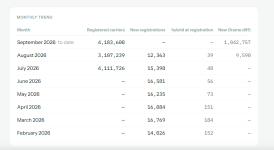
16 out of how many... What is the percentage of companies?

How many trucking companies are there in the US?​

As of September 2026, FMCSA's registration census contains 4,183,608 entities registered with a motor-carrier designation — out of 4,494,845 registered entities of all types. Of those, 53,166 also hold freight broker authority — the carrier-broker hybrids at the center of double-brokering risk.

1790809548984.png
 
16 out of how many... What is the percentage of companies?

How many trucking companies are there in the US?​

As of September 2026, FMCSA's registration census contains 4,183,608 entities registered with a motor-carrier designation — out of 4,494,845 registered entities of all types. Of those, 53,166 also hold freight broker authority — the carrier-broker hybrids at the center of double-brokering risk.

View attachment 622730
16 = .000300944% We are doomed!! :hof:
 
Because the other side - the retailers that are paying for the transport of the goods being trucked wont pay for the increase because if they pass that cost on to the consumer, they wont buy the products.

If you were paying $150 for a TV and now that price is $350 and you also have to save for the increase in groceries and gas yourself, would you buy that TV, or pass it over and wait? Multiply that decision for the whole country and suddenly there are a whole lot of "nice to have" items that aren't being purchased because the "need to have" item costs have increased dramatically.
So, if "they" won't pay, then trucking companies move on to more profitable contracts.
Your example: Supply and Demand; the fewer the amount of TV's, the higher the price for those that are available. And then the market "miraculously" has adjusted to higher prices, which include shipping.
 
Bad things usually start off small……..

Just something to keep an eye on.
Was that also because of high diesel prices in 2023 and 2024... or just part of the overall normal and changing market?

The Largest Trucking Company Bankruptcies: 2024 Update​

Statistical Highlights:

  • In 2023, nearly 88,000 trucking companies shut down their operations, along with 8,000 freight brokers.
  • Compared with 2023, trucking demand in 2020 was 30% higher in volumes.
  • After the pandemic, railroad shipping volumes decreased by 20% without recovery, last mile deliveries were 10x, and ocean shipping decreased by 25%.
  • Big trucking companies have to deal with rising operational costs: Driver wages accounted for 32% of all trucking-related costs in 2022, with driver benefits accounting for another 8%.
  • A forecasted increase of 8.8% in e-commerce sales in 2024 signifies that the trucking industry will have to adapt to more hub & spoke demand with box truck & localized services.
  • In 2023, there were 1,183 cargo theft incidents, with each incident resulting in an average loss of $586,917, amounting to a total of $694,327,811 in stolen goods.

Top 10 Recent Trucking Company Bankruptcies​

Below, we've provided an up-to-date out of business trucking companies list.

‍Trucking companies shutting down 2023:

Yellow Corp. - In August of 2023, Yellow Corp filed for Chapter 11 bankruptcy. This has marked the largest bankruptcy filing in US trucking history.
Convoy - As of October 2023, Convoy shut down operations. This came after a series of layoffs and operational downsizing.
Matheson Trucking - In December 2023, Matheson Trucking announced plans to wind down operations. This was due to financial disputes.
Surge Transportation - In late July 2023, Surge Transportation filed for bankruptcy. This came after significant operational changes and financial struggles.
Elite Transit Solutions - Late in November of 2023, Elite Transit solutions closed operations. This followed the subsequent revocation of broker authority.
Meadow Lark Agency - This 40-year old Montana-based company filed for Chapter 7 bankruptcy in early November 2023.
Transplus - In June 2023, Transplus filed for bankruptcy. This affected numerous small trucking companies that had not been paid for their services.

Trucking companies shutting down 2024:

Arnold Transportation Services - A 92-year-old trucking company based in Grand Prairie, Texas, was acquired by Pride Group Logistics in February 2022. As of May 2024, Arnold Transportation Services has filed for Chapter 7 bankruptcy liquidation, along with its affiliated companies.
Tony's Express - This 70-year-old California trucking company abruptly ceased operations in May 2024. In its wake, this shutdown has left over 200 employees jobless.
Flagship Transport - a Miami-Dade trucking company that ceased operations in May of 2024. Flagship Transport faces demands from unpaid drivers. The shutdown has left workers frustrated and uncertain about their financial losses and futures.

How many trucking companies were closed in 2023?
According to CarrierOK, nearly 88,000 trucking companies ceased their operations, alongside 8,000 freight brokerages.


More than a dozen American trucking companies have sought bankruptcy protection in the past month as diesel prices climb to record highs and other operating costs keep rising.
What is scary is maintenance might be delayed which could make trucks unsafe for drivers and the general population.

Until store shelves are empty sheeple will not pay attention. Same people who believe produce comes from the grocery store without considering every job behind its production to get it there. Starting with the land, taxes, fertilizer, equipment, seeds, plants, fuel, labor, transportation and probably many more inputs all of which explain the increase in prices. Just the increase in transportation costs which are passed on all down the line are legitimate reasons for retail price increases which I'm hearing people blame on the retailer. Trickle down is real and sometimes it's not a trickle, it's a flood.
What is happening is a slow roll from covid. A lot of businesses saw how fragile JIT was and are preparing for supply chain delays. Having months of product on hand instead of 3 days.
 
No one is investing in drilling.
Is that because they're waiting for the outcome of the midterms? If Dems win, they try and shut it all down, so why would oil companies invest now?

Same reason why refineries aren't being built. It's a 10 year committment, and if Dems get into power, they do everything possible to make it difficult. I can see why no oil companies want to gamble on that type of investment.
 
Top