ECON Deflation or Inflation...

doctor_fungcool

TB Fanatic
1. Lenders (banks) do not want to lend because they think they may not get their money back. This is because the money supply is shrinking rapidly. All prices around you were based on inflated bank credit. People borrowed and bought things and inflated prices along with salaries. It is very possible that all prices and salaries can be cut in half if the money supply shrinks 50%. Then it will be very hard to pay back a fixed rate loan.

2. Borrowers do not want to borrow because they think they may not be able to pay it back. This is normal because people see job cuts, companies cut costs, prices fall, so how can they be sure that they will make same salary in the future to pay back what they owe.

3. For inflation to happen, people must have alot of money to chase too few products. What we have now is the opposite. We have wage reduction. We have high debt levels. We have excess capacity producing too many products. The supply exceeds the demand. The prices will fall, not go up. All companies are selling less, good results are just a result of cost cutting. When one company does it, it is good. But when all companies do it, cost cutting is detrimental to the economy. Earnings will go lower. Imagine an IT company produces software and hardware, but cuts costs: layoff workers, freeze salaries, stop investments. Their customer is a bank. If the bank cuts costs what will they do? They will say: Hey we are not buying new software from this IT company this year. We will run with fixer upper systems we have, sorry. This mentality will effect everyone's earnings! It may sound good for the bank, but it is bad for the IT guy. There is a chain reaction.

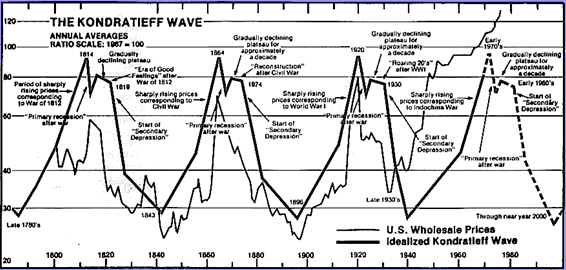
Almost all of the money supply in the economy is in terms of bank credit. This monetary system is prone to a deflationary crash. There is a herd effect in the population. People borrow and spend alltogether and they stop borrowing alltogether. This creates cycles like kontradiev wave. The herd effect causes great booms and great busts. This is explained in Conquer the Crash:

www.tradingstocks.net/ html/forecasting.html


JMJM2.jpg


We need to understand a few things, JGF..

We must search beneath the surface to understand what drives human behavior and fear in our economic world today. If we discover our work activity (behavior) is driven to areas for the wrong reasons on a large scale, and further, if we discover the “future stream of goods and services” that we are expecting to enjoy is largely an illusion, we become fearful and lose confidence in our governing system, our leadership, and ourselves. The more extreme these conditions become, the more severe will be the depression. Currently we exceed any level experienced during the past century in the noted areas.

We know:

· Wealth is created by work; not by artificially suppressing interest rates and increasing bond and real estate perceived valuations, nor by rapidly expanding the money supply enabling Ponzi momentum schemes to inflate equities far beyond real valuations.

· There is financial peace of mind in those who believe they can depend upon a “future stream of goods and services” from financial and equity assets they possess. Equity valuations generally provide a “medium” piece of mind, since we are conditioned to expect volatility. Bond and real estate valuations generally provide “high” piece of mind, since we are conditioned to believe they are stable. Note: An illusion discovery on bonds and real estate would be very unsettling.
· A business enterprise cannot continue indefinitely losing money, unless it is subsidized.

Therefore, we are presently walking gingerly through a very deep valley of depression...........who knows how many years this walk will take before inflation takes hold....but in the meantime, the money from the printing presses is going down the blackhole of deflation.......never to be seen again. If you cannot see the error of your ways, then I suggest rethink your theories......for if those that are out of work...those factories that are closed permanently....and the tremendous drop in the prices of housing and other things that we've invested in over the years aren't signs of a deflationary depression, then what is my friend?

You were wrong when you predicted hyperinflation several years ago.....and the economy sank...and you are wrong once again.....Time for you to rethink your economic philosophy.....because my friend, it's just....plain wrong.
 
Last edited:

doctor_fungcool

TB Fanatic
kondratieff3.gif


Kondratiev wave
http://en.wikipedia.org/wiki/Kondratiev_wave


"Kondratiev waves—also called Supercycles, surges, long waves or K-waves—are described as regular, sinusoidal-like cycles in the modern (capitalist) world economy. Averaging fifty and ranging from approximately forty to sixty years in length, the cycles consist of alternating periods between high sectoral growth and periods of relatively slow growth. Unlike the short-term business cycle which in various forms has been familiar since the nineteenth century, the long wave of this theory does not belong within current orthodox economics and is sometimes categorized as part of heterodox economics (a catch-all term for alternative ideas).

The Russian economist Nikolai Kondratiev (also written Kondratieff) was the first to bring these observations to international attention in his book The Major Economic Cycles (1925) alongside other works written in the same decade. Two Dutch economists, Jacob van Gelderen and Samuel de Wolff, had previously argued for the existence of 50 to 60 year cycles in 1913. However, the work of de Wolff and van Gelderen has only recently been translated from Dutch to reach a wider audience.

Kondratiev was a Soviet economist, but his economic conclusions were disliked by the Soviet leadership and upon their release he was quickly dismissed from his post as director of the Institute for the Study of Business Activity in the Soviet Union in 1928. His conclusions were seen as a criticism of Stalin’s intentions for the Soviet economy: as a result he was sentenced to the Russian Gulag and later received the death penalty in 1938.

Later, in Business Cycles (1939), Joseph Schumpeter suggested naming the cycles, "Kondratieff waves", in honor of the economist who first noticed them. In the 1950s, French economist François Simiand proposed naming the ascendant period of the cycle "Phase A" and the downward period "Phase B". Some market commentators divide the Kondratiev wave into four 'seasons', namely, the Kondratiev Spring (improvement or plateau) and Summer (acceleration or prosperity) of the ascendant period and the Kondratiev Fall (recession or plateau) and Winter (acceleration or depression) of the downward period."
 

doctor_fungcool

TB Fanatic
The Years 1922-1923 -- Hyperinflation! Here's what happened in Germany.....and yes, it could happen here...but NOT YET JGF....not yet.

http://www.usagold.com/germannightmare.html

From Mid-1922 to November 1923 hyperinflation raged. The table above tells the story. Seemingly Reichsbank officials believed that the basic trouble was the depreciation of the mark in terms of foreign currencies. In late 1922 they tried to support the mark by purchasing it in the foreign exchange markets. However, since they continued printing new currency at a feverish rate, the attempt failed. They merely succeeded in buying worthless marks in return for valuable gold and foreign exchange.

All hope of checking the collapse of the mark vanished in January 1923 when the French--alleging treaty violations--occupied Germany's key industrial district, the Ruhr. Germany subsidized the occupied companies and financed an expensive program of "passive resistance." New billions of marks were printing to finance these heavy new costs. By late 1923, 300 paper mills were working top speed and 150 printing companies had 2000 presses going day and night turning out currency.

Under the forced draft of inflation, business was now operating at feverish speed and unemployment had disappeared. However, the real wages of workers dropped badly. Unions obtained frequent increases, but these could not keep pace. Workers --domestics, farm workers and various white collar groups-- fared especially badly. They had no unions to fight for pay boosts for them, and often they were reduced to hunger. Many people showed visible signs of malnutrition. Skilled workers, writers, artisans and professionals found their wages lagging until they reached the unskilled worker level, which often meant the bare minimum needed to support life.

Businessmen began to abandon their legitimate occupations to speculate in stocks and in goods. Thousands of small businessmen tried to eke out a living by speculating in fabrics, shoes, meat, soap, clothing--in any produce they could obtain. Each fall in the mark brought a rush to the shops. People bought dozens of hats or sweaters.

By mid-1923 workers were being paid as often as three times a day. Their wives would meet them, take the money and rush to the shops to exchange it for goods. However, by this time, more and more often, shops were empty. Storekeepers could not obtain goods or could not do business fast enough to protect their cash receipts. Farmers refused to bring produce into the city in return for worthless paper. Food riots broke out. Parties of workers marched into the countryside to dig up vegetables and to loot the farms. Businesses started to close down and unemployment suddenly soared. The economy was collapsing.

Bread line in Germany

Meanwhile, middle-class people who depended on any sort of fixed income found themselves destitute. They sold furniture, clothing, jewelry and works of art to buy food. Little shops became crowded with such merchandise. Hospitals, literary and art societies, charitable and religious institutions closed down as their funds disappeared.

Then by a mere effort of will, the government stepped in and stabilized the currency overnight.

Throughout the "miracle of the Rentenmark" the depreciation halted in its tracks, business revived, the inflationary spree was ended although, as we shall see, there was a nasty hangover yet to come.

Millions of middle-class Germans--normally the mainstay of a republic--were ruined by the inflation. They became receptive to rabid right wing propaganda and formed a fertile soil for Hitler. Workers who had suffered through the inflation turned, in many cases, to the Communists. The biggest beneficiaries of this enormous redistribution of wealth were feudalistic industrial leaders who distrusted the democracy and who proved willing to deal with Hitler, thinking that they could control him. The democratic parties and the labor unions lost their capital and were weakened. The liberal democratic regime was discredited.

What caused the inflation?

Our thesis is simple: The inflation was caused by the government issuing a flood of new money, causing prices to rise. Then, as the inflation gained momentum, events seemed to demand the printing of larger and larger issues of currency. To half the process would have taken political courage, and this was lacking. As usual, the true facts were hidden behind a barrage of excuses, explanations and propaganda laying blame on everyone except the true culprit.

First, it would be wrong to think that everyone was opposed to inflation. Many big business leaders accepted it cheerfully. It wiped out their debts. They knew how to protect themselves and even profit--by speculating in foreign exchange, by converting money into goods and fixed plant, by borrowing money from the bank and using it to buy up cheap stocks and competing companies. Their wage costs, in true value, decreased, swelling their profits. Yet many workers also thought that they were benefiting, at least in the earlier stages of the inflation. Their wages were increased, and it took time before they recognized that, with prices soaring even faster, they were actually suffering a cut in true income.

A crew of speculators arose who traded in goods and foreign exchange, they had a vested interest in continued inflations. And the government could not help realizing that the inflation was wiping out its burden of debt and would ease its financial problems.

Above all, it became an article of faith german gold coinamong the political leaders and most ordinary citizens that the inflation was really due to the burden of reparation payments imposed by the peace treaty. This meant, so the argument ran, that Germany would be stripped of its gold, foreign exchange and wealth; it would be bankrupt. Hence, the mark fell in value in terms of gold or dollars. This drop in the foreign exchange value of the mark was said to be the true reason for the inflation.

The German leaders felt that the collapse of the mark was proving how impossible it was for Germany to pay the reparations which were demanded. Stabilization of the mark would have spoiled this "proof." Especially after France occupied the Ruhr in January 1923, it was felt that the destruction of the mark was somehow a blow against the hated occupier--the only patriotic response available to disarmed Germany.

Finally, inflation seemed to bring prosperity. In 1921, when the rest of the world was in a severe post-war recession, production indices in Germany rose sharply. Late in 1921 the mark stabilized temporarily, and business promptly weakened. By early 1922 the mark was sliding again, and business immediately revived. People were buying goods as fast as they obtained money; companies rushed to expand plants and turn money into fixed investment. Germany was actually envied for its "prosperity" by many foreigners. [Does this sound like modern-day America, albeit with people spending on stocks in addition to goods?]

The mechanism of inflation was simple. The government issued paper promises to pay, and the Reichsbank issued money on the security of these promises. When a government spends more than its income, it must borrow. If it merely borrows money from its citizens by selling them bonds, there need be no inflation. Instead of that money being spent or invested by the citizen, it is borrowed and spent by the government, but the total amount of money is not increased.

When the government needs more money than its people are able or willing to lend it, it monetizes the debt. That is what happens in this country when the government runs a big deficit. The Federal Reserve (our central bank) "buys" as many bonds as necessary to stabilize the market. It prints money on the security of these bonds. Despite the facade of the government supposedly "borrowing," the net result is the creation of printing press money. (Actually these days the money is created in the form of new bank deposits--checkbook money--but the net result is exactly the same as if bills were printed.)

This is what happened in Germany. The government issued notes which were promptly discounted by the Reichsbank, i.e., the bank issued money on the "security" of these worthless notes. To compound the evil, the bank failed to raise its interest rate sufficiently. Businessmen found it very profitable to borrow money from the bank and buy up goods, shares and companies. Their debt was wiped out within weeks by the rapid inflation, and the businessman remained holding the valuable assets he had bought. The net result was a huge "private inflation" caused by the rapid expansion of credit. Even foreign exchange was bought with borrowed money, so that the Reichsbank actually financed speculation against its own currency. Yet the bank refused to raise interest rates, arguing that this would only add to the cost of business and thus would increase inflation!

The tax system virtually broke down. Businessmen found that by merely delaying tax payments, the depreciation in the mark would virtually eliminate their true value. But the government, lacking adequate income, felt forced to resort more and more to creating money. By October 1923, 1% of government income came from taxes and 99% from the creation of new money.

But the main force which gave inflation its momentum was the steady decrease in the true value of money in circulation. This has been observed in all past rapid inflations and it is vital to understand it if inflation is to be coped with. During the war, as we saw, the price inflation lagged behind the rate at which money was issued. But now, as people lost confidence, prices began jumping much faster than the government could generate new money. Thus the total circulating currency fell drastically when measured in terms of its true value. One economist stated that, "In proportion to the need, less money circulates in Germany now than before the war. This statement may cause surprise but it is correct. The circulation is now 15-20 times that of pre-war days, whilst prices have risen 40-50 times." In fact, the total currency when calculated in gold value fell from 7428 million marks in January 1920 to a mere 168 million by July 1923.

Despite the proliferating billions of trillions of marks, the average citizen found it harder and harder to get enough money for necessities. Banks, short of money, could not honor checks. Businessmen were strapped for money to buy materials and meet payrolls. The government faced the same problem. It appeared that there was not too much money around, but rather much too little. The clamor for more money grew on all sides. It seemed that any halt to the printing presses would bring business to a standstill and throw millions of workers out on the street. The government itself would be unable to carry on. Riding a tiger, it dared not dismount. On October 25, 1923, the Reichsbank noted that it had that day printed 120,000 trillion marks. Unfortunately, the day's demand had been for one million trillion. However, it announced that it was expanding production and the daily issue would soon be 500,000 trillion!

Once people lose confidence in a currency, they try to get rid of it. As Lord Keynes pointed out, this makes circulation speed up enormously, and hence prices rise faster than the government can print new money. Marshall, studying this process, concluded that, "The total value of an ' inconvertible paper currency cannot be increased by increasing its quantity; any increase in quantity which seems likely to be repeated will lower the value of each unit more than in proportion to the increase."

Customarily, however, governments blame everyone and everything except themselves for inflation. When inflation lags behind issue of money, as it did in the war, they say that this shows that the issue of money is not dangerously high. Later, when confidence vanishes, and prices soar ahead of currency issues, that again is taken to prove that the government is not to blame--it is only reluctantly issuing money that is desperately needed in view of rising prices.

We will conclude this discussion with a quotation from Dr. Milton Friedman's book, Dollars and Deficits. Friedman notes that after the Russian revolution, the Bolsheviks introduced a new currency. They printed huge amounts of it and soon it became almost worthless. At the same time some of the older Czarist currency still circulated and maintained its value in terms of goods. It appreciated enormously in terms of the new money. Why? This money was not redeemable. Nobody expected the Czarist government to return. Why did this currency hold up? "Because," says Friedman, "there was nobody to print any more of it."

Effects of Inflation on Business

As inflation proceeded, people rushed to buy goods and get rid of their depreciated money. For similar reasons, businessmen hastened to buy machinery, to build new factories, to buy huge stocks of coal, steel and other raw materials. Those who had access to credit borrowed heavily for these purposes, and inflation wiped out their debt. There was a tremendous conversion of working capital into fixed investments. Business was booming and unemployment virtually vanished until the last stages of the inflation.

Farmers got rid of currency by heavy purchases of equipment, and later many were left holding large supplies of useless machinery. Shipbuilding was expanded beyond all market needs. Marginal mines were opened leading to serious overproduction later on. But while basic industries prospered, there was a severe depression in consumer goods industries such as textiles, meat, beer, sugar and tobacco. Too many workers and persons on fixed incomes had lost their purchasing power.

There was a tremendous move toward concentration of industry. Large firms or combinations found it much easier to raise prices, to obtain raw materials and above all to obtain bank credit. Also, they could issue "notgeld" or emergency money which more and more came to replace the paper mark as a medium of exchange. Some of these new industrial combinations were rational and efficient, but many were purely speculative operations. A new breed of financier arose.

Earlier the great German industrial leaders--men like Krupp, Thyssen and Siemens--had developed basic new ideas in technology or in organization. But now the rising stars were those of shrewd speculators and manipulators geared to quick trading and to jumping from deal to deal and from company to company. The most successful were those who saw the trend of events early, who borrowed to the hilt and bought up goods, shares and companies at bargain prices. Conglomerates sprung up forty years before the heyday of the conglomerate movement in the U.S. Perhaps the biggest operator of the day, Hugo Stinnes, formed a giant conglomerate including companies in oil, coal, steel, shipyards, electrical works, insurance, newspapers and hotels. He died in 1924, just before his empire fell apart in the cold winds of the stabilization period. Most of these new mushroom combinations and conglomerates were speculative bubbles which were only able to survive as long as they benefited from ongoing inflation.

Beneath the surface of prosperity there was enormous waste and inefficiency. Much of the new capital plant proved inefficient or unneeded. Middlemen multiplied like locusts, and more and more time and energy went to speculation and to endless paperwork generated by currency fluctuations, new tax law regulations and labor disputes. Speculation caused banks to multiply; there were 100,000 bank workers in 1913 and 375,000 in 1923. Labor became much less productive. Workmen were pre-occupied with their own problems of trading, getting wage boosts, and staying ahead of inflation. With paper wages rising rapidly and full employment, they were less inclined to work hard. Despite the surface boom, net production was really much less than before the war.

Bewildering fluctuations in costs prices and wages made it impossible to allocate resources and production rationally. More and more, the businessman became a speculator in goods and currencies. However, very few businesses failed, since their debts were constantly wiped out by inflation. Bankruptcies had run to 815 per month in 1913; by late 1923 they were 10 per month.

Finally, however, in the last stages of the inflation, the economy began to collapse. Retailers could not get goods or else could not sell at a profit. The money they received was depreciating too fast. Farmers stopped selling their produce. More and more stores became empty. Now unemployment began to soar.

Some economists argued that inflation may have helped Germany by stimulating the building of capital plant and the rationalization of industry. But much of this investment proved to have no value except in the dream world of inflation. Most of the inflation combinations fell apart after stabilization. On the whole, much energy and wealth was wasted in unproductive channels--speculation, paperwork and unprofitable equipment. The working capital of industry was largely dissipated, making that much harder the eventual process of economic rebuilding and rationalization.

Stabilization--The Rentenmark Miracle

In November 1923, a currency reform was undertaken. A new bank, the Rentenbank, was created to issue a new currency--the Rentenmark. This money was exchangeable for bonds supposedly backed up by land and industrial plant A total of 2.4 billion Rentenmarks was created, and each Rentenmark was valued at one trillion old paper marks. From that moment on the depreciation stopped--the Rentenmarks held their value; even the old paper marks held stable. Inflation ceased.

What was the secret of the "miracle of the Rentenmark"? After all, the new currency was not redeemable in anything. Its backing by real property was a fiction, since there was no way by which property could be foreclosed or distributed. Further, there we have the government distributing a vast new supply of money--2.4 billion trillion in terms of the old mark. Ought that not have led to a new wild inflation?

To understand this, we must recall that the real value of the money circulating in late 1923 was small--equal to a mere 168 million pre-war gold marks. The continued depreciation at this point was due to utter lack of confidence--to the belief that the printing presses would run indefinitely. But actually there was a great shortage of and need for money. New money could be introduced without price inflation if only people had confidence in it. How was confidence developed?

First, the government announced that the new currency would be "wertbestaendig"--stable in value. In their hunger for usable money people accepted this, at least until it should be proven false. Then the property backing seemed to give the currency value. True, the Assignats of the French Revolution, backed by fixed property, had depreciated, but still the backing helped.

Second, and certainly most important, the government limited strictly the amount of Rentenmarks which could be issued and it halted the issue and discounting of notes and the creation of paper marks. Finally, after April 1924, the Reichsbank stopped the expansion of credit to businesses which had been stimulating inflation. Businessmen were required to repay loans in gold marks, equal to the original value of the loan. Thereafter, incentive was gone to borrow except for legitimate needs.

In August 1924 the reform was completed by introduction of a new Reichsmark, equal in value to the Rentenmark. The Reichsmark has a 30% gold backing. It was not redeemable in gold, but the government undertook to support it by buying in the foreign exchange markets as necessary. Drastic new taxes were imposed, and with the inflation ended, tax receipts increased impressively. In 1924-1925 the government had a surplus.

After the stabilization, most companies found that they were critically short of working capital. Their funds had been dissipated or converted into goods and plant, and cash was very short. They could no longer rely on a stream of incoming capital at the cost of bond holders and workers. Taxes were again a serious burden, as were wage agreements that had been made under the inflation.

In other ways the business climate changed. Now there was a huge demand for consumer goods, but the capital goods industries which had so overexpanded in the inflation were depressed. Huge stocks of coal, steel and other materials which had been accumulated were a drug on the market. Agriculture and building, however, flourished.

Many of the speculative and conglomerate companies which had been formed in the inflation were unable to survive. They failed, or split up into their original components. In 1923 there had been only 263 bankruptcies; in 1924 there were 6,033. Most of the great inflation speculators were ruined or faded from the business scene. However, strong, well-organized companies like Krupp and Thyssen which had resisted overexpansion and speculation were able to weather the stabilization period and to thrive.

How Investments Fared

At the start it is important to understand how hard it was to obtain real income during the inflation. Professionals, skilled workers and others used to enjoying good income found their real salaries disastrously cut. Those who depended on savings, pensions or investment income for a living faced a terrible situation.

Interest from bonds or savings deposits soon depreciated to where they had no real value. Stocks paid meager dividends or none at all; corporate managements needed the money for working capital, or used it for capital building and speculation. Owners of rental property fared no better; the government froze rents, which soon meant that tenants were occupying premises virtually rent-free. Dipping into capital led to big losses, since cash, bonds and even stocks quickly shrunk drastically in value. The urgent need for income had important effects on the true prices of various types of property and investments.

Cash: Money held in cash lost value rapidly and soon became completely worthless. Of all investment forms, this was the most disastrous.

Bank Deposits: In theory, bank deposits became as worthless as cash. However, after the stabilization the government decreed partial reimbursement, and sums in the range of 15-30% of the original deposit value were repaid. Naturally, however, the great majority of depositors withdrew their funds at some time during the inflation, after much of the value had been lost, and exchanged them for goods. Few Germans held money in deposits through the entire period.

Bonds, Mortgages: As usual in an inflation, bonds and mortgages fell in value even faster than cash. After the stabilization, some restitution was provided by law. Holders of government bonds were reimbursed to the extent of 2.5% of the original bond values. Mortgage holders also received some repayment, while a 1925 law provided for 15-25% reimbursement of corporate bondholders, though the payment was delayed for some years. Here again, few investors held bonds or mortgages throughout the entire period; most holders got rid of them for whatever pittance they would bring during the inflation.

Real Estate: Farmers and holders of urban property seemed to benefit if their property was mortgaged; the inflation soon wiped out the mortgage debt. However, they received no income, as noted above, since rents were frozen. After the stabilization, heavy new taxes and the urgent need for cash forced most holders to remortgage their property, often more heavily than originally, so that their gains were illusory. Still, those who held real estate throughout managed to save the capital thus invested. However, those who sold during the inflation (often through desperate need for cash) fared poorly. Because it brought no income, real estate sold at extremely low real price levels during inflation.

Foreign Exchange: Those who held funds in dollars, pounds or other stable currencies, or in gold,german gold coin saved their capital. The government set up rigid exchange controls as the inflation proceeded. As usual under such conditions, a black market flourished. The ones who fared best were the small minority who had the foresight to exchange marks into foreign money or gold very early, before new laws made this difficult and before the mark lost too much value.

Personal Property: Capital was preserved by those who early changed it into objects of lasting value--rare coins, stamps, jewelry, works of art, antiques--or into merchandise such as clothing, fabrics, etc. Of course, most people did not understand the advantage of accumulating such property until the inflation was well along. By that time the prices of all goods had risen so much that they seemed outrageously bad bargains. In the event, however, cash proved an even worse bargain.

Common Stocks: In an inflation, common stocks are generally considered a desirable hedge to protect against or even to profit from the rise in prices. In practice, it is not so simple. In this country stock prices have been known to fall violently just when inflation was most evident (1946, 1957, 1966, 1969). Market fluctuations--the rise of exciting new speculative stocks, waves of fear or greed--all make it much too easy to buy or to sell at the wrong time or to go into the wrong stocks.

Getting down to specifics, we can say that those who bought a well-diversified list of stocks in solid, well-established companies quite early in the inflation and who held on throughout the period and also through the stabilization crisis saved much or all of their capital. However, there were many pitfalls along the wayside for the greedy, the fearful and the over-clever. Those who did best were investors with a certain unemotional, stolid character, a basic confidence that strong, well-managed companies would come through, and an immunity to excitement, anxiety and speculative temptations.

Many very sharp but brief advances and declines in the market led to widespread speculation, and well-intentioned investors often wound up as traders. Naturally most of them did as badly as amateur speculators generally do. Many decided that speculation was the only sensible approach; when the entire economy and financial structure was visibly crumbling, who could wait patiently with confidence in the long-range value of anything?

Could it Happen Here?

Since 1939 the general price levels have gone up some 200% in this country. Much of this inflation was due to the government generating large amounts of money to pay for three wars. You can be absolutely certain that if we are involved in any further wars for big increases in military spending, there will be new inflationary surges. Modem governments do not dare to impose the taxes needed to pay for war. They find it much easier politically to inflate instead.

The most recent wave of inflation, which got underway in 1965, was triggered by enormous expansion in spending for the Vietnam war. The government ran deficits as big as $25 billion, and much of this debt was monetized by a process similar to that by which the Reichsbank monetized the German government's debt. The main difference is that the newly generated money shows up mainly as bank deposits instead of printed currency. Since bank demand deposits are in fact money, convertible into currency and usable for any type of purchase, the net result is the same.

At the same time that Vietnam war spending mushroomed, our government undertook a vast program of expensive social welfare spending. It was argued that this country could afford guns and butter. The result was an inflation which already has imposed a 20% capital tax on all savings held as cash, bonds, insurance and on pension payments and other fixed income.

Now, in March 1970, the government and the Federal Reserve have been fighting for a year to check the inflation. Thus far, they have succeeded in slowing down the economy, but prices have continued rising as fast as ever. The reason is simple. Inflation has developed momentum. Many people, especially businessmen, have no faith that the government will stick to its policy. They look for more boom and inflation ahead. Hence, they have continued to get rid of money as fast as possible and convert it into goods, machinery and factory buildings. Even though our manufacturing plant is already in excess in needs and is being utilized at only 82% of capacity, the building boom continues. The reasons are precisely those which led to this behavior in the German inflation.

The late 1960s also saw the rise of a new breed of financial speculator. Huge conglomerates were organized, often with heavy borrowing, taking advantage of inflationary trends. Although their stocks soared in 1967-1968, even a hint of possible deflation and a cooler economy led to drastic declines of 60-80% in 1969. Many reported serious losses or sharply lower earnings. We believe that many of these companies could not survive a period of recession and deflation. Further, some bankruptcies in a few huge, prominent speculative companies could set off a chain reaction and a financial crash. And that is where the great danger of a wild inflation lies.

Today the public expects and demands that the government must maintain prosperity and full employment. If a very severe business slump developed, Washington would have no choice at all--it would have to spend huge sums for relief, public works, to pay off mortgages, etc. Yet at the same time tax payments would drop sharply as business profits disappeared. Taxes could hardly be raised under such circumstances. What would the President do? Turn on the printing presses? What else could he do? [Editor's note: As a reminder, after this report was written, the redeemability of the dollar for gold was terminated in 1971, two Oil Crises struck in 1973 and 1979, and massive Cold War expenditures characterized the 1980's.]

Ironically enough, we think that all this could be triggered by the anti-inflation campaign. It may prove all too successful. The money managers in Washington are aiming at a mild cooling down in business. This would reduce spending and investment, and hopefully would slow down the rate of price escalation. We think that it may work for a while and to a degree. Unhappily it poses tremendous danger.

During the last several years of inflationary boom, debt has gone far too high. Government, individuals and especially businesses have borrowed and spent without limit. In an inflationary period, this makes sense. At the same time liquidity is at an all-time low. Cash and government bills are less than 20% of the current liabilities of business against a normal 40-50% (and 90% right after the war).

The danger is that some of the especially vulnerable businesses will get into deep trouble and that the trouble will spread. In 1954, 1958 and 1960 the economy could stand a moderate recession without its escalating into something worse. In 1970 this may no longer be the case. The trend toward illiquidity and dangerously high debt has proceeded for twenty years, and other figures indicate that the breaking point is near. It might come very soon, or not for many months or even a year or two. Who can tell just when some stray breeze will cause a rickety house of cards to collapse?

Once a snowballing financial and economic deflation gets underway, it could develop with breathtaking speed. Soon the government, instead of worrying about inflation, would be using desperation measures to halt the collapse, even if it had to run budgetary deficits of 100 billion or more. In the short run, in a pragmatic sense, Washington would simply feel that it was tackling an overriding emergency, relieving hardship, etc. In the long term, what it would be doing was to inflate up to the point where most of the huge debt burden was wiped out, and a fresh start could be made. Of course, this would be at the expense of millions of savers who would lose most of their capital. Hopefully the expropriation would be less drastic than it was in Germany.

Reprinted from The Nightmare German Inflation by Scientific Market Analysis, 1970.

 
Last edited:

doctor_fungcool

TB Fanatic
AND my friend, the trucking industry is next.......it's already started...and unfortunately, it has hit home for me, since my son just lost his job with a major trucking firm....
 

doctor_fungcool

TB Fanatic
Deflation Has Arrived
January 28, 2004
(Written back when the economy was supposedly still booming...)

http://bullnotbull.com/archive/prechter-1.html
by Robert Prechter
A version of this essay was first published in The Daily Reckoning.

"The deflationary potential is historically large... we risk overwhelming deflation in every corner of the globe." - Conquer the Crash (2002)

Virtually everyone - and I do not use that word lightly - believes that inflation will accelerate. Stock-market bulls think that the economy is going to boom, bringing inflation. Economic bears expect an inflationary, if not hyperinflationary, monetary crisis. Economists believe that the Fed can inflate at will and is committed to an inflationary policy. The general population is convinced that prices of their homes and property can only go up. The few articles mentioning deflation in recent months have declared the prospect for it "dead."

This consensus is not merely overwhelming but reflects a belief as vast and deeply held as a religion. Investment News in September reported a survey by the National Association for Business Economics in Washington. It revealed, "None of the respondents to the May survey, all of whom were responsible for making macroeconomic predictions, predicted a decline in the consumer price index during the next two years." USA Today confirmed the fact, reporting, "Not one economist [of 67 surveyed] said it was 'very likely' the economy would slip into deflation." That is a consensus!

Against this backdrop of opinion, M3 since September has fallen over two percent, its largest decline in 60 years. This is different from a lack of inflation. It is real, actual, deflation. What's more, M3 has declined despite the strongest quarter of economic growth in decades, the lowest interest rates in half a century and a central bank committed verbally and by action to facilitating the expansion of credit! There is no interest rate spike or recession to explain away the decline in the money supply.

The dichotomy between what is happening and what people think will happen is colossal. Inflation is dead. Deflation is here, now. The monetary trend is no longer close to the edge of the cliff; it is beginning to slide down its face. As this is written, not a single major newspaper, magazine or TV network has done a story on the dramatic contraction in M3. People are so drunk with inflationary certainty that they can't even see that deflation is happening. And if they do, they don't believe that it is meaningful.

Why is there such a consensus that deflation is unlikely, if not impossible? Many people believe that the Fed is virtually omnipotent and can manipulate the money supply (and therefore the stock market and the economy) at will. Is that so? On June 25, 2003, the Fed lowered the federal funds rate for the 13th time in a row, to one percent.

Most observers think that the Fed still has that one percentage point of "ammo" left. But consider: The U.S. has a thriving money-market fund industry, which costs one percent of assets per year to administer. As it stands now, investors are getting extremely low returns from money- market funds. If the Fed were to let its funds rate drop to zero and other short-term rates fell along with it, money- market investors' return after fees could go negative. This event would make holding cash more attractive than holding debt, a situation the Fed surely wants to avoid. The monetary system appears to have reached the point at which pesky reactionary forces will come into play if the Fed tries any more "deflation fighting," no matter what the mechanism.

Why did I put the term "deflation fighting" in quotes? Commentators tell us that the Fed is fighting deflation by aggressively lowering its interest rates, but is that an accurate assessment? After all, the result of deflation - its primary outward symptom - is lower prices. And what has the Fed been doing? It spent over a year lowering the price of renting money. Within that period, in fact, the Fed lowered prices more than anyone! It has participated in the initial phase of the deflationary process as if it were a merchant on the street discounting its wares to a disinterested public. It did so in response to slack demand for its product - credit - just as the auto manufacturers and others are doing with their products. Deflationary psychology brings about lower prices, and the Fed has been lowering its prices. It is powerless to stop the trend.

A persistent decline in the money supply will have consequences. Some things will have to give. One of them will be prices for goods and services. To the astute observer, a change in prices has been in the wind for some time. The PPI has been flat for three years, and now even the CPI has had a down quarter. A severe deflation will also devastate the economy, as it has done in each of the rare times it has occurred over the past 300 years. With M3 dropping, it should be only a matter of months before the economy follows suit.

Are economists concerned? Well, besides the deflation opinion cited above from last year's polls, the only other time that I have ever seen a 100-percent consensus in a survey was... a few weeks ago! In separate year-end surveys of economists, The Wall Street Journal and Business Week independently reported unanimity that the U.S. economy would expand throughout 2004. That's right: not one dissenter. If it is usually wise to bet against a large majority in finance, what does it mean when there is no detectable minority?

I think that the continual denials that deflation can happen, against a backdrop of evidence to the contrary, appear to be part of a typical social psychological progression toward a credit crisis, which in turn will lead to economic contraction. The money supply might rebound for a quarter or two as the stock market and economy top out this year, but at the largest degree of trend, the credit bubble - 70 years in the making - has burst.

In 2001, there was little talk of deflation. Statistics relating to newspaper stories show that by late 2002/early 2003, it had become a commonly used word, even if most writers used it simply to dismiss the idea.

The next word that should begin to slide into the public lexicon is depression. I would like to offer quotes from authorities on the low likelihood of depression, but my diligent staff can find literally no mainstream economists, academics or Wall Street strategists even discussing the possibility. It is too remote even to mention! The term " depression" is where the word "deflation" was a few years ago, i.e., outside the general consciousness. Although no one is using that term now, in coming years it will be everywhere. The first phase will be widespread insistence that a depression can't happen, which will be a big clue that it is happening.

The two "d" words at the end of the subtitle to Conquer the Crash, i.e., "Deflationary Depression," were anticipatory. The book was published at a time when the likelihood of these two events occurring was (and still is) considered - as one economist said at the time about deflation - as remote as "being eaten by piranhas." My advice: Keep your toes on the riverbank.
 

UncurledA

Inactive
There seem to be too many screen doors for money to come from, and to disappear into, to keep a good theoretical model for either inflation or deflation going, I think. That said, I also think it is still possible to get a sense of which is occurring. If certain real economy trends emerge, then it is indicative of a net effect in the financial arena. This is getting to be the only gauge I trust.

What I am seeing in the real economy is a downward spiral of plant and support business closings, mass layoffs ( well over 1500 each month ), and retail closings. This to me indicates a decrease in puchasing vitality that is accelerating. I can feel the same inability to buy goods and services whether my steady job is paying me in more and more valueless money, or my loss of employment removes my paycheck. As it is, both of these are occurring right now, but the loss of jobs factor is predominant. So, this pressures sellers, and gives those who still have jobs the upper hand, where their cash is king. How often do you hear, among a group of people complaining about their tough times, somebody speak up, mystified, and proclaim people are still spending money on whatever is providing their job; they see no hard times whatsoever. Thus, with certain people who are "out" unable to buy, and others who are still in a buyer's market of discounted prices, the present situation simulates deflation, whatever the money-ginners decide they are going to do in a given administration. This "simulated" deflation counters all the sleight-of-hand of the Fed and Treasury as they attempt to hide it. People suffer loss from the collapse of debt that was sustaining their livelihood, whatever the accounting practices du jour of the financial wizards indicates.

So, while games of "pretend" are played by all sides financial, the economic reality of who eats and who doesn't, plods onward. Eventually it will engulf all the "protected" ones as well. If looming food production and transportation problems are a part of the equation for the real economy right now, as some propose, I think that day is going to arrive very quickly. It will feel like a raw, stark deflation to nearly everyone then, despite the shrill screams of the Fed and Treasury that "buisness conditions are good" ( i.e., the money coffers are full ).

This is going to continue to "feel" like a very large deflation. That is going to become the dominant mass mood, continuing on with the way it has been developing thus far. With the hyper-ludicrous amounts of debt lurking everywhere, it also seems to me that even a government attempt at spending wildly to ignite hyperinflation, will fail due to lack of credibility this time. Weimar Germany, unlike the U.S., did not spend years manipulating the worldwide money supply and markets prior to their pumping, and therefore were taken at their word for quite a while. I think the U.S. has used up their reserve of goodwill and good faith - look at the comments that come out of China, India, Germany, Switzerland, etc. These aren't exactly votes of confidence. I think a hyperinflation ability depends on not throwing your sticks into the wind beforehand. We may not be ABLE to hyperinflate later. We'll get laughed out of that bar when we flash our cash. Just MHO.
 

HeliumAvid

Too Tired to ReTire
They announced today that the county dole will stop after 3months for families of working aged folks. No more "assistance" after April if you are on the rolls Jan 1 you are out of luck come April 1.

HeliumAvid
 

Rastech

Veteran Member
"You were wrong when you predicted hyperinflation several years ago.....and the economy sank...and you are wrong once again.....Time for you to rethink your economic philosophy.....because my friend, it's just....plain wrong."

I tried telling him it was hyper-deflation we were staring at, and the fundamentals all pointed to it, maybe 3+ years back now?

NoThing explained the deflation aspects well too.

It's not going to be followed by hyper-inflation either (because just where are the fundamentals for that going to come from under their own head of steam?).

But sad to say, if you are a gold salesman, all you are interested in, is selling gold, and drumming up sales of gold. To me, that's all JGF really is, is a gold saleman.

It would be far more honest selling vacuum cleaners or double glazing, imho.

eta: Uncurled, this is no simulated deflation. This is the real McCoy. Yes there are still firms trying to put up prices into a deflationary collapse, as well as stupid Politicians trying to put up taxes. The only thing you can say about that is, they have almost certainly commited financial suicide, and the Politicians are committing political suicide.

This hasn't even begun to hit its stride yet.

PS. I would dearly love to be proved wrong, in many respects. But, for a new door for us all to open, we have to close the door we have just gone through, first. It's going to hurt for us, but the kids should be facing a much brighter future because of it.

As long as we keep a firm grip on things like Constitutions and the Rule of Law, along the way.
 
Last edited:

UncurledA

Inactive
Uncurled, this is no simulated deflation. This is the real McCoy.

No argument, ras. That was an attempt to get people to see past the conflicting financial and banking noise, and grasp that this is going to feel like a severe deflation, regardless of what the Wizard was telling them. If it looks like a duck, and quacks like a duck, well............ I just posted on another thread yet another reason hyperinflation is going to be very hard to EVER accomplish: there is little remaining industrial base to pretend and hope it can be re-energized even by "stimulus". Germany could hyperinflate into a productive wealth-creating primarily industrial economy ( even without the Ruhr ); we can't hyperinflate into more cell phone plans, web designs, or nursing homes.

I totally concur we are still in the infancy of this collapse. The palpable groundless optimism is very frustrating to those who can see how this is actually going to occur, and precisely why.
 

doctor_fungcool

TB Fanatic
They announced today that the county dole will stop after 3months for families of working aged folks. No more "assistance" after April if you are on the rolls Jan 1 you are out of luck come April 1.

HeliumAvid

WOW...that info should have a thread of its own, Helium...it's going to be a very long hot summer for that happens in other places.
 

Adino

paradigm shaper
Of course all deflationists are correct; as long as you are expecting debt default by the fed.gov, state.govs, municipal.govs, corporations and individuals on a scale never before witnessed by humanity.

The level of debt held by all the above entities cannot be paid without massive hyperinflation.

The choice is either default or inflation there is no middle ground.

And Doc I find the personal attacks most unbecoming. Every point made could've been addressed to those holding inflationist views and would've been much less inflammatory. The odds are bad enough with us fighting them without fighting the us's.
 

Squid

Veteran Member
In the constant battle between the deplationist/inflationist camp.

One always seems to be winning... But not necessarily for a long time or in every battle.

While electronic wizbangs seem to have come down in price, not so much when I heat my house. Filling up the car can be painful but notice how easily we have come to accept 2.75 - 3.00 dollar gas and for all the economic dislocation and job losses the price per barrel seems to have stabilized and may be raising again.

As each camp search's for the final proof that they are right there is one absolute that we cannot escape from: The government debt that has spiraled out of control to prevent the deflationary depression death drop can end in one of 2 ways, The helicopter continues but China and Middle East balks and they are forced to start raising interest rates choking off the remaining economy, Or the gob again pressured by China and the Middle East starts ruthlessly raising all taxes choking off the remaining economy.

I guess 2010/2011 are the years that the chickens WE HAVE CREATED by our voting these idiots into office while demanding free rides IS OVER! And not over like you get back in line and ride it again, TPTB are frantically scrambling to not scare the sheeple, while they scramble for gold plated parachutes, and you and I my friends are not on the list to receive either a lifevest or a pass to the lifeboats.

Hey might as well go to the back of the boat and listen I hear the orchestra is still playing...
 

Hfcomms

EN66iq
Since John no longer comes here I don't know what you think your going to be able to acccomplish though. "Deflation or Inflation...JGF...You're Just Plain Wrong" This is a continuation of an old argument and FWIW I learn things from you, John, Denninger, Schiff, Paul, Sinclair and many others. Nobody knows for sure how this is all going to play out. The one thing we do know is a lot more pain is coming and we've only seen the beginning of it.
 

doctor_fungcool

TB Fanatic
Of course all deflationists are correct; as long as you are expecting debt default by the fed.gov, state.govs, municipal.govs, corporations and individuals on a scale never before witnessed by humanity.

The level of debt held by all the above entities cannot be paid without massive hyperinflation.

The choice is either default or inflation there is no middle ground.

And Doc I find the personal attacks most unbecoming. Every point made could've been addressed to those holding inflationist views and would've been much less inflammatory. The odds are bad enough with us fighting them without fighting the us's.

Actually this is not a personal attack....this is more of a gentlemanly challenge. I am always a gentleman....and so is JGF. Certain facts must be brought out...argued and or discussed in a cerebral manner. Such a discussion may get ones passions flowing, and thoughts racing. This isn't about celebrity.....this is about survival....Believe it or not there are folks that make some of their decisions (financially) based on what they read on the net...(unfortunately). That's why this coin is being tossed......The winners will be the readers...the losers will be those that don't enter into the fray...my two cents
 

Freeholder

This too shall pass.
What I have a hard time understanding is why Zimbabwe had (has?) such horrific inflation, when it seems like almost everyone there was already extremely poor? How did that happen? And could it happen here?

Kathleen
 

mule skinner

Inactive
Food and fuel are subject to inflation. Most everything else that is not as necassary to our continued existance is either less subject to inflation or actually subject to deflation.

There is a reason why the government doesn't include food and fuel in their "core" group when they calculate inflation.

So, the conclusion is that we have both inflation and deflation. Inflation in that which we must buy and deflation in those things that we can do without.

Therefore, while we may have both conditions at the same time, It is inflation which will most affect our daily lives.
 

doctor_fungcool

TB Fanatic
Food and fuel are subject to inflation. Most everything else that is not as necassary to our continued existance is either less subject to inflation or actually subject to deflation.

There is a reason why the government doesn't include food and fuel in their "core" group when they calculate inflation.

So, the conclusion is that we have both inflation and deflation. Inflation in that which we must buy and deflation in those things that we can do without.

Therefore, while we may have both conditions at the same time, It is inflation which will most affect our daily lives.

All things necessary for everyday living are subject to inflation.....all the rest....deflation...they have it all figured out....
 

diamonds

Administrator
_______________
Since John no longer comes here I don't know what you think your going to be able to acccomplish though. "Deflation or Inflation...JGF...You're Just Plain Wrong" This is a continuation of an old argument .

It is from an old argument from TOL and next time I will delete them on site.. Title will also be changed now by me.... Readers are intelligent enough to draw conclusions and do not need petty arguments started...
 
.................

calling someone out who no longer lives here is = :screw:


But the main force which gave inflation its momentum was the steady decrease in the true value of money in circulation. This has been observed in all past rapid inflations and it is vital to understand it if inflation is to be coped with. During the war, as we saw, the price inflation lagged behind the rate at which money was issued. But now, as people lost confidence, prices began jumping much faster than the government could generate new money. Thus the total circulating currency fell drastically when measured in terms of its true value. One economist stated that, "In proportion to the need, less money circulates in Germany now than before the war. This statement may cause surprise but it is correct. The circulation is now 15-20 times that of pre-war days, whilst prices have risen 40-50 times." In fact, the total currency when calculated in gold value fell from 7428 million marks in January 1920 to a mere 168 million by July 1923.


We are in the beginning stages of an asset collapse of monumental proportions, and during it we are going to also see a run of inflation/hyperinflation of necessities, like food and gas - and later things like clothes, new ones, as they become rare.
 

doctor_fungcool

TB Fanatic
calling someone out who no longer lives here is = :screw:


But the main force which gave inflation its momentum was the steady decrease in the true value of money in circulation. This has been observed in all past rapid inflations and it is vital to understand it if inflation is to be coped with. During the war, as we saw, the price inflation lagged behind the rate at which money was issued. But now, as people lost confidence, prices began jumping much faster than the government could generate new money. Thus the total circulating currency fell drastically when measured in terms of its true value. One economist stated that, "In proportion to the need, less money circulates in Germany now than before the war. This statement may cause surprise but it is correct. The circulation is now 15-20 times that of pre-war days, whilst prices have risen 40-50 times." In fact, the total currency when calculated in gold value fell from 7428 million marks in January 1920 to a mere 168 million by July 1923.


We are in the beginning stages of an asset collapse of monumental proportions, and during it we are going to also see a run of inflation/hyperinflation of necessities, like food and gas - and later things like clothes, new ones, as they become rare.

Will simply take a break from posting....sorry if anyone was offended...
 

Doc1

Has No Life - Lives on TB
Hey Doc!

Will simply take a break from posting....sorry if anyone was offended...

Hey Brother,

Take it easy, man. FWIW I've always enjoyed your posts and find them invaluable. I think most folks who follow or post to the various survival boards gets a little edgy (and maybe sometimes, hypersensitive). You almost comes with the territory if you keep up with the sh*t storm that's approaching. I know I've been so afflicted in the past and might be tomorrow for all I know.

NONE of us gets it 100% right. Not me, you, John...anyone. Oh, we call some things 100% and a broken clock is correct twice a day, right ;-)

I'm much more in the inflation camp, but don't believe for a second that my prognostications are infallible. That's why we're all here, right: To learn from the other guys, whether we agree completely or not. I can tell you that if looked at through the right prisms, in my life I've learned about as much from what was wrong as I have from what was right!

Best regards
Doc
 
DEflation vs. INflation


Just a thought - we'll have bit of each and if we're really, really lucky - not too much of either.

Perhaps it'll be a bit like the early 70's - 'stagflation' was the term bandied about...which wasn't in
most economics textbooks. WIN (whip inflation now) was the watchword of the day - but wages
were stuck in the mud...so we had some of each.

When the p'nut fool took over things turned quite nasty - inflation-wise...that was outright
near runaway inflation, IIRC.


'Course pigs might start flying too, but that's another matter.
 

FarmerJohn

Has No Life - Lives on TB
I think that most of us 'get' inflation; we pay back our debts with cheaper money. That has been the strategy of the fed/gov for most of out lifetimes.

Deflation is a strange animal. In an inflationary environment it's better to hold assets e.g. PMs, real estate, stocks, antiques, etc. In a deflationary environment cash is king.

I wish I knew which way we were heading. I'm not even sure what signs I should be looking for....

FJ
 

greenhart

Veteran Member
Okay...I have a question. Make that two questions.

How does one prepare for inflation?

How does one prepare for deflation?
 

UncurledA

Inactive
doc,

We used to have an "opinion board" at my college, and people would check it and post up little comments. Then those comments waited awhile until someone noticed them, and they in turn got comments.

What I noticed about it was, if anyone was called out by name, the nature of the delayed ability to respond caused much more apoplexy in the next response. I think this is due to the perception that "everyone has read this about me before I found out and now I'm really mad". This also brought all their friends in to post notes in defense, further the personal attacks, etc. It got quite out of hand sometimes. It took an administrative person to clear the board once in awhile to stop it. Applying this to the instant case, it's probably best to leave off the personal references due to the lack of immediate ability for feedback.

I needed to say that, so I could also say, please don't post less, as you suggest you might. Who doesn't take a faux pas occasionally ? You are extremely stimulative to rational thought around here; one of the best, as a matter of fact. I was getting ready to find other more fresh forum activities when you showed back up. I'm looking forward to more brief, yet pointed mini-essays with the doc fungcool byline. There's only a few people here hitting the grit of the economic calamity coming, and you are one of them who realizes this will massively affect every other issue. NOW KEEP UP THE GOOD WORK, AND STOP SCARING ME LIKE THAT !
 

FarmerJohn

Has No Life - Lives on TB
Okay...I have a question. Make that two questions.

How does one prepare for inflation?

How does one prepare for deflation?

If inflation is what's happening (or is going to happen), conventional wisdom says "own stuff" that can be physical stuff like real estate, PMs or even less tangible assets like stocks or REITs. It's also a good environment to be paying down debt, in that you'll be paying down that debt in cheaper dollars.

If deflation is what's happening (or is going to happen) then it's better to hold cash or cash-equivalent securities like US Treasury bills. It's also important in a deflationary environment to NOT owe money. If you do owe, you'll be paying down your debt in more expensive dollars.

FJ
 
Last edited:

jed turtle

a brother in the Lord
thanks doc funcool. you and jgf have been entertaining and enlightening the rest of us for several years and the discussion re: inflation/deflation STILL continues, although it sure feels like we're running out of track, and the answer might not be that far away.

i feel like one of those kids in the audience that leans over to hear what one side says and is convinced of their wisdom,

then leans the other way to hear the other side and realize "that guy might be right too"! sheesh. what to do!

that's why i consistently return to the POV that we might be overdue in returning to the original "system": seeds. planting, harvesting. rinse, repeat.

sure, computers, metals, DVDs, Hollywood, all fascinating.

but looks like it might be time for a cosmic reset. perhaps being "close to the Earth" will mean not having so far to fall, when the reset button is punched.

anyways, don't stop now, Doc. there's nowhere else to get this many great minds together for a great discussion, unhindered with advertisements and lobbyists.
 

Dux

Veteran Member
If inflation is what's happening (or is going to happen), conventional wisdom says "own stuff" that can be physical stuff like real estate, PMs or even less tangible assets like stocks or REITs. It's also a good environment to be paying down debt, in that you'll be paying down that debt in cheaper dollars.

If deflation is what's happening (or is going to happen) then it's better to hold cash or cash-equivalent securities like US Treasury bills. It's also important in a deflationary environment to NOT owe money. If you do owe, you'll be paying down your debt in more expensive dollars.

FJ

To prepare for both inflation and deflation: Have some investments that are leveraged, such as your house. Have some PM's, some foreign currency, some FRN's, some stocks, no bonds. Stock up on food and supplies. Get used to victory gardening and small livestock tending. Reassess your career. Live well within your means. Have a social network (a real one, not just TB2K!).
 

doctor_fungcool

TB Fanatic
doc,

We used to have an "opinion board" at my college, and people would check it and post up little comments. Then those comments waited awhile until someone noticed them, and they in turn got comments.

What I noticed about it was, if anyone was called out by name, the nature of the delayed ability to respond caused much more apoplexy in the next response. I think this is due to the perception that "everyone has read this about me before I found out and now I'm really mad". This also brought all their friends in to post notes in defense, further the personal attacks, etc. It got quite out of hand sometimes. It took an administrative person to clear the board once in awhile to stop it. Applying this to the instant case, it's probably best to leave off the personal references due to the lack of immediate ability for feedback.

I needed to say that, so I could also say, please don't post less, as you suggest you might. Who doesn't take a faux pas occasionally ? You are extremely stimulative to rational thought around here; one of the best, as a matter of fact. I was getting ready to find other more fresh forum activities when you showed back up. I'm looking forward to more brief, yet pointed mini-essays with the doc fungcool byline. There's only a few people here hitting the grit of the economic calamity coming, and you are one of them who realizes this will massively affect every other issue. NOW KEEP UP THE GOOD WORK, AND STOP SCARING ME LIKE THAT !

Will be back today with bells on...have been working hard on another project....however, I won't cut down on the posting.......will just be a bit more circumspect concerning calling folks out....I do enjoy this board, it's members, and the info provided. The atmosphere here is a breath of fresh air....

BRKNG....# Report: North Korea will ban use of foreign currencies beginning Jan. 1 - China Central Television via Kyodo 18 minutes ago from BreakingNews Headquarters
 
Last edited:

greenhart

Veteran Member
Thank you FarmerJohn and Dux. I've been prepping for inflation for a long time. At the same time I've been paying down some debt.

on another note, sorry bout the thread drift.
 

workerbee

* Winter is Coming *
I appreciate the thread.

I just don't see how it can be anything other than deflation.

I do believe inflation in food/gas is highly likely, but everything else = deflation.
 

Reborn

Seeking Aslan's Country
BRKNG....# Report: North Korea will ban use of foreign currencies beginning Jan. 1 - China Central Television via Kyodo 18 minutes ago from BreakingNews Headquarters

It's looking like 2010 is going to be a very eventful year (eye-opening) in every way. Btw, whenever a link becomes available with more on this NK news I hope someone will post it here. It's getting hard to keep track of all the nations switching currencies these days.
 

Dozdoats

Deceased
We happen to be living in a time when politics can still trump economics. Of course that time won't last forever, but for the time being the laws of economics- like so many other laws- have been set aside by the political leadership of this country.

So IMHO what we are talking right here right now is NOT economics. It's politics.

The usual economic discussions over inflation vs. deflation (vs. disinflation vs. stagflation) revolve around simple questions of the size of the money supply relative to the amount of goods and services in a given economy. Unfortunately it isn't really possible to have that relatively simple discussion at this time, because the necessary data to have that discussion is not being reliably provided.

Why?

Because the true data re. the size of the money supply, and the overall value of the total goods and services provided by this economy, seems to be perceived as being ... politically disadvantageous, let's say. So the data is concealed as much as possible by the government that has traditionally accumulated, analyzed and published it.

No one in either/any camp can confidently postulate a solid position without having reliable data. In other words, how can you know what is likely to happen, when you don't really know what IS happening? And with that said, how much good does it really do to argue about it all?

IMHO for as long as politics trumps economics, the status quo will continue to prevail. At some point however, the immutable laws of economics will come back into play, and with a vengeance. What will happen then? I don't know.

I know that in the past, every government/politician/leader with a choice has opted for inflation over deflation. How long will that choice be available? Will the dollar survive the process? If so, or of not, what influence will that development (the survival of the dollar, vs. the death of the dollar) have on the larger picture, and on each individual's anticipation of how to handle what is likely to happen as a result?

The question of inflation vs. deflation is a deceptively simple one, I think. With that said, I think we need to explore all its aspects, not just the economics involved.

fwiw,

dd
 

Dean Miller

Archaic Member
Well, I'll tell ya. :)

I've been mulling this debate in my mind for quite a while (years), and my conclusion is that we'll see a bit of deflation early-on, but the whole world will be wiped out, financially, by a super inflationary period until all the fat cats really feel the pain as much as us peons.

A really good discussion, debate and summary can be heard at: http://www.financialsense.com/fsn/main.php

What convinced me that the end result will be inflation is the segment by Peter Schiff, when he (paraphrased) said that we'll see deflation in prices based on gold, but hyper-inflation in prices in terms of dollars (or almost any other currency you can name).
 
Top