
ECON Girl from iconic Great Depression photo: 'We were ashamed'

Fisher

Has No Life - Lives on TB
Fair use
http://www.cnn.com/2008/LIVING/12/02/dustbowl.photo/index.html

Video: 'We'd go home and cry' 1:09
http://www.cnn.com/2008/LIVING/12/02/dustbowl.photo/index.html#cnnSTCVideo
art.dustbowl.cnn.jpg

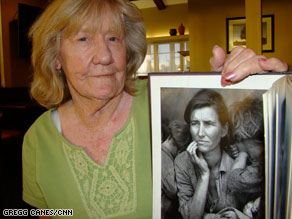
Katherine McIntosh holds the photograph taken with her mother in 1936.
art.photo.loc.jpg

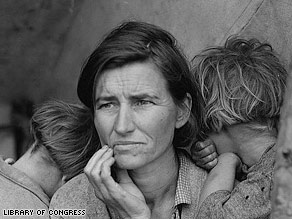
The photo is best known as "Migrant Mother." "It was to help the people in the plight that we were all in."
art.katherine.cnn.jpg

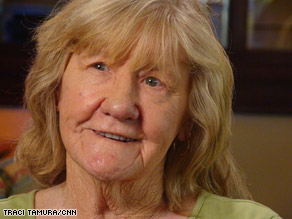
McIntosh says the photo helped motivate her to "make sure I never lived like that again."

Girl from iconic Great Depression photo: 'We were ashamed'
Dorothea Lange snapped iconic Great Depression photo of "Migrant Mother" in 1936
By Thelma Gutierrez and Wayne Drash
CNN
updated 2 hours, 1 minute ago

MODESTO, California (CNN) -- The photograph became an icon of the Great Depression: a migrant mother with her children burying their faces in her shoulder. Katherine McIntosh was 4 years old when the photo was snapped. She said it brought shame -- and determination -- to her family.

"I wanted to make sure I never lived like that again," says McIntosh, who turns 77 on Saturday. "We all worked hard and we all had good jobs and we all stayed with it. When we got a home, we stayed with it."

McIntosh is the girl to the left of her mother when you look at the photograph. The picture is best known as "Migrant Mother," a black-and-white photo taken in February or March 1936 by Dorothea Lange of Florence Owens Thompson, then 32, and her children.

Lange was traveling through Nipomo, California, taking photographs of migrant farm workers for the Resettlement Administration. At the time, Thompson had seven children who worked with her in the fields.

"She asked my mother if she could take her picture -- that ... her name would never be published, but it was to help the people in the plight that we were all in, the hard times," McIntosh says.

"So mother let her take the picture, because she thought it would help."

The next morning, the photo was printed in a local paper, but by then the family had already moved on to another farm, McIntosh says.

"The picture came out in the paper to show the people what hard times was. People was starving in that camp. There was no food," she says. "We were ashamed of it. We didn't want no one to know who we were."

The photograph helped define the Great Depression, yet McIntosh says her mom didn't let it define her, although the picture "was always talked about in our family."

"It always stayed with her. She always wanted a better life, you know."

Her mother, she says, was a "very strong lady" who liked to have a good time and listen to music, especially the yodeler named Montana Slim. She laughs when she recalls her brothers bringing home a skinny greyhound pooch. "Mom, Montana Slim is outside," they said.

Thompson rushed outside. The boys chuckled. They had named the dog after her favorite musician.

"She was the backbone of our family," McIntosh says of her mom. "We never had a lot, but she always made sure we had something. She didn't eat sometimes, but she made sure us children ate. That's one thing she did do."

Her memories of her youth are filled with about 50 percent good times, 50 percent hard times.

It was nearly impossible to get an education. Children worked the fields with their parents. As soon as they'd get settled at a school, it was time to pick up and move again.

Her mom would put newborns in cotton sacks and pull them along as she picked cotton. The older kids would stay in front, so mom could keep a close eye on them. "We would pick the cotton and pile it up in front of her, and she'd come along and pick it up and put it in her sack," McIntosh says.

They lived in tents or in a car. Local kids would tease them, telling them to clean up and bathe. "They'd tell you, 'Go home and take a bath.' You couldn't very well take a bath when you're out in a car [with] nowhere to go."

She adds, "We'd go home and cry."

McIntosh now cleans homes in the Modesto, California, area. She's proud of the living she's been able to make -- that she has a roof over her head and has been able to maintain a job all these years. She says her obsession to keep things clean started in her youth when her chore was to keep the family tent clean. There were two white sheets that she cleaned each day.

"Even today, when it comes to cleaning, I make sure things are clean. I can't stand dirty things," she says with a laugh.

With the nation sinking into tough economic times and analysts saying the current economic crisis is the worst since the Great Depression, McIntosh says if there's a lesson to be learned from her experience it is to save your money and don't overextend yourself. iReport: Are you worried about losing your job?

"People live from paycheck to paycheck, even people making good money," she says. "Do your best to make sure it doesn't happen again. Elect the people you think is going to do you good."

Her message for President-elect Barack Obama is simple: "Think of the middle-class people."


She says she'll never forget the lessons of her hard-working mother, who died at the age of 80 in 1983. Her gravestone says: "Migrant Mother: A Legend of the strength of American motherhood."

"She was very strict, but very loving and caring. She cared for us all," McIntosh says.
 
Last edited:

breezyhill

Veteran Member
Her mom would put newborns in cotton sacks and pull them along as she picked cotton. The older kids would stay in front, so mom could keep a close eye on them. "We would pick the cotton and pile it up in front of her, and she'd come along and pick it up and put it in her sack," McIntosh says.

:(:(:bwl::bwl:
 

Kronos

Inactive
Where was her dad? :shr:

I was wondering the same. No mention of a dad in the article.

Guess mom functioned as both.

7 children, and no dad.

BUT, the lady took care of them all.
If she were doing this today, more than likely The State would have taken her children away.

Would that have been better or worse for the children?

This woman shows pride of her mother, and of her own self-sufficiency.

Still, she recalls 50% 'bad times'.

Times are SO VERY DIFFERENT now, going into GD II
 

D_el

Veteran Member
This woman came from tough stock and worked all her life. No shame at all in that.

AMEN. Hard work and determination built strong character traits that her mom passed on to her girls.God bless them and all the 'New Depression' folks we'll be seeing soon. Let's hope a strong work ethic and moral code can be maintained where it exists.
 

Fisher

Has No Life - Lives on TB
Here is her Mothers wikipedia page.

Florence Owens Thompson
http://en.wikipedia.org/wiki/Florence_Owens_Thompson

Snipet on her Father.

Cleo lost his job at the sawmill in 1931, and the family moved to Oroville in northern California, where Cleo joined his brothers and sisters working in the fields picking peaches. Cleo died from a high fever at the age of 32 soon after moving, and was buried in Oroville.
 

Barry Natchitoches

Has No Life - Lives on TB
Her mom would put newborns in cotton sacks and pull them along as she picked cotton. The older kids would stay in front, so mom could keep a close eye on them. "We would pick the cotton and pile it up in front of her, and she'd come along and pick it up and put it in her sack," McIntosh says.

:(:(:bwl::bwl:


Today, this mother would be reported to Child "Protective" Services, and her children would probably be taken away from her.


But would they really be better, thrown into the foster care system?


These folks were poor in money and material things, but it seems to me that they were rich when it came to love.


God bless all the mothers like this lady.
 

SouthernGal

"Don't retreat...reload"
"The picture is best known as "Migrant Mother," a black-and-white photo taken in February or March 1936 by Dorothea Lange of Florence Owens Thompson, then 32, and her children."

Oh, my dear Lord! Now, I don't mean this in a mean way at all - ONLY an observation. Florence Owens Thompson looks like she's in her forties in that picture; she was barely out of her twenties?!!

Can you even imagine the life she had led up to that point to make her look that old at 32?
 

Breeta

Veteran Member
Here is her Mothers wikipedia page.

Florence Owens Thompson
http://en.wikipedia.org/wiki/Florence_Owens_Thompson

Snipet on her Father.

Cleo lost his job at the sawmill in 1931, and the family moved to Oroville in northern California, where Cleo joined his brothers and sisters working in the fields picking peaches. Cleo died from a high fever at the age of 32 soon after moving, and was buried in Oroville.

Thank you.

They should have mentioned that in the story... that fact makes it all more compelling. God bless her.
 

night driver

ESFP adrift in INTJ sea
Sou8thern Gal, while IN Pakistan, when treating Indigenous patients I REGULARLY OVERestimated the ages of the women I was treating by 30 years or more. I'd guess 65-70 and they would be 35 or 40.

The doc I went with called it SLS (S#!TTY Life Syndrome)....
 

Palmetto

Son, Husband, Father
Now, those are true American heros.

This should be taught in every HS and middle school classroom in the US.

I am sorry to say that most kids don't have a clue as to what hard times REALLY are.

Palmetto
 

summerthyme

Administrator
_______________
Part of the "looking much older than we'd think" problem is that we are *very* used to seeing women who have had good medical and dental care. Add in the care most women take these days with sunscreens, moisturizers, etc... and I think we'll all be in for a real shock about 2 years after TSTHF! (men, as well, although, aside from a smallish- I hope!- group of "metrosexuals", they generally don't tend to pamper themselves in cosmetic ways as much as your average woman)

And yes, the stress of being in that type of situation, with small children dependant on you, and lack of proper nutrition, etc... VERY aging.

I found it rather amazing- and very heartening- to read that the mother lived to 80, after all that! So many didn't last nearly that long... I believe it's DisasterCat who often mentions her grandmother who died in her ?40's? of "old age".

And yes, these days, it would be illegal to have your children work with you, especially if you don't own the farm. Even then, you have to be careful to not tick the wrong person off, or have a "certain type" of nanny stater see your kid's working with you on your own farm... reports HAVE been made before.

Summerthyme
 
Today, this mother would be reported to Child "Protective" Services, and her children would probably be taken away from her.


But would they really be better, thrown into the foster care system?


These folks were poor in money and material things, but it seems to me that they were rich when it came to love.


God bless all the mothers like this lady.

Yep! It's a matter of attitude.
 

bakodgid

Contributing Member
My great grandma raised six kids through the depression by herself after her husband died. She was one tough lady. She died in 1989 at the age of 101.
 

Brutus

Inactive
Honestly not trying to mean or anything, but that's what happens when you are so undisciplined as to have 7 kids and you have no skills beyond millworker or cottonpicker.

:shk:
 

Perpetuity

Inactive
Honestly not trying to mean or anything, but that's what happens when you are so undisciplined as to have 7 kids and you have no skills beyond millworker or cottonpicker.

:shk:
Remember the times as well. Opportunities were rare, and survival was paramount.

My great grandfather was a migrant who found himself in Tazewell county Virginia at the age of 14. Ran away from home, stowed on a ship and just ended up there. How he would never say. He moved to the mountains of West Virginia soon afterwards, and started laying railroad tracks in the mountians for coal trains at that age to make a living, a hard job for even someone older. He stuck with it for many, many years, and eventually worked his way into being on a train as a conductor, and stuck with that until he retired. He died at age 97, still deep in the mountains of West Virginia near the Kentucky border. I don't think he "wanted" to carry railroad ties for hours upon hours a day for very little money, but it was enough for him to survive on at a time where opportunities were few, and even fewer being in the mountains where the other option was being in a coal mine. The other option was to leave the area, which a few did, but for the most part, family ties stayed strong if you were born there. And you never really leave the mountains if you're born there. They're a part of you.

This story has been played out by multitudes across the country while our country was growing. Geographical locations may change, but the blood, sweat, love and frustrations were the same for everyone then, no matter where you were.

Times have changed, but even for those in deep Appalachia change was even slower. Even as a kid I remember being "deep in the hollers" and seeing settings that weren't much different then the pics Dozdoats posted the link to, and that was only about 30 to 40 some years ago. College was reserved for only the few that were wealthy and fortunate, for others, coal mines were about the only option. While the mines at that time paid relatively decent, poverty was still the norm due to strikes, mine accidents, and your body physically wearing out. Respiratory diseases were also rampant due to the coal dust. But you did the job because you and your family had to eat. Not because you wanted to. We've been spoiled with our educational and career opportunities today, and have forgotten that simple survival often takes precedence in different times.
 

Perpetuity

Inactive
Honestly not trying to mean or anything, but that's what happens when you are so undisciplined as to have 7 kids and you have no skills beyond millworker or cottonpicker.

:shk:
Also remember the effects of the Dust Bowl combined with the Depression. The farm you had suddenly was worthless and incapable of growing anything, and then the bank owned it because you couldn't grow anything on it to pay the banks. What were thriving communities in the Midwest suddenly became ghost towns, economically unviable, and you had no choice to leave and to try to find work elsewhere. And there was the problem. There was no other work, and you found yourself with the other masses, moving around for enough to survive and to keep your kids somewhat fed to keep them from starving. And it wasn't just farmers either. Store owners, business owners, and others found themselves victims of what was happening. That was the reality of the day for a huge number of families.
 
That mother left behind a strong legacy that hard work never killed anyone and if you want a better life, you need to work for it. I wish more parents would do that today.
 

vetus

Inactive
Honestly not trying to mean or anything, but that's what happens when you are so undisciplined as to have 7 kids and you have no skills beyond millworker or cottonpicker.

:shk:

So your saying these people failed by not predicting the great depression. They should have lived more frugal, somehow.

I wonder what 'skills' you have that will bring you through in style and comfort.

So quick to criticize, so little understanding.
 

Amaryllis

Inactive
Honestly not trying to mean or anything, but that's what happens when you are so undisciplined as to have 7 kids and you have no skills beyond millworker or cottonpicker.

:shk:

What's wrong with being a millworker or a cottonpicker? What if any skills are good for a Great Depression? If we enter another Great Depression, we could find ourselves in the same position despite our skills. I have a feeling that those white collar six figure jobs aren't going to cut it. Unlike the lady in the picture, at least we'll have the advantage of having the history she lived through to learn from. She was on unchartered territory. JMHO.
 

timbo

Deceased
Brutus, it was another time,another era.
My Mom was one of nine kids and Grandpa had a so-so job in a factory.

DW,Dad side was a family of nine kids. Italian immigrants that were in WV. That was either the coal mines or if you knew someone, the glass factory.

DW,Mom side had nine kids as well. (Italian immigrants as well) but the unfortunate part was the first 5 kids were girls! That meant very little money coming into the home!

All these families worked at a young age and brought home the paycheck and put it in a collective pot so all could eat,have a home, clothes,etc.

Big families were kind of an investment in a built in job bank.

If you look up the demographics of the USA all the way from our inception, large families were the norm.
My Dad only had two sisters.......a real exceptional family of those times.

BTW, my Dad was born in 1905, my Mom in 1910 just to give you a perspective of the times.

Oh yeah, I was one of 4 brothers. Two of us being single and staying home, donated income to the house.
 

Wombatcat

Bibliophile
Where was her dad? :shr:

From what I know, I think a lot of husbands left home in search of work, and others left home because they were ashamed that they couldn't support their families....?

Someone please correct me if I'm wrong....
 

Wombatcat

Bibliophile
Honestly not trying to mean or anything, but that's what happens when you are so undisciplined as to have 7 kids and you have no skills beyond millworker or cottonpicker.

:shk:

Just wondering how you figure this could have been avoided?
After all, there was no birth control. Divorce was HUGELY frowned upon, and comparatively few women worked outside the home. The ones that did had to deal with a certain stigma.

So. Basically, since the most socially acceptable thing to do at the time was get married and have babies, what you are suggesting is that this woman (and countless others) say to themselves "Hmmm. I probably shouldn't sleep with my husband, because a Depression might happen and it might be hard to feed these kids when my husband dies or disappears." "I'm sure my husband, who currently supports all of us, will completely understand that."

Right.

Honestly, not trying to be mean or anything, but could you please just explain to me how she realistically could have done differently?
 

theoriginaldeb

Still A Geology Fanatic
Honestly not trying to mean or anything, but that's what happens when you are so undisciplined as to have 7 kids and you have no skills beyond millworker or cottonpicker.

:shk:

I am not trying to be mean here either but contraceptives have not always been available to the general populous even as recently as the great Depression. And having 7 living healthy children was once considered a great blessing.
Discipline was not the issue....when people were closer to the earth.....living and dying was a fact of daily life and most of the population was agrarian. I am a little puzzled by this comment.
 

theoriginaldeb

Still A Geology Fanatic
Honestly not trying to mean or anything, but that's what happens when you are so undisciplined as to have 7 kids and you have no skills beyond millworker or cottonpicker.

:shk:

I just scrolled back...you really stepped in it huh! ;)
But the question incited some interesting historic perspective.
 

Border Guns

Veteran Member
I was told that some women back then used kerosene soaked rags and stuffed them up "there" as a contraceptive. Other methods were used as well. Brutus, all I can say is, it's a good thing you were not a woman back then. Most women died early in child birth or worked to death.
 

Brutus

Inactive
Just wondering how you figure this could have been avoided?
After all, there was no birth control. Divorce was HUGELY frowned upon, and comparatively few women worked outside the home. The ones that did had to deal with a certain stigma.

So. Basically, since the most socially acceptable thing to do at the time was get married and have babies, what you are suggesting is that this woman (and countless others) say to themselves "Hmmm. I probably shouldn't sleep with my husband, because a Depression might happen and it might be hard to feed these kids when my husband dies or disappears." "I'm sure my husband, who currently supports all of us, will completely understand that."

Right.

Honestly, not trying to be mean or anything, but could you please just explain to me how she realistically could have done differently?

I am not trying to be mean here either but contraceptives have not always been available to the general populous even as recently as the great Depression. And having 7 living healthy children was once considered a great blessing.
Discipline was not the issue....when people were closer to the earth.....living and dying was a fact of daily life and most of the population was agrarian. I am a little puzzled by this comment.

Hey Dopey #1 and Dopey #2, pulling out has *ALWAYS* been available.

:smkd:

:smkd:
 

FREEBIRD

Has No Life - Lives on TB
"So quick to criticize, so little understanding."

So true---apparently this woman was so "undisciplined" that her husband got sick and died---I imagine that's all her fault too.

I just love it when the pregnancy police show up.
 

Surprise

Inactive
Honestly not trying to mean or anything, but that's what happens when you are so undisciplined as to have 7 kids and you have no skills beyond millworker or cottonpicker.

:shk:

I recall my Grandmother telling me "All we had back then wuz rubbers and most of the time you couldn't even afford them. They wuz like a luxury ".

My other Grandmaw who birthed 8, said after her last one, (my Dad), she desperately begged and pleaded with the doctor to "do something to her" so she could not have anymore. My Dad ran away at 14 because he said there was not enough food for everybody and he felt like he was such a burden.

If I had a bunch already that I could not feed, and knowing what would cause yet another, I would probably have not been too inviting to a feller wanting to probe. There were other things they could have done . I guess in such a dismal world, sex might have been one of the few pleasures in life. :shr:
 
Last edited:

NC Susan

Deceased
Thank you.

They should have mentioned that in the story... that fact makes it all more compelling. God bless her.


Fathers have been edited out of society since the Feminists started rearranging society by killing unborns. Look where we are 2 generations later..........:shkr:.
 
Top