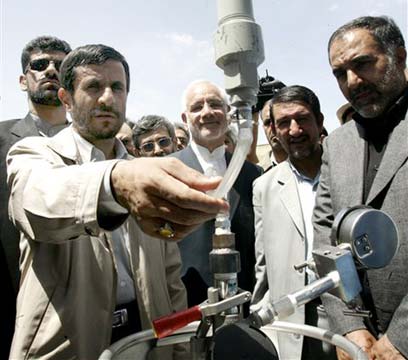
WAR Construction on Iranian plutonium reactor to be completed THIS year...Israel

Zulu Cowboy

Keep It Real...
I believe that the Israelis will attack the Busher nuclear reactor, as well as the enrichment facilities at Natanz...before this reactor is even fueled up!

We're talking, within the next couple of months...

The Israeli's aren't about, to let this thing go online!

And if they attack AFTER it is fueled and started up...it would be an environmental nightmare, (think Chernobyl).

Hell...we might see a radioactive cloud...either way this goes! :shr:

:srdot:
Zulu Cowboy
www.SurvivalUSA.org

- - - - - - -

Moscow halts Iran cooperation with US, will complete Bushehr reactor
http://www.debka.com/headline.php?hid=5545
DEBKAfile Special Report

August 30, 2008, 7:32 PM (GMT+02:00)

The Georgia quarrel has all but derailed US-Russian cooperation on the Iran issue. Moscow is not only pulling out of the diplomatic and sanctions front against Iran’s nuclear program; according to DEBKAfile’s Russian sources, Moscow has decided to finally finish building Iran’s nuclear reactor in the southern town of Bushehr before the end of the year, after holding back for five years at Washington’s insistence.

Russian prime minister Vladimir Putin said in reference to the impact of the Georgia row on US-Russian cooperation on Iran Thursday, Aug. 28: “If nobody wants to talks with us on these issues and cooperation with Russia is not needed, then for God’s sake, do it yourself.”

Moscow has now committed to completing the reactor within four months. DEBKAfile’s military sources report that the functioning plant will enable Iran to operate a heavy water plant and produce plutonium as an alternative to enriched uranium for building a nuclear bomb. Tehran had originally counted on the Syria’s North Korean reactor at al Kibar for plutonium. It was demolished by Israel last September.

Putin’s sharp comment means the West can forget about Russian support for another round of harsh sanctions to punish Iran for refusing to suspend uranium enrichment. He made it clear that Western nations will have to resolve the standoff without Russian help if they refuse to cooperate with Moscow on Georgia.

The Russians have lost no time in following through on their threat. This week, they are sending the head of their Nuclear Energy Board, Sergei Kireinko, to Tehran at the head of a large delegation. They will stay for at least ten days to clear away the problems for getting the Bushehr reactor up and running by the end of 2008.


In accordance with Title 17 U.S.C. Section 107, the material in this post is distributed without profit to those who have expressed a prior interest in receiving the included information for research and educational purposes…

- - - - - - - - -

'What To Do If A Nuclear Disaster Is Imminent'

How to use radiological instruments - (Survey Meters/Dosimeters)

Fallout Protection - What to know and do about nuclear attack

Nuclear War Survival Skills, by Cresson Kearney

Radiation Safety in Shelters

FEMA - The Effects of Nuclear War

CDC - Acute Radiation Syndrome - A Fact Sheet For Physicians

CDC - Explosions and Blast Injuries
 
Last edited:
=


The reactor is designed to procude Plutonium!!

Plutonium is used for "advanced designed nuclear weapons" And RARELY as a fuel for reactors....
 

RobinYyes

Inactive
FD,
I doubt they'll get the opportunity to complete it. Not if Benne has anything to say about it (Benjamin Netenyahu that is)
 

kozanne

Inactive
How many times on this board and elsewhere were we warned about this? And how many times was the warning ridiculed or outright ignored?

Now I gotta go search some threads and see what was being said about all of this.....
 

dberszerker

Veteran Member
Anyone that thinks Russia was going to stop helping Iran EVER, might well be intersted in some snake oil, that I have for sale, it cures every damn thing only $1,000,000,000,000,000,001 an ounce.:kaid:
 

SarahLynn

Veteran Member
=


The reactor is designed to procude Plutonium!!

Plutonium is used for "advanced designed nuclear weapons" And RARELY as a fuel for reactors....


I expect about now all the Russian and Muslim apologetics folks will come galloping out of the woodwork with comments like, "But, but, but, Iran has had enough! Iran has been poked in the eye by the evil Israelis and Americans! Iran is feeling unloved today! We must look for root causes and they lead through Israel! This is all the work of the neeeeeeeeeeohcons!! Cheney and Bush planned this with the Joos!!"

You just KNOW they'll be here soon!

:kk2:
 
=


The reactor is designed to procude Plutonium!!

Plutonium is used for "advanced designed nuclear weapons" And RARELY as a fuel for reactors....

I am going to add to my own post:

I believe that a Plutonium reactor is also called a "fast breeder" reactor. And it has one GIANT DRAWBACK! A Fast Breeder reactor will not have a "meltdown" like an ordinary reactor - when problems occur!

A Fast Breeder Reactor will EXPLODE like a GIANT THERMONUCLEAR BOMB! And being in 'contact' with the ground - the fall out would indeed, cover vast territories down wind.

*A thought occurs to me. The reactor it's self would be a Islamic doomsday weapon much like the Israeli's "Samson Opition" because the whole of the ME would become a radioactive hell...

The US has / Had a fast breeder reactor (Clinch River) I believe it was called.
 

Wardogs

Inactive
This story, while alarming, has a couple of obvious flaws.
First is the fact that Russia has never stopped the construction on the Bushehr plant. In fact it delivered the first fuel shipment in January and the rest in April. Far from cooperating, they have fought sanctions and continued to supply materials and weapons to defend the plants.

Secondly, the Bushehr plant is NOT a plutonium reactor.
The one in Arak is however.

We wouldn't know a thing about either one if not for the revelations of defectors in 2002.

The timeline went like this as I recall.

In the 1980s, China had ceased nuclear cooperation with Iran, a nuclear embargo by Western nuclear suppliers was holding firm, and, through constant U.S. intervention, it was hoped that leakage of sensitive nuclear technology from Russia could be halted.

By the end of 2002, this hopeful view of the international nonproliferation regime was dashed by the discovery that in the previous 18-24 months, despite the vigilance of U.S. and other intelligence services, Iran had secretly made considerable progress on two different routes to nuclear weapons.

First, it had completed a pilot-scale facility to enrich uranium at Natanz using high-speed centrifuges, a demanding technology but one that is now spreading rapidly. Iran has said it now has 4,000 working, the IAEA says it's closer to 3500. If enlarged to the 54,000 capability it's designed for, the facility would be capable of producing large quantities of uranium enriched to the level needed for nuclear weapons of the type used against Hiroshima.

Second, Iran at the time appeared to have completed, or to be near completing, a facility at Arak for the production of heavy water, a product used in reactors designed to produce plutonium. This was the material used in the Nagasaki bomb. The Arak facility was confirmed to be operating in mid '03, and Natanz was opened with much fanfare in '06.

The advanced state of these facilities was doubly disturbing because it implied that Iran possessed still other, as yet undeclared nuclear plants. When the IAEA's Director-General, Mohammed El Baradei, eventually requested and was granted a visit to the Natanz facility, his team concluded that the facility was so sophisticated that it could only have been built after Iran had constructed and operated a smaller scale, experimental enrichment unit. While Iran might claim that it had no obligation to declare the Natanz plant because it had not yet introduced natural uranium into the facility, it would have had to take this step to test out the smaller experimental facility - a clear violation of its inspection obligations under the NPT.

Moreover, the fact that Iran was attempting to produce heavy water implied that it was constructing - or had completed - a heavy-water-using reactor, which it had also not declared. This is a Plutonium producing facility. (Heavy water or Plutonium is not needed for the nuclear power plant that Russia is building for Iran, at Bushehr, nor ANY planned reactor in Iran).

The Syrian reactor was without a doubt an "offshore" reactor, placed there to avoid inspections of any kind. This was also a Plutonium reactor, based on a N Korean design, and did not even have the pretense of power generation, as it had no facilities at all for electricity generation.

Just like Iraq, Iran has used inspections to "prove" their "peaceful intent" for nuclear research. Even the IAEA, whose pitiful attempts to cover for them, finally admitted last April that "there were concerns" about Iran's openness.

The inspections have been used as a ploy to keep the "peaceful purpose" facade going and prevent harsher actions.
If they fail completely, I look for what is called the "break-out" scenario.

Under the NPT, Iran is permitted to enrich uranium, even to weapons grade, as long as the material is kept under IAEA inspection. The treaty also permits states to withdraw from it on 90 days notice, if its supreme national interests are threatened.

Thus, even if Iran complied impeccably with its IAEA obligations, over time, it could amass a stockpile of enriched uranium. Then, if at some future juncture it found itself threatened by the United States or a resurgent Iraq, it could withdraw from the NPT, seize this stockpile, and manufacture nuclear weapons in a matter of weeks. Indeed, even if it produced stocks only of low-enriched uranium of the type used in the Bushehr reactor, Iran's centrifuge enrichment plant could be rapidly modified to "re-enrich" the material and bring it to weapons grade in a few weeks' time. The fuel that Russia has delivered already could also be further enriched very quickly.
wardogs
 

almost ready

Inactive
WarDogs

If I understand you correctly, and ARak is operational now for years, then

1 Iran has hot plutonium and has had it for years

2 Any hit on Arak could be devastating to the entire region

If this is correct, then everything we thought we knew is wrong. Just wrong. The deadlines, the worry about timelines is all just so much hot air.

:confused:
 

Wardogs

Inactive
If I understand you correctly, and ARak is operational now for years, then

1 Iran has hot plutonium and has had it for years

2 Any hit on Arak could be devastating to the entire region

If this is correct, then everything we thought we knew is wrong. Just wrong. The deadlines, the worry about timelines is all just so much hot air.

:confused:

Although Arak actually went on-line in 2003, Iran made a big deal of "inauguration" in '06. This came just a few months before the opening of the Natanz enrichment facility, which had also been operating for several years.

This does not even consider the "clandestine" facilities scattered through the country, or the "research" facilities at Universities that don't come under any inspection protocol.

It does highlight the ineffectiveness of inspections, treaties and sanctions.

The Arak facility was used as a propaganda ploy by Iran in '06, when they made a big deal of it's "opening" in the press.

Neither the heavy water facilities or the enrichment facility at natanz produce fuel compatible with the Bushehr reactor. Russia is under contract to supply fuel for that reactor for ten years. A further, 30 year contract for supply was rejected by Iran as unnecessary.

Iran flares off more natural gas than would be needed to run it's electrical needs for even a 30 year projection., let alone using it as an applied resource. Only Russia has a larger supply.
To think that Iran needs nuclear energy for power is a joke.

Here is just one of the articles covering the "opening" of Arak from '06.

Iran achieves significant nuclear goal

http://www.ynetnews.com/articles/0,7340,L-3295794,00.html

(VIDEO) Iran continues to signal unwillingness to halt nuclear development: Official in Tehran announces heavy water plant completed. Ahmadinejad claims Iran does not constitute a threat, states that nation willing to defend its right to nuclear activity with force

Dana Zimmerman
Latest Update: 08.26.06, 13:15 / Israel News

VIDEO - Four days after sending back a rebellious but politely-couched answer to the West's 'stick and carrot' approach, and five days before the expiration of the UN's ultimatum to halt uranium enrichment, Tehran poured fuel on the fire regarding the issue of its nuclear development with the completion of a heavy water plant.

An official source announced the completion of the heavy water plant on Saturday. Iranian president Mahmoud Ahmadinejad inaugurated the plant later the same day and issued a relevant statement.

Iranian president visits Arak nuclear plant (Video: Reuters)

Ahmadinejad said that Iran will not relinquish its right to a nuclear program and stated that the nation does not constitute a threat, not even to Israel. AFP reported that the president also declared that his country was willing to defend its right to nuclear development with force.

Iran insists that the heavy water plant, and its nuclear development program in general, is intended for energy, and not military purposes. However, Western countries fear the nation's nuclear development because it is possible to utilize the reactor's output, Plutonium, to build nuclear warheads.

VAH101_wa.jpg


Nuclear weapons can be produced using either Plutonium or highly enriched uranium as the explosive core. Either substance can be produced in the process of running a reactor. Reactors fueled by enriched Uranium use regular (or light) water as part of the energy producing chain reaction.

Heavy water, which contains a heavier Hydrogen particle, would allow Iran to use naturally mined Uranium, foregoing the enrichment process. The chief of the facility, Manouchehr Madadi, said that up to 16 tons of heavy water could be produced annually.

Diplomatic Developments

Iran refuses to suspend nuclear activity / Dudi Cohen
Tehran offers new formula for solving crisis surrounding nuclear program, but in fact rejects incentive plan offered by western states, Fars news agency reported; US disappointed by Iranian reply
Full Story:

Earlier this week, a senior official involved in Iran's nuclear project stated that Iran was close to completion of the heavy water phase of nuclear development, but had not completed the reactor itself. The nuclear reactor has been under construction for years and it anticipated to be complete in 2009.

The source claimed that the project is intended for a number of industrial purposes and that the heavy water would not be used for military purposes. As such, he said, there was no reason for international monitors to supervise the project.

Western responses

A Western diplomat confirmed that the heavy water project is not being used for military purposes, but added that such an announcement, at a time when the crisis between Iran and the west regarding the nuclear issue is at its peak, is a catastrophic step.

Last Tuesday, Iran responded to the 'carrot and stick' offer of financial and diplomatic incentives, proposed by the five members of the UN Security Council and Germany, which was intended to goad Iran in halting its nuclear development without resorting to the use of sanctions.

Despite the fact that the proposal was extended in June, sources in Tehran refused to respond, causing the six nations to issue an ultimatum to Iran to stop enriching Uranium by August 31.

Iran's response to the proposal – a statement of over 20 pages, including questions and comments – arrived only in the past week and contained a "new formula" of dialogue between Iran and the west, which would assure the west of the peaceful motivations of Iran's nuclear project.

The response, which greatly disappointed the western recipients, is still being examined, although German Chancellor Angela Merkel stated that the document "lacks even one decisive sentence" regarding a cessation of uranium enrichment. French Foreign Minister, Philippe Douste-Blazy concurred that Iran's response is insufficient.
 

KKC

Veteran Member
Although Arak actually went on-line in 2003, Iran made a big deal of "inauguration" in '06. This came just a few months before the opening of the Natanz enrichment facility, which had also been operating for several years.

This does not even consider the "clandestine" facilities scattered through the country, or the "research" facilities at Universities that don't come under any inspection protocol.

It does highlight the ineffectiveness of inspections, treaties and sanctions.

The Arak facility was used as a propaganda ploy by Iran in '06, when they made a big deal of it's "opening" in the press.

Neither the heavy water facilities or the enrichment facility at natanz produce fuel compatible with the Bushehr reactor. Russia is under contract to supply fuel for that reactor for ten years. A further, 30 year contract for supply was rejected by Iran as unnecessary.

Iran flares off more natural gas than would be needed to run it's electrical needs for even a 30 year projection., let alone using it as an applied resource. Only Russia has a larger supply.
To think that Iran needs nuclear energy for power is a joke.

Here is just one of the articles covering the "opening" of Arak from '06.

Iran achieves significant nuclear goal

http://www.ynetnews.com/articles/0,7340,L-3295794,00.html

(VIDEO) Iran continues to signal unwillingness to halt nuclear development: Official in Tehran announces heavy water plant completed. Ahmadinejad claims Iran does not constitute a threat, states that nation willing to defend its right to nuclear activity with force

Dana Zimmerman
Latest Update: 08.26.06, 13:15 / Israel News

VIDEO - Four days after sending back a rebellious but politely-couched answer to the West's 'stick and carrot' approach, and five days before the expiration of the UN's ultimatum to halt uranium enrichment, Tehran poured fuel on the fire regarding the issue of its nuclear development with the completion of a heavy water plant.

An official source announced the completion of the heavy water plant on Saturday. Iranian president Mahmoud Ahmadinejad inaugurated the plant later the same day and issued a relevant statement.

Iranian president visits Arak nuclear plant (Video: Reuters)

Ahmadinejad said that Iran will not relinquish its right to a nuclear program and stated that the nation does not constitute a threat, not even to Israel. AFP reported that the president also declared that his country was willing to defend its right to nuclear development with force.

Iran insists that the heavy water plant, and its nuclear development program in general, is intended for energy, and not military purposes. However, Western countries fear the nation's nuclear development because it is possible to utilize the reactor's output, Plutonium, to build nuclear warheads.

VAH101_wa.jpg


Nuclear weapons can be produced using either Plutonium or highly enriched uranium as the explosive core. Either substance can be produced in the process of running a reactor. Reactors fueled by enriched Uranium use regular (or light) water as part of the energy producing chain reaction.

Heavy water, which contains a heavier Hydrogen particle, would allow Iran to use naturally mined Uranium, foregoing the enrichment process. The chief of the facility, Manouchehr Madadi, said that up to 16 tons of heavy water could be produced annually.

Diplomatic Developments

Iran refuses to suspend nuclear activity / Dudi Cohen
Tehran offers new formula for solving crisis surrounding nuclear program, but in fact rejects incentive plan offered by western states, Fars news agency reported; US disappointed by Iranian reply
Full Story:

Earlier this week, a senior official involved in Iran's nuclear project stated that Iran was close to completion of the heavy water phase of nuclear development, but had not completed the reactor itself. The nuclear reactor has been under construction for years and it anticipated to be complete in 2009.

The source claimed that the project is intended for a number of industrial purposes and that the heavy water would not be used for military purposes. As such, he said, there was no reason for international monitors to supervise the project.

Western responses

A Western diplomat confirmed that the heavy water project is not being used for military purposes, but added that such an announcement, at a time when the crisis between Iran and the west regarding the nuclear issue is at its peak, is a catastrophic step.

Last Tuesday, Iran responded to the 'carrot and stick' offer of financial and diplomatic incentives, proposed by the five members of the UN Security Council and Germany, which was intended to goad Iran in halting its nuclear development without resorting to the use of sanctions.

Despite the fact that the proposal was extended in June, sources in Tehran refused to respond, causing the six nations to issue an ultimatum to Iran to stop enriching Uranium by August 31.

Iran's response to the proposal – a statement of over 20 pages, including questions and comments – arrived only in the past week and contained a "new formula" of dialogue between Iran and the west, which would assure the west of the peaceful motivations of Iran's nuclear project.

The response, which greatly disappointed the western recipients, is still being examined, although German Chancellor Angela Merkel stated that the document "lacks even one decisive sentence" regarding a cessation of uranium enrichment. French Foreign Minister, Philippe Douste-Blazy concurred that Iran's response is insufficient.


This just keeps getting better by the minute!!!:popcorn1:

I need some coolaid...
 

Zulu Cowboy

Keep It Real...
This story, while alarming, has a couple of obvious flaws.
First is the fact that Russia has never stopped the construction on the Bushehr plant. In fact it delivered the first fuel shipment in January and the rest in April. Far from cooperating, they have fought sanctions and continued to supply materials and weapons to defend the plants.

Secondly, the Bushehr plant is NOT a plutonium reactor....(snip)..."

wardogs

- - - - - - -

Quote: "US opposition to Russian construction of Bushehr rests on three issues; first that weapons grade plutonium could be extracted from the reactor allowing the Iranians to construct nuclear weapons...(snip)..."

"Russia withheld fuel for the reactor because of international concerns about Iran's nuclear ambitions. Iran and Russia will sign a deal in the summer of 2004 on the return of spent nuclear fuel Russia will provide for the Bushehr plant. The deal is intended to prevent the extraction of plutonium from spent fuel and its possible use in nuclear warheads...(snip)..."

"According to Paul Leventhal of the Nuclear Control Institute, if Iran were to withdraw from the Nonproliferation Treaty and renounce the agreement with Russia, the Bushehr reactor could produce a quarter ton of plutonium per year, which Leventhal says is enough for at least 30 atomic bombs...(snip)..."

http://www.globalsecurity.org/wmd/world/iran/bushehr.htm

- - - - -
"The VVER-1000 reactor to be installed at Bushehr will generate spent fuel each year containing more than 180kg of plutonium.[5] Even reactor-grade plutonium can be used to build a primitive nuclear device, if Iran were to divert and reprocess this fuel in violation of its NPT obligations. In addition, if Iran were to abruptly exit from the NPT at some point (as North Korea tried to do in 1993), and fuel burnup were reduced, the reactor could produce a significant quantity of weapons-grade plutonium...(snip)..."

http://www.nti.org/db/nisprofs/russia/exports/rusiran/react.htm

- - - - - - -

Now I'm no nuclear scientist...but, I guess I just don't understand the discrepancy?

:shr:
Zulu Cowboy
 
Last edited:

Wardogs

Inactive
Now I'm no nuclear scientist...but, I guess I just don't understand the discrepancy?
Zulu Cowboy

Each type of reactor produces Plutonium. A heavy water plant is called a "Plutonium reactor" because it produces significantly more.

Both plants in question can be used to enrich uranium, a critical part in nuclear programs, but the extraction of weapons-grade material from a light-water reactor is much more difficult. Most light water plants "re-process" the spent fuel leaving a minimum of material that can be further enriched for weapons grade material. Uranium enriched to low grades is used for fuel in nuclear reactors, but further enrichment makes it suitable for atomic bombs.

A light water reactor also needs more highly enriched Uranium for fuel than it's heavy water counterpart. Those reactors use natural uranium rather than the enriched form, which is costlier and more complicated to produce.

Iran has said that it will sell nuclear fuel including spent fuel (enriched in the reactor) to all who want it. In fact, it's their Islamic duty to do so.

Heavy water is D2O, it has two hydrogen isotopes, each with a neutron (called deuterium), instead of none (which would be normal hydrogen). Light water is normal H2O.

Light water reactors require graphite control rods to slow down the neutrons produced by the fission. Heavy water reactors use the duterated water instead of the control rods to slow them down. They also can produce Tritium, another component in weapons production.

Simpler to build, more plutonium from spent fuel and more dangerous to operate.

The Bushehr plant could produce a significant amount of Plutonium if it's fuel is not re-processed, but the cost of enriching the fuel initially makes it much more costly to operate that way.

Iran is not working on re-processing technology at all, only enrichment.

The Arak plant produces Plutonium in greater quantities and much more economically. Plus, it's fuel is not under any restrictions to be returned to Russia or anyone else. (Not that I believe for a minute that they would honor any such agreement anyway).

I think some of the confusion is in the headline.
I bet the Debka article is referring to the Arak plant, not Bushehr. Iran has indicated that the heavy-water production facility at Arak will operate in tandem with a 40 MW research reactor that has a scheduled completion date in 2009.
The Bushehr reactor is supposed to come online in 2009 also, and it's not a heavy water facility.

wardogs
 
Last edited:
Top