Lack of Sunspots

Moggy

Inactive
Note: To view the picture, see the site given at end of story.

Science
Sun Makes History: First Spotless Month in a Century

The record-setting surface of the sun. A full month has gone by without a single spot (Source: Solar and Heliospheric Observatory (SOHO))

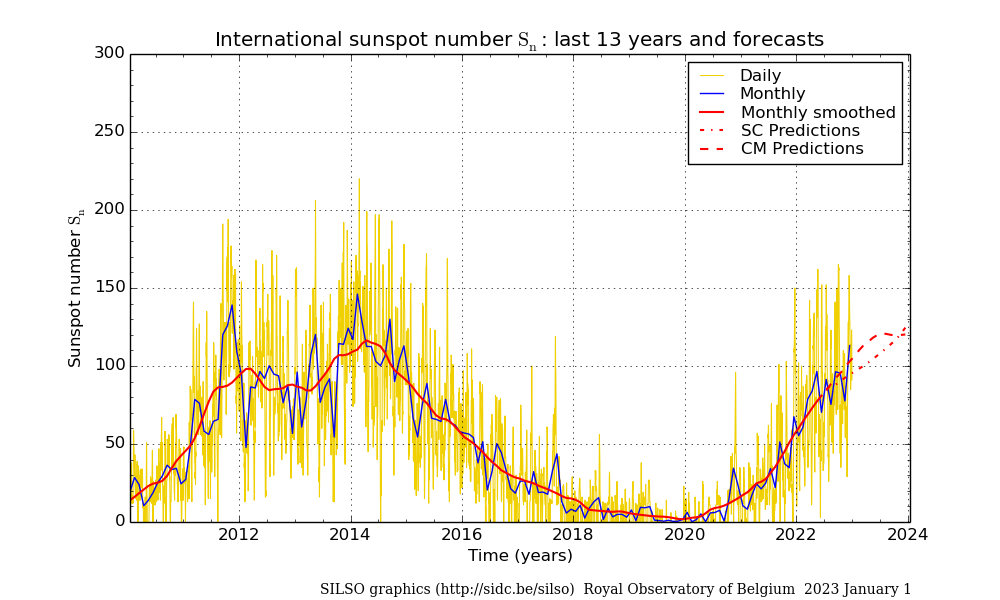
Sunspot activity of the past decade. Over the past year, SIDC has continually revised its predictions downward (Source: Solar Influences Data Center)

Geomagnetic solar activity for the past two decades. The recent drop corresponds to the decline in sunspots. (Source: Anthony Watts)

A chart of sunspot activity showing two prior solar minima, along with heightened activity during the 20th century (Source: Wikimedia Commons)Drop in solar activity has potential effect for climate on earth.

The sun has reached a milestone not seen for nearly 100 years: an entire month has passed without a single visible sunspot being noted.

The event is significant as many climatologists now believe solar magnetic activity – which determines the number of sunspots -- is an influencing factor for climate on earth.

According to data from Mount Wilson Observatory, UCLA, more than an entire month has passed without a spot. The last time such an event occurred was June of 1913. Sunspot data has been collected since 1749.

When the sun is active, it's not uncommon to see sunspot numbers of 100 or more in a single month. Every 11 years, activity slows, and numbers briefly drop to near-zero. Normally sunspots return very quickly, as a new cycle begins.

But this year -- which corresponds to the start of Solar Cycle 24 -- has been extraordinarily long and quiet, with the first seven months averaging a sunspot number of only 3. August followed with none at all. The astonishing rapid drop of the past year has defied predictions, and caught nearly all astronomers by surprise.

In 2005, a pair of astronomers from the National Solar Observatory (NSO) in Tucson attempted to publish a paper in the journal Science. The pair looked at minute spectroscopic and magnetic changes in the sun. By extrapolating forward, they reached the startling result that, within 10 years, sunspots would vanish entirely. At the time, the sun was very active. Most of their peers laughed at what they considered an unsubstantiated conclusion.

The journal ultimately rejected the paper as being too controversial.

The paper's lead author, William Livingston, tells DailyTech that, while the refusal may have been justified at the time, recent data fits his theory well. He says he will be "secretly pleased" if his predictions come to pass.

But will the rest of us? In the past 1000 years, three previous such events -- the Dalton, Maunder, and Spörer Minimums, have all led to rapid cooling. One was large enough to be called a "mini ice age". For a society dependent on agriculture, cold is more damaging than heat. The growing season shortens, yields drop, and the occurrence of crop-destroying frosts increases.

Meteorologist Anthony Watts, who runs a climate data auditing site, tells DailyTech the sunspot numbers are another indication the "sun's dynamo" is idling. According to Watts, the effect of sunspots on TSI (total solar irradiance) is negligible, but the reduction in the solar magnetosphere affects cloud formation here on Earth, which in turn modulates climate.

This theory was originally proposed by physicist Henrik Svensmark, who has published a number of scientific papers on the subject. Last year Svensmark's "SKY" experiment claimed to have proven that galactic cosmic rays -- which the sun's magnetic field partially shields the Earth from -- increase the formation of molecular clusters that promote cloud growth. Svensmark, who recently published a book on the theory, says the relationship is a larger factor in climate change than greenhouse gases.

Solar physicist Ilya Usoskin of the University of Oulu, Finland, tells DailyTech the correlation between cosmic rays and terrestrial cloud cover is more complex than "more rays equals more clouds". Usoskin, who notes the sun has been more active since 1940 than at any point in the past 11 centuries, says the effects are most important at certain latitudes and altitudes which control climate. He says the relationship needs more study before we can understand it fully.

Other researchers have proposed solar effects on other terrestrial processes besides cloud formation. The sunspot cycle has strong effects on irradiance in certain wavelengths such as the far ultraviolet, which affects ozone production. Natural production of isotopes such as C-14 is also tied to solar activity. The overall effects on climate are still poorly understood.

What is incontrovertible, though, is that ice ages have occurred before. And no scientist, even the most skeptical, is prepared to say it won't happen again.

Article Update, Sep 1 2008. After this story was published, the NOAA reversed their previous decision on a tiny speck seen Aug 21, which gives their version of the August data a half-point. Other observation centers such as Mount Wilson Observatory are still reporting a spotless month. So depending on which center you believe, August was a record for either a full century, or only 50 years.

http://www.dailytech.com/Sun+Makes+History+First+Spotless+Month+in+a+Century/article12823.htm

Moggy
 

jed turtle

a brother in the Lord
Fire and Ice

(From Harper’s Magazine, December 1920.)


SOME say the world will end in fire,
Some say in ice.
From what I’ve tasted of desire
I hold with those who favor fire.
But if it had to perish twice,
I think I know enough of hate
To know that for destruction ice
Is also great
And would suffice.

Robert Frost (1874–1963). Miscellaneous Poems to 1920.

had to get that out of my system.

so, looks like we're headed for a cold day in hell.
 

Publius

On TB every waking moment
Will it go two months? Just how cold can this coming winter get? At 35 degree longitude will we see record cold this winter or next?
 

Reborn

Seeking Aslan's Country
This is incredible. Please continue to post more updated info about this in this thread!!!
 

Publius

On TB every waking moment
Ok; just looked and we still have no sun spots and up to this point it has gone two weeks longer than it did in 1913.
 

Reborn

Seeking Aslan's Country
Uncharted Territory? This is fascinating to me. I guess with all TEOTWAWKI news going on (Russia and the Economy quickly come to mind) this sun spot news is relegated to a back burner for the most part. I'm glad we've got this thread to follow it with.

midi512_blank.gif
 

gdpetti

Inactive
September 18, 2008 - NASA Announces Sun's Solar Wind
Is At 50-Year-Low. Teleconference September 23 to Discuss Data.
Report upcoming.

“The sun's current state could result in changing conditions in the solar system.”
- NASA Press Release, September 18, 2008

NASA Headquarters reported today that there will be a media teleconference Tuesday, Sept. 23, at 12:30 p.m. EDT, to discuss data from the joint NASA and European Space Agency Ulysses mission that has revealed “the sun's solar wind is at a 50-year low. The sun's current state could result in changing conditions in the solar system. Ulysses was the first mission to survey the space environment above and below the poles of the sun. The reams of data Ulysses returned have changed forever the way scientists view our star and its effects. The venerable spacecraft has lasted more than 17 years - almost four times its expected mission lifetime.”
fair use http://earthfiles.com/

And FWIW... from those Cassio' sessions: back in '98.
Session980711:
[...]
Q: (A) I want to continue questions from the previous session. First, about this companion star: where is it now, which part of the zodiac?
A: Libra Constellation.
Q: (A) Where is the periodic comet cluster?
A: Not visible. It approaches in "scatter pattern," indicating that one or two of the members may have already made the circuit.
Q: (A) We have been told that it will look like one solid object at first.
A: Yes, but not necessarily only one grouping. Will show up first in the region of the Magellanic Clouds.
Q: (A) So, we have the idea. Next question concerning this companion star; we were told that its mass is less than the sun, can we have a figure on how much less?
A: 56 percent of the mass of the sun.
Q: (A) Okay, if this is really so, then when it really starts to approach the solar system, and they rotate in tandem, it means that the sun will really start to feel its gravity, and because of this, the solar system will start to move with respect to other stars, so all the constellations will shift, is this correct?
A: More like a slight "wobble" effect.
Q: (L) Will that be perceptible to us here on the Earth?
A: Only through measurements.
Q: (T) There have been a lot of reports of late regarding major solar activity, solar flares, solar winds, etc. The surface of the sun has a whole lot going on. The last I heard, one of the two satellites observing the sun, one of them is gone. Is this an effect from the sun itself, or is this an effect of the approaching brown dwarf?
A: The sun.
Q: (T) As the brown dwarf approaches, will it intensify the solar flare activity?
A: The effect on the physical orientation of the sun from the periodic passage of its companion is to flatten the sphere slightly. This returns to its original spherical shape with the retreat.
Q: (L) Is this flattening of the sphere of the sun going to have any noticeable effects in terms of enhanced, accelerated, or magnified radiation from the sun?
A: No.
Q: (T) Solar flares or anything like that?
A: No.
Q: (T) So there is not going to be any appreciable effect on the planet from this as far as the sun goes?
A: The sun's gravity increases, thus inhibiting flares.
Q: (T) Inhibiting flares is good. (L) No necessarily. Solar minimums have been periods of ice ages. (T) One of the recent crop circles this year shows what the crop circle interpreters say is an image of the sun with a large solar flare coming off of it. It is supposed to be a warning to us that the surface of the sun has become unstable...
A: All events intersect.
Q: (A) Okay, I would like to ask what kind of effects other than just gravity we should expect from the close passage of this star? Any particular electro-magnetic, gamma radiation, or what to look for? In which part of the spectrum?
A: Radiation emits from those cosmic bodies which radiate.
Q: (L) Are you saying that the brown star does not radiate?
A: Yes.
Q: (L) If it doesn't radiate, what does it do?
A: Its radioactive field is severely limited as the "fire" went out long ago. It does not give off light.
Q: (J) It's a brown star. [...]
[...]
Q: (A) We have been told that there is going to be a change of the magnetic field of the earth. Does this mean that the magnetic pole will shift?
A: Yes.
Q: (A) About this shift of the poles, is it going to be a complete pole reversal?
A: Yes.
[...]
A: Pole reversal is cyclical anyway; these events merely serve as trigger mechanism.
[...]
Q: ...[...] (A) We have been told that this magnetic disturbance is closely related to this realm border crossing, and you asked us the question 'what is the root of realm' and it is reality. Now, realm has an m at the end. Does this have something to do with magnetic?
A: Realm border is when the reality shifts for all.
Q: (A) Yes, but why is this reality shift related to magnetic field disturbance? What is the connection?
A: Your physiology and etheric orientation are both tied into the magnetic state of your environment.
Q: (L) Okay, you said before that the magnetic field is going to reverse...
A: Magnetic poles reverse.
[...]
Q: (T) Are you indicating that the magnetic field will be stronger?
A: Broader and larger.
[...]
Q: (T) Does this mean it will be stronger also?
A: Larger and broader.
[...]
 
Last edited:

Heliobas Disciple

TB Fanatic
Got this in an email today:

Space Weather News for Sept. 22, 2008
http://spaceweather.com

NEW SUNSPOT: For the first time in months, a significant sunspot is emerging on the sun. It is a fast-growing active region with two dark cores, each larger than Earth. The magnetic polarity of the sunspot identifies it as a member of new Sunspot Cycle 24. Because the year 2008 has brought so many blank suns, some observers have wondered if we are ever going to climb out of the ongoing deep solar minimum. Today's new sunspot is an encouraging sign that the 11-year solar cycle is indeed progressing, albeit slowly. Visit http://spaceweather.com for sunspot photos and updates.


http://www.spaceweather.com/
(fair use applies)

NEW SUNSPOT: A new sunspot is emerging in the sun's northern hemisphere. After several months of almost-relentlessly blank suns, "this is like a breath of fresh plasma," says photographer Pete Lawrence who sends this picture from Selsey, UK. The magnetic polarity of the emerging spot identifies it as a member of new Sunspot Cycle 24.
 

Attachments

  • midi_lab.jpg
    midi_lab.jpg
    38.1 KB · Views: 520

Publius

On TB every waking moment
Don't know when the next one will appear it may be week's before we see another one. Now they were talking about a spot on the sun weeks back but it was detected using modern equipment and could not be seen with standard equipment, so they all agreed that it does not count.
 

sssarawolf

We're just plugging along.
Thanks to all who have posted this information, really interesting. Especially since watching The Little Ice Age the other day.
 

gdpetti

Inactive
Linda has her update up with interview at her site... fair use http://www.earthfiles.com/news.php?ID=1475&category=Science
Solar Wind Pressure Lowest in 50 Years

© 2008 by Linda Moulton Howe


“The entire sun is blowing solar wind significantly less harder,
about 20% to 25% less harder and 13% lower temperature, than it was
during the previous solar minimum a decade ago. ...Over the entire record
of solar wind observations (about 50 years), this is the lowest prolonged
pressure that we’ve ever observed.” – Dave McComas, Ph.D.,
Solar Wind Principal Investigator, Ulysses
This is a whole sun phenomenon. The entire sun is blowing significantly less harder, about 20% to 25% less harder and 13% lower temperature, than it was during the previous solar minimum a decade ago. That’s a very significant change. In fact, the solar wind that we are seeing now is blowing the least hard we’ve ever seen it for a prolonged time since the start of such observations in the early 1960s at the start of the Space Age. So, over the entire record of solar wind observations (about 50 years), this is the lowest prolonged pressure that we’ve ever observed.
The longer it goes on decreasing like this, the more important the effects of the deflation in the heliosphere will become. We don’t yet understand the implications of the decreasing solar wind and deflating heliosphere on Earth and the solar system.”
 

Reborn

Seeking Aslan's Country
We don't yet understand the implications...

Here's the NASA report too:

Solar Wind Loses Power, Hits 50-year Low

Sept. 23, 2008: In a briefing today at NASA headquarters, solar physicists announced that the solar wind is losing power.

"The average pressure of the solar wind has dropped more than 20% since the mid-1990s," says Dave McComas of the Southwest Research Institute in San Antonio, Texas. "This is the weakest it's been since we began monitoring solar wind almost 50 years ago."

McComas is principal investigator for the SWOOPS solar wind sensor onboard the Ulysses spacecraft, which measured the decrease. Ulysses, launched in 1990, circles the sun in a unique orbit that carries it over both the sun's poles and equator, giving Ulysses a global view of solar wind activity:

276531main_McComas-2ndImage-full_strip.jpg

Above: Global measurements of solar wind pressure by Ulysses. Green curves trace the solar wind in 1992-1998, while blue curves denote lower pressure winds in 2004-2008. [Larger image]

Curiously, the speed of the million mph solar wind hasn't decreased much—only 3%. The change in pressure comes mainly from reductions in temperature and density. The solar wind is 13% cooler and 20% less dense.

"What we're seeing is a long term trend, a steady decrease in pressure that began sometime in the mid-1990s," explains Arik Posner, NASA's Ulysses Program Scientist in Washington DC.

How unusual is this event?

"It's hard to say. We've only been monitoring solar wind since the early years of the Space Age—from the early 60s to the present," says Posner. "Over that period of time, it's unique. How the event stands out over centuries or millennia, however, is anybody's guess. We don't have data going back that far."

Flagging solar wind has repercussions across the entire solar system—beginning with the heliosphere.

The heliosphere is a bubble of magnetism springing from the sun and inflated to colossal proportions by the solar wind. Every planet from Mercury to Pluto and beyond is inside it. The heliosphere is our solar system's first line of defense against galactic cosmic rays. High-energy particles from black holes and supernovas try to enter the solar system, but most are deflected by the heliosphere's magnetic fields.

bubble_med2.jpg

Above: The heliosphere. Click to view a larger image showing the rest of the bubble.

"The solar wind isn't inflating the heliosphere as much as it used to," says McComas. "That means less shielding against cosmic rays."

In addition to weakened solar wind, "Ulysses also finds that the sun's underlying magnetic field has weakened by more than 30% since the mid-1990s," says Posner. "This reduces natural shielding even more."

Unpublished Ulysses cosmic ray data show that, indeed, high energy (GeV) electrons, a minor but telltale component of cosmic rays around Earth, have jumped in number by about 20%.

These extra particles pose no threat to people on Earth's surface. Our thick atmosphere and planetary magnetic field provide additional layers of protection that keep us safe.

But any extra cosmic rays can have consequences. If the trend continues, astronauts on the Moon or en route to Mars would get a higher dose of space radiation. Robotic space probes and satellites in high Earth orbit face an increased risk of instrument malfunctions and reboots due to cosmic ray strikes. Also, there are controversial studies linking cosmic ray fluxes to cloudiness and climate change on Earth. That link may be tested in the years ahead.

electrons_strip.gif

Above: The temperature and density of electrons in the solar wind have dropped since the mid-1990s.

Some of most dramatic effects of the phenomenon may be felt by NASA's two Voyager spacecraft. After traveling outward for 30+ years, the two probes are now at the edge of the heliosphere. With the heliosphere shrinking, the Voyagers may soon find themselves on the outside looking in, thrust into interstellar space long before anyone expected. No spacecraft has ever been outside the heliosphere before and no one knows what the Voyagers may find there.

NASA is about to launch a new spacecraft named IBEX (short for Interstellar Boundary Explorer) that can monitor the dimensions of the heliosphere without actually traveling to the edge of the solar system. IBEX may actually be able to "see" the heliosphere shrinking and anticipate the Voyager's exit. Moreover, IBEX will reveal how our solar system's cosmic ray shield reacts to changes in solar wind.

"The potential for discovery," says McComas, "is breathtaking."

http://science.nasa.gov/headlines/y2008/23sep_solarwind.htm
 

Reborn

Seeking Aslan's Country
Meanwhile, according to Spaceweather, that small sunspot faded away in less than 48 hours. Well, at least it was a sun spot.
 

Heliobas Disciple

TB Fanatic
http://science.nasa.gov/headlines/y2008/30sep_blankyear.htm?list745528
(fair use applies)

Spotless Sun: Blankest Year of the Space Age
09.30.2008

Sept. 30, 2008: Astronomers who count sunspots have announced that 2008 is now the "blankest year" of the Space Age.

As of Sept. 27, 2008, the sun had been blank, i.e., had no visible sunspots, on 200 days of the year. To find a year with more blank suns, you have to go back to 1954, three years before the launch of Sputnik, when the sun was blank 241 times.

"Sunspot counts are at a 50-year low," says solar physicist David Hathaway of the NASA Marshall Space Flight Center. "We're experiencing a deep minimum of the solar cycle."

A spotless day looks like this:

20080927_1600_mdi_igr_strip.gif


The image, taken by the Solar and Heliospheric Observatory (SOHO) on Sept. 27, 2008, shows a solar disk completely unmarked by sunspots. For comparison, a SOHO image taken seven years earlier on Sept. 27, 2001, is peppered with colossal sunspots, all crackling with solar flares: image. The difference is the phase of the 11-year solar cycle. 2001 was a year of solar maximum, with lots of sunspots, solar flares and geomagnetic storms. 2008 is at the cycle's opposite extreme, solar minimum, a quiet time on the sun.

And it is a very quiet time. If solar activity continues as low as it has been, 2008 could rack up a whopping 290 spotless days by the end of December, making it a century-level year in terms of spotlessness.

Hathaway cautions that this development may sound more exciting than it actually is: "While the solar minimum of 2008 is shaping up to be the deepest of the Space Age, it is still unremarkable compared to the long and deep solar minima of the late 19th and early 20th centuries." Those earlier minima routinely racked up 200 to 300 spotless days per year.

50years2_strip.gif

Above: A histogram showing the blankest years of the last half-century. The vertical axis is a count of spotless days in each year. The bar for 2008, which was updated on Sept. 27th, is still growing

100years.gif

(100 year chart from http://science.nasa.gov/headlines/y2008/images/blankyear/100years.gif)

Some solar physicists are welcoming the lull.

"This gives us a chance to study the sun without the complications of sunspots," says Dean Pesnell of the Goddard Space Flight Center. "Right now we have the best instrumentation in history looking at the sun. There is a whole fleet of spacecraft devoted to solar physics--SOHO, Hinode, ACE, STEREO and others. We're bound to learn new things during this long solar minimum."

As an example he offers helioseismology: "By monitoring the sun's vibrating surface, helioseismologists can probe the stellar interior in much the same way geologists use earthquakes to probe inside Earth. With sunspots out of the way, we gain a better view of the sun's subsurface winds and inner magnetic dynamo."

"There is also the matter of solar irradiance," adds Pesnell. "Researchers are now seeing the dimmest sun in their records. The change is small, just a fraction of a percent, but significant. Questions about effects on climate are natural if the sun continues to dim."

Pesnell is NASA's project scientist for the Solar Dynamics Observatory (SDO), a new spacecraft equipped to study both solar irradiance and helioseismic waves. Construction of SDO is complete, he says, and it has passed pre-launch vibration and thermal testing. "We are ready to launch! Solar minimum is a great time to go."

Coinciding with the string of blank suns is a 50-year record low in solar wind pressure, a recent discovery of the Ulysses spacecraft. (See the Science@NASA story Solar Wind Loses Pressure.) The pressure drop began years before the current minimum, so it is unclear how the two phenomena are connected, if at all. This is another mystery for SDO and the others.

Who knew the blank sun could be so interesting? More to come...
 

Reborn

Seeking Aslan's Country
Well, I certainly didn't know the blank sun could be so interesting. I've followed the active phases of the sun with a lot of interest, but this is even more interesting to me. Maybe we'll get 4 feet of snow this winter or perhaps the young folk will be able to ice skate on local ponds the way I did around here as a kid. ;)

Thanks for the updated info HD.
 

Giblin

Veteran Member
Reborn, I told you last Spring, just come up north for a visit. ;) Or maybe I can come SW to stay warm. :D
 

Reborn

Seeking Aslan's Country
Reborn, I told you last Spring, just come up north for a visit. ;) Or maybe I can come SW to stay warm. :D

:lol: I'd love to move up there or to Montana, but my DH can't relocate so the snow has to come to us. From the looks of the sun though, if you're wanting to stay warm this winter I think you'll have to go pass our place and head on down to the border. ;)
 

Publius

On TB every waking moment
Well, I certainly didn't know the blank sun could be so interesting. I've followed the active phases of the sun with a lot of interest, but this is even more interesting to me. Maybe we'll get 4 feet of snow this winter or perhaps the young folk will be able to ice skate on local ponds the way I did around here as a kid. ;)

Thanks for the updated info HD.

I remember the winters back in the 60's and 70's it was allot colder and we got snow more often. I did try looking for weather info for the years 1913-1914-1915 to see what the temps were & snow fall, no luck I must be looking in the wrong place's.:shr:
 

Publius

On TB every waking moment
We finally have "A" sunspot but don't know how many more will follow or if continuos going blank in next months. I have looked into the past weather records and it shows a pattern of much colder weather when this happens and it looks as if it takes some time for the sun to warm back up.
 

Reborn

Seeking Aslan's Country
Someone posted this winter's weather outlook for the St. Louis area, and the temps were listed as above normal. I'm surprised. I thought, with such a low level of sun spots, that we'd get back to colder winters. :shr:
 

gdpetti

Inactive
Perhaps after this twin/companion star passes by, which is said to be inhibiting flare activity. So it passes by and the opposite type of activity might begin?
 

gdpetti

Inactive
Publicly? No, and most likely won't be announced until amateurs point it out in the sky. Most of the data comes from those working on the fringes from channeled sources to scientists like the following: http://www.binaryresearchinstitute.org/bri/research/findingit/gravprobeb-update.shtml

All the data fits, but without access to those government controlled telescopes, such groups cannot 'prove' their data, much as business analysts cannot 'prove' their sceptical figures without looking through a business's books, though we can see the result on the Street as the market falls and requires blind allegiance to bail them out.

Science isn't much different, same as religions.. blind faith is asked for, but not the sort of blindness based in knowledge but rather ignorance. They don't want questions to be asked etc.

The companion/twin dark star is said to act like an electron and our sun like a proton, both revolving around the nucleus of the galaxy or something like that. Check out that site and see if it doesn't make sense. But if you want 'proof', then you will most likely be upset same as all those investors on the market, as all the activity of the stock price makes no sense at all given the fundamental financial concerns. It is always a matter of discernment in who/what to believe in and this has to be done by the individual for themself same as that 'belief' always asked for by those least deserving of it.

Other than the simple fact that the data fits having such a companion/twin star in our system as those scientists are discovering more and more in other systems, what we are left with seems to be looking for 'leaks' in the official reporting from observatories... all government run by governments all working together as recent market activity well demonstrates. We know the complaints of such scientists for decades as their findings have been hushed up/hidden/destroyed. This facet covers the rest of our lives as well, not just science and this missing dark (brown) star that is said to pass by in the next few months... followed by this returning comet cluster in April.

Again, check that sites data files and see the issue for yourself. It is said by these 'channeled' sources that the data is known but hidden and won't be released until/if it is in their self-interest to do so... to create more fear most likely, same as on the worldwide stock markets, geopolitical war games etc... same pattern everywhere you look.
 

Publius

On TB every waking moment
Publicly? No, and most likely won't be announced until amateurs point it out in the sky. Most of the data comes from those working on the fringes from channeled sources to scientists like the following: http://www.binaryresearchinstitute.org/bri/research/findingit/gravprobeb-update.shtml

All the data fits, but without access to those government controlled telescopes, such groups cannot 'prove' their data, much as business analysts cannot 'prove' their sceptical figures without looking through a business's books, though we can see the result on the Street as the market falls and requires blind allegiance to bail them out.

Science isn't much different, same as religions.. blind faith is asked for, but not the sort of blindness based in knowledge but rather ignorance. They don't want questions to be asked etc.

The companion/twin dark star is said to act like an electron and our sun like a proton, both revolving around the nucleus of the galaxy or something like that. Check out that site and see if it doesn't make sense. But if you want 'proof', then you will most likely be upset same as all those investors on the market, as all the activity of the stock price makes no sense at all given the fundamental financial concerns. It is always a matter of discernment in who/what to believe in and this has to be done by the individual for themself same as that 'belief' always asked for by those least deserving of it.

Other than the simple fact that the data fits having such a companion/twin star in our system as those scientists are discovering more and more in other systems, what we are left with seems to be looking for 'leaks' in the official reporting from observatories... all government run by governments all working together as recent market activity well demonstrates. We know the complaints of such scientists for decades as their findings have been hushed up/hidden/destroyed. This facet covers the rest of our lives as well, not just science and this missing dark (brown) star that is said to pass by in the next few months... followed by this returning comet cluster in April.

Again, check that sites data files and see the issue for yourself. It is said by these 'channeled' sources that the data is known but hidden and won't be released until/if it is in their self-interest to do so... to create more fear most likely, same as on the worldwide stock markets, geopolitical war games etc... same pattern everywhere you look.

I will have to look into the data on that link, I do remember reading some new info that our Galaxy system the Milky way is really two Galaxy System's that have collided long ago and is still merging. Now try imagine to ring's that fit one inside the other and one of them is just a little out of alinement and thats what our galaxy would look like if we could steep away from it and look at it. I think its this movement they are getting, As we are in the smaller dwarf galaxy and it coming into aliment with the bigger one and they gave it a name! The Galactic Plane.:confused::shr:
 

gdpetti

Inactive
Return of the Ice Age?

Add this for the ice age affect of 'global warming' and less solar activity.

fair use http://earthobservatory.nasa.gov/Newsroom/NewImages/images.php3?img_id=17257

Antarctic Temperature Trend 1982-2004


19 May 2005
Increased snowfall could slow sea-level rise.

Mark Peplow

Increased snowfall over a large area of Antarctica is thickening the ice sheet and slowing the rise in sea level caused by melting ice.

A satellite survey shows that between 1992 and 2003, the East Antarctic ice sheet gained about 45 billion tonnes of ice - enough to reduce the oceans' rise by 0.12 millimetres per year. The ice sheets that cover Antarctica's bedrock are several kilometres thick in places, and contain about 90% of the world's ice. But scientists fear that if they melt in substantial quantities, this will swell the oceans and cause devastation on islands and coastal lands.

The Intergovernmental Panel on Climate Change (IPCC) has reported that sea level is currently rising at about 1.8 millimetres per year, largely through melting of the Greenland and Antarctic ice sheets as a result of global warming. But the panel also expected that climate change would trigger an increase in snowfall over the Antarctic continent, as increased evaporation from the oceans puts more moisture into the air.

"This is a phenomenal piece of research, but it is what we expected, " comments David Vaughan, a glaciologist at the British Antarctic Survey in Cambridge, UK. "These effects have been predicted for a long time, it's just that no one has measured them before."

Although the results of the satellite survey are in line with the predictions of global-warming models, the thickening of the ice sheet could still be explained by natural weather variability, warns Curt Davis of the University of Missouri, Columbia, a member of the research team. He and his colleagues present their results in the online edition of Science1.

Remote view

The team used data from the European Space Agency's radar satellites ERS-1 and ERS-2, which measured changes in altitude over about 70% of Antarctica's interior - more than 8.5 million square kilometres, roughly the same size as the United States.

East Antarctica thickened at an average rate of about 1.8 centimetres per year over the time period studied, the researchers discovered. The region comprises about 75% of Antarctica's total land area - but as its ice is thicker, it carries about 85% of the total ice volume. "It is the only large terrestrial ice body that is gaining mass rather than losing it," says Davis.

In contrast, smaller West Antarctica showed an overall thinning of 0.9 centimetres per year. "It's amazing that they can measure such small changes," says Vaughan.

Thick skin

The thickening of the eastern ice sheet should not be seen as a long-term protection against a rise in sea level, warns Vaughan. Glaciers in West Antarctica are accelerating, releasing more and more icebergs into the sea. And the Antarctic Peninsula, which stretches towards South America, now regularly hits temperatures above 0 °C in the summer, leading to direct melting of the ice there.

What's more, snowfall over East Antarctica will not continue to increase indefinitely in a warming world, Vaughan adds. Conversely, every extra degree of temperature rise will continue to accelerate glaciers and cause more melting on the western side of Antarctica, swelling the world's oceans further.

Scientists have already estimated that Antarctic melting may be responsible for up to a third of the overall sea-level rise. But the instruments on ERS-1 and 2 only work over very flat areas, and tend to lose track of the radar echo over steeper areas around the continent's coast, so a vital piece of the puzzle is still missing, says Vaughan. And because Antarctica is so vast, it is also impossible to measure snowfall comprehensively on the ground, he adds.

However, the European Space Agency satellite CryoSat, due to be launched later this year, should be able to make very accurate altitude measurements around the coast, providing evidence of exactly how much ice is being lost there. Only when scientists put all these measurements together will the full truth about Antarctica's ice become clear, says Vaughan.
 

gdpetti

Inactive
fair use http://www.bbc.co.uk/science/horizon/2003/bigchilltrans.shtml
BBC Two, Thursday 13 November 2003, 9pm

The Big Chill - transcript

NARRATOR (JACK FORTUNE): In thirty years time they say Britain’s summers could be like the South of France. By the end of the century we could be as hot as Greece. This they say is what global warming could bring us. But a growing number of scientists believe we could have our future climate completely wrong.

PROF BILL MCGUIRE: I can only describe it as catastrophic. It’s clearly going to influence every single one of us every day of our lives.

Dr RICHARD WOOD: You could expect to see sea ice off the coast of South East England, probably several miles off shore.

BOB GASGOSIAN: The implications are huge. The economic implications, the political implications, and the national security implications, for all countries.

NARRATOR: If these scientists have it right forget the Riviera, Britain could be heading for a climate like Alaska’s. And it could all happen in the just the next twenty years.

NARRATOR: In the Atlantic waters north of Scotland a fisheries researcher was the first to record a warning from the deep. Bill Turrell has spent his career studying the ocean currents. Until recently his concern has been how they affect fish stocks. But ten years ago he began to see something in the water that really alarmed him.

DR BILL TURRELL (Marine Laboratory, Aberdeen): We really worried when we saw these results, we’d never seen a change like this ever before. Changes that don’t occur quickly and don't stop quickly.

NARRATOR: Turrell believes that he has found evidence that a climate catastrophe could be heading right towards us.

DR BILL TURRELL: These changes are fundamental, they’re substantial. They are going to impact our climate and the climate our children have to live in.

NARRATOR: If he is right then Britain could be heading for a massive drop in temperatures. It seems we could be heading for something like an ice age. The ice ages were one of the greatest forces nature has unleashed on our planet.

PROF BILL MCGUIRE (University College London): They simply were the most dynamic, destructive phenomenon that’s ever hit the planet. They involve glaciers hurtling down from mountainous regions, pouring out from the polar regions and devastating everything in their paths, grinding rock to nothing, lowering mountains, filling valleys.

NARRATOR: More than twenty times in the earth’s history ice sheets have come down from the North Pole, the last one struck a hundred thousand years ago. Britain was buried in a tomb of ice.

PROF BILL MCGUIRE: Effectively they wiped the slate clean in the northern hemisphere, over twenty times in the last two million years.

NARRATOR: These events were so terrible that for years scientists wondered what had caused it, and could they ever threaten us again.

NARRATOR: In the search for answers they turned to the sun, our ultimate source of heat. They discovered that the pattern of ice ages matched strange wobbles in the earth’s orbit around the sun. These altered how the sun’s heat shone upon the earth. They allowed the ice to grow and retreat.

Prof RICHARD ALLEY (Penn State University): And these wiggles in earth’s orbit are very regular, they’re very predictable, they make sense and so there’s this long slow bumpy slide in to an ice age and then a climb out of an ice age.

NARRATOR: They found that the ice ages didn’t happen at random. They followed a slow and predictable pattern. It took ninety thousand years to grow an ice sheet and about ten thousand years to melt it. That predictability allowed scientists to calculate when the next one was due. It was reassuring news, not for thousands of years.

Prof RICHARD ALLEY: For a big ice age, a big climate change, we don’t expect anything to happen on human time scales of a few dozen generations.

NARRATOR: The message from the sun seemed to be clear. We had no reason to fear a massive drop in temperatures, at least that’s what conventional theory said.

NARRATOR: Then fifteen years ago Richard Alley came to Greenland to study how our climate had changed since the last ice age.

Prof RICHARD ALLEY: When we started working in Greenland we knew we were on to something big. We really expected that we were going to find things that might surprise us.

NARRATOR: Greenland is like an ancient thermometer, a unique record of what has happened to the weather. Every single year for the last a hundred thousand years. It’s all because the ice is preserved in layers, the further down you drill the older the snow.

Prof RICHARD ALLEY: If you took all these pieces of core that have been collected and put them end to end they’re about two miles long and this is a sort of two mile time machine.

NARRATOR: Each layer records what was happening in the earth’s atmosphere at the time the ice was formed. Whether it’s the traces of a huge natural disaster or pollution from human activity, it’s all frozen and perfectly preserved.

Prof RICHARD ALLEY: We can see this, this ice core is beautifully layered and we can ask of it what happened, what was coming through the atmosphere at that time. Is there ash and acids from a big volcano, is there lead from Roman lead refining or what have you? So there’s this history of what was blowing through the air and piling up on top of the Greenland ice sheet, sitting here on these beautiful layers.

NARRATOR: But the most important measurement preserved in the layers is the temperature. The ice that Ally brought back to the lab was in effect the annual weather reports since the beginning of the last ice age. What he was looking for was changes in the amount of so called heavy water held in the ice. The basic rule, the more heavy water the warmer the climate. If the conventional wisdom about climate change was true then when he plotted the results he would expect to see slow changes in heavy water as the world warmed and cooled during the last ice age. But that’s not what he found.

Prof RICHARD ALLEY: This flabbergasted us, I think this flabbergasted a lot of people.

NARRATOR: The changes were anything but slow. He saw that temperatures could drop suddenly and catastrophically. And it happened far more often than was predicted by the passage of ice ages.

Prof RICHARD ALLEY: The world sometimes did change in the slow grand sleeps and sometimes it changed like a light switch.

NARRATOR: The earth’s past was full of devastating climate jilts, none as bad as a full ice age but enough to turn Britain in to Alaska. The search was on to find out what could trigger these climatic disasters. They searched through the ice record for clues. Had huge volcanoes blotted out the sun? There was no evidence for that. A succession of asteroid impacts? Again, no evidence. More wobbles in the sun’s orbit? That didn’t fit. In fact no one could account for what Ally had discovered. Except for one man who thought he could. Wally Broecker is the guru of climate science. He was convinced that it was all to do with the oceans.

Prof WALLY BROECKER (Columbia University): I’m convinced that the ocean is at the core of the whole thing. The trigger lies in the ocean.

NARRATOR: Not everyone saw it his way.

Prof WALLY BROECKER: And of course you started out was three allies in a hundred people, who think it’s nuts.

NARRATOR: Broecker’s attention was drawn to one ocean current in particular, the gulf stream. Britain bathes in its heat. It begins south of the equator and as it flows along the gulf of Mexico it absorbs heat from the tropics. It continues on past the coast of Britain.

Prof WALLY BROECKER: It’s roughly equal to all the rain in the world. Fifteen million cubic meters per second.

NARRATOR: The current carries the heat of a million power stations. It means we can swim in the sea at the same latitudes that Canada has polar bears. But the most important thing about it happens further north. It sinks.

Prof WALLY BROECKER: When it gets up in to the northern regions of the Atlantic, cooled and make denser and it sinks in to the deep sea and goes back the other way.

NARRATOR: This sinking is caused by salt in the water. When the salty water cools near Greenland it becomes so dense that it plummets to the bottom of the ocean. The water then heads back south to where the gulf stream began, and the whole process begins again. It’s a continuously circulating belt of water and heat, that’s why it’s called the conveyor. The sinking off Greenland is vital, this is what keeps Britain forever warm. So Wally began to speculate what would happen if the conveyor ceased to flow. Could that explain those dramatic falls in temperature? Trouble was most scientists were convinced that the oceans never changed at all.

Prof WALLY BROECKER: People tended to think about it as something that went on and on and on and on. We assume that the properties of the ocean are at a steady state, but if it’s changing then you can't assume that anymore and it makes real chaos.

NARRATOR: Then came something that shocked everyone out of their complacency. Something so small it might have been completely overlooked. Lloyd Keigwin spends his time examining mud samples from the bottom of the ocean. Mud cores just like the ice in Greenland can tell the history of activity in the ocean and what was going on in the conveyor. In particular Keigwin was looking for tiny sea shells called forams. These lurk on the ocean floor feeding on nutrients that sink to the sea bed.

Dr LLOYD KEIGWIN (Woods Hole Oceanographic Inst.): The forams build their shells out of calcium carbonate like any sea shell you’d find on the beach. And when they take carbon and oxygen and other elements out of the water to make their shell the chemistry of their shell reflects the chemistry and the physical properties of the water.

NARRATOR: When the conveyor flows most of the nutrients get swept past the forams, and so their shells are usually poor in nutrients.

Dr LLOYD KEIGWIN: When the conveyor is on the deep water of the north Atlantic is continually being flushed out and there aren’t a lot of nutrients that have accumulated. But if the conveyor went in to an off mode or a reduced mode um more nutrients would accumulate.

NARRATOR: Keigwin developed a way of measuring how much nutrients the forams must have absorbed.

Dr LLOYD KEIGWIN: We add a little more liquid nitrogen here, and this trap will capture the carbon dioxide produced as this sample falls in the hot acid. And soon we’ll know was the conveyor circulation on or off at this particular time.

NARRATOR: To his surprise he found massive variations in the composition of the shells. In other words at times in the past the conveyor must have switched off. When this work was published Wally Broecker knew exactly what it meant. It was the clue he had been looking for.

Prof WALLY BROECKER: The greatest joy to a scientist is discovery. It’s almost as if nature is trying to prevent us from uncovering her secrets.

NARRATOR: So he put it all together. The huge drops in temperature seen in the Greenland ice, the shells that said the conveyor had been cut off, they had to be connected.

Prof WALLY BROECKER: Well it was, it was this merging two parts of my science, the understanding of the ocean and the understanding of the climate. It popped in to my head that one way you could do that would be by turning on and off the what’s now called the conveyor belt, the deep water formation in the north Atlantic. And so I got the idea well hell if you turned that on and off or up and down, that could make at least in Europe very large climate changes.

NARRATOR: Broecker believed this explained the massive jolts in temperature seen in Greenland, the conveyor had switched off.

STATION ANNOUNCEMENT: We can only apologise to passengers for the inconvenience caused and for the disruption to services this morning.

NARRATOR: And if it had happened before it could happen again. And if it did Britain would be plunged in to a bitterly cold climate. But then someone pointed out one obvious flaw in the theory. This isn’t the age of global cooling but of global warming. Eight of the ten warmest years on record fell in the last decade. Climate experts are predicting temperatures to rise faster than at any time since the last ice age.

Dr RICHARD WOOD (Met. Office): The models that are used to make the predictions of global warming suggest that by the end of the century the warming we would see will be between about one and a half degrees and around six degrees. And really to go to see that in historical context you’d have to go back hundreds of thousands, maybe even millions of years to see a climate in the past that was that warm.

NARRATOR: The effects of global warming are being felt across the planet. The talk is not of ice but about how to prepare for hotter weather and the extremes that would bring.

PROF BILL MCGUIRE: Global warming should make the UK a more hazardous place to live. Particularly during the winter when we have not only more rain but we have more heavy precipitation, bursts of extreme rainfall. This is going to mean that for example river flooding is much more common, much more frequent and its implications will be much more serious.

Dr RICHARD WOOD: They’ll be changes in er frequency of things like tropical cyclones. And possible storms in the er outside the tropics and there are some latitudes to the UK and Europe.

NARRATOR: These are the changes our government is urgently planning for in the coming century. But recent discoveries suggest we might have to gear up for ice, not heat and rain. But our understanding of global warming maybe too simplistic. One of the most important of these discoveries was made by a team of NASA scientists based inside the arctic circle. Bill Krabill and his team have spent the last decade monitoring the effect of global warming upon the vast Greenland ice sheet.

BILL KRABILL (NASA, Wallops Island): This particular area, you can think of it as a huge ice cube that nicely offers global climate, an ice cube that’s a thousand miles long, four hundred miles wide and two miles thick in the centre.

NARRATOR: For years accurate measurements of the effects of global warming across the ice sheet were impossible. It was just too huge and inhospitable to measure from the ground. So they took to the air. Greenland is one of the biggest blocks of frozen water in the world. And if it started to melt the effects would be felt worldwide.

BOB THOMAS (NASA, Wallops Island): It comprises enough water to raise sea level by about six or seven metres if it all were to melt.

NARRATOR: They mapped the ice with a combination of global positioning satellites and lasers. The satellite measures the height of the plane and the laser measures the distance from the plane to the ice.

BILL KRABILL: There are five thousand individual beams per second that are being projected in to that scan there and then down in a pattern on the surface, measures the surface at ten centimetre accuracy.

NARRATOR: At five year intervals they have flown the same route across the island, each time they have measured the height of the ice. By comparing the two measurements they can see if the ice is growing or shrinking.

BILL KRABILL : There’s definitely changes taking place here, all over the margin of the Greenland ice sheet it is thinning. It’s equivalent to fifty cubic kilometres of ice and snow that are disappearing off the Greenland ice sheet each year.

NARRATOR: This fifty gigotonnes of water melting from Greenland was the first evidence that global warming might be effecting the ice sheet here. But one change really shocked them. They started to measure one of the island’s biggest glaciers.

BOB THOMAS: Less than ten years ago, five years ago, it was moving at about six, seven kilometres per year. And that was more or less in balance with the snowfall. Now in the five years since then the speed is almost doubled.

NARRATOR: It’s now advancing at twelve kilometres a year. The increase seems to be linked to global warming. It’s the fastest moving glacier on the planet. It dumps enough fresh water in to the sea each day to supply London for several months. Global warming seems to be reshaping the whole landscape of one of the biggest ice sheets on earth.

BOB THOMAS: Well I myself am convinced that global warming has affected the dynamics of the Greenland ice sheet and um that is possibly because increased melt water is creeping to the bed through crevasses and boullans and lubricating the bed and making it far more easy for the er, for the ice to flow.

NARRATOR: NASA have recently doubled their estimates of how much fresh water is coming off Greenland. To a hundred cubic kilometres per year. And much of that fresh water is flowing towards the sinking zone of the conveyor. Scientists began to wonder just what could be the effect of all that fresh water on the conveyor. They began to realise that because the conveyor was driven by the salty water sinking then too much fresh water would dilute the salt and so if the salt was diluted too much the conveyor wouldn’t sink.

Dr TERRY JOYCE (Woods Hole Oceanographic Inst.): What’s amazing about this is that how well fine tuned the system is. Where only a one percent chance in the salinities maybe significant, may tip us over in to this regime where the water is too fresh at higher altitudes to sink and the conveyor will stop.

NARRATOR: Cut off the conveyor and a climate catastrophe would happen. The only question was just how much fresh water would it take. The truth is that no one quite knows. What they do know is that Greenland isn’t the half of it. There is another even bigger source of fresh water heading straight for the sinking zone. Predictions are that global warming will lead to a much wetter world, because warm air can hold more moisture. And when it heads north and cools it should lead to more rain. In 2000 a team of American scientists travelled to Siberia. They studied the effects of global warming on some of the biggest rivers in the world.

Dr BRUCE PETERSON (MBL, Woods Hole): If you took the Ob, the Enesai and the Elena rivers and put them side by side you’d have a volume of discharge equivalent to three Mississippi rivers.

NARRATOR: The rivers collect rain that has fallen over a vast area of land. They already carry nearly twenty times the amount of fresh water towards the sinking zone, then drains from the ice in Greenland. Peterson wanted to find out if global warming had led to more water in these rivers. The warming in the last hundred years is only about half a degree. He measured how the flow of water had changed.

Dr BRUCE PETERSON: An increase in annual discharge of a hundred and twenty eight cubic kilometres per year. You probably can not imagine what a hundred and twenty eight cubic kilometres per year’s like. It’s a large volume of water.

NARRATOR: And in the coming century we’re expecting up to ten times more global warming. So Peterson decided to calculate how much more fresh water that could bring.

Dr BRUCE PETERSON: At the end of the next hundred years we expect approximately fifty percent increase in the discharge that these rivers would occur.

NARRATOR: It’s a horrifying prospect. A fifty percent increase in some of the world’s biggest rivers. If Peterson’s projections are true a vast wall of fresh water will soon come flooding through northern Siberia. An extra thousand cubic kilometres a year more could flow in to the salty waters of the conveyor. The impact could be immense. And that was the warning that Bill Turrell had seen in the deep. He’s been monitoring the saltiness of the conveyor as it flows past the Faro Isles north of Scotland.

DR BILL TURRELL: This is the device we use to measure the salinity in the ocean. These bottles here collect the water samples that we bring back to the ship to analyse, to collaborate the electronics which are down here. This package measures temperature, salinity, about twenty five times a second as we lower it down from the surface down to the seabed.

NARRATOR: If the saltiness of the water is dropping it’s a sign that the driving force of the conveyor is weakening.

DR BILL TURRELL: This graph shows the salinity or saltiness of the bottom water. It’s the saltiness from 1900 to the present day.

NARRATOR: Until the 1970s the salinity had been almost constant. But then it began to drop.

DR BILL TURRELL: After the late seventies we began to see a freshening of the bottom water. So much so that we, we began to doubt our own results. We took further samples, we checked with other countries who are sampling the same water, until eventually we became convinced that this change was actually happening.

NARRATOR: Turrell had measured the largest and most dramatic change recorded in the era of modern instruments. And there was worse. He took measurements from the very bottom of the ocean, from the return leg of the conveyor. Its flow had fallen by a massive twenty percent.

DR BILL TURRELL: It’s the first changes that we’d expect to see if we thought that global warming was beginning to effect the conveyor belt. Er a few years ago I probably wouldn’t have said that because global warming was far more iffy, it wasn’t so significant, it wasn’t so certain. Now we really do know that fresh water input to the Arctic is increasing. The Siberian rivers are pumping out more fresh water. The Arctic ice sheets are melting and there is more release of fresh water. It, it’s the most fundamental change I’ve observed in my career.

NARRATOR: The process that could cut off the conveyor has begun. We don’t know where the cut off point is, we just know we’re getting closer to it.

Prof RICHARD ALLEY: I don’t think that an abrupt sudden trip and fall down the stairs is the most likely outcome. But I think that the probability of that is high enough that we should really think about it.

Dr TERRY JOYCE : The likelihood of having an abrupt change is increasing because of global warming is moving us closer and closer to the brink. We don’t know where that is but we know one thing, we’re moving towards the edge. And so I would say within the next hundred years it’s very likely. In other words a fifty percent probability that this might happen.

NARRATOR: So there could be a fifty percent probability that the conveyor will stop flowing past the shores of Britain. Perhaps a one in two chance that one of the most important sources of heat in the world will just disappear. What would happen to us if the heat of a million power stations were to cut off? The answer depends crucially on how soon it happens. The Met Office has run a series of possible scenarios. In the first they examined what would happen if the conveyor cut off in fifty years. They have balanced the effects of fifty years of global warming against the regional cooling caused by the conveyor cutting off. In this scenario the area around Britain does indeed get colder.

Dr RICHARD WOOD: Cooling due to the ocean circulation collapsed is even stronger than the global warming. We’re still looking at a climate which is a lot colder than today’s.

NARRATOR: But how much colder? This was the coldest winter in the past century. A freak event not easily forgotten.

PROF BILL MCGUIRE: The winter of 1962 to 1963 is something that people of my age particular remember because from Boxing day ‘til March there was very deep snow on the ground across much of England.

NARRATOR: Blizzards lashed the country for day after day. In places snow lay eight meters deep. And temperatures fell to minus twenty two degrees.

Dr RICHARD WOOD: That would have had a huge impact on, on people’s lives. There’s a lot of disruption to all sorts of infrastructure, people were snowed in for long periods, over quite a wide part of the country.

NARRATOR: The electricity supply failed across the whole south east. Crops had to be drilled out of the ground. We asked the Met. Office to examine their scenario and calculate how often we could expect a winter like this. Their answer, once every seven years. But there is a second scenario the scientists have been examining.

PROF BILL MCGUIRE: Well I can only describe it as catastrophic.
BOB GASGOSIAN: The implications are huge.

PROF BILL MCGUIRE: It’s clearly going to influence every single one of us every day of our lives.

BOB GASGOSIAN: The economic implications, the political implications, er and the national security implications, for all countries.

NARRATOR: This scenario is that the gulf stream conveyor cuts off, not within fifty years but twenty. It’s described as a low probability, high impact event. The whole of north west Europe gets a lot colder.

Dr RICHARD WOOD: This is really a huge change in climate, a massive cooling. If this was to happen we would certainly have a future which was very cold, very different from what we have today.

NARRATOR: The coastline of Britain would become unrecognisable.

Dr RICHARD WOOD: You could expect to see er sea ice off the coast of, off the coast of south east England probably several miles off shore.

NARRATOR: We would struggle to keep our coastline open and our ports working. But the effects of a shutdown could be even greater on land. Winter blizzards would bring us entirely new hazards.

PROF BILL MCGUIRE: We’d expect to see ice storms. Now these are severe winds but they bring with them either frozen rain or snow which clogs up and builds up on cables, power cables, telephone cables, brings them down very effectively. These conditions can persist for days and can really bring a country to its knees.

NARRATOR: Our infrastructure would be in danger of collapse.

PROF BILL MCGUIRE: The power lines would ice up, they’d snap, they’d collapse and this could happen virtually country wide during the worst of these storms.

NARRATOR: With enough warning we could make plans and adapt to our new landscape. The trouble is there wouldn’t be any warning.

Dr TERRY JOYCE: It’ll be quick and suddenly one decade we’re warm, the next decade we’re in the coldest winter that we’ve experienced in the last hundred years, but we’re in it for a hundred years.

NARRATOR: Winters like this would be commonplace.

PROF BILL MCGUIRE: I think we’d be extraordinarily poorly equipped to deal with a gulf stream shutdown. If we’re dealing with a situation where snow is on the ground for perhaps thirty days a year or maybe up to a hundred days a year, with temperatures regularly down in the minus twenties, I think we’ll find it very, very difficult to cope with that.

NARRATOR: It could mark the end of the British way of life as we’ve known it. But there is something even more disturbing about the conveyor cutting off. Something that suggests it could cause a catastrophe of truly global proportions if it were to happen. The Met Office have run another computer simulation. It shows a clear link between a conveyor cut off and patterns of rainfall across the world.

Dr RICHARD WOOD: One thing that’s really surprised us was the fact that, that the impact is not just confined to our part of the world.

NARRATOR: The dark red areas of his map suffer massive drops in rainfall.

Dr RICHARD WOOD: The main rain band in the tropics would move quite a bit south so all these countries in the red region here would lose a very large proportion of their rainfall and that could impact on a large number of people in those parts of the world.

NARRATOR: Central America would be one of the worst hit regions. It could lose up to forty percent of its rainfall.

Dr RICHARD WOOD: The model suggests that the present er vegetation in the rainforest wouldn’t be sustainable in that situation, and the forest would die and be replaced by grassland.

NARRATOR: While we shivered through long and bitter winters huge tracks of forest would die away. Well that’s what the computer model said. And then came evidence that it had actually happened before. The clues came from within Richard Alley’s ice cores. They contained bubbles of ancient air, evidence of how the atmosphere has changed. Alley’s attention focussed on one gas that was present in the bubbles, methane. It’s produced naturally by bacteria in the tropics when they receive plenty of rainfall, and it disappears at times of drought.

Prof RICHARD ALLEY: And so you can ask of those bubbles how many swamps were there on earth. And this is wonderful because it tells you something that’s happening across a whole bunch of the land area. If the world dries up partially they’ll be much less methane in the air and it will show up, right there.

NARRATOR: He found that the methane levels plummeted at the same time as temperatures had dropped in the past. It seemed the conveyor cut off made the world drier.

Prof RICHARD ALLEY: And when the north Atlantic has been cold in the past the monsoon seems to have weakened or failed in places in Asia. Chill out the northern Europe and you dry a lot of places around a lot of millions of people with that.

NARRATOR: The monsoon is a lifeline to hundreds of millions of people living across the Asian subcontinent. Agriculture depends on its heavy rains. Should this scenario ever happen it would bring disaster on an unimaginable scale. There would be famine, economic collapse and refugees on the move.

DR BOB GASGOSIAN: We had only three billion people on this earth in 1962, we have over six billion now. Where are these people going to go if there are economic hard times? If we were to get on the same scale of the Irish famine today, that occurred then, I am very concerned at what would happen at that time.

NARRATOR: And there is a final twist to these scenarios. Switching the conveyor off can happen at speed. But switching it back on is altogether harder.

TERRY JOYCE: We’re moving along and suddenly we drop down, how do we switch it back on? Well we would have to climb this cliff. There’s an enormous amount of energy required to climb that cliff.

Prof WALLY BROECKER: And there’d be nothing in the meantime we could do to change it.

TERRY JOYCE: We have to reveres this effect of global warming by hundreds of years.

NARRATOR: We are now preparing for more heat and more rain. But our new understanding of how climate change works challenges all that. It suggests our defences could be pointing the wrong way.

 

gdpetti

Inactive
Now FWIW> those Cassiopaeans of Laura's group... fair use http://www.cassiopaea.org

Session#970222:
[...]
Q: ....(L) Is the weather being controlled or changed or in any way affected by HAARP?
A: Climate is being influenced by three factors, and soon a fourth.
Q: (L) All right, I'll take the bait; give me the three factors, and also the fourth!
A: 1) Wave approach. 2) Chlorofluorocarbon increase in atmosphere, thus affecting ozone layer. 3) Change in the planet's axis rotation orientation. 4) Artificial tampering by 3rd and 4th density STS forces in a number of different ways. Be vigilant. Be observant. Be cautious in your planning and be aware. Do not let emotional anomalies cloud your knowledge base. This is not a "time" to let one's guard down. Be especially careful of travel to unfamiliar locators, as well as sleeping in unfamiliar surroundings!!! You are being watched. Or, at least, it is best to assume you are, and act, think, and prepare accordingly. Remember what you have been warned about concerning attack. As you learn more and know more, you become more interesting... and, when your ranks swell, you are more vulnerable unless you are more aware!!
Q: (L) All right, were those given in the order in which they are occurring? The fourth being the one that's coming later?
A: Maybe, but remember this: a change in the speed of the rotation may not be reported while it is imperceptible except by instrumentation. Equator is slightly "wider" than the polar zones. But, this discrepancy is decreasing slowly currently. One change to occur in 21st Century is sudden glacial rebound, over Eurasia first, then North America. Ice ages develop much, much, much faster than thought.
[...]
Session#980509:
[...]
A: It is "time for you" to know that Atlantis was not a nation, land, Island, or continent, but rather, a civilization!
Q: All I wanted was to have an idea of a land mass in the Atlantic Ocean that people talk about - where did it sit?
A: Where do you think?
Q: Well, I sort of think that the Azores and the Canary Islands are sort of...
A: Yes, but many other places too. Remember, the sea level was several hundred feet lower then..
Q: Why was the sea level several hundred feet lower? Because there was ice somewhere or because there was not as much water on the earth at that time?
A: Ice.
Q: Was the ice piled up at the poles? The ice sheet of the ice age?
A: Yes.
Q: So, Atlantis existed during the ice age?
A: Largely, yes. And the world's climate was scarcely any colder away from the ice sheets than it is today.
Q: Well, how could that be? What caused these glaciers?
A: Global warming.
Q: How does global warming cause glaciers?
A: Increases precipitation dramatically. Then moves the belt of great precipitation much farther north. This causes rapid buildup of ice sheets, followed by increasingly rapid and intense glacial rebound.
[...]
Session#980711:
[...]
Q: (T) As the brown dwarf approaches, will it intensify the solar flare activity?
A: The effect on the physical orientation of the sun from the periodic passage of its companion is to flatten the sphere slightly. This returns to its original spherical shape with the retreat.
Q: (L) Is this flattening of the sphere of the sun going to have any noticeable effects in terms of enhanced, acclerated, or magnified radiation from the sun?
A: No.
Q: (T) Solar flares or anything like that?
A: No.
Q: (T) So there is not going to be any appreciable effect on the planet from this as far as the sun goes?
A: The sun's gravity increases, thus inhibiting flares.
Q: (T) Inhibiting flares is good. (L) Not necessarily. Solar minimums have been periods of ice ages. (T) One of the recent crop circles this year shows what the crop circle interpreters say is an image of the sun with a large solar flare coming off of it. It is supposed to be a warning to us that the surface of the sun has become unstable...
A: All events intersect.
[...]
Session#000318:
[..]
Q: You also made a remark once that ice ages occur much, much faster than people ever thought...
A: Yes.
Q: Do we need to invest in some mukluks and snowshoes?
A: ??
Q: Well, what I am trying to get at is: should we start stockpiling firewood?
A: Maybe.
Q: So, it could be that fast?
A: Oh yes, and faster when in response to global "warming."
Q: When you put "warming" in quotes, you obviously mean warming in more than just an ordinary sense? Is that correct?
A: And/or not really "warm."
Q: Whitley Strieber and Art Bell have published a book about a "global superstorm." Is any of the information they have given in this book fairly accurate?
A: Derived from non-human sources known for stark accuracy, when convenient.
Q: What makes it convenient at the present time for them to be "starkly accurate?"
A: Fits into plans.
Q: Plans for what?
A: Do we not know already?
Q: In other words: world conquest and the takeover of humanity?
A: Not as simple.
Q: What would make my statement more accurate?
A: Call it amalgamation.
[...]
Session#030817:
[...]
Q: (J) Can we expect an ice age any time soon?
A: wait a couple of years and check the thermometer!!!
[group laughter]
Q: (L) Is a couple of years a clue here?
A: Is it? Hmm...
[more laughter]
Q: (L) I suppose we can take that as a yes. (H) We recently pulled together some info on the Maunder Minimum. Are we correct in the direction we are taking on that?
A: We wondered how long it would take you to figure that one out.
fair use http://www.cassiopaea.org/forum/index.php?PHPSESSID=minl2h3684j454ip33hhoiapvp7&topic=9420.0
Same link to:
Session#050806:
[...]
Q: (H) What percentage of the US population actually thinks at all?
A: 12% if you define it rigidly.
Q: (group amazement at this figure)
A: What do you expect with HAARP turning brains to tapioca
Q: (J) So it's a Zombie nation then?
A: You took the words right out of 6th density.
Q: (J) so does HAARP only affect the US population?
A: Mostly.
Q: (J) In terms of our group members, the only solution would be to get out of the US then? Is that true?
A: Or be aware and network.
[...]
Same link to
Session#051020:
[...]
Q: (J) He was there to try and lure you away, Henry. (L) (In a sinister voice) He was reading you. He was taking a profile. (J) I want to know about these strange formations on the radar image of Hurricane Rita.
A: 4th density “battle.” Also includes some “practice.”
Q: (L) They’re practicing with new weapons.
(J) Some people said Katrina was the product of HAARP heating up the waters in the Gulf.
A: We’ve already dealt with HAARP and weather. Read transcripts.
Q: (W) (Quoting transcripts) “HAARP has nothing to do with the weather or EM associated with same.” (H) Which suggests that there is EM associated with the weather. There could be some EM stuff associated with the weather that isn’t part of HAARP. (L) 4th density. (J) Were any of the storms manufactured from 3rd density or was it a natural storm?
A: Mfg in 3D? No. As we have said… 4D battles represent as weather. But the “veil” is thinning.
Q: (R) So if there is more weather it is due to more battles, and it being thinner. (J) Possibly. The thinning of the veil creates more natural… (L) Or unnatural, depending upon how you look at it.
[...]
Same link to:
Session#0704--:
[...]
Q: What percentage of what we’re seeing today as global warming is
coming from manmade compared to cosmic?
A: 4 percent.
Q: (J) There ya go. So let’s buy a hummer. (laughter) (H) And are the people that are selling us the global warming…are they aware that this is all….. all fake?
A: Some.
[...]

Belief without proof... but the proof is starting to show up as the previous post demonstrates.. but those never get the attention... :zzz:
 

gdpetti

Inactive
Might as well put it here for reference... to show some scientists are paying attention. It has been mentioned before of course. fair use http://www.tbrnews.org/Archives/a2869.htm#008
Scientist Predicts Ice Age Within 10 Years

University of Mexico expert says lack of solar activity to cause significant cooling that will last over half a century
August 19, 2008

by Paul Joseph Watson


As evidence builds of the earth entering a dramatic cooling trend, another scientist has gone public with his conviction that we are about to enter a new ice age, rendering warnings about global warming fraudulent and irrelevant.

Victor Manuel Velasco Herrera of the Institute of Geophysics at the University of Mexico states that “In about ten years the Earth will enter a “little ice age” which will last from 60 to 80 years and may be caused by the decrease in solar activity,” according to a report in the major Mexican newspaper Milenio Diario.

Herrera slammed the UN Intergovernmental Panel on Climate Change’s (IPCC) stance on global warming as “erroneous” because of their failure to factor in the impact of solar activity.

The models and forecasts of the IPCC “is incorrect because only are based on mathematical models and presented results at scenarios that do not include, for example, solar activity,” said Herrera.

Herrera states that the earth is entering a natural phase of climate transition during which solar activity will diminish considerably, “so that in two years or so, there will be a small ice age that lasts from 60 to 80 years.”

Herrera cited the growth in glaciers observed at the Andes, Perito Moreno, Logan, the highest mountain in Canada, and Franz-Josef Glacier, New Zealand.

A dramatic cooling trend is being observed across the planet even as people like Al Gore continue to claim that the threat of global warming mandates the poor and middle class be hit with CO2 taxes in order to prevent climate change.

Both anecdotal evidence and hard data indicates that the planet is in the beginning stages of a significant downturn in global temperatures.

Following the end of the Sun’s most active period in over 11,000 years, the last 10 years have displayed a clear cooling trend as temperatures post-1998 leveled out and are now plummeting.

China recently experienced its coldest winter in 100 years while northeast America was hit by record snow levels and Britain suffered its coldest April in decades as late-blooming daffodils were pounded with hail and snow on an almost daily basis. The British summer has also left many yearning for global warming, with temperatures in June and July rarely struggling to get over 16 degrees and on one occasion even dropping as low as 9 degrees in the middle of the afternoon.

“Summer heat continues in short supply, continuing a trend that has dominated much of the 21st Century’s opening decade,” reports the Chicago Tribune. “There have been only 162 days 90 degrees or warmer at Midway Airport over the period from 2000 to 2008. That’s by far the fewest 90-degree temperatures in the opening nine years of any decade on record here since 1930.”

The reason? Sunspot activity has dwindled. There have only been a handful of days in the past two months where any sunspot activity has been observed and over 400 spotless days have been recorded in the current solar cycle.

“The sun’s surface has been fairly blank for the last couple of years, and that has some worried that it may be entering another Maunder minimum, the sun’s 50-year abstinence from sunspots, which some scientists have linked to the Little Ice Age of the 17th century,” reports one science blog.

Since the sun, and not carbon dioxide, is the principle driver of climate change, a dearth of sunspot activity would herald a repeat of the Maunder Minimum, the name given to the period roughly from 1645 to 1715, when sunspots became exceedingly rare and contributed to the onset of the Little Ice Age during which Europe and North America were hit by bitterly cold winters and the Thames river in London completely froze.

Long-time man-made global warming advocates NASA assure us that significant sunspot activity will return in 2012, but a recent a paper on recent solar trends by William Livingston and Matthew Penn of the National Solar Observatory in Tucson, predicts that sunspots will all but vanish after 2015.

As we reported last week, the Armagh observatory, which has been measuring sun cycles for over 200 years. predicts that global temperatures will drop by two degrees over the next 20 years as solar activity grinds to a halt and the planet drastically cools down, potentially heralding the onset of a new ice age.

“Based on the past Armagh measurements, this suggests that over the next two decades, global temperatures may fall by about 2 degrees C — that is, to a level lower than any we have seen in the last 100 years….”Temperatures have already fallen by about 0.5 degrees C over the past 12 months and, if this is only the start of it, it would be a serious concern,” concludes David Watt.

-----

Comment: The Global Warming freaks caper about bellowing like demented Luddites but it is Global Cooling we are facing, not Global Warming. And no, Emily, it is not the evil old cars packing our highways, or even farting cows that will raise the Earth’s temperature to 200 Fahrenheit by next June 15. The absence of sunspots is a certain harbinger of extensive and very serious global cooling. We could all ride bicycles and plug up all the cows’ bungholes with cement and we will still have a small ice age..BH
 

Publius

On TB every waking moment
I can't say what will happen this year or any time in the next 10 years, but if it gets as bad as some are suggesting, I can see a lot of people abandoning their homes around here and moving south because they can't afford to heat them or the heating system isn't adequate enough to heat it, and replacement heating system is not in the cards either.
 

Mixin

Veteran Member
I remember the winters back in the 60's and 70's it was allot colder and we got snow more often. I did try looking for weather info for the years 1913-1914-1915 to see what the temps were & snow fall, no luck I must be looking in the wrong place's.:shr:
Have you seen the American Meteorological Society site?
http://docs.lib.noaa.gov/rescue/mwr/041/mwr-041-12-1910.pdf Climate data for December 1913
Or you can pick and choose from here.
http://ams.allenpress.com/perlserv/?request=get-toc&issn=1520-0493&volume=41&issue=12
 
Top