Read Josephus
Josephus. The Zealots caused the destruction of Jerusalem and Judea, when besieged they killed, robbed, raped, pillaged, and terrorized their fellow citizens inside Jerusalem, then when the city fell they fled.
Some went to Masada. And when that was about to fall, they committed suicide in mass rather than fight. They couldn't flee that one and they weren't willing to fight to the last man.
Josephus had a different take on them. These are the sons of the same Zealots that Jesus rebuked.
I expect buscho will learn the wrong lesson from Masada. It is better NOT to destroy your country and culture and get dispearsed for 2000 years than to die in mass in terror committing suicide trapped through your own folly and false pride.
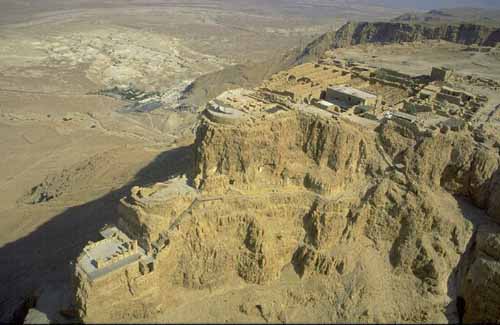
Masada (Hebrew for fortress), is situated atop an isolated rock cliff at the western end of the Judean Desert, overlooking the Dead Sea. It is a place of gaunt and majestic beauty.
On the east the rock falls in a sheer drop of about 450 meters to the Dead Sea (the lowest point on earth, some 400 m. below sea level) and in the west it stands about 100 meters above the surrounding terrain. The natural approaches to the cliff top are very difficult.
The only written source about Masada is Josephus Flavius’ The Jewish War. Born Joseph ben Matityahu of a priestly family, he was a young leader at the outbreak of the Great Jewish Rebellion against Rome (66 CE) when he was appointed governor of Galilee. He managed to survive the suicide pact of the last defenders of Jodfat and surrendered to Vespasian (who shortly thereafter was proclaimed emperor) – events he described in detail. Calling himself Josephus Flavius, he became a Roman citizen and a successful historian. Moral judgment aside, his accounts have been proved largely accurate.
According to Josephus Flavius, Herod the Great built the fortress of Masada between 37 and 31 BCE. Herod, an Idumean, had been made King of Judea by his Roman overlords and was hated by his Jewish subjects. Herod, the master builder, “furnished this fortress as a refuge for himself.” It included a casemate wall around the plateau, storehouses, large cisterns ingeniously filled with rainwater, barracks, palaces and an armory.
Some 75 years after Herod’s death, at the beginning of the Revolt of the Jews against the Romans in 66 CE, a group of Jewish rebels overcame the Roman garrison of Masada. After the fall of Jerusalem and the destruction of the Temple (70 CE) they were joined by zealots and their families who had fled from Jerusalem. With Masada as their base, they raided and harassed the Romans for two years. Then, in 73 CE, the Roman governor Flavius Silva marched against Masada with the Tenth Legion, auxiliary units and thousands of Jewish prisoners-of-war. The Romans established camps at the base of Masada, laid siege to it and built a circumvallation wall. They then constructed a rampart of thousands of tons of stones and beaten earth against the western approaches of the fortress and, in the spring of the year 74 CE, moved a battering ram up the ramp and breached the wall of the fortress.
Josephus Flavius dramatically recounts the story told him by two surviving women. The defenders – almost one thousand men, women and children – led by Eleazar ben Ya’ir, decided to burn the fortress and end their own lives, rather than be taken alive. “And so met (the Romans) with the multitude of the slain, but could take no pleasure in the fact, though it were done to their enemies. Nor could they do other than wonder at the courage of their resolution, and at the immovable contempt of death which so great a number of them had shown, when they went through with such an action as that was.”
The Zealots cast lots to choose 10 men to kill the remainder. They then chose among themselves the one man who would kill the survivors. That last Jew then killed himself.
The heroic story of Masada and its dramatic end attracted many explorers to the Judean desert in attempts to locate the remains of the fortress. The site was identified in 1842, but intensive excavations took place only in 1963-65, with the help of hundreds of enthusiastic volunteers from Israel and from many foreign countries, eager to participate in this exciting archeological venture. To them and to Israelis, Masada symbolizes the determination of the Jewish people to be free in its own land.