

Spirit Of Truth
Inactive
FYI....the U.S. banking system is currently insolvent.
The Fed pumped $100 billion into banks via its new fangled auction in recent days, but this was mainly just so that major investment banks, e.g., Citigroup, meet their capital reserve ratios at the end of the quarter.
http://news.yahoo.com/s/ap/20080328/ap_on_bi_ge/fed_credit_crisis
http://news.bbc.co.uk/2/hi/business/7319413.stm
In effect, what the Fed is doing is temporarily allowing banks to trade some of their virtually worthless subprime financial assets for AAA Treasuries for 100 cents on the dollar so that they are technically still solvent. However, they are not solvent in reality, as was seen in the case of Bear Stearns when the rumor mill forced reality to the surface.
The question is: How long the Fed and Wall Street can "make believe"?
To underscore how the banking system is insolvent, examine a current chart of non-borrowed bank reserves at the Fed's web site:
http://research.stlouisfed.org/fred2/series/BOGNONBR
In March the negative reserves worsened severely, which would look like this:
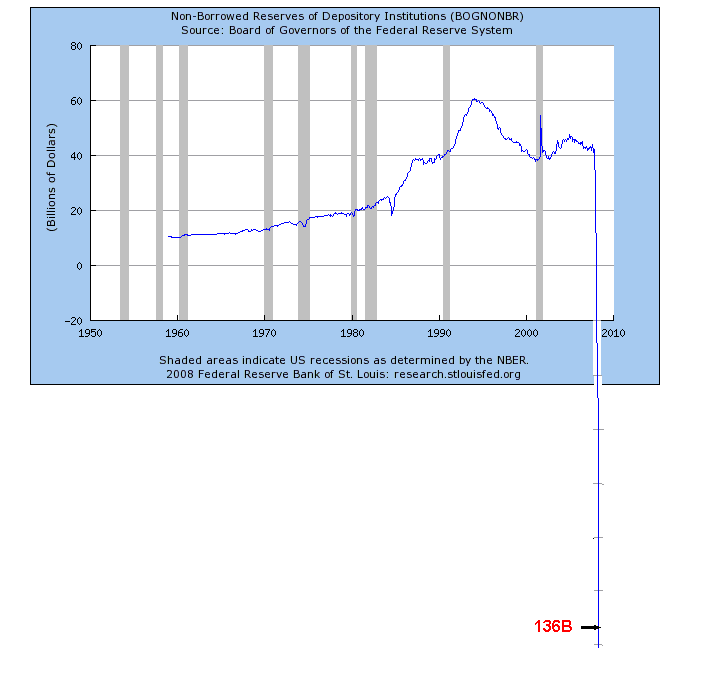
(graph compliments of a poster at Ticker Forum)
Hence, the billions pumped into the banking system in recent weeks was just to maintain sufficiently positive reserves to meet mandated reserve requirements.
Given the current condition of the U.S. banking system, one should be focused on capital preservation and anticipation of a severe economic contraction....possibly as bad as the 1930s.
A bear market fund which may be effective if U.S. equities start to collapse is the Prudent Bear Fund (BEARX):
http://finance.yahoo.com/q?s=bearx
More information about this fund and their concerns regarding the economy can be viewed at:
http://www.prudentbear.com
There could be a short-term rally in U.S. stocks, but 2008 is likely to see an unprecedented collapse in the values of almost all financial, and probably real, assets. One should plan accordingly.
The Fed pumped $100 billion into banks via its new fangled auction in recent days, but this was mainly just so that major investment banks, e.g., Citigroup, meet their capital reserve ratios at the end of the quarter.
http://news.yahoo.com/s/ap/20080328/ap_on_bi_ge/fed_credit_crisis
http://news.bbc.co.uk/2/hi/business/7319413.stm
In effect, what the Fed is doing is temporarily allowing banks to trade some of their virtually worthless subprime financial assets for AAA Treasuries for 100 cents on the dollar so that they are technically still solvent. However, they are not solvent in reality, as was seen in the case of Bear Stearns when the rumor mill forced reality to the surface.
The question is: How long the Fed and Wall Street can "make believe"?
To underscore how the banking system is insolvent, examine a current chart of non-borrowed bank reserves at the Fed's web site:
http://research.stlouisfed.org/fred2/series/BOGNONBR
In March the negative reserves worsened severely, which would look like this:
(graph compliments of a poster at Ticker Forum)
Hence, the billions pumped into the banking system in recent weeks was just to maintain sufficiently positive reserves to meet mandated reserve requirements.
Given the current condition of the U.S. banking system, one should be focused on capital preservation and anticipation of a severe economic contraction....possibly as bad as the 1930s.
A bear market fund which may be effective if U.S. equities start to collapse is the Prudent Bear Fund (BEARX):
http://finance.yahoo.com/q?s=bearx
More information about this fund and their concerns regarding the economy can be viewed at:
http://www.prudentbear.com
There could be a short-term rally in U.S. stocks, but 2008 is likely to see an unprecedented collapse in the values of almost all financial, and probably real, assets. One should plan accordingly.


 Hell, I can't afford it at $3.


