Reborn
Seeking Aslan's Country
The rise of British sea power
A barge towing an inverted windmill to the mouth of Strangford Lough will launch a new programme to create sustainable energy. Geoffrey Lean, Environment Editor, reports
Sunday, 23 March 2008
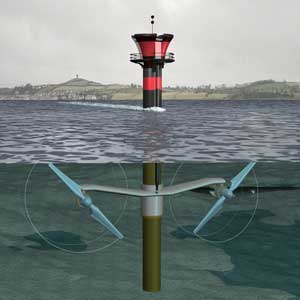
Britain is set this week to enter a new age, generating energy directly from the seas that surge around its shores. On Saturday a strange, 122ft- long contraption – looking like an upside-down windmill – will set off from the Belfast dock that built the Titanic to produce the first electricity ever brought ashore from British tides.
The device – the first of its kind anywhere in the world – is expected to start a revolution which could lead to our island nation getting a fifth of its power from its surrounding waters, and to the far north of Scotland becoming "the Saudi Arabia of marine energy".
Remarkably, the pioneering device, which will start producing power from predictable and clean tidal energy, is the fruit of the vision and persistence of a single campaigning engineer, and has been developed by a small West Country firm. Though it has recently had some Government support, ministers have traditionally preferred to pour resources into much bigger projects, such as nuclear power stations. Indeed, the installation of the new device – near the mouth of Northern Ireland's Strangford Lough – is scheduled to take place only days after the Prime Minister, Gordon Brown, and the French President, Nicolas Sarkozy, are expected to sign a deal to jointly construct a new generation of reactors and to sell the technology around the world.
Yet the inauguration of a tidal turbine, dubbed SeaGen – which will generate enough electricity to power 1,140 homes by being placed directly in the tide race that rushes in and out of the lough – may unexpectedly prove to be the more significant event. While the much-vaunted Severn Barrage has only just begun to undergo a two-year feasibility study, experts are hailing the new turbine as the start of a giant leap in exploiting marine energy, where Britain, for once, is now leading the world.
Later this year, in another global first, a wave energy power station developed by an Edinburgh firm is to be installed in the Atlantic Ocean off the coast of Portugal. Next year, an even bigger one, off Cornwall, is expected to start feeding electricity into the national grid, and yet another is planned for the Orkneys. And Marine Current Turbines, the firm behind SeaGen, has joined with the utility company npower to develop a tidal power station off Anglesey.
Britain has the best tide and wave energy resources in the world – the official Carbon Trust estimates that they could together provide a fifth of our electricity. Yet, until recently, successive governments have set their face against developing them.
In the 1980s the then Department of Energy killed off promising proposals for exploiting the waves amid evidence that it did so because they threatened its (never realised) plans to expand nuclear power. In 1992 an official report concluded that it "did not see any justification for significant public expenditure" on offshore energy, and as recently as 2003 a Government White Paper ruled out the development of a Severn Barrage.
The tide only turned decisively about a year ago when, as The Independent on Sunday exclusively reported, ministers began backing plans for the £14bn, 10-mile barrage. Gordon Brown officially announced a feasibility study at the last Labour Party conference, and this got under way in January.
Launching the study, which will continue until 2010, the Secretary of State for Business, John Hutton, described the barrage's potential as "breathtaking". But though it could alone provide 5 per cent of the country's electricity from a completely dependable, renewable resource it could not be in operation until at least 2020.
And the Government's official environmental advisers – the Environment Agency, Natural England and the Countryside Council for Wales – have warned that the barrage would "cause irreversible impacts" to the estuary's "internationally important habitats" for wildlife and to its "unique ecology".
The scheme in Northern Ireland avoids these drawbacks by using a radically different technology. While the barrage impounds the rising tide behind a dam – letting it out, as it falls, through some 200 turbines in the structure – SeaGen sits in the tidal currents like an inverted windmill, capturing some of the energy by letting the water, rather than air, turn its sails as it flows.
While the barrage is a mammoth and expensive structure, which takes many years to build and then cannot be moved, the turbines can be constructed and sited relatively quickly, cheaply and flexibly. And while damming the Severn estuary inevitably fundamentally alters its ecology, SeaGen is expected to have far less impact on wildlife and the environment. But its technology's potential is no smaller. A report by the Sustainable Development Commission last year estimated that exploiting Britain's tidal currents could generate at least 5 per cent of the nation's electricity. Other authorities put it even higher.
Professor Stephen Salter of Edinburgh University, one of Britain's leading marine energy experts, estimates that the Pentland Firth alone could generate up to a quarter of Britain's electricity – more than is now being provided by all the country's nuclear power stations – making the channel between Orkney and the north Scottish mainland "the Saudi Arabia of marine energy."
Martin Wright, managing director of Marine Current Turbines, calls the firth, the "Mount Everest" of the industry, and describes its tidal currents as "the equivalent of an underwater hurricane". Every second, about 2.5 million cubic metres of water – enough to fill 1,000 Olympic swimming pools – passes at a speed of up to 12 knots across a line traced across the Firth.
This is just the biggest of a host of potential sites, usually where the tides are speeded up by being squeezed through narrow channels, forming one of the most intense resources provided by any form of renewable energy. In all, the Government estimates, Britain has about half of all Europe's such "tidal stream" potential and between 10 and 15 per cent of what has been identified worldwide, making it uniquely blessed.
Some 24 technologies, at various stages of research and development, have been put forward for exploiting tidal currents, but SeaGen – invented by Peter Fraenkel – a renewable energy pioneer who is now Marine Current Turbines' technical director (see right) is well in the lead.
In 2003 a smaller prototype, called Seaflow, was installed off Lynmouth in Devon becoming the first renewable energy device, powered by the sea, to be installed in the open ocean anywhere in the world. It operated through three winters, with regular force 8 gales, without any important technical failures – with an overall performance that exceeded expectations. Dr Fraenkel says it "proved the feasibility" of the technology.
He adds that SeaGen – four times as powerful, with a capacity of 1.2 megawatts – "is the world's first commercial scale system for generating electricity from marine currents" – and is "needed to prove economic and commercial feasibility".
Originally designed to be installed in 2006, it was held up by a series of events including the commercial takeover of the company due to install it, and an accident to a vessel due to carry it.
The latest delay occurred only last week, when bad weather held up the barge due to carry it from Belfast's Harland and Wolff shipyard to Strangford Lough, causing the installation – due for tomorrow – to be postponed. It is now expected next Monday.
It will be put in the 500m-wide Narrows at the mouth of the lough, where the currents exceed seven knots. This is a particularly important wildlife area, and so its operation will be closely monitored. The chief fear is that the turbines may damage marine mammals such as seals, but Dr Fraenkel says that they will turn too slowly, and that the animals are too nimble, for this to be a serious concern.
If all goes well, the company will then work with npower on the next development, a "tidal farm" of seven SeaGen devices, together capable of generating 10.5MW, in the Skerries of the North-west coast of Anglesey, which it hopes will start operating by 2012. It will be commissioned from next month and go into full commercial operation in July.
Later in the year, Pelamis Wave Power, an Edinburgh-based company, is planning to install the word's first ocean-going wave power station – made of a series of tubes, each the size of a small commuter train, that bob up and down with the waves off the Portuguese coast .
To have your say on this or any other issue visit www.independent.co.uk/IoSblogs
http://www.independent.co.uk/enviro...f-british-sea-power-799630.html?service=Print
A barge towing an inverted windmill to the mouth of Strangford Lough will launch a new programme to create sustainable energy. Geoffrey Lean, Environment Editor, reports
Sunday, 23 March 2008
Britain is set this week to enter a new age, generating energy directly from the seas that surge around its shores. On Saturday a strange, 122ft- long contraption – looking like an upside-down windmill – will set off from the Belfast dock that built the Titanic to produce the first electricity ever brought ashore from British tides.
The device – the first of its kind anywhere in the world – is expected to start a revolution which could lead to our island nation getting a fifth of its power from its surrounding waters, and to the far north of Scotland becoming "the Saudi Arabia of marine energy".
Remarkably, the pioneering device, which will start producing power from predictable and clean tidal energy, is the fruit of the vision and persistence of a single campaigning engineer, and has been developed by a small West Country firm. Though it has recently had some Government support, ministers have traditionally preferred to pour resources into much bigger projects, such as nuclear power stations. Indeed, the installation of the new device – near the mouth of Northern Ireland's Strangford Lough – is scheduled to take place only days after the Prime Minister, Gordon Brown, and the French President, Nicolas Sarkozy, are expected to sign a deal to jointly construct a new generation of reactors and to sell the technology around the world.
Yet the inauguration of a tidal turbine, dubbed SeaGen – which will generate enough electricity to power 1,140 homes by being placed directly in the tide race that rushes in and out of the lough – may unexpectedly prove to be the more significant event. While the much-vaunted Severn Barrage has only just begun to undergo a two-year feasibility study, experts are hailing the new turbine as the start of a giant leap in exploiting marine energy, where Britain, for once, is now leading the world.
Later this year, in another global first, a wave energy power station developed by an Edinburgh firm is to be installed in the Atlantic Ocean off the coast of Portugal. Next year, an even bigger one, off Cornwall, is expected to start feeding electricity into the national grid, and yet another is planned for the Orkneys. And Marine Current Turbines, the firm behind SeaGen, has joined with the utility company npower to develop a tidal power station off Anglesey.
Britain has the best tide and wave energy resources in the world – the official Carbon Trust estimates that they could together provide a fifth of our electricity. Yet, until recently, successive governments have set their face against developing them.
In the 1980s the then Department of Energy killed off promising proposals for exploiting the waves amid evidence that it did so because they threatened its (never realised) plans to expand nuclear power. In 1992 an official report concluded that it "did not see any justification for significant public expenditure" on offshore energy, and as recently as 2003 a Government White Paper ruled out the development of a Severn Barrage.
The tide only turned decisively about a year ago when, as The Independent on Sunday exclusively reported, ministers began backing plans for the £14bn, 10-mile barrage. Gordon Brown officially announced a feasibility study at the last Labour Party conference, and this got under way in January.
Launching the study, which will continue until 2010, the Secretary of State for Business, John Hutton, described the barrage's potential as "breathtaking". But though it could alone provide 5 per cent of the country's electricity from a completely dependable, renewable resource it could not be in operation until at least 2020.
And the Government's official environmental advisers – the Environment Agency, Natural England and the Countryside Council for Wales – have warned that the barrage would "cause irreversible impacts" to the estuary's "internationally important habitats" for wildlife and to its "unique ecology".
The scheme in Northern Ireland avoids these drawbacks by using a radically different technology. While the barrage impounds the rising tide behind a dam – letting it out, as it falls, through some 200 turbines in the structure – SeaGen sits in the tidal currents like an inverted windmill, capturing some of the energy by letting the water, rather than air, turn its sails as it flows.
While the barrage is a mammoth and expensive structure, which takes many years to build and then cannot be moved, the turbines can be constructed and sited relatively quickly, cheaply and flexibly. And while damming the Severn estuary inevitably fundamentally alters its ecology, SeaGen is expected to have far less impact on wildlife and the environment. But its technology's potential is no smaller. A report by the Sustainable Development Commission last year estimated that exploiting Britain's tidal currents could generate at least 5 per cent of the nation's electricity. Other authorities put it even higher.
Professor Stephen Salter of Edinburgh University, one of Britain's leading marine energy experts, estimates that the Pentland Firth alone could generate up to a quarter of Britain's electricity – more than is now being provided by all the country's nuclear power stations – making the channel between Orkney and the north Scottish mainland "the Saudi Arabia of marine energy."
Martin Wright, managing director of Marine Current Turbines, calls the firth, the "Mount Everest" of the industry, and describes its tidal currents as "the equivalent of an underwater hurricane". Every second, about 2.5 million cubic metres of water – enough to fill 1,000 Olympic swimming pools – passes at a speed of up to 12 knots across a line traced across the Firth.
This is just the biggest of a host of potential sites, usually where the tides are speeded up by being squeezed through narrow channels, forming one of the most intense resources provided by any form of renewable energy. In all, the Government estimates, Britain has about half of all Europe's such "tidal stream" potential and between 10 and 15 per cent of what has been identified worldwide, making it uniquely blessed.
Some 24 technologies, at various stages of research and development, have been put forward for exploiting tidal currents, but SeaGen – invented by Peter Fraenkel – a renewable energy pioneer who is now Marine Current Turbines' technical director (see right) is well in the lead.
In 2003 a smaller prototype, called Seaflow, was installed off Lynmouth in Devon becoming the first renewable energy device, powered by the sea, to be installed in the open ocean anywhere in the world. It operated through three winters, with regular force 8 gales, without any important technical failures – with an overall performance that exceeded expectations. Dr Fraenkel says it "proved the feasibility" of the technology.
He adds that SeaGen – four times as powerful, with a capacity of 1.2 megawatts – "is the world's first commercial scale system for generating electricity from marine currents" – and is "needed to prove economic and commercial feasibility".
Originally designed to be installed in 2006, it was held up by a series of events including the commercial takeover of the company due to install it, and an accident to a vessel due to carry it.
The latest delay occurred only last week, when bad weather held up the barge due to carry it from Belfast's Harland and Wolff shipyard to Strangford Lough, causing the installation – due for tomorrow – to be postponed. It is now expected next Monday.
It will be put in the 500m-wide Narrows at the mouth of the lough, where the currents exceed seven knots. This is a particularly important wildlife area, and so its operation will be closely monitored. The chief fear is that the turbines may damage marine mammals such as seals, but Dr Fraenkel says that they will turn too slowly, and that the animals are too nimble, for this to be a serious concern.
If all goes well, the company will then work with npower on the next development, a "tidal farm" of seven SeaGen devices, together capable of generating 10.5MW, in the Skerries of the North-west coast of Anglesey, which it hopes will start operating by 2012. It will be commissioned from next month and go into full commercial operation in July.
Later in the year, Pelamis Wave Power, an Edinburgh-based company, is planning to install the word's first ocean-going wave power station – made of a series of tubes, each the size of a small commuter train, that bob up and down with the waves off the Portuguese coast .
To have your say on this or any other issue visit www.independent.co.uk/IoSblogs
http://www.independent.co.uk/enviro...f-british-sea-power-799630.html?service=Print