Space Weather

RJC

Has No Life - Lives on TB
http://www.swpc.noaa.gov/alerts/alerts_timeline.html

April 11,2010 7:26 PDT

Space Weather Message Code: ALTK06
Serial Number: 263
Issue Time: 2010 Apr 12 0226 UTC

ALERT: Geomagnetic K-index of 6
Threshold Reached: 2010 Apr 12 0225 UTC
Synoptic Period: 0000-0300 UTC
Station: Boulder
Active Warning: Yes
NOAA Scale: G2 - Moderate
--------------------------------------------------

Space Weather Message Code: WARK07
Serial Number: 31
Issue Time: 2010 Apr 12 0427 UTC

CANCEL WARNING: Geomagnetic K-index of 7 or greater expected
Cancel Serial Number: 30
Original Issue Time: 2010 Apr 12 0239 UTC

Comment: The K index of 7 which occured at 0240UTC is no longer expected to re-occur due to this event.
-----------------------------

Space Weather Message Code: ALTEF3
Serial Number: 1657
Issue Time: 2010 Apr 11 0917 UTC

CONTINUED ALERT: Electron 2MeV Integral Flux exceeded 1000pfu
Continuation of Serial Number: 1656
Begin Time: 2010 Apr 05 0915 UTC
Yesterday Maximum 2MeV Flux: 82248 pfu

Bou_12h.png
 
Last edited:

RJC

Has No Life - Lives on TB
Solar Cycle 24

To help in understanding where we are in reference to Solar Cycles, the Blue line is the last part of Solar Cycle 23 and the Red line is the predicted Solar Cycle 24, which we are now in.

sunspot.gif


The great solar activity has occurred in the years following after the solar maximum, thus the greatest activity as would predictably occur in the years 2015, 2016 in the cycle 24. However it is just prediction.

“On January 4, 2008, a reversed-polarity sunspot appeared—and this signals the start of Solar Cycle 24," says David Hathaway of the Marshall Space Flight Center.

newspot_strip.jpg


Images of the first sunspot of Solar Cycle 24 taken by the NASA/ESA Solar and Heliospheric Observatory (SOHO).

.
 

Rex Jackson

Has No Life - Lives on TB
So far there isnt much normal about this cycle. I can't predict anything!


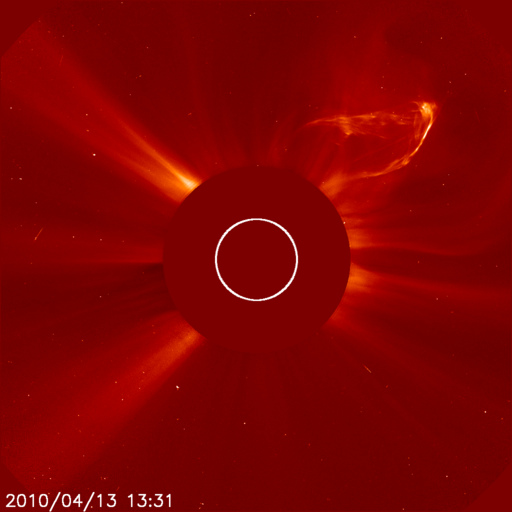
WOW check out the CME that just blasted off....with some sort of filament in the middle!

20100413_1331_c2_512.jpg


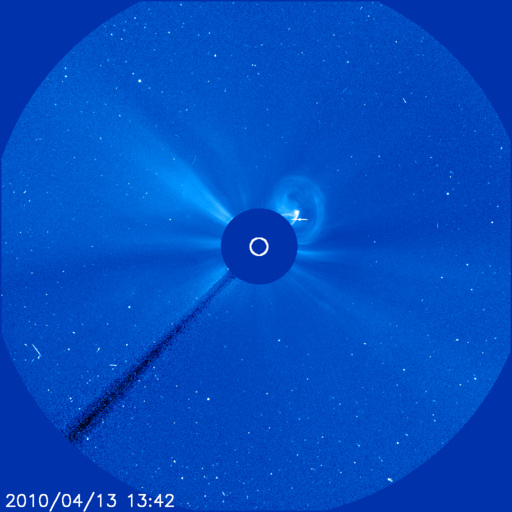
20100413_1342_c3_512.jpg
 

willdo

Veteran Member
from spaceweather.com

OMG! MONSTER PROMINENCE: The biggest prominence in years has just lept off the surface of the sun. Readers, if you have a solar telescope, look now!

I don't think it is a CME is it?
 

willdo

Veteran Member
From wiki...on solar prominence

A prominence is a large, bright feature extending outward from the Sun's surface, often in a loop shape. Prominences are anchored to the Sun's surface in the photosphere, and extend outwards into the Sun's corona. While the corona consists of extremely hot ionized gases, known as plasma, which do not emit much visible light, prominences contain much cooler plasma, similar in composition to that of the chromosphere. A prominence forms over timescales of about a day, and stable prominences may persist in the corona for several months. Some prominences break apart and give rise to coronal mass ejections. Scientists are currently researching how and why prominences are formed.

A typical prominence extends over many thousands of kilometers; the largest observed by SOHO was seen in 1997 and was some 350,000 km (216,000 miles) long [1] - some 28 times the diameter of the Earth. The mass contained within a prominence is typically of the order of 100 billion tonnes of material.

When a prominence is viewed from a different perspective so that it is against the sun instead of against space, it appears darker than the surrounding background. This formation is instead called a solar filament. [1] It is possible for a projection to be both a filament and a prominence. [2] Flocculi (plural of flocculus) is another term for these filaments, and dark flocculi typically describes the appearance of solar prominences when viewed against the solar disk in certain wavelengths.
 

mscoffee

Veteran Member
So far there isnt much normal about this cycle. I can't predict anything!


WOW check out the CME that just blasted off....with some sort of filament in the middle!

20100413_1331_c2_512.jpg


20100413_1342_c3_512.jpg

Do you know if those photos taken are from earth or a satellite?
And if from a satellite where abouts are we in the big picture?
 

Aardaerimus

Anunnaku
Wow! That thing looked like it was almost far enough out to zap Mercury. How far out is mercury on this scale, anyway?
 

RJC

Has No Life - Lives on TB
Do you know if those photos taken are from earth or a satellite?
And if from a satellite where abouts are we in the big picture?

Answer no on the warning then click on the time.

http://orbits.esa.int/orbits/science/app/soho_inc.htm

Wow! That thing looked like it was almost far enough out to zap Mercury. How far out is mercury on this scale, anyway?
Mercury is off to the left of the sun from our view (about 230 degrees if our direction is pointed to the sun) and the stream of incandescent gas projecting above the sun's chromosphere, was off to the right.
 
Last edited:

Heliobas Disciple

TB Fanatic
Wow! That thing looked like it was almost far enough out to zap Mercury. How far out is mercury on this scale, anyway?

Mercury is off to the left of the sun from our view (about 230 degrees if our direction is pointed to the sun) and the stream of incandescent gas projecting above the sun's chromosphere, was off to the right.

When you see a circle with a line through it, it means it's a planet. I'd guess Mercury too. I think those C images are reversed (mirror image type deal), but either way, if it's not Mercury, whatever it is, it looks like it got a direct hit. Good catch.

I blew the picture up a little and circled where the planet is in a red circle for those who missed it when looking the first time.

HD
 

Attachments

  • 20100413_1342_c3_512.jpg
    20100413_1342_c3_512.jpg
    38.5 KB · Views: 479

Heliobas Disciple

TB Fanatic
Just pulled up the first orbit diagram I had flagged to illustrate the position of the planets.

http://ssd.jpl.nasa.gov/sbdb.cgi?sstr=2001PM9;orb=1


You realize that the position of the planets change depending on where you have the sliders on top and to the right, right?

Disregard the object it is not the point of discussion.

Point of discussion (thread title) is Space Weather. :confused: Mercury, the sun = space weather to me. I'll start a new thread so as not to infringe;)

HD
 
OTOH

Disregarding the disregard, using the JPL Small-Body Database Browser, moving the bottom slider placing the Earth at center line, then moving the left hand slider to align the orbit - viola, 68372 (2001 PM9) is north east of the sun.

Then again the view (perspective) from SOHO (C3) is another story.

Aint modern technology grand?

;^)

===


.
 

Heliobas Disciple

TB Fanatic
The object RJC is referring to is 68372 (2001 PM9) noted on the JPL Small-Body Database Browser. Which isn't relevant to figuring out where Mercury is in relation to SOHO and the Earth and what that other frisky planetary object is.


Oh ! I thought he meant Mercury was to be disregarded! I guess I deserve this: :sb:

Thanks for clearing that up for me. :)

RJC is right - that object is not important to the discussion. It is also not the planetary object being hit by the CME/prominence. I'm pretty sure it is Mercury. Question now is of perspective since that graphic isn't 3D - was Mercury directly taking that hit or is it further out /closer up than where that large eruption blew. I'd love to see some studies of what happened on the surface of Mercury if it did take a direct hit. We may be able to extrapolate out what could happen here on Earth (although obviously Mercury is a lot closer to the sun so will always be more effected by it).

HD
 

RJC

Has No Life - Lives on TB
You realize that the position of the planets change depending on where you have the sliders on top and to the right, right?
Our position of viewing changes, NOT the relative position of the planets, sun and objects being viewed

Point of discussion (thread title) is Space Weather. :confused: Mercury, the sun = space weather to me. I'll start a new thread so as not to infringe;)

HD
Sorry for failing to clarify which object to which I referred, thanks Tom McDowell for your clarification.

SOHO sits about 4 lunar distances between us and the sun. To illustrate, if you held ball on a short string, looking at the sun and rotated the ball, swinging it in a circle in front of your view of the sun, that is the position and orbit of SOHO. Also as we orbit the sun in a counter clockwise direction SOHO tracks right along with us in it continuous counterclockwise orbit between us and the sun.
 

willdo

Veteran Member
update from spaceweather

OMG! HUGE PROMINENCE: One of the biggest prominences in years erupted from the sun's northwestern limb today. The massive plasma-filled structure rose up and burst during a ~2 hour period around 0900 UT. Mark Townley sends this freeze-frame from his backyard observatory in Brierley Hill, West Midlands, UK:

The eruption hurled a bright coronal mass ejection (CME) into space: SOHO movie. The cloud is not heading toward Earth, at least not directly. A glancing blow from the outskirts of the CME is possible two to three days from now, but any impact is likely to be mild. The eruption was more photogenic than geoeffective.
 

RJC

Has No Life - Lives on TB
Things change, it started out one thing and evolved into a CME, thanks for the update, Willdo.

Also it seems to me that it is not possible for the imagery of the event to include the planet Mercury as some are proposing. Mercury would be far to the left and toward the bottom of the image if the image could be enlarged to such a large scale. Mercury is 180 degrees opposite from the CME. If we point a compass at the sun with the sun direction as 0 then Mercury would be about 230 degrees on the compass and the ejection maybe 40 or 50 degrees.

ETA:

The mysterious object may have been a reflection of a mass of ejecta whereas there may have existed a proton acceleration region above or around the outward moving ejecta far above the flare site.
 
Last edited:

Heliobas Disciple

TB Fanatic
Our position of viewing changes, NOT the relative position of the planets, sun and objects being viewed.

Obviously! It would be a pretty neat feat if anyone with a sidebar on a computer could instantly change the position of the planets. :D

Also it seems to me that it is not possible for the imagery of the event to include the planet Mercury as some are proposing. Mercury would be far to the left and toward the bottom of the image if the image could be enlarged to such a large scale. Mercury is 180 degrees opposite from the CME. If we point a compass at the sun with the sun direction as 0 then Mercury would be about 230 degrees on the compass and the ejection maybe 40 or 50 degrees.

ETA:

The mysterious object may have been a reflection of a mass of ejecta whereas there may have existed a proton acceleration region above or around the outward moving ejecta far above the flare site.

If it's not Mercury, maybe it's Venus - but I think it's Mercury. As Tom pointed out, it's not in the earlier pictures, so it looks like it's coming into view from beind the sun, whatever it is. And keep in mind, a lot of the sun images are flipped and mirror images.

HD

ETA: did some research on the horizontal line. Usually it's a planet or bright star - Mercury, Venus, etc. Could be something else- but if you look again at the picture posted by Tom above (I'll repost it) - it's not at the brightest part of the CME/prominence - which you'd think would be brighter than some other ejecta. Also it doesn't look like where an ejecta could be. If it's not Mercury (or Venus) - it's reallllly interesting showing up like that ;)

http://sohowww.nascom.nasa.gov/explore/faq.html
(fair use applies)

EXCERPT:

What are those flying saucer-shaped objects in the LASCO images?

The "funny-looking spheroid" is a typical response of the SOHO LASCO coronagraph CCD detector to an object (planet or bright star) of small angular extent but so bright that it saturates the CCD camera so that "bleeding" occurs along pixel rows. There is a bright horizontal streak on either side of the image, because the charge leaks easier along the direction in which the CCD image is read out by the associated electronics.

CCD stands for charge-coupled detector, and refers to a silicon chip, usually a centimeter or two across, divided into a grid of cells, each of which acts like a small photomultiplier in that an incoming photon knocks loose one or more electrons. The electrons are "read out" by row (fast direction) and column (slow direction), the current converted to a digital signal, and each cell or picture element ("pixel") thus assigned a digital value proportional to the the number of incoming photons in that pixel (the brightness of the part of the image falling on that pixel). This is the same kind of detector as is used in a hand-held video camera, though until recently, the analog-to-digital conversion was left out in consumer devices.

If you point a video camera at a very bright source (say, the Sun), the image "blooms" or brightens all over --- there are so many electrons produced in the pixels corresponding to the bright source that they spill over into adjacent rows and column, perhaps over the entire detector. Better CCD's will "bleed" only along the fast readout direction (a single row), and perhaps a few adjacent rows.

The LASCO and EIT CCD cameras include "anti-bleed" electronics which limit the pixel bleeding around bright sources to less than the full row (and usually no adjacent rows). In the case of a marginally too-bright object, the pixel bleeding will be only a few pixels in either direction along the fast readout direction. Thus, the "flying saucer" images.

A few of the LASCO images that have appeared on the "extraterrestrial" Web sites show much larger and brighter, but still saucer-like features. These images are in fact obtained with the instrument door closed, but with an incorrectly long exposure. The big "saucers" result from massive pixel bleeding along every row of the detector containing part of the image of the "opal," or small diffusing lens, in the instrument door, that is used for obtaining calibration data.

If your correspondents still prefer to believe that the pixel-bled images of planets or bright stars are something else, ask them why the extended part of the "saucers" (i.e., the pixel bleeding) always occurs in the same direction relative to the image --- even when the spacecraft is rolled relative to its normal orientation relative to the Sun.


http://www.badastronomy.com/bitesize/proper.html#stisimage
(fair use applies)

EXCERPTS:

Sometimes, a pixel is more sensitive to light than others. This can happen when a pixel is hit by high energy radiation like cosmic rays (which I'll abbreviate "CR"), which are subatomic particles zipping around space. What happens then is that pixel is always "bright", or "hot", even when nothing is putting light into it. You have to make a map of the hot pixels in a CCD so you can compensate for them.

(snip)

A pixel can only hold so many electrons before it overflows. Because of the way the pixels are made, the overflow goes into the adjoining pixels horizontally, so the overflowing pixel leaks electrons into the pixels to its left and right (or above and below it). If enough light is hitting the one pixel, it can overflow the adjacent pixels, which flow into the next ones, and so on. When you look at the resulting image, a bright object appears to have a bright horizontal line going through it. This is called "blooming". A bright star may bloom over several vertical pixels, so you get many rows of blooming
 

Attachments

  • 1.jpg
    1.jpg
    101.6 KB · Views: 410
Last edited:

Heliobas Disciple

TB Fanatic
Good info in your last post also IIRC having read somewhere that the reflection of proton mass ejecta is recorded in just such occurances as this one. Too tired to look it up.


Looks like it could be something very bright that was separately ejected when the prominence lifted off and the CME happened. I'm starting to come to terms with the idea that the predictions for an 'interesting' solar maximum this time around may actually happen (which to my mind is not a good thing).

I was visiting family for a while and away from TB so I couldn't post this when it happened, but here's another interesting spaceweather item that was reported on March 29th, connected to sunspot 1057. It's not unusual to hear radio bursts from X class flares or complex sunspots, but 1057 was neither. All these sort-of rare things happening one after the other within the last few months are starting to add up to a solar maximum that will keep us all paying attention.

http://www.spaceweather.com/archive.php?view=1&day=29&month=03&year=2010
(fair use applies)

RADIO-ACTIVE SUNSPOT: Yesterday in new Mexico, a startling roar issued from the loudspeaker of amateur astronomer Thomas Ashcraft's radio telescope. "It was sunspot 1057," he says. "All day long it had been producing small radio bursts around 21 MHz. Then, at 1813 UT, it let loose a big one. The burst only lasted a minute, but it saturated the radios."

Click here to listen.

http://www.heliotown.com/201003281813ut2123Ashcraft.mp3


The sounds you just heard were a mix of Type III and Type V radio emissions. They're caused by beams of electrons shooting out of the sunspot into the sun's atmosphere overhead. Not all sunspots produce radio emissions, but AR1057 is definitely "radio-active." "I'll be listening for more bursts in the days ahead," says Ashcraft.

More on this:

http://news.discovery.com/space/the-sun-points-radio-active-sunspot-at-earth.html
(fair use applies)

The Sun Points Radio-Active Sunspot at Earth
Analysis by Ian O'Neill | Mon Mar 29, 2010 04:46 PM ET

As the sun continues to ramp up in activity after a long period in the doldrums, solar astronomers have been treated to an up-tick in sunspot numbers, solar prominences and flares.

And now, radio astronomers have joined the fun, listening to the roar of a particularly "noisy" sunspot currently pointing in our direction.

Not all sunspots emit strong radio emissions, but sunspot 1057 certainly isn't shy. As reported by SpaceWeather.com, a radio astronomer in New Mexico received a mix of Type III and Type V radio emissions:

"It was sunspot 1057. All day long it had been producing small radio bursts around 21 MHz. Then, at 1813 UT, it let loose a big one. The burst only lasted a minute, but it saturated the radios." --Thomas Ashcraft, radio astronomer.

But why are these radio bursts important? Primarily, they give solar physicists an idea about the extreme magnetic fields and plasma conditions inside sunspots. Sunspots are produced when vast magnetic fields push through the surface of the sun, pushing the uppermost layer of the sun's body (the photosphere) away, exposing the cooler (thus darker) solar interior.

("Cooler" is a misnomer, nothing on the sun can be termed "cool." But when compared with the photospheric temperature of approximately 6,000 Kelvin, a sunspot interior can be as low as 3,000 Kelvin.)

As sunspots contain very intense magnetic fields, clouds of charged particles (plasma) are confined and injected along these fields. Often flares result, exciting electrons trapped in the plasma. As electrons accelerate (often to velocities close to the speed of light) and oscillate, they can generate intense radio waves.

Type III and Type V radio bursts are pretty much the same thing apart from differing periods; Type III emissions last for longer, whereas Type V's are more bursty and associated with intense flare activity.

Besides what they are and how they are generated, the coolest thing about these radio events is how they sound: Listen to Thomas Ashcraft's recording of the radio emissions from sunspot 1057 (sounds like the "whoosh" of a rainstorm hammering down on my shed roof).

If you want to become a solar radio astronomer too, NASA runs a program called Radio JOVE that will help you set up your own radio telescope for less than $200. I think I know what my next space project will be...


If your speakers work, it's definitely worth listening to. It builds up to quite a roar.

HD


ETA: interview with the radio astronomer can be found here:
http://www.npr.org/templates/story/story.php?storyId=123694113

and here:

http://www.wired.com/wiredscience/2010/02/solar-radio-bursts/#more-17826

and here's his page with some links too:

http://www.heliotown.com/Sun_20100207_Ashcraft.html

Notice he's an amateur, doesn't work for NASA or the government, so we can have (at least for now) uncensored/unlimited access to what he finds. It makes me wonder what the NASA guys are hearing.
 
Last edited:

Rastech

Veteran Member
In the top picture, here:

http://www.spaceweather.com/submiss...-08-27-21UT-coloured-composite_1271197116.jpg

I can see at least 4 'sphere's (due to my eyes, I do have this 'thing' with seeing strangely into red, which completely messed up my night shooting of foxes with red filter light combined with their red fur).

An easy to spot one in this:

http://www.spaceweather.com/submiss...rk-Townley-mega-prom-full-disk_1271156607.jpg

Several captured in black and white:

http://www.spaceweather.com/submiss...inwright-HugeProm-processedres_1271152074.jpg

Another black and white:

http://www.spaceweather.com/submiss...3_Soleil_Ha_foy_0007-10-43-41o_1271154269.jpg

Quite a few in this (also B&W):

http://www.spaceweather.com/submiss...bert-Arnold-0413-10-20-01-copy_1271151832.jpg

7 or 8 in this B&W:

http://www.spaceweather.com/submiss..._06563_c1_20100413_08205600_b1_1271155384.png

Now from the spaceweather picture itself:

http://www.spaceweather.com/

I've blown up the section at the rim to the left side, and one just 'on and over the horizon' (there's a couple more in it) is pretty clearly visible, of the type of thing I have been seeing a lot of in other photos (if you use what in astronomy is known as 'averted viewing', that is, observing by not looking directly at what you are looking at, you may find it easier to spot them):
 

Attachments

  • Sunblowup.jpg
    Sunblowup.jpg
    2.4 KB · Views: 395

Rastech

Veteran Member
Now I've blown up the area just to the right of the right hand prominence from this:

http://www.spaceweather.com/

At the top you should see a pretty big sphere with the right hand prominence a considerable distance behind it. Notice how the light of the prominence behind the sphere changes?

Then I zoomed in to just to the right of the right hand prominence and with your eyes now a bit practiced, see what you can see in the second one:
 

Attachments

  • Bigun.jpg
    Bigun.jpg
    3.9 KB · Views: 391
  • rightprominence.jpg
    rightprominence.jpg
    3.9 KB · Views: 390

Rastech

Veteran Member
It's almost as if 3 of the 'smaller spheres' make up a 'big sphere'?

They definitely interfere with the lightsource behind them (as well as in front of them?), as should be clear from especially that right hand prominence.

Would plasma type 'ball lightning' on a massive scale behave like this?

Or for some complete woooowooooo, hehe, the small ones can pass light from behind with their shields, but the big 'group' shield does something different and can't, it just reflects what it is 'looking at'? Now say if 3 groups of 3 made a 'unit', 3 groups of 'units' made a 'flight', 3 'flights' made a 'squadron', 3 'squadrons' made a 'wing', 3 'wings' made a 'group', 3 'groups' made a 'command', 3 'command's' made a 'small sphere', and 3 'small sphere's' made a 'big sphere', I wonder how all the interacting and complementary fields/shields would scale up? We'd certainly see lots of reflections of reflections wouldn't we?

Well woooowooooo or not, it's very pretty to visualise. :)
 
Last edited:

Rex Jackson

Has No Life - Lives on TB
I will post about this here seeing it was first talked about here yesterday.

The magnetosphere has me worried. Its been being bombarded nonstop for two weeks with only small several hour breaks in the middle. The effects of the hyder flare or prominence CME will be here tomorrow. Even though we are getting only a glance, we need to remember, the X50 we seen in 2003 was a glance too! In fact, it came from nearly the same exact spot!

More concerning to me is hyder flares, CMEs, magnetosphere are ALL blasting away. If people have the means, I would prepare for no grid. I give it a 25% chance of grid collapse within this year at this point. Seeing everything Sun related is on the rise, my 25% will be on the rise too.

Check this out. Fresh from this morning -

http://www.telegraph.co.uk/science/...uld-knock-out-National-Grid-and-Sat-Navs.html
 
Many Thanks Rex!

It does seem as though this batch of storms will be ongoing for the near future.

The magnetopause is currently moving pretty close to the area most of the satellites inhabit.

Been watching this and even though this is a minor storm it seems as though it's closest I've ever had the opportunity to observe.

For those who need the info:

The magnetopause is the separation interface between the magnetosphere and the interplanetary space. It is normally located at a distance of about 10 times the Earth's radius, towards the Sun. However, during high solar activity episodes, this distance may be reduced to about 6,6 times the Earth's radius.

Geosynchronous orbit, where communications, weather, military, GPS, and other satellites live is about 6 times the Earth's Radius.

I'm under the assumption that these satellites begin to misbehave anytime the magnetopause pushes into their zone. Please someone correct me if this is in error.

Here again is a link to watch this activity:

http://pixie.spasci.com/DynMod/

Also for those new to seeing these images for the first time especially the one on the bottom right - Red and White are not good colors to be seeing. Under calm situations this a sky blue color.

===


.
 

Attachments

  • 6.20100414224106.jpg
    6.20100414224106.jpg
    52.8 KB · Views: 354

RJC

Has No Life - Lives on TB
Mscoffee

I hope you played around with that SOHO view site a little as it shows both the SOHO orbit or real time. If you click on the image and hold down you can move the object to any orientation without using the arrows. I like the site for the clarity of the moon position in real time. Set the axis to North.

Here’s the real time model from Tom McDowell's link

movie1.gif


We should have a special Space Weather thread just for all the real time links and other useful links. Maybe someone can set that up.
 
Another CME

At the three o' Clock position.

The storm yesterday peaked out at just below a KP of 5.

Next up, possible storm from the 4/13 OMG event. ;^)

===
 

Attachments

  • 2010_04_15_1508.jpg
    2010_04_15_1508.jpg
    70.9 KB · Views: 305

RJC

Has No Life - Lives on TB
Okay... so compared to 2009 and earlier, is it my imagination or are we getting MORE CME's?
You're right, alot more in the last few weeks. I don't think we can draw too much of a conclusion yet as this may cool down a little .... or not.
 
Last edited:

Rastech

Veteran Member
Now isn't it odd how serendipitous different threads can be? I googled a search based on knickgnat's thread http://www.timebomb2000.com/vb/showthread.php?t=359064 and found this:

Chaos and the Solar System

"Toward the end of the nineteenth century, the unresolved question of the stability of the solar system set the stage for the discovery of chaos. In 1887, King Oscar II of Sweden, who had a strong interest in mathematics, arranged an international mathematical competition involving four major problems, one of which was to solve the equations of motion for any planetary system. A committee of five of the most distinguished mathematicians of the time was to select the winner, who would take home a prize of 2,500 crowns. Henri Poincaré, a young mathematician who had already been working on problems in celestial mechanics for a number of years (and whose cousin Raymond would later become President of France), decided to take up the challenge.
As other mathematicians had done before, Poincaré considered a special case in which there are just three planetary bodies (the so-called three-body problem). Poincaré, however, tried a novel approach to the problem: rather than trying to explicitly solve the equations of motion, as mathematicians had always done previously, he looked at the qualitative behavior of planetary orbits - for example, whether they were periodic or followed more irregular paths. This approach had a liberating effect, enabling him to see possibilities that others had overlooked. What he discovered was quite unexpected: the motion of a planet in a three-body system can be very wild and unpredictable indeed. Its orbit can follow an apparently random curve, winding back around itself over and over again, like a long and tangled string. As he described such curves:
When one tries to depict the figure formed by these two curves and their infinity of intersections, each of which corresponds to a doubly asymptotic solution, these intersections form a kind of net, web, or infinitely tight mesh; neither of the two curves can ever cross itself, but must fold back on itself in a very complex way … Nothing can give us a better idea of the complexity of the three-body problem."

from here: http://ptrow.com/articles/ChaosandSolarSystem5.htm


{my bold added above}

Well, well, well!
 

RJC

Has No Life - Lives on TB
That is a most interesting read.

From the article.

“To understand how chaos limits our ability to predict the future, we must look a little more closely at solutions to differential equations. A differential equation can have many solutions, corresponding to different possible motions in the system. To find a specific solution, we must know the initial conditions, such as the position and velocity of an object at a given instant. Different initial conditions will yield different solutions: if the direction of the Earth’s orbit were to suddenly change, say by a collision with an asteroid, then the resulting orbit would also be changed. It turns out that in many systems, a small change in initial conditions will lead to large changes in the solution after a period of time. If the original change is too small to be detected, then the evolution of the system will be effectively unpredictable. This property, called sensitive dependence on initial conditions, is one of the essential features of chaos.”

Do you suppose that God presses the reset button, until change is needed to accomplish the divine word?
 
Top