WAR North Korea news/watch thread under new Military leadership...and maybe not a good thing

Status
Not open for further replies.

Lilbitsnana

On TB every waking moment
intersting...
----------------------------------
ETA:
Luke Herman‏@luke_herman3m
Under KJI (1996-2011) there were 3 MPAF and 3 Chief of KPA GS that served. Under KJU (2012-Present) already 4 MPAF and 3 Chief of KPA GS.[/B]
Retweeted by Steve Herman
-------------------------------
Original post----------------

Steve Herman‏@W7VOA6m
I still am not clear, however, if Hyon remains a vice chairman of the Central Military Comm. under its chairman Kim Jong Un.


Steve Herman‏@W7VOA9m
Some media speculated Kim, a hardliner, had been ousted & this signaled a lessening of military influence in #DPRK. Not so.


Steve Herman‏@W7VOA10m
Kim's return as defense chief noted today in this KCNA dispatch: Pyongyang, May 22 (KCNA) -- Vice Marshal of (cont) http://tl.gd/n_1rkdrd3


Steve Herman‏@W7VOA11m
Kim Kyok Sik again named #DPRK military chief replacing Hyon Yong Chol. Kim recently defense minister until replaced by Jang Jong Nam.


Steve Herman‏@W7VOA19m
Yonhap: #DPRK special envoy (member of of presidium of politburo) has arrived in China.
 
Last edited:

Housecarl

On TB every waking moment
For links see article source.....
Posted for fair use....
http://www.khaleejtimes.com/kt-arti...013/May/editorial_May47.xml&section=editorial

Pyongyang’s Beijing route

23 May 2013

The North Korean leader has made a smart diplomatic move.

He has sent his special emissary to China, apparently with a message that will go a long way in resurrecting not only their fractured relations but also bringing some relief to the ongoing tensions on the Korean Peninsula. Kim Jong-un’s attempt primarily is to cool down the tension that of late had gathered enough heat, as Beijing was seen off the hook as far as diplomatic vibes on the reclusive state were concerned. China, which had voted against North Korea early this year along side the Western countries in an endeavour to slap Pyongyang with fresh sanctions, had literally distanced itself from its ally fearing that Kim’s brinkmanship will be inadvertently blamed as a covert move of international politics. Now it remains to be seen what vibes are generated in Beijing as Kim’s envoy is debriefed and what impact it will have on the missiles race that Pyongyang had unleashed for the past several weeks.

The unnamed envoy whose talking points are not known to the world — well in tandem with the secrecy of the Stalinist state — will be closely awaited to make a disclosure, and one that comes as a relief to the peace constituents. United Nations Secretary-General Ban Ki-moon during his recent visit to Russia had called for resuming the Six-plus-Two dialogue on demilitarisation in the region, and one hopes this concurrent move on the part of Kim could be a step in this direction.

Pyongyang, in order to remain viable in the corridors of international diplomacy, has to reach out to Beijing — and that too with a roadmap to pull back the Peninsula from the brink. Kim’s kneejerk reactions hardly helped him in striking a strong bargaining point, thus all he has to do is to calm down and give diplomacy a chance.
 

Housecarl

On TB every waking moment
For links see article source....
Posted for fair use.....
http://www.heritage.org/research/le...rea-have-a-missile-deliverable-nuclear-weapon

Does North Korea Have a Missile-Deliverable Nuclear Weapon?
By Mark B. Schneider
May 22, 2013

Print PDF
Download PDF

Key Points

1 A recent unclassified Defense Intelligence Agency report stated that "DIA assesses with moderate confidence the North currently has nuclear weapons capable of delivery by ballistic missiles."
2 In recent years, the regime has engaged in two major military attacks on South Korea. It has clearly engaged in an escalating pattern of threats and could miscalculate the impact of further military action.
3 The Obama Administration's "nuclear zero" ideology does not impress North Korea and may have precipitated the unprecedented nuclear attack threats from North Korea.
4 Although concerns about U.S. willingness to respond promptly and effectively to WMD threats did not start with the Obama Administration, it is clear that the Administration's talk about nuclear disarmament contributes to these concerns.
5 This is very risky. North Korea has the potential to kill millions of people, particularly if there is a weak, ideologically driven response by the Administration to a North Korean WMD attack.

Abstract
According to a recent unclassified Defense Intelligence Agency report, “DIA assesses with moderate confidence the North currently has nuclear weapons capable of delivery by ballistic missiles.” The day the DIA report came out, Secretary of Defense Chuck Hagel stated that neither Iran nor North Korea is capable of attacking the U.S. with nuclear weapons. Despite the Obama Administration’s denials, however, there is every reason to believe that the DIA assessment is accurate. Indeed, on April 3, Secretary of Defense Hagel himself stated, “They [the North Koreans] have nuclear capacity now, they have missile delivery capacity now.” The fact is that North Korea has the potential to kill millions of people, particularly if there is a weak, ideologically driven response by the Obama Administration to a North Korean WMD attack.

A recent unclassified Defense Intelligence Agency (DIA) report, revealed by Congressman Doug Lamborn (R–CO) on April 11, 2013, stated, “DIA assesses with moderate confidence the North currently has nuclear weapons capable of delivery by ballistic missiles.”[1] This is disturbing news.

The North Korean regime is one of the most fanatic, paranoid, and militaristic dictatorships on the planet. The “supreme leader” is virtually worshipped as a god. The population lives in abject poverty while the regime pursues a “military first” policy. North Korea has nuclear, chemical, and perhaps biological weapons and is developing missiles of all ranges.

While North Korea has long made occasional nuclear attack threats, the scope, magnitude, and frequency of these threats have vastly increased in 2013. These have included threats of thermonuclear attack on the U.S. and our allies, a verbal declaration of war, and a statement that the 1953 armistice has been terminated and that launch authority has been given to the military.

The Obama Administration immediately tried to walk back the DIA assessment. Defense News reported that “Pentagon spokesman George Little said ‘it would be inaccurate to suggest that the North Korean regime has fully tested, developed, or demonstrated the kinds of nuclear capabilities referenced in’ the intelligence report.”[2] The Director of National Intelligence, General (ret.) James R. Clapper, endorsed this statement.[3] Defense News also revealed that a “senior House Armed Services Committee aide told them that while the finding was unclassified, the Obama administration wanted to keep it under wraps.”[4]

The DIA assessment is not even really new. As Bruce Klingner of The Heritage Foundation writes, in 2011, DIA Director Lieutenant General Ronald Burgess testified that North Korea “may now have several plutonium-based nuclear warheads that it can deliver by ballistic missiles and aircraft as well as unconventional means.”[5] The assessment is quite credible. What makes the assessment far more significant today is that it must be viewed within the context of an unprecedented barrage of nuclear attack threats and belligerent actions from North Korea with no end in sight.

The day the DIA report came out, Secretary of Defense Chuck Hagel stated that neither Iran nor North Korea is capable of attacking the U.S. with nuclear weapons. Despite the Obama Administration’s denials, however, there is every reason to believe that the DIA assessment is accurate. Indeed, on April 3, Secretary of Defense Hagel stated, “They [the North Koreans] have nuclear capacity now, they have missile delivery capacity now.”[6]

Building a nuclear weapon small enough to be carried by the relatively large payloads of North Korea’s ballistic missiles is not a very difficult task because of (1) the vast improvement in computers and in high explosive technology over the last five decades; (2) the public availability of a vast amount of scientific data on both fission and fusion; (3) the U.S. declassification of a great deal of information on nuclear weapons technology; (4) the leak of vastly more classified information on nuclear weapons design; and (5) the proliferation of nuclear weapons designs by China and Dr. A. Q. Khan, the father of the Pakistani nuclear bomb.
Downgrading U.S. Military Capabilities

The Obama Administration’s current position may very well be linked with its plans to radically reduce U.S. military capabilities in both the nuclear and the conventional arenas in the near future, starting with sequestration. From its first days in office, the Administration downgraded the importance of nuclear deterrence and cut missile defense. It is now standing back and allowing a large and rapid reduction in U.S. combat readiness due to sequestration, which is hardly the first and unlikely to be the last Obama Administration cut to defense spending.

The Air Force is now grounding at least 30 percent of its already old inventory of combat aircraft due to funding cuts. According to Secretary of the Air Force Michael B. Donley, “This week, eight fighter and bomber units ceased flying operations, and four additional squadrons will completely stand down when they return from deployment in the next few weeks.”[7] Donley added, “Flying hour reductions will halt training for the rest of the year in many units, and [it] will take up to six months to restore pilot proficiency.”[8]

The Navy also reports “Significant Training, Readiness, and Maintenance impacts” and lower levels of weapons procurement. The Army notes a “Readiness erosion” including “erosion of crew certification in non-deploying units.”[9] Planned aircraft maintenance will not happen, further reducing combat readiness and the time needed to restore it.

Procurement of weapons is being seriously cut on top of repeated cuts during the Obama Administration, the “procurement holiday” of the 1990s, and wear and tear on U.S. military equipment due to more than a decade of constant warfare. In congressional testimony in April 2013, U.S. Strategic Command commander General C. Robert Kehler stated, “As time passes, we will see greater impacts to the nuclear deterrent, global strike, missile warning and missile defense, situational awareness and space and cyberspace, and to our support for war-fighters around the globe.”[10]
Evidence from North Korean Defectors

The argument that there is no current nuclear missile threat to the U.S. from North Korea is based upon the dubious assertion that North Korean nuclear weapons are too heavy to be delivered by the North Korea ICBM that successfully orbited a satellite. This position is frequently taken by opponents of U.S. missile defense and nuclear deterrence both in the U.S. and abroad. For example, China Arms Control and Disarmament Association Research Department Director Teng Jianqun characterized the situation as follows: “To install a nuclear warhead on a missile, the weight of the nuclear warhead has to be less than 500 kg. North Korea’s technology is still unable to miniaturize its nuclear warheads.”[11]

Yet many of North Korea’s missiles reportedly carry a much larger payload. Moreover, a North Korean defector indicated in 2005 that North Korea had developed a 500-kilogram nuclear weapon.

North Korea was assessed to have nuclear weapons long before the actual (or at least detected) first test of these weapons in 2006. They have apparently made considerable progress in nuclear weapons modernization. Substantial evidence on the North Korean nuclear weapons program has been provided by North Korean defectors who have been interviewed in the South Korean and Japanese press. Little of this has been picked up by the Western media. Their statements appear consistent with the DIA assessment.

The highest ranking North Korean defector (1997), Hwang Jang-yop, said in 2003 that “he personally heard from Kim Jong-il (Kim Chong-il) that the communist country has developed nuclear weapons.”[12] In 2005, a North Korean defector who was a Deputy in the Supreme People’s Council reported that North Korea was building a small nuclear weapon weighing 500 kilograms.[13] A 500-kilogram warhead is probably small enough to be deployed on most or all North Korean missiles, and it is likely to have benefited from North Korea nuclear testing, which began in 2006.

In 2007, North Korean defector Pak To-il said that the first North Korean nuclear bomb was built in 1992, and he estimated the weight of the bomb at over one ton.[14] According to Pak To-il, information for making the bomb was obtained from Russia. He also said that by the year 2000, North Korea “had succeeded in miniaturizing the plutonium core from eight to six kilograms. The goal was four kilograms.”[15] He said the designed yield of the North Korean bomb was from four to 15 kilotons.[16]

In 2008, the Japanese press reported, “An engineer who escaped from North Korea” said he “saw a nuclear bomb in January 2001.” According to Japanese journalist Osamu Eya, who made it public, the engineer (an expert in explosives) said the nuclear bomb “was cylindrical and about one meter in both diameter and height.”[17] He reported “there was an electric cord wrapped around the top and bottom parts,” and there “were less than 60 ignition devices.”[18] It included “priming powder as well as plutonium, and there was a neutron launcher in the middle (made of materials) such as beryllium.”[19]

He is clearly describing a spherical implosion nuclear bomb. The dimensions he described are a good match for a warhead for the North Korean Scud and No Dong missiles.

Writing in 2009, former Secretary of the Air Force Thomas Reed and former Director of Intelligence at the Los Alamos National Laboratory Danny Stillman revealed that Chinese nuclear scientists told them that the North Korean nuclear bomb was “a descendant of the [Chinese] CHIC-4 design, provided [by China] to the Pakistanis more than a decade ago and then franchised by Dr. [A. Q.] Khan throughout the proliferation world.”[20] The bomb tested in 2006 was “probably a plutonium-based derivative of the ChIC-4….”[21] They believe the design yield of the bomb was 12 kilotons but the actual yield when tested in 2006 was only a half kiloton.[22] If the first North Korean bomb was based upon the Chinese CHIC-4 design, an early Chinese missile warhead, it is presumably the larger of the two bombs reported by Pak To-il.
North Korea’s Nuclear Test Program

North Korea staged its first nuclear test in 2006. It was assessed by the office of the Director of National Intelligence as a sub-kiloton weapon,[23] Japan’s Kyodo News Agency reported that North Korea declared it used two kilograms of plutonium in the 2006 nuclear test.[24] If true, this would partially explain the low yield. If the yield had been lower than expected, as was reported based upon Chinese statements to journalists, presumably North Korea redesigned the weapon to improve its performance. A second test was conducted in 2009. The yield of the second test was assessed by the Director of National Intelligence to be a few kilotons.[25] Notably, for both of these tests, many foreign yield estimates are considerably higher.

In 2012, the journal Nature reported, “North Korea may have conducted two covert nuclear weapons tests in 2010, according to a fresh analysis of radioisotope data.”[26] Lars-Erik De Geer, a Swedish Defence Research Agency atmospheric scientist, concluded that the two tests were “in the range of 50–200 tonnes of TNT equivalent.”[27] He believes that the tests may be related to the boosting of the yields of North Korean nuclear weapons.

Hans Ruehle, who from 1982–1988 headed the German Defense Ministry’s planning staff, has said regarding these two reported tests, “Several intelligence services believe that at least one of them was commissioned by Iran.”[28] According to the Times of Israel, Ruehle also said “a second North Korean test was also carried out that year on Iran’s behalf.”[29 ]

In 2013, North Korea staged its third announced nuclear test. Its yield has generally been reported at six–seven kilotons, although there are reports of as much as 20 kilotons.[30] Just prior to the test, General Jung Seung-jo, the Chairman of the South Korean Joint Chiefs of Staff, said that North Korea was likely to test a “boosted fission weapon,”[31] a technique involving the use of thermonuclear material for producing a smaller, more capable nuclear bomb and a key component of modern thermonuclear bombs. There are also reports that the test used highly enriched uranium (HEU).[32] If the yield of the North Korean test was really 20 kilotons, it could potentially have much greater implications for thermonuclear weapons development.
EMP and Enriched Uranium

Two retired Russian generals told the Congressional Commission on EMP that Russian scientists were helping North Korea to develop an enhanced electromagnetic pulse (EMP) weapon.[33]

General Kang P’yo-yo’ng of the North Korean Army has actually claimed that North Korea has “miniaturized and reduced-weight warheads.”[34] North Korea also claims to have tested them in its third announced nuclear test.

The generally reported estimate of 10 North Korean nuclear weapons may be low. It reflects estimates of how much plutonium North Korea has. Yet we know that North Korea also has an HEU program.

In 2008, former Under Secretary of State and Ambassador to the United Nations John Bolton characterized the North Korean HEU program at the Six-Party Talks as the “800-pound gorilla” at the negotiating table because of its implications for the outcome of the talks, which only sought (unsuccessfully) to eliminate the North Korean plutonium program.[35]
In January 2009, then-U.S. Secretary of State Condoleezza Rice stated, “I think the intelligence community now believes that there is an undisclosed either imported or manufactured weapons-grade HEU in North Korea.”[36]
In February 2009, CBS News reported, “The Dong A IIbo (East Asia Daily), citing an unnamed senior government official in Seoul, said South Korea and the U.S. were aware of the existence of an underground facility to produce highly enriched Uranium [in North Korea].”[37]

North Korea reportedly obtained HEU from Pakistan in a 1996 deal. Indeed, in 2008, the South Korean newspaper Chosun Ilbo said there was discovery of “fresh traces of highly enriched uranium (HEU)…among 18,000 pages of North Korean documents” which were provided as a result of a deal reached in the Six-Party Talks.[38]

In November 2010, Siegfried Hecker, a former Director of the Los Alamos National Laboratory, and a group of scientists were allowed to visit the North Korean enrichment facility. Hecker stated, “we saw a modern, clean centrifuge plant of more than a thousand centrifuges, all neatly aligned and plumbed below us.”[39] In December 2009, Pakistani nuclear scientist A. Q. Khan said that North Korea, with Pakistani help, was enriching uranium with 3,000 or more centrifuges as early as 2002.[40] In November 2011, North Korea said that it had 2,000 uranium enrichment centrifuges.[41]
Toxic Chemical Agents

Nuclear weapons are not the only type of WMD[42] North Korea has. In 2005, North Korea was estimated to have 2,500–5,000 tons of toxic chemical agents.[43] The U.S. has no in-kind deterrent to chemical weapons. The Obama Administration states that North Korea may still have biological weapons.

The Obama Administration dramatically reduced the U.S. deterrence of chemical attack in the 2010 Nuclear Posture Review Report, which fundamentally changed policy with regard to nuclear deterrence of chemical attack. It stated:

With the advent of U.S. conventional military preeminence and continued improvements in U.S. missile defenses and capabilities to counter and mitigate the effects of CBW, the role of U.S. nuclear weapons in deterring non-nuclear attacks—conventional, biological, or chemical—has declined significantly. The United States will continue to reduce the role of nuclear weapons in deterring non-nuclear attacks.[44]

According to the report, retaliation against chemical attack would be a “devastating conventional military response.”[45] This is almost laughable in view of the enormous lethality differences between chemical and conventional weapons and the reductions that have been made in U.S. conventional forces in numerous Obama Administration cuts in military spending and sequestration.
De-emphasizing U.S. Nuclear Deterrence

The de-emphasis on nuclear deterrence in the Obama Administration is blatant. Secretary of Defense Chuck Hagel’s first statement to the Congress on the FY 2014 budget did not mention nuclear weapons or deterrence. The statement of General Martin E. Dempsey, Chairman of the Joint Chiefs of Staff, had a single sentence on nuclear deterrence. The Administration even cancelled the launch of the Minuteman ICBM that was scheduled during the period of North Korean provocations.

Even before sequestration, the U.S. missile defense programs had taken numerous hits in the Obama Administration’s repeated large cuts in planned military spending.

In the initial round of cuts decided on in 2009, a number of key systems (the mini-kill vehicle and the Kinetic Energy Interceptor) were killed.
The defense cuts announced in January 2012 “mothballed” the large X-band radar that supported the strategic defense of the U.S. against North Korean attack and announced a considerable reduction in planned production of theater missile defense systems. As the Defense Department stated, “We reduced spending and accepted some risk in deployable regional missile defense and will increase reliance on allies and partners in the future.”[46]
Ground- based interceptor procurement has been reduced to one missile in FY 2014. This directly impacts what we have available to counter North Korean nuclear threats.
The proposed FY 2014 budget kills the program to develop space-based missile defense sensors.

The Obama Administration’s “nuclear zero” ideology does not impress North Korea. Indeed, it may have precipitated the unprecedented nuclear attack threats from North Korea. As U.K. Prime Minister David Cameron has recently observed, “trying to save money by just relying on the United States to act on our behalf allows potential adversaries to gamble that one day the US might not put itself at risk in order to deter an attack on the UK.”[47]

To be fair, concerns about U.S. willingness to respond promptly and effectively to WMD threats did not start with the Obama Administration, but it is clear that the Administration’s talk about nuclear disarmament contributes to these concerns. This is very risky. As Mark Halperin has pointed out, North Korea has the potential to kill millions of people. This is particularly the case if there is a weak, ideologically driven response by the Obama Administration to a North Korean WMD attack.
An Escalating Pattern of Threats

Will North Korea implement its nuclear threats? Despite confident predictions to the contrary, no one really knows. In recent years, the regime has engaged in two major military attacks on South Korea. It has clearly engaged in an escalating pattern of threats and may miscalculate the impact of further military action.

As Russian journalist Alexander Golts has pointed out, Kim Jun Un is a type of dictator who exhibits “total indifference to the fate of their own country and people…. If, God forbid, something were to happen, Chernobyl might seem a child’s fairy tale.”[48]
—Mark B. Schneider, PhD is a Senior Analyst with the National Institute for Public Policy and former senior official in the U.S. Department of Defense.

Show references in this report

[1] Reuters, “Pentagon Says North Korea Can Likely Launch Nuclear Missile,” April 11, 2013, http://www.reuters.com/article/2013/04/11/us-korea-north-usa-idUSBRE93A15N20130411.

[2] Agence France-Presse, “U.S.: ‘Inaccurate’ To Say N. Korea Has Nuclear Missiles,” Defense News, April 12, 2013, http://www.defensenews.com/article/...ccurate-8217-Say-N-Korea-Has-Nuclear-Missiles.

[3] Press release, “DNI Statement on North Korea’s Nuclear Capability,” Office of the Director of National Intelligence, April 13, 2013, http://www.dni.gov/index.php/newsro...statement-on-north-korea-s-nuclear-capability.

[4] John T. Bennett, “Source: White House Wanted to Keep DIA Finding on N. Korean Nukes Under Wraps,” Defense News, April 13, 2013, http://blogs.defensenews.com/interc...eep-dia-finding-on-n-korean-nukes-under-wraps.

[5] Bruce Klingner, “North Korea May Have Nuclear Warheads,” Heritage Foundation Commentary, March 15, 2011, http://www.heritage.org/research/commentary/2011/03/north-korea-may-have-nuclear-warheads.

[6] “Remarks by Secretary Hagel at the National Defense University, Ft. McNair, Washington, D.C.,” April 3, 2013, http://www.defense.gov/transcripts/transcript.aspx?transcriptid=5213.

[7] Tyrone C. Marshall Jr., “Air Force Secretary Discusses $114.1 Billion Budget Proposal,” American Forces Press Service, April 12, 2013, http://www.defense.gov/news/newsarticle.aspx? id=119768.

[8] Ibid.

[9] “Department of the Navy FY 2014 President’s Budget,” April 10, 2013, http://www.defense.gov/news/briefingslide.aspx?briefingslideid=366.

[10] Cheryl Pellin, “Strategic Command: Cuts Erode Capabilities,” American Forces Press Service, March 13, 2013, http://www.defense.gov/news/newsarticle.aspx?id=119443.

[11] Song Liwei, “Just What Direction Will North Korea’s Nuclear Testing Take?,” Zhongguo Qingnian Bao Online, April 6, 2013, http://www.http://wnc.dialog.com/index.cfm?fuseaction=wnc.simple_search.

[12] Yonhap, “‘Highest’ Defector Claims DPRK, Pakistan Concluded Uranium Enrichment ‘Deal’,” July 4, 2003, http://www.wnc.dialog.com.

[13] Mark B. Schneider, The Emerging EMP Threat to the United States (Fairfax, Va.: National Institute Press, 2007), http://www.nipp.org/National Institute Press/Current Publications/PDF/EMP Paper Final November07.pdf.

[14] Osamu Eya, “Analysis of Unusual North Korean Behavior—Unexpected Progress Made by North Korea on Miniaturizing Nuclear Weapons,” August 20, 2007, http://www.wnc.dialog.com.

[15] Ibid.

[16] Ibid.

[17] “DPRK Engineer Refugee: ‘I Saw Nuclear Bomb’,” Sankei Shimbun, June 27, 2008, http://www.wnc.dialog.com.

[18] Ibid.

[19] Ibid.

[20] Thomas C. Reed and Danny B. Stillman, The Nuclear Express—A Political History of the Bomb and Its Proliferation (New York: Zenith, 2009), p. 261.

[21] Ibid., p. 262.

[22] Ibid.

[23] Press release, “Statement by the Office of the Director of National Intelligence on the North Korean Nuclear Test,” October 16, 2006, http://www.fas.org/nuke/guide/dprk/odni101606.pdf.

[24] NTI, “North Korea Declares 31 Kilograms of Plutonium,” October 24, 2008, http://www.nti.org/gsn/article/north-korea-declares-31-kilograms-of-plutonium; KYODO News, “N. Korea Says Used 2 kg of Plutonium in 2006 Nuke Test: Source,” June 28, 2008, http://www.freerepublic.com/focus/f-news/2038037/posts.

[25] “Statement by the Office of the Director of National Intelligence on North Korea’s Declared Nuclear Test on May 25, 2009,” June 15, 2009, http://www.dni.gov/files/documents/Newsroom/Press Releases/2009 Press Releases/20090615_release.pdf.

[26] Geoff Brumfiel, “Isotopes Hint at North Korean Nuclear Test,” Nature, February 3, 2012, http://www.nature.com/news/isotopes-hint-at-north-korean-nuclear-test-1.9972.

[27] Ibid.

[28] “German Expert Suggests Iran Tested Nuclear Bomb in North Korea in 2010,” BBC Monitoring International Reports, March 7, 2012, http://www.accessmylibrary.com/article-1G1-2824 11462/german-expert-suggests-iran.html.

[29] Raphael Ahren, “A German Nuclear Proliferation Expert Claims Pyongyang Performed Two Tests in 2010 on Iran’s Behalf, Contradicting Assertions by the US,” The Times of Israel, March 5, 2012, http://www.timesofisrael.com/report-iran-tested-nuclear-bombs-in-north-korea/.

[30] Robert Farley. “North Korea’s Nuclear Test,” The Diplomat, February 13, 2013, http://thediplomat.com/flashpoints-blog/2013/02/13/north-koreas-nuclear-test/; “N.Korea Nuclear Test May Cause Volcano Eruption Near Chinese Border—Report,” Russia Today, February 8, 2013, http://rt.com/news/north-korea-nuclear-volcano-757/.

[31] Kim Eun-jung, “Military Commander Hints at ‘Pre-emptive Strike’ on N. Korea,” Yonhap, February 6, 2013, http://www.wnc.dialog.com.

[32] “North Could Use Uranium for Test; Tunnel Site Located,” Korea JoongAng Daily Online, February 5, 2013, http://www.wnc.dialog.com.

[33] Peter Vincent Pry, “North Korea EMP Attack Could Destroy U.S.—Now,” The Washington Times, December 19, 2012, http://www.washingtontimes.com/news/2012/dec/19/ north-korea-emp-attack-could-destroy-us-now/?page=all.

[34] “Speech by ‘Korean People’s Army [KPA] General Comrade Kang P’yo-yo’ng,’ on Behalf of the KPA Officers and Men at a Pyongyang Municipal Army-People Joint Meeting Held at the Kim Il Sung Plaza on 7 March to Support the 5 March KPA Supreme Command Spokesman’s Statement,” Korean Central Broadcasting Station, March 8, 2013, http://www.wnc.dialog.com.

[35] Patrick Goodenough, “Denials of Uranium Program Could Jeopardize North Korea Nuclear Talks,” CBS News, July 7, 2008, http://cnsnews.com/node/15291.

[36] “ROK Daily: N.Korea Believed to ‘Possess Weapons-Grade HEU’,” Chosun.com, January 16, 2009, http://www.wnc.dialog.com.

[37] CBS News, “North Korean Uranium Enrichment Issue Re-Emerges as Clinton Visits Seoul,” February 9, 2009, http://cnsnews.com/news/article/north-korean-uranium-enrichment-issue-re-emerges- clinton-visits-seoul.

[38] “U.S. Troubled by Info about N.Korea’s Uranium Program,” The Chosun Ilbo, June 23, 2008, http://english.chosun.com/site/data/html_dir/2008/06/23/2008062361012.html.

[39] Associated Pres, “Scientist: North Korea Secretly Built New Nuclear Facility,” November 21, 2010, http://www.foxnews.com/world/2010/11/21/times-n-korea-secretly-builds-new-nuclear-facility.

[40] Bruce W. Bennett, “Uncertainties in the North Korean Nuclear Threat,” The Rand Corporation, 2010, p. 16, http://www.rand.org/content/dam/rand/pubs/documented briefings/2010/RAND_ DB589.pdf.

[41] James R. Clapper, “Statement for the Record on the Worldwide Threat Assessment of the U.S. Intelligence Community for the Senate Select Committee on Intelligence,” February 16, 2011, p. 6, http://intelligence.senate.gov/110216/dni.pdf.

[42] Weapons of mass destruction.

[43] NTI, “North Korea Chemical,” February 2013, http://www.nti.org/country-profiles/north-korea/chemical.

[44] U.S. Department of Defense, Nuclear Posture Review Report, April 2010, p. viii , http://www.defense.gov/npr/docs/2010 nuclear posture review report.pdf.

[45] Ibid.

[46] U.S. Department of Defense, Defense Budget Priorities and Choices, January 2012, p. 10, http://www.defense.gov/news/Defense_Budget_Priorities.pdf.

[47] David Cameron, “David Cameron: We Need a Nuclear Deterrent More Than Ever,” The Telegraph, April 3, 2013, http://www.telegraph.co.uk/news/pol...-need-a-nuclear-deterrent-more-than-ever.html.

[48] Aleksandr Golts, “Week’s Results. Waiting for End of World,” Yezhednevnyy Zhurnal, April 12, 2013, http://www.wnc.dialog.com.
 

Lilbitsnana

On TB every waking moment
posted for fair use


N.Korea's Hawkish Military Chief Resurfaces


North Korea's hawkish Gen. Kim Kyok-sik, who led the shelling of Yeonpyeong Island in 2010, has been named chief of the Army’s General Staff.

The official KCNA news agency on Wednesday reported a visit to China by Vice Marshal Choe Ryong-hae, the military's top political officer, and mentioned that he was seen off by Kim Kyok-sik under his new title.

There had been hopes that the septuagenarian relic of the military-first era had been fired after he was replaced as armed forces minister, but it seems he was reinstated in his old job as army chief.

Kim is a veteran field commander who led North Korea’s troops on the western front from 1994 to 2007. He also served as army chief from 2007 to 2009.

Kim Kyok-sik was close to former North Korean leader Kim Jong-il, who cherished his hawkish ways.

Outgoing army chief Hyon Yong-chol has apparently been moved to the 5th Corps in the central region. "It may look like a demotion, but he may have been given an important mission when he was appointed to lead frontline troops," said a military source here.

South Korean officials have intelligence that Kim Kyok-sik was given an order by former leader Kim Jong-il to launch a provocation against the South when he was demoted to lead the 4th Corps.

Meanwhile, the equally aggressive Kim Yong-chol, the director of the Reconnaissance General Bureau, has apparently been appointed vice army chief, scuppering any remaining hopes that new leader Kim Jong-un is trying to distance himself from the old bellicose regime.

englishnews@chosun.com / May 23, 2013 10:57 KST


http://english.chosun.com/site/data/html_dir/2013/05/23/2013052301409.html
 

Lilbitsnana

On TB every waking moment
posted for fair use


2013/05/23 18:00 KST


(LEAD) N. Korean envoy's meeting with Xi Jinping becomes center of attention

BEIJING, May 23 (Yonhap) -- North Korea's special envoy's visit to China is drawing international attention with focus being given to whether he will be able to meet Chinese President Xi Jinping, diplomatic sources here said Thursday.

Choe Ryong-hae, the director of the General Political Bureau of the Korean People's Army, flew into Beijing Wednesday as an envoy to North Korean leader Kim Jong-un. He met with Wang Jiarui, the head of the Communist Party of China's (CPC) central committee's external affairs department, shortly after his arrival.

He also toured the Beijing Economic and Technological Development Area (BDA) earlier in the day in the company of Liu Jieyi, the vice minister of the International Department of the CPC. Media reports said the North Korean delegation was warmly received by workers at the BDA.

Most observers in Beijing said Choe will touch on the country's long-range missile and nuclear program as well as asking for more food and energy aid in the face of frayed bilateral relations caused by the North detonating its third nuclear device on Feb. 12. China countered by not opposing fresh U.N. sanctions against its neighbor.

A diplomatic source said because Choe has come to the Chinese capital representing Kim and may be carrying a personal letter from the North Korean leader to Xi, it is likely a meeting with the president will take place.

On the other hand, he may not be able to meet the top leader since outstanding differences between the two countries exist on key issues such as the denuclearization of the Korean Peninsula and resumption of the six party talks aimed to get the North to give up its nuclear program.

"Choe's visit is taking place without the two sides having reached an understanding on key issues, which raises the possibility that the president may not meet the envoy," the source, who wanted to remain anonymous, speculated.

Others said that while there is a need to wait and see if talks with Xi will occur, Choe as a member of the North Politburo, the top governing body, will likely hold talks with Yang Jiechi, the working-level head of China's foreign policy team, as well as either Fan Changlong and Xu Qiliang, who are both vice chairs of China's Central Military Commission.

Related to the trip, Ministry of Foreign Affairs spokesman Hong Lei said Choe's trip should allow the two sides to exchange views on the latest developments taking place on the Korean Peninsula and other mutual interests.

(END)


http://english.yonhapnews.co.kr/national/2013/05/23/26/0301000000AEN20130523010200315F.HTML
 

Lilbitsnana

On TB every waking moment
posted for fair use

http://english.yonhapnews.co.kr/news/2013/05/23/0200000000AEN20130523004251315.HTML

2013/05/23 21:03 KST


(LEAD) N. Korea proposes joint event to mark 2000 declaration anniversary


(ATTN: UPDATES with more details in para 5-8)
SEOUL, May 23 (Yonhap) -- North Korea has proposed holding a joint event with South Korea to mark the 2000 signing of a landmark inter-Korean declaration, a civic organization here said Thursday.

June 15 is the 13th anniversary of the signing of the June 15th North-South Joint Declaration between liberal-minded late South Korean President Kim Dae-jung and late North Korean leader Kim Jong-il. The landmark declaration laid out a reconciliatory mode for the Korean Peninsula, pledging the two countries to jointly promote reunification and other economic and cultural cooperation.
 
Last edited:

Lilbitsnana

On TB every waking moment
posted for fair use

http://english.yonhapnews.co.kr/news/2013/05/23/0200000000AEN20130523010251315.HTML

2013/05/23 22:51 KST


(LEAD) N. Korea wants talks with 'concerned parties': envoy

(ATTN: UPDATES throughout with details; AMENDS headline)
BEIJING, May 23 (Yonhap) -- North Korean leader Kim Jong-il's special envoy met with another top Chinese party official Thursday, the second day of his scheduled three-day trip here seen as aimed at mending frayed ties between the two countries.

Vice Marshall Choe Ryong-hae, director of the General Political Bureau of North Korea's People's Army, flew to Beijing on Wednesday. Shortly after his arrival, he had met with Wang Jiarui, the head of the central committee's external affairs of the Communist Party of China (CPC).
 

Lilbitsnana

On TB every waking moment
posted for fair use

http://english.chosun.com/site/data/html_dir/2013/05/23/2013052300990.html

N.Korean Envoy Visits China


Choe Ryong-hae

Senior North Korean Army military figure Choe Ryong-hae arrived in China on Wednesday as a special envoy for leader Kim Jong-un. Choe is believed to be the real power in the North Korean military and one of Kim’s closest aides.

Vice Marshal Choe is the first top-level North Korean official to visit China since eminence grise Jang Song-taek nine months ago.

One of four members of the Politburo's presidium, Choe is also one of a triumvirate of heavyweights alongside Kim's aunt Kim Kyong-hee and her husband Jang.

North Korean media published neither the purpose of Choe's visit nor his itinerary. But he is expected to deliver a letter from Kim to Chinese President Xi Jinping.

Some pundits speculate that Choe is preparing the ground for a visit to China by Kim.

Chinese Foreign Ministry spokesman Hong Lei said any such visit will be announced "in due time."

Hong said the both sides will exchange views on the situation surrounding the Korean Peninsula and stressed Beijing continues to urge a return to the six-park talks with its "commitment to maintaining the peace and stability" in the region.

An Air Koryo flight carrying the North Korean envoy arrived at Beijing Capital International Airport around 10:30 a.m. Wednesday. Choe first met Wang Jiarui, the director of the Chinese Communist Party's International Department, who is in charge of inter-party exchanges with the North, Chinese media reported.

englishnews@chosun.com / May 23, 2013 09:26 KST
 

Lilbitsnana

On TB every waking moment
South Korea - US

posted for fair use


http://english.yonhapnews.co.kr/news/2013/05/24/0200000000AEN20130524000200315.HTML


2013/05/24 04:36 KST

U.S. announces possible sale of weapons for F-35, F-15 to Korea

By Lee Chi-dong

WASHINGTON, May 23 (Yonhap) -- The U.S. government has notified Congress of possible sales to South Korea of armament for the F-35 or F-15 SE, one of which may be selected as South Korea's new fighter jet, according to a Pentagon agency Thursday.

South Korea plans to purchase 60 advanced jets to replace its aging fleet of F-4s and F-5s. The three competitors for the contract, worth about 8.3 trillion won (US$7.4 billion), are Lockheed Martin's F-35 stealth jet, Boeing's F-15 SE and the Eurofighter Tranche 3 from European Aerospace Defense.
 

Lilbitsnana

On TB every waking moment
posted for fair use
http://english.yonhapnews.co.kr/news/2013/05/24/0200000000AEN20130524000100315.HTML

2013/05/24 04:04 KST


U.S. cautious about reports of N. Korea's intent on dialogue

By Lee Chi-dong
WASHINGTON, May 23 (Yonhap) -- The U.S. government declined to bite Thursday on the latest carrot offered up by North Korea, saying it needs more details on the reported overture.

On a trip to Beijing, North Korean leader Kim Jong-un's special envoy, Vice Marshal Choe Ryong-hae, was quoted as saying his country is willing to take China's advice and resume joint talks with the U.S. and other nations.
 

Lilbitsnana

On TB every waking moment
posted for fair use

http://english.yonhapnews.co.kr/news/2013/05/23/16/0200000000AEN20130523003200315F.HTML

2013/05/23 11:09 KST


Envoy's visit to China gets extensive N. Korean media coverage

SEOUL, May 23 (Yonhap) -- North Korean media gave extensive coverage Thursday to the visit by its special envoy to Beijing that may help ease strained ties between the two neighboring countries.

Choe Ryong-hae, the director of the General Political Bureau of the Korean People's Army, arrived in the Chinese capital on Wednesday as an envoy of North Korean leader Kim Jong-un.

He met with Wang Jiarui, the head of the Communist Party of China's central committee's external affairs department, shortly after his arrival, and is expected to meet with senior political, government and military officials.

The Rodong Sinmun, an organ of the ruling Workers' Party of Korea, gave the trip front page coverage and included photos of Choe leaving Pyongyang, arriving in Beijing and meeting with Wang.

AEN20130523003200315_01_i.jpg


North Korea watchers in Seoul said the daily's high-profile reporting is in contrast to the "lack of interest" shown for Jang Song-thaek's trip to China that took place last August. The trip by Jang, which focused mainly on bilateral economic and investment issues, received a slight mention on page four of the paper.

Jang, the current vice chairman of the country's powerful National Defense Commission and uncle to the incumbent leader, is considered one of the most influential people in the country.

"This shows the high level of expectation that the North is placing on Choe's visit," said a government source, who did not want to be identified.

Two-way relations have deteriorated in recent months after the North ignored repeated calls by China to stop escalating tension on the Korean Peninsula. In defiance of Beijing's call for restraint, Pyongyang launched two long-range rockets in 2012 and detonated its third nuclear device on Feb. 12. In response China approved the U.N. Security Council's sanction resolution in March and took steps to block financial transactions with North Korea.

In addition to the Rodong Sinmun, media outlets such as the Korean Central News Agency and Korean Central Television reported in detail on Choe's trip and his meeting.

The North Korean news outlets claimed the Choe-Wang talks improved the traditionally strong ties that have existed between the two countries and raised them to the next level. They added the two men exchanged views on how to further strengthen relations.

North's state media, meanwhile, did not give details on the envoy's itinerary, how long he will be in the country or who he will meet, but many experts predict that Choe will be able to meet with Chinese President Xi Jinping and deliver a personal letter by Kim.

yonngong@yna.co.kr
(END)
 
Last edited:

Lilbitsnana

On TB every waking moment
[
posted for fair use


2013/05/23 14:58 KST

(LEAD) China tips S. Korea off in advance about N.K. envoy's visit: official

SEOUL, May 23 (Yonhap) -- China had tipped South Korea off in advance that a special envoy of North Korean leader Kim Jong-un would be visiting the neighboring nation, a South Korean official said Thursday, an unusual move that may suggest a shift in Beijing's policy on Pyongyang.

North Korean Vice Marshal Choe Ryong-hae arrived in Beijing Wednesday and met with Wang Jiarui, a top Chinese Communist Party official. Choe, a close aide to the North's leader, was widely expected to pay a visit to Chinese President Xi Jinping during the trip.
U][/U]


http://english.yonhapnews.co.kr/news/2013/05/23/0200000000AEN20130523004751315.HTML
 

Housecarl

On TB every waking moment
Tokyo, Seoul hold 'ugly' nuclear option
Started by Housecarl‎, Today 01:30 AM
http://www.timebomb2000.com/vb/showthread.php?429092-Tokyo-Seoul-hold-ugly-nuclear-option
______

For links see article source.....
Posted for fair use......
http://www.strategypage.com/htmw/htlog/articles/20130523.aspx

The Flaw In North Korean War Plans

May 23, 2013: North Korea is often described as having the fourth largest military on the planet. That’s quite an accomplishment for a country of 24 million but the numbers are achieved at the expense of quality and sustainability. The 950,000 personnel in the active military are four percent of the population. When you include reservists who can be called to service in wartime, over 25 percent of the population gets involved. That means the economy, as shabby as it is, pretty much shuts down until the war is over. Fortunately, that won’t take long.

Since North Korea has drawn on its war reserves of food and fuel over the last decade (because of bad harvests and little cash to buy oil), it’s likely that North Korea would be out of fuel for military operations after about a month and food shortages for the entire population would quickly become catastrophic. That’s because the military takes over much of the vehicle transport in wartime and enemy (South Korean/U.S.) air attacks would cripple the railroads. Without transportation, food cannot be moved to areas that don’t produce much of it.

North Korea keeps its data on “war reserves” (food, fuel, ammo, and other supplies stockpiled for wartime) a secret. But many more North Korean refugees have reached South Korea in the last decade and most have served in the military, many quite recently. They all tell a similar tale of low reserves and little new material to replace stuff that is withdrawn to deal with severe food or fuel shortages, or simply goes bad because of age. All this helps to explain the North Korea eagerness to build some nuclear bombs that can be used as weapons. The nukes are rapidly becoming the only effective wartime weapon available but the nukes are not yet ready for prime time.
 
Last edited:

Lilbitsnana

On TB every waking moment
posted for fair use

http://english.yonhapnews.co.kr/news/2013/05/24/0200000000AEN20130524009600315.HTML


2013/05/24 20:18 KST

(LEAD) Kim Jong-un's special envoy meets Chinese president

(ATTN: RECASTS with new headline, lead; ADDS more details throughout)
BEIJING, May 24 (Yonhap) -- North Korean leader Kim Jong-un's special envoy met with Chinese President Xi Jinping Friday to deliver Pyongyang's willingness to re-join long-suspended six-party talks on ending its nuclear programs, news reports and sources said.

Choe Ryong-hae, the director of the General Political Bureau of North Korea's People's Army, met Xi at the Great Hall of the People on the final day of his three-day trip to China, China News Service said.
 

Housecarl

On TB every waking moment
For links see article source.....
Posted for fair use......
http://thepeninsulaqatar.com/asia/238683-doubts-over-n-korea-dialogue-offer.html

Doubts over N Korea dialogue offer
Sunday, 26 May 2013

SEOUL: South Korea’s press yesterday expressed scepticism over an apparent offer by North Korea that it was willing to return to six-party nuclear disarmament talks.

North Korean special envoy Choe Ryong-Hae met Chinese President Xi Jinping and reportedly handed him a letter from leader Kim Jong-Un in a sign Pyongyang may be backing away from confrontation with the international community.

Choe said that North Korea was willing to take positive actions to solve problems through dialogue, China’s official Xinhua news agency said, after months of high tensions over Pyongyang’s nuclear and missile tests.

Choe was quoted as saying that dialogue included the talks aimed at persuading Pyongyang to abandon its nuclear programme, chaired by China and also attended by South Korea, the United States, Russia and Japan.

“North Korea appears to be backing away from provocative acts and extending an olive branch,” South Korea’s largest circulation daily Chosun Ilbo said in an editorial.

“But we must not leap to a conclusion that North Korea is seriously minded to come to the dialogue table for denuclearisation. It is more interested in mollifying an angry China.

“North Korea has offered talks for talks’ sake and it has no intention to disarm. No matter what kind of dialogue may take place down the road, the North must not be allowed to play for time.”

There was no comment from the South Korean government but Yonhap news agency said officials were mostly sceptical.

“Who would believe what the North said now after it said so many times it will push through with a policy of promoting both nuclear buildup and economic development,” said one government official quoted by

Yonhap.

The Joongang Ilbo also said it remained unclear whether North Korea would come back to the six-party dialogue but its latest gesture meant it has “not lost touch with reality to step back when necessary”.

AFP
 

Housecarl

On TB every waking moment
For links see article source....
Posted for fair use....
http://www.canberratimes.com.au/comment/new-path-needed-20130526-2n5g2.html

New path needed

Date: May 27, 2013
Ramesh Thakur

Condemnations by the United Nations Security Council of North Korea's nuclear weapons and ballistic programs have become so ritualised that they corrode the UN's credibility as its demands are continually and serially defied. Unilateral punitive measures are impractical because of China's fault tolerance for Pyongyang. The path of still more punitive sanctions and isolation seems to lead nowhere.

The possible solutions would seem to be either a return of North Korea to the Treaty on the Non-Proliferation of Nuclear Weapons as a non-nuclear-weapon state under full International Atomic Energy Agency safeguards and inspections, or an acceptance of its nuclear weapon status subject to binding commitments to observe the same disciplines on export, transfer and disciplines as other nuclear powers.

Why should a strategy of deterrence not work against North Korea (or Iran)? It worked against the far more formidable and powerful Soviet threat in the Cold War. We managed to live with thousands of nuclear weapons being added to the Soviet arsenal year after year; why should the sky fall if a few more bombs are built by some additional countries?

Some answer by branding Iran and North Korea ''rogue regimes''. Such demonisation has two negative consequences. It adds to their paranoia and deepens their determination to strengthen nuclear weapons capability in order to complicate the calculus of anyone seeking regime change. And it makes it difficult for us to craft political responses to the security dilemma or seek reconciliation based on some compromise and mutual accommodation: the only acceptable goal is complete roll-back, not containment based on deterrence.

Japan and South Korea may not be willing to accept a nuclear-armed North Korea under any circumstances and would be tempted to get the bomb themselves under that scenario. Lawmakers from Seoul's governing party have begun openly canvassing the possibility of redeploying US tactical nuclear weapons or even South Korea acquiring its own independent nuclear deterrent.

The Japan Times reported on April 29 that in 2006 the Japanese government commissioned an internal confidential report on the possibility of producing its own nuclear weapons. Japan's nuclear weaponisation taboo may survive intact but the threshold for debate about it has been progressively lowered, with serial North Korean provocations and Chinese belligerence. Internationally, the non-proliferation treaty constrains the weapon option and the US nuclear extended deterrence bolsters Japan's security confidence.

Domestically, the three non-nuclear principles (no manufacture, possession or basing of nuclear weapons); the strong nuclear allergy in public opinion; and the atomic energy basic law that limits nuclear activity to peaceful purposes are powerful constraints on the weapons option. Few Japanese fear a North Korean nuclear attack. The public reaction is more of annoyance and exasperation at North Korean antics.

The key is Beijing. On the one hand, there are many costs and risks to China from the nuclear brinksmanship practised periodically by Pyongyang. Misperceptions, miscalculations or mistakes could see a situation spin out of control and lead to a war that neither side wants, seeks or expects.

China frets that North Korea's seemingly unstoppable provocations could strengthen sentiment in Japan and South Korea to develop nuclear weapons, thereby nuclearising China's neighbourhood and increasing the prospects of a nuclear war along its borders. It could provoke a pre-emptive strike against the North by a US under pressure from Japan and South Korea.

As a signatory to the non-proliferation treaty and P5 status quo power, China has a strategic stake in the treaty and does not want it to unravel; the export of nuclear and missile technologies and material by North Korea is unwelcome. Even short of war, rising tensions on the Korean peninsula strengthen the military alliance between Seoul, Tokyo and Washington and could produce an increased US military presence or deployments. They would encourage a strengthening of nationalist sentiment in both Japan and South Korea.

On the other hand, the worst possible outcome from Beijing's point of view is a collapse or defeat of the North Korean regime. This would cause a flood of refugees to stream across the border into China and bring South Korean and US forces right to China's borders - precisely the prospect that provoked China to counter-intervene in the Korean War in the 1950s in the first place. A collapse of North Korea could also risk its nuclear bombs falling into the hands of rogue groups or else being secured by South Korea.

The presence of a communist regime in Pyongyang is critical to ensure a buffer state, no matter how unpredictable and exasperating it may be. Besides, a nuclear North Korea may be a nuisance to China but it seriously complicates Washington's military planning in east Asia.

In a report for the Carnegie-Tsinghua Centre for Global Policy, Lora Saalman notes that Beijing often believes Washington hides behind the rhetoric of non-proliferation to engage in destabilising acts of its own with a view to containing China both economically and militarily. So, China seeks to strike a balance in its own policy between keeping the US preoccupied but dissuading it from an extreme response.

There is a moral hazard in making concessions to nuclear brinksmanship: a reward for serial provocations. The appetite for concessions has diminished with each new outburst of brinksmanship. However reluctantly, sooner or later North Korea will have to be brought back to the negotiating table. Hence the interest in the alternative strategy of engagement that tries to moderate North Korea's behaviour as a nuclear-armed state instead of rewarding it for each test in return for no longer credible and unenforceable promises of no more tests.

Some experts have come round to the conclusion that denuclearisation is now a pipedream, and that arms control is the only realistic option. A ''solution'' would hold the line at four 'Nos': no addition to the nuclear arsenal; no more tests; no quality upgrades in sophistication of its bombs; and no export of nuclear or missile material, components or technology.

Ramesh Thakur is director of the Centre for Nuclear Non-Proliferation and Disarmament, Australian National University, and co-editor of The Oxford Handbook of Modern Diplomacy.
 

Lilbitsnana

On TB every waking moment
posted for fair use...

N.Korea Doubles Ground-to-Ground Missiles


Since 2005, North Korea has doubled the number of ground-to-ground missiles to three times the number South Korea has, an academic said Thursday. Prof. Chun Jae-sung of Seoul National University was speaking during a seminar in Seoul.

"While its naval and air force capabilities are relatively weak, the North has been improving surprise attack capabilities by focused on reinforcing weapons of mass destruction such as ballistic missiles, special warfare forces, long-range artillery and tanks," Chun said.

The North has also deployed Scud B and C missiles with a range of 300 to 500 km, Rodong missiles with a range of 1,300 km, and Musudan missiles with a range of 3,000 km warfare ready, he added.

He said the North has also been trying to improve short-range KN-02 missiles with a range of 120 to 160 km, which require much less preparation to fire because they use solid fuel.

A researcher with a state-funded think tank said the North's recent missile test probably aimed to test precision guidance technology.

Meanwhile at the same seminar, Maj. Gen. Lee Jin-won said South Korea is developing a next-generation rifle to replace the current K-1 and K-2, which will likely be deployed combat-ready by around 2020.

englishnews@chosun.com / Jun. 07, 2013 12:08 KST
 

Lilbitsnana

On TB every waking moment
posted for fair use...

http://english.yonhapnews.co.kr/news/2013/06/08/0200000000AEN20130608000800315.HTML


2013/06/08 10:31 KST

N. Korea declares no-sail zone in Yellow Sea: Seoul source

SEOUL, June 8 (Yonhap) -- North Korea has set a no-sail zone in the Yellow Sea off its central west coast apparently for an artillery exercise, a South Korean military source said Saturday.

"North Korea has designated the sailing ban area around the Seohan bay starting from today until early next week," the source said, noting that the North has previously taken similar actions when conducting artillery exercises.
 

Lilbitsnana

On TB every waking moment
just keeping things updated

.

http://english.yonhapnews.co.kr/nort...02400315F.HTML

2013/06/09 15:37 KST

(3rd LD) Koreas agree on ministerial meeting in Seoul


PANMUNJOM, South Korea, June 9 (Yonhap) -- South and North Korea agreed to hold a ministerial meeting in Seoul next week at their first government-level contact in more than two years, seeking to build mutual trust and ease uncertainties on the Korean Peninsula.

In the morning session of the government-level talks held at Freedom House on the South Korean side of the joint security area of Panmunjom, the two sides exchanged views on the protocol, location, agenda and size of the delegation to attend Wednesday's ministerial meeting in Seoul, the Ministry of Unification said.

"The two sides shared the understanding in regards to the ministers' meeting," said ministry spokesman Kim Hyung-suk, stressing that both Seoul and Pyongyang effectively want the meeting of senior policymakers to take place.

Seoul will be represented by Unification Minister Ryoo Kihl-jae as chief negotiator, with authorities here asking the North to send Kim Yang-gon, the head of the United Front Department of the ruling Workers' Party of Korea as its top negotiator.

The spokesman also said that discussions took place in a calm manner and without any particular contentious issues surfacing.

He declined to elaborate on the details since negotiations are pending but pledged to be forthcoming with information once an agreement is reached. The morning talks that took place with all delegates present started at 10:13 a.m. and were concluded a little after 11 a.m.

The ministry in charge of conducting negotiations with the North then said that talks between leading delegates at Panmunjom resumed at around 2 p.m. and lasted an hour after Seoul and Pyongyang reviewed the issues raised by the other side.

"Chun Hae-sung, who is leading the three-person South Korean delegation held one-on-one talks with Kim Song-hye, the senior official representing the North for about an hour," the ministry said. Chun heads the unification ministry's policy bureau while Kim is an official for the Committee for the Peaceful Reunification of Korea (CPRK) with extensive experience in dealing with the South.

A ministry source, who did not want to be identified, said that working-level talks should be completed within the day and hinted some understandings have already been reached.

http://img.yonhapnews.co.kr/etc/inne...00315_01_i.jpg
South Korea's chief delegate to the working-level government talks Chun Hae-sung (L) discusses outstanding issues with his North Korean counterpart Kim Song-hye at Freedom House in the truce village of Panmunjom on June 9, 2013. (Yonhap)


The working-level meeting came after the North's CPRK called for working-level talks Friday following its earlier proposal to hold government-level talks to resolve issues such as the Kaesong Industrial Complex, Mount Kumgang tours and reunions of families separated by the Korean War (1950-53).

Seoul has accepted the government-to-government talks and countered by asking for a ministerial-level meeting so all key issues can be discussed by responsible officials.

The communist country had, moreover, called for the joint hosting of celebratory events to mark the 13th anniversary of the June 15 South-North Joint Declaration and the 1972 July 4th North-South Joint Statement. The two statements are considered to be key documents that have helped lay the foundation for inter-Korean talks.

Chun, meanwhile, told reporters before leaving for the talks earlier in the day that every effort will be made to build trust that can lay the foundation for improving South-North relations.

"There is a need to build trust from small issues and the South's goal is to keep faithful to the principle of the 'trust building' process for the Korean Peninsula," the head of the policy setting office at the unification ministry said. The trust-building process is the main policy goal of South Korean President Park Geun-hye.

He said that the Panmunjom talks aim to lay the successful groundwork for the ministerial-level talks. The official said administrative and technical matters will be discussed.
Related to the talks, the presidential office of Cheong Wa Dae said it is carefully monitoring developments at Panmunjom and said it will maintain a cautious wait-and-see approach. It said all senior aides have reported to work to keep tabs on the talks.

yonngong@yna.co.kr
(END)
 

Lilbitsnana

On TB every waking moment
ETA: apparently their meetings don't last long...current time is 18:28 (6:28 PM) KST

Steve Herman‏@W7VOA1m
ROK MoU: 3rd meeting of senior representatives at Panmunjom ended 1815 KST. Additional (lower level) meeting to be held soon.


-------------------------------------------------------------


current time in Korea is 18:09 KST (6:09 PM)


Steve Hermanþ@W7VOA1m
#ROK MoU: 3rd meeting of sr. level reps from both sides at Panmunjom began at 17:50 KST. #Korea

Steve Hermanþ@W7VOA22m
#ROK MoU: 2nd mtg. of N & S sr. officials at working level talks lasted ~ 20 mins. Additional mtg. to begin soon at Panmunjom. #Korea

Steve Hermanþ@W7VOA51m
#ROK MoU: 2nd meeting of sr. reps from South and North was set to begin again at 1700 KST (0800 UTC) at Panmunjom.
 
Last edited:

Lilbitsnana

On TB every waking moment
ETA: they have short little meeting/rounds....adding 8th info

Steve Herman‏@W7VOA1m
#ROK MoU: 8th round with sr. representatives lasted 20 minutes. Talks involving all the officials at Panmunjom now underway. #Korea


-----------------------------------------------


Steve Herman‏@W7VOA43m
#ROK MoU: 7th round at inter-Korean working talks at Panmunjom finished at 02:05 KST.


----------------------------------------

2013/06/10 01:42 KST


Koreas agree on ministerial talks in Seoul, snagged over chief delegate, joint event

SEOUL, June 10 (Yonhap) -- South and North Korea have agreed to hold a ministerial meeting in Seoul later this week, but issues still remain over who will represent Pyongyang and an event to mark a joint declaration reached in 2000, official sources said Monday.

The ministerial meeting set for Wednesday will be the first of its kind in six years and aims to build mutual trust and ease uncertainties on the Korean Peninsula.

http://english.yonhapnews.co.kr/news/2013/06/10/0200000000AEN20130610000100315.HTML


---------------------------------

there are updated versions of the main story on this, but the way yonhap does it, is just change little bits of info and normally (as in this case) the full updated version is not available to non-subscribers (like me).

As soon as the final version, currently 7th update and counting, of the "full story" is made available, I will post it here.
 

Lilbitsnana

On TB every waking moment
Steve Herman‏@W7VOA3h
#ROK Unification Ministry not taking questions until 1030 KST briefing about the confusion over level/title for Wednesday's talks.


Steve Herman‏@W7VOA3h
Either North Korea backed away from earlier agreement to have ministerial-level talks (or call them that) or South misinterpreted.

Steve Herman‏@W7VOA3h
KCNA: "Talks between authorities of North and South" to be held from Wednesday in Seoul. #Korea


Steve Herman‏@W7VOA4h
Seoul inter-Korean meeting will NOT be ministerial talks. #DPRK wouldn't accept that.


Steve Herman‏@W7VOA4h
#ROK MoU: Inter-Korean working meeting at Panmunjom has ended.
 

Lilbitsnana

On TB every waking moment
2013/06/10 05:34 KST


(2nd LD) Two Koreas agree to hold government meeting in Seoul

SEOUL, June 10 (Yonhap) -- South and North Korea came to an agreement Monday to hold an official government meeting between "responsible authorities" in Seoul later this week with the aim of resolving pressing inter-Korean issues that can help build mutual trust and ease uncertainties on the Korean Peninsula.

The Ministry of Unification said in a statement released after a marathon negotiation lasting 17 hours that the two sides reached a partial understanding on outstanding issues at the working-level talks carried out at the truce village of Panmunjom.

The understanding reached opens the way for formal talks to be held between government authorities of both countries for the first time in several years.

The statement said Seoul and Pyongyang agreed to hold talks for two days starting on Wednesday, and that the official title of the gathering has been changed to the South and North Korean governments meeting. Originally the South called for a ministerial meeting.

The two sides concurred on the North Korean delegation arriving in the South by land, and that additional details of the planned talks are to be discussed through the liaison channels that run through Panmunjom.

Despite the long, drawn-out talks, the two sides failed to see eye-to-eye on what agendas should be fixed in the upcoming discussions and who will lead the delegations for the two sides.


AEN20130610000500315_01_i.jpg


"The two sides reached a compromise that allows Seoul and Pyongyang to release two separate statements reflecting their respective views on what should be discussed as agendas in the two-day talks and who should lead the respectively delegations," a ministry official said.

He said South Korea's position called for pressing matters such as the Kaesong Industrial Complex, Mount Kumgang tours and reunions for families separated by the Korean War (1950-53), while the North emphasized the need to arrange joint celebrations involving non-government groups. The communist country had called for the joint hosting of celebratory events to mark the 13th anniversary of the June 15 South-North Joint Declaration and the 1972 July 4th North-South Joint Statement.

Seoul has banned its citizens from going to the North to take part in the June 15 event since 2008. It sees the event as a ploy by the North to fuel internal discord in the South.

The North also said that it will send a "senior official" as the chief delegate, while Seoul wanted a person who has the authority and stature to touch on and resolve outstanding issues.

South Korea said it will send Unification Minister Ryoo Kihl-jae and wanted Kim Yang-gon, the head of the North's United Front Department of the ruling Workers' Party of Korea, at the talks. Kim is viewed as being the top official in Pyongyang for South Korean affairs.

Related to the talks, an official at the ministry who did not wished to be identified said that Seoul's insistence on Kim attending as chief delegate and inclusion of the June 15 celebration in the formal statement delayed the conclusion of talks.

"In the end the two sides opted to get over their differences by skirting the difficult issues," he said, admitting that the issues could be a problem when the meeting does take place. He declined to say if Seoul will bring up denuclearization at the future talks.

There has been speculation that Seoul will ask for assurances from the North that would make it difficult for the communist country to unilaterally close the Kaesong complex and to win an apology for the shooting death of a tourist in 2008 that stopped the Mount Kumgang tours. Operation at Kaesong came to a stop after the North pulled all of its laborers from the complex on April 9.

The working-level meeting came after the North's Committee for the Peaceful Reunification of Korea (CPRK) called for working-level talks Friday following its earlier proposal to hold government-level talks to resolve various inter-Korean issues.

Seoul accepted the government-to-government talks and countered by asking for a ministerial-level meeting so all key issues could be discussed by responsible officials.

Chun Hae-sung, head of the unification ministry's policy bureau, led the three-person South Korean delegation at the truce village. Leading the talks for the North was Kim Song-hye, an official at the CPRK with extensive experience in dealing with the South. She is one of the few female officials at the CPRK with experience in handling inter-Korean talks.

Related to the talks, the presidential office of Cheong Wa Dae said it carefully monitored the developments at Panmunjom.

The Cheong Wa Dae added that President Park is expected to chair a meeting of security and foreign affairs ministers later in the day to reflect ongoing efforts by Seoul and Pyongyang to resolve outstanding issues through dialogue and review the recent summit meeting between U.S. President Barack Obama and Chinese leader Xi Jinping. The two leaders confirmed that they will not accept North Korea as a nuclear power, despite insistence by Pyongyang that it will never give up is nuclear capability.

The communist country detonated its third nuclear device on Feb. 12 and claimed it has successfully miniaturized its nuclear arsenal.

Political observers in Seoul, meanwhile, speculate that if ministerial talks do take place and progress is made, North Korean representatives may be able to meet the South Korean president.

"There is precedence for such a meeting taking place, that could allow North Korea to convey the wishes of their leader Kim Jong-un to the South Korean chief executive," an expert said. This, he claimed, would be a sort of "indirect summit" that could lay the foundation for trust building down the road.

yonngong@yna.co.kr
(END)

http://english.yonhapnews.co.kr/national/2013/06/10/65/0301000000AEN20130610000500315F.HTML
 

Lilbitsnana

On TB every waking moment
feels like they're up to something. They just recently got approved by the UN for billions in food aid, then they want ministerial level talks, but, not really. :screw:


Steve Hermanþ@W7VOA1m
Yonhap: Sources say issue of denuclearization will likely be touched upon at Wednesday's inter-Korean meeting in Seoul.


Steve Hermanþ@W7VOA10m
RT @VOA_Seoul: #DPRK avoids terming next round of discussions in Seoul "ministerial talks": http://fb.me/20zSv3MRT #Korea


http://www.voanews.com/content/koreas-talks/1678118.html

North, South Korea Agree to Hold More Talks


Print
Comment
Share:


--------------------------------------------------------------------------------
B19F9468-A890-4304-97B8-47AB318B8FC9_w268_r1_cx0_cy6_cw0.jpg


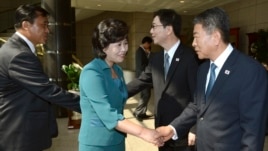
The head of North Korea's delegation Kim Song Hye, center, shakes hands with South Korean delegate Kwon Young-yang, right, upon their arrival for a meeting at the southern side of Panmunjom, in Paju, north of Seoul, South Korea, June 9, 2013. (Photo released by S. Korean Unification Ministry)


Related Articles
Seoul Issues Positive Response to North's Surprise Offer of Talks
N. Korea Accuses South of 'Kidnapping' 9 Youths


Steve Herman

June 09, 2013


SEOUL — After marathon discussions, South Korea has conceded to a demand from the North that dialogue to be held in Seoul this week not be termed ministerial talks - as Seoul had earlier announced.

For the first time in years, officials of the rival governments sat face-to-face at the truce village of Panmunjom. Their talks throughout Sunday and early Monday stretched over a period of 18 hours.

After the conclusion of the marathon talks at Freedom House on the southern side of the Joint Security Area, Unification Ministry spokesman Kim Hyung-suk in Seoul read a brief statement but took no questions from reporters.

Kim said both sides agreed to call the upcoming meeting an “inter-governmental talk,” to discuss issues that should be resolved as soon as possible, such as the resumption of two stalled inter-Korean ventures in the North: the Kaesong Industrial Complex and the Mt. Keumgang tourism complex.

Kim said they also agreed they would discuss resuming meetings of separated families on the peninsula.

The spokesman added that both sides agreed to create delegations consisting of five representatives. The chief of the South Korean delegation will be the Minister of Unification.

North Korea's official news agency later said its delegation would be headed by "minister level authorities."

There has been no dialogue at the ministerial level since 2007.

After the initial Sunday morning round of working talks, Unification Ministry officials in Seoul announced that the North had agreed to ministerial-level talks.

Last week, the communist North called for a resumption of inter-Korean dialogue after it engaged in a period of intense bellicose rhetoric and provocative nuclear and missile tests, which sent tensions on the peninsula to the highest level in decades. Pyongyang also expressed anger about joint U.S.-South Korean annual military drills that, this year, included publicized flights of American bombers capable of carrying nuclear weapons.

The direct discussions mark a significant reversal for the North, which is under international sanctions for its ballistic missile and nuclear weapons development.

A state of war on the peninsula has technically remained in effect since 1953 when three years of devastating conflict halted with a truce but no peace treaty.

Additional reporting by Youmi Kim.
 

Lilbitsnana

On TB every waking moment
It'll never happen. NK might say they will or have, but they won't. I don't know how many they already have, but I suspect more than one, after all, they have to make them for Iran too. (at least do the testing for Iran)


posted for fair use..

http://english.yonhapnews.co.kr/national/2013/06/10/51/0301000000AEN20130610002700315F.HTML


2013/06/10 10:46 KST


(News Focus) Denuclearization likely on agenda of inter-Korean meeting

By Lee Joon-seung
SEOUL, June 10 (Yonhap) -- Denuclearization has consistently been on the agenda of past inter-Korean talks and will likely be touched upon at the upcoming South-North Korea government meeting set for this week in Seoul, sources said Monday.

Earlier in the day, representatives from the two sides agreed to hold a senior-level meeting on Wednesday and Thursday to discuss such matters as the standoff over the Kaesong Industrial Complex, the Mount Kumgang tours and reunions for families separated by the Korean War.

According to the sources familiar with past contacts made between the two Koreas, Seoul has persistently raised the denuclearization issue at these "ministerial-level" meetings from 2002 onwards. The two Koreas held 21 ministerial negotiations from 2000 through 2007 to touch on various outstanding issues facing the two sides.

"For more than a decade, Seoul had used the talks to raise its concerns about North Korea's nuclear weapons development program," a Pyongyang watcher said.

He pointed out that such issues as the North's uranium enrichment program (UEP) and the North's declaration to leave the Nuclear Non-Proliferation Treaty (NPT) have been mentioned by South Korea.

On the UEP issue, South Korean officials at the eighth ministerial meeting held in Pyongyang in October 2002 expressed grave concerns to their counterparts. At that time the North said it was willing to alleviate concerns raised if the United States halted its belligerent policy stance against Pyongyang.

In regards to the NPT issue, South Korean delegates at the ninth meeting urged the North not to take drastic measures and received a reply that the communist country was not seeking to become a nuclear power.

The high-level officials' meetings that took place in 2003 were helpful in getting the North to accept multilateral talks that developed into the six-party talks.

In addition, Seoul objected to the North's attempt to reprocess spent fuel rods from its graphite moderated reactor in Yongbyon as well using the meetings to remind the North of its pledge to fulfill the Sept. 19, 2005 joint declaration. This declaration called for verifiable denuclearization of the Korean Peninsula in a peaceful manner.

The Ministry of Unification, which handles dialogue with the North, said it cannot confirm if denuclearization will be raised, but officials did not rule it out.

"All matters that can enhance peace and stability can be discussed at the two-day talks," said a ministry official, who declined to be identified.

"Seoul may actually be more vocal since the North detonated its third nuclear device on Feb. 12 in the face of strong warnings by the international community," he said.

Last year, the North included a clause in its constitution that made clear it is a nuclear power, and its leader Kim Jong-un started calling for the country to simultaneously push forward for economic construction and the building of its nuclear force this year.

Seoul has said that such a move is bound to fail and further trigger the country's isolation from the rest of the world.

Senior South Korean officials have started to hint that Seoul may link economic cooperation with denuclearization.

Besides denuclearization, South Korea may ask the North for solid assurances that it will not unilaterally close down the Kaesong complex and secure guarantees that the North will not endanger South Koreans who visit Mount Kumgang on the east coast.

The tours to the mountain resort were stopped after a North Korean guard shot and killed a South Korean tourist, while business at Kaesong was hurt because Pyongyang ordered all 53,000 of its laborers there not to report to work in early April.

There has even been speculation that Seoul may demand an official apology for the shelling of an island in the Yellow Sea by North Korean artillery in late 2010 that left four people dead and the sinking of one of its warships eight months earlier. The torpedoing of the Cheonan claimed 46 lives. The North said it was not involved in the sinking.

Other North Korean experts said that while Seoul will mention the need for denuclearization and remind the North that it had said on numerous occasions that it isn't seeking a nuclear arsenal, policymakers may not press the issue.

"Since Seoul wants progress made on inter-Korean exchange, it may not seriously pursue the issue," a source said.

yonngong@yna.co.kr
(END)
 

Lilbitsnana

On TB every waking moment
Nathan J Huntþ@ISNJH1h
News handout from SANA shows DPRK mil attaches at Syrian mil hospital @CustosDivini @DougPologe http://english.chosun.com/site/data/html_dir/2013/06/11/2013061101459.html


They are just confirming what we on tb2k already knew and have posted about, only this time there's a pic, albeit slightly dated.

posted for fair use


N.Korean Army Chief Fingered in Syria Connection


The North Korean military is involved in the Syrian civil war at the initiative of hardline Army chief Gen. Kim Kyok-sik, the Dagongbao daily in Hong Kong speculated Monday.

Kim was allegedly behind the sinking of the South Korean Navy corvette Cheonan and shelling of Yeonpyeong Island in 2010. He is considered one of the key figures in the North Korean regime and was recently promoted from armed forces minister to the chief of the Army's General Staff.

Some dozen North Korean military officers were seen working with Syrian government troops on the northern battlefield of Halab, according to a group called Syrian Observatory for Human Rights.

Information about the reality in strife-torn Syria is notoriously hard to verify, and this piece of news comes from a London-based pan-Arabic newspaper owned by a Saudi prince.

Saudi Arabia is arming the Sunni jihadist opposition to the Assad regime because Syria is a buffer state under the influence of its mortal foe Iran.

A man whose organization monitors developments on the ground has told the prince's Asharq Al-Awsat daily that the North Koreans are acting as advisers to Syrian government forces.


2013061101370_0.jpg

This handout picture from the Syrian Arab News Agency shows two military attaches from the North Korean Embassy in Syria during a visit to the Tishreen Military Hospital in Damascus on March 6, 2012.

Dagongbao pointed to Kim Kyok-sik as a likely link that would lend credence to the story, since he worked as an assistant military attache at the North Korean Embassy in Damascus in the 1970s and led North Korean and Syrian troops in joint operations for about 10 years.

Kim returned to the North around April 1982.

In Syria, he was in charge of military training and delivery of North Korean weapons.

During the fourth Middle East War in 1973, the North supported Syria's attacks on Israel. Kim is believed to have played an important role in the process. During the Syria-Lebanon War in 1982, the North also sent troops to the frontline to help Syrian troops advance into Lebanon, the daily added.

The North Korea-Syria military connection is also suspected of a crucial role in developing conventional and nuclear weapons. A nuclear facility Syria was building in the desert in the mid-2000s, allegedly with North Korean help, was destroyed by Israeli fighters in 2007.


Read this article in Korean

englishnews@chosun.com / Jun. 11, 2013 13:02 KST

http://english.chosun.com/site/data/html_dir/2013/06/11/2013061101459.html
 

Lilbitsnana

On TB every waking moment
I had seen tweets that they (NK) weren't picking up the hotline and speculation that NK had cut/disconnected it again.

Nathan J Hunt‏@ISNJH2h
#ROK to attempt to call #DPRK again in afternoon, if no answer by afternoon could be deemed phone disconnected again.

The Chosun Ilbo‏@EnglishChosun4h
N.Korea Calls Off Cross-Border Talks http://bit.ly/16b2Btn
Retweeted by Nathan J Hunt

posted for fair use...


http://english.chosun.com/site/data/html_dir/2013/06/12/2013061200901.html

N.Korea Calls Off Cross-Border Talks


North Korea on Tuesday called off high-level government talks with South Korea amid wrangling about the rank of the chief delegates from the two sides. The talks had been scheduled for Wednesday and Thursday, raising hopes of a thaw in long-frozen ties between the two Koreas.

"North Korea informed us it would not be sending delegates," Unification Ministry spokesman Kim Hyung-suk told reporters Tuesday evening. "After exchanging lists of the five negotiators each planned to send, the North said the meeting could not be held if no [South Korean] minister-level official attended."

Seoul had named Vice Unification Minister Kim Nam-sik as chief negotiator, while the North proposed to send Kang Ji-yong, a director at the Committee for the Peaceful Reunification of the Fatherland, which is in charge of cross-border affairs.

The government initially wanted the unification minister to head the South Korean group, provided North Korea sent someone of roughly similar rank. But Pyongyang had apparently been planning a calculated insult by sending someone of lower rank, and this plan was thwarted by Seoul's decision to name the vice minister instead.

Kim said North Korea promptly took offence, saying Seoul's choice of lead representative went back on agreements between mid-level officials from both sides. In talks over the weekend, the mid-level officials failed to reach any substantive agreement and the North stubbornly declined to name its own chief representative.

The meeting had originally been billed as "ministerial talks" predicated on the South being represented by the unification minister, but the North Koreans insisted they should be called "governmental" instead.

South Korea believes that this change in terminology made the rank of the lead delegate a less pressing matter and it was only proper to appoint a vice minister instead.


North and South Korea held 21 rounds of ministerial talks between July 2000 and May 2007. The South Korean side was indeed always helmed by a minister, as the moniker suggests, but North Korea repeatedly sent underlings, apparently as a snub to signal how little store it set by these meetings.

The Park Geun-hye administration feels that any more such imbalances would do nothing for mutual respect and trust, and blamed North Korea's failure to change its unpredictable attitude for the cancellation.

It was North Korea that initially proposed the talks five days ago.

Seoul voiced "strong regret" at the cancelation but said the "door remains open" for talks. But North Korea's petty maneuvering makes it unlikely that talks will happen any time soon.


Experts believe other reasons contributed to the North Korean decision, since Seoul had sent strong signals that Pyongyang could expect no immediate concessions or aid simply for showing up. The hasty offer of cross-border talks also failed to impress the U.S. and China, whose leaders met over the weekend.

"It looks like North Korea felt there would be little to gain from talks after the leaders of the U.S. and China agreed that it cannot be allowed to acquire nuclear weapons," said Yoo Ho-yeol at Korea University.


englishnews@chosun.com / Jun. 12, 2013 09:56 KST
 
Last edited:

Lilbitsnana

On TB every waking moment
The poke/prod games seem to be starting again.

-----------------------------
Nathan J Huntþ@ISNJH2h
#ROK moving ahead with deployment of new SM-6 surface to air missile for aegis ships.. http://english.yonhapnews.co.kr/news/2013/06/12/0200000000AEN20130612004900315.HTML


posted for fair use
http://english.yonhapnews.co.kr/news/2013/06/12/0200000000AEN20130612004900315.HTML

2013/06/12 11:18 KST

S. Korea to deploy new surface-to-air missiles for Aegis destroyers

By Kim Eun-jung


SEOUL, June 12 (Yonhap) -- South Korea will arm its Aegis destroyers with the surface-to-air Standard Missile 6 (SM-6) starting 2016 as part of efforts to bolster its missile defense against North Korean threats, a senior government official said Wednesday.

The SM-6, which is suitable for low-altitude sky defense with a maximum range of 320-400 kilometers, is an upgrade of the SM-2 by U.S. defense firm Raytheon.
 

Lilbitsnana

On TB every waking moment
Steve Herman‏@W7VOA41m
Chosun Ilbo (#ROK): #DPRK Vice Foreign Minister Kim Kye-gwan will soon visit China & Russia.
 

Lilbitsnana

On TB every waking moment
posted for fair use

N.Korea Still Dangerous and Unpredictable, Says Pentagon


U.S. Defense Secretary Chuck Hagel on Monday warned that North Korea is still dangerous and unpredictable despite a recent offer of dialogue with South Korea.

At a Senate hearing in Washington Tuesday, Hagel said the U.S. must stay fully prepared to deal with any possible emergency scenarios involving North Korea.

The remark proved prophetic as Pyongyang only hours later abruptly cancelled scheduled high-level talks with Seoul.

Meanwhile, South Korean Vice Foreign Minister Kim Kyou-hyun met with his U.S. counterparts on Tuesday to assess Pyongyang's latest moves. Kim and Assistant Secretary of State for East Asian and Pacific affairs Daniel Russel also discussed the results of the recent U.S.-China summit.

Arirang News / Jun. 12, 2013 13:14 KST

http://english.chosun.com/site/data/html_dir/2013/06/12/2013061201636.html
 

Housecarl

On TB every waking moment
For links see article source.....
Posted for fair use......
http://www.voanews.com/content/skorea-blames-north-for-cancelled-talks/1680034.html

Breaking News
SKorea Blames North for Cancelled Talks
June 12, 2013

South Korea's unification minister says the cancellation of high-level talks with the North is an unfortunate but necessary part of its new relationship with Pyongyang.

The talks, which were to be held Wednesday in Seoul, were called off at the last minute because of what appears to be a relatively minor disagreement over who would represent each country.

Unification minister Ryoo Kihl-jae said Wednesday the blame for the cancelled talks lies with the North, which he said must show sincerity if it wants improved relations with Seoul.

"We could not bring about a result that our people were expecting. But I think it is one of the pains we have to go through for a new relationship between South and North Korea. North Korea should show sincerity for a new relationship between the two Koreas in the future."

South Korean officials say the North refused to send officials to the talks because it was offended by the South's nomination of a vice-minister, rather than minister, as its chief delegate.

Just days earlier, Pyongyang had rejected Seoul's offer to hold minister-level negotiations, which the two Koreas have not held since 2007. There has been no public statement by the North on the status of the talks.

Seoul said Wednesday that North Korea is not answering an inter-governmental hotline that Pyongyang restored last week in an effort to coordinate the negotiations.

Pyongyang unexpectedly offered to hold the negotiations. South Korea quickly agreed, and the two sides held working-level talks Sunday and early Monday in the border village of Panmunjom to try to determine the makeup of each side's delegation.

On the agenda for the proposed talks were the resumption of two stalled joint commercial projects, as well as the reunion of separated Korean families.

Some analysts said it was unlikely the discussions would touch on Pyongyang's nuclear program. Pyongyang has insisted that it will not give up the program, while the United States says abandoning the program is crucial to restoring the North's ties with the international community.
 

Housecarl

On TB every waking moment
For links see article source.....
Posted for fair use.....
http://www.france24.com/en/20130612-north-south-korea-cancel-talks

Latest update: 12/06/2013
- diplomacy - North Korea - South Korea - talks

North Korea cancels high-level talks with South
© AFP

The first high-level talks between North and South Korea in years were cancelled a day before they were due to begin on Wednesday, after the two sides failed to reach an agreement on delegation leaders, South Korea said.
By News Wires (text)

The Koreas’ first high-level talks in years were scrapped a day before they were to begin Wednesday because the sides didn’t agree on the delegation leaders, South Korea said. The cancellation deflated tentative hopes that the rivals would improve ties following years of rising hostility.

North Korea said it wasn’t sending its officials to Seoul for the two-day meeting because the South had changed the head of its delegation, Kim Hyung-suk, a spokesman for Seoul’s Unification Ministry, told reporters in a briefing Tuesday. The ministry is in charge of North Korea matters.

The hope was that talks on reviving two high-profile economic cooperation projects would start to mend a relationship marred earlier this year by North Korean threats of nuclear war and South Korean vows of counterstrikes. But the collapse over what’s essentially a protocol matter is testament to the difficulty the countries have in finding common ground.

South Korea had originally wanted a minister-level meeting between the top officials responsible for inter-Korean affairs, but Pyongyang wouldn’t commit to that. The last minister-level meeting between the Koreas occurred in 2007.

When Seoul told Pyongyang on Tuesday that it was sending a lower-level official than it had initially proposed in preparatory talks, North Korea said it would consider that a “provocation,” Kim said.

The cancellation arises partly from misunderstandings that the sides have about who equals whom in power between their different political systems, Koh Yu-hwan, a North Korea scholar at Seoul’s Dongguk University, said.

“The two sides are offended by each other now. The relations may again undergo a cooling-off period before negotiations for further talks resume,” he said.

North Korea did not issue its own statement about the canceled talks. North Korea did not answer a call from South Korea on Wednesday morning through a Red Cross line that Pyongyang restored last week to communicate before the scrapped talks.

The talks were set up in a painstaking 17-hour negotiating session Sunday, but the rivals had set aside the issue of who would lead North Korea’s delegation. Kim said North Korea offered Tuesday to send a senior official of the Committee for the Peaceful Reunification of Korea as chief delegate, and Seoul said it would send its vice unification minister as chief delegate.

South Korea had previously proposed sending its unification minister. After it announced the vice minister would go instead, North Korea said it wouldn’t send anyone and that “all responsibility is entirely on South Korea,” Kim said. He added that Seoul is still open to talks if North Korea reconsiders.

The main goal of the planned talks had been to see if the Koreas could restore economic projects that were born in the “sunshine era,” a 10-year period ending in 2008 when South Korea was ruled by liberal presidents who shipped large quantities of aid to Pyongyang as they sought to improve ties. The last of those projects, a North Korean factory complex run with North Korean workers and South Korean managers and capital, shut down this spring.

North Korea also wanted Seoul to restart an era of rapprochement by commemorating past joint statements on reunification and joint economic cooperation efforts. But Seoul balked at this; it has demanded apologies for past bloodshed before allowing such exchanges.

North Korea’s interest in talks followed its longstanding cycle of alternating between provocative behavior and attempts to seek dialogue in what analysts say are efforts to win outside concessions.

After U.N. sanctions were strengthened following North Korea’s third nuclear test in February, the country, which is estimated to have a handful of crude nuclear devices, threatened nuclear war and missile strikes against Seoul and Washington. North Korea has also conducted recent nuclear tests and long-range rocket launches.

Some observers believe Pyongyang was trying to ease ties with Seoul, Tokyo and Beijing as a way to win coveted talks with Washington, which it believes could grant it aid and security guarantees.

South Korean President Park Geun-hye has made trust-building with Pyongyang a hallmark of her nascent rule, even as she vows strong counterstrikes to any North Korean attacks.

There was skepticism in Seoul about the talks even before they collapsed.

“We cannot be overly hopeful about inter-Korean relations, which reached a new low not long ago,” the conservative Korea JoongAng Daily said in an editorial Tuesday. “We have experienced numerous setbacks during past talks with Pyongyang.”

(AP)
 

Housecarl

On TB every waking moment
For links see article source.....
Posted for fair use.....
http://apnews.myway.com/article/20130612/DA6S9CRG2.html

Incentive for Korea talks remains despite failure

Jun 12, 11:40 AM (ET)
By SAM KIM and YOUKYUNG LEE

(AP) South Korean workers dismantle a signboard at the venue for the Koreas' first high-level meeting at...
Full Image

SEOUL, South Korea (AP) - South Korea dismantled the meeting table, pulled down the placards and rolled up the red carpet. Its intended guest, North Korea, has stopped answering the phone.

The rivals' much-anticipated meeting, which had been set for Wednesday, collapsed before it even began. But while the last-minute cancellation over a protocol dispute shows the Koreas' deep mutual mistrust, they may have more reasons than not to eventually unpack the meeting gear and get back to negotiations.

New South Korean President Park Geun-hye is under pressure to make good on her campaign promises to reverse a deterioration of ties under her hard-line predecessor. A high-level meeting would validate her attempt to combine a tough line against provocations with commitments to provide aid and steady calls for dialogue.

North Korea is interested in reviving the two economic projects that were to be the main focus of the meetings, both as an emblem of reconciliation and as a source of foreign investment and hard cash. Pyongyang may also be feeling a pinch from its only major ally, China, which has clamped down on cross-border trade and financial dealings in a show of displeasure over a recent spike in tensions.

(AP) South Korean workers roll up red carpets to remove them from the venue for the Koreas' first...
Full Image
"Even though a cooling-off period at this point is inevitable, it is still possible for a different level of the South-North talks to take place as time passes," said Kim Yong-hyun, a professor of North Korea studies of Dongguk University in Seoul.

On Wednesday, Pyongyang wouldn't answer Seoul's calls on a communications line at their border that was restored ahead of preliminary negotiations for the failed meeting. But Ryoo Kihl-jae, South Korea's Unification Minister and Park's point man on North Korea, likened the talks' failure to "labor pains" in the creation of new relations.

North Korea has not issued its own statement about the canceled talks. In an editorial Wednesday, the North's main newspaper, Rodong Sinmun, called for a better mood for dialogue but made no reference to the scrapped meeting.

The talks were meant to focus on reviving South Korean tours to a North Korean mountain resort, and on restoring operations at a factory park in the North Korean border city of Kaesong. The complex, run with North Korean workers and South Korean managers and capital, was responsible for nearly $2 billion a year in cross-border trade until it shut down this spring during high tensions.

The South Korean businessmen who were forced to abandon their operations expressed dismay over the aborted talks.

(AP) A man takes souvenir photos a directional sign showing the distance to North Korea's Kaesong city...
Full Image
"I feel miserable," said Kang Chang-beom, who runs a women's apparel company that has dormant assembly lines at Kaesong.

"The Kaesong complex is dying and our machines are getting rustier as they argue" over protocol, he said. He was not just speaking figuratively; the rainy season starts next week.

The hope had been that the narrowly defined economic talks would lead to the start of a new relationship. Inter-Korean relations have been marred in recent months by a rocket launch, a nuclear test and threats of nuclear war by the North, followed by South Korean vows of counterstrikes.

But the talks collapsed over a dispute over who would participate in them. North Korea said it wasn't sending its officials to Seoul for the meeting because the South scrapped its plan to send Ryoo, according to Kim Hyung-suk, a spokesman for Seoul's Unification Ministry. South Korea decided to send the vice unification minister instead because the North was not sending the official Seoul considers to be Ryoo's equivalent.

"Koreans are very aware of issues of hierarchy and juniors and seniors," said Robert Kelly, a professor at Pusan National University in South Korea. "The larger picture is that North Korea is wary of giving too much recognition to the South."

(AP) South Korean workers dismantle a signboard at the venue for the Koreas' first high-level meeting at...
Full Image
Yoo Ho-yeol, a North Korea studies professor at Korea University in the South, said calling off the talks at the last minute shows how high the level of mistrust is between the governments. Even if the two sides begin talks, it's not clear how much progress can be made, he said.

North Korea's interest in talks followed its longstanding cycle of alternating between provocative behavior and attempts to seek dialogue in what analysts say are efforts to win outside concessions.

Animosity has been high on the Korean Peninsula since U.N. sanctions were strengthened following North Korea's third nuclear test in February. For weeks Pyongyang, which is estimated to have a handful of crude nuclear devices, unleashed a torrent of threats, including vows of nuclear strikes against Seoul and Washington.

South Korean activists held dueling rallies Wednesday in Seoul over the collapsed talks.

"Bickering over the rank of the envoys shows a lack of South Korean resolve to carry dialogue to the next level," Yun Hee-sook of Korea Youth Solidarity, a leftist student organization, said at a protest urging Seoul to restart talks with Pyongyang.

Later Wednesday, more than 100 right-wing protesters, including Korean War veterans, chanted anti-Pyongyang slogans as they burned an effigy of North Korean leader Kim Jong Un and ripped a North Korean flag with a box-cutter.

"We gathered here today to praise Park Geun-hye's decision," said Chu Sun-hee, one of the organizers of the protest.

---

AP writers Elizabeth Shim and Foster Klug contributed to this report.
 

Weft and Warp

Senior Member
This might be slightly off topic but I heard (this morning-6/12/13)from someone I know living in S. Korea--that S. Korea is shutting down half of their reactors due to defective parts/etc... and energy needs to be conserved.
 

Lilbitsnana

On TB every waking moment
This might be slightly off topic but I heard (this morning-6/12/13)from someone I know living in S. Korea--that S. Korea is shutting down half of their reactors due to defective parts/etc... and energy needs to be conserved.

Not OT, it relates to the Koreas. I've been seeing stuff for several weeks, but haven't kept up with it all. Various reasons and excuses have been given during that time.

Here is an article from the end of May.


South Korea Shuts 2 Reactors Over Faked Certificates


Ahn Young-Joon/Associated Press

Questions have been raised about whether nuclear plants can supply South Korea’s power needs.

By CHOE SANG-HUN

Published: May 28, 2013


SEOUL, South Korea — South Korea said on Tuesday that it was turning off two nuclear power reactors and delaying the scheduled start of operations at another two after its inspectors discovered that the reactors used components whose safety certificates had been fabricated.


Connect With Us on Twitter
Follow @nytimesworld for international breaking news and headlines.
Twitter List: Reporters and Editors


South Korea’s nuclear power industry has been plagued by a series of forced shutdowns, corruption scandals and mechanical failures in recent years, undermining public confidence in atomic energy even as the country’s dependence on it for electricity is expected to grow.

An anonymous whistle-blower led government investigators to uncover the latest problem, in which control cables that had failed to pass a safety test were given fake certificates and supplied to four reactors, the country’s Nuclear Safety and Security Commission said Tuesday. The control cable is used to send electronic signals to a reactor’s control system in the event of an accident.

The commission halted operations at two reactors on Tuesday so the problematic cables could be replaced. The planned start-up of two other reactors — one under a routine maintenance shutdown and the other a newly built reactor waiting for operational approval — will be delayed for the same reason.

South Korea has 23 reactors, and Tuesday’s decision means that 10 reactors are temporarily off line for safety concerns, maintenance and other reasons, raising the risk of power shortages in the summer, when electricity consumption peaks.

The two reactors shut down on Tuesday are on the southeastern coast of South Korea, and each has a capacity of 1,000 megawatts. The recurring scandals have damaged the reputation of South Korea’s nuclear power industry, which supplies one-third of the country’s electricity needs and aspires to become a global exporter of reactors.

Despite increasing public concern, however, the government remained determined to push ahead with its aggressive nuclear power program; the country plans to add 16 more reactors by 2030.

Last year, South Korea was forced to shut down two reactors when it was revealed that thousands of substandard parts had been supplied with fake warranties for over 10 years. The country resorted to various power-saving measures to avoid blackouts. Several nuclear power engineers and parts suppliers were later jailed for involvement in the scandal.

A version of this article appeared in print on May 29, 2013, on page A8 of the New York edition with the headline: South Korea Shuts 2 Reactors Over Faked Certificates.


http://www.nytimes.com/2013/05/29/world/asia/south-korea-turns-off-nuclear-reactors.html?_r=0
 

Housecarl

On TB every waking moment
Not OT, it relates to the Koreas. I've been seeing stuff for several weeks, but haven't kept up with it all. Various reasons and excuses have been given during that time.

Here is an article from the end of May.


South Korea Shuts 2 Reactors Over Faked Certificates


Ahn Young-Joon/Associated Press

Questions have been raised about whether nuclear plants can supply South Korea’s power needs.

By CHOE SANG-HUN

Published: May 28, 2013


SEOUL, South Korea — South Korea said on Tuesday that it was turning off two nuclear power reactors and delaying the scheduled start of operations at another two after its inspectors discovered that the reactors used components whose safety certificates had been fabricated.


Connect With Us on Twitter
Follow @nytimesworld for international breaking news and headlines.
Twitter List: Reporters and Editors


South Korea’s nuclear power industry has been plagued by a series of forced shutdowns, corruption scandals and mechanical failures in recent years, undermining public confidence in atomic energy even as the country’s dependence on it for electricity is expected to grow.

An anonymous whistle-blower led government investigators to uncover the latest problem, in which control cables that had failed to pass a safety test were given fake certificates and supplied to four reactors, the country’s Nuclear Safety and Security Commission said Tuesday. The control cable is used to send electronic signals to a reactor’s control system in the event of an accident.

The commission halted operations at two reactors on Tuesday so the problematic cables could be replaced. The planned start-up of two other reactors — one under a routine maintenance shutdown and the other a newly built reactor waiting for operational approval — will be delayed for the same reason.

South Korea has 23 reactors, and Tuesday’s decision means that 10 reactors are temporarily off line for safety concerns, maintenance and other reasons, raising the risk of power shortages in the summer, when electricity consumption peaks.

The two reactors shut down on Tuesday are on the southeastern coast of South Korea, and each has a capacity of 1,000 megawatts. The recurring scandals have damaged the reputation of South Korea’s nuclear power industry, which supplies one-third of the country’s electricity needs and aspires to become a global exporter of reactors.

Despite increasing public concern, however, the government remained determined to push ahead with its aggressive nuclear power program; the country plans to add 16 more reactors by 2030.

Last year, South Korea was forced to shut down two reactors when it was revealed that thousands of substandard parts had been supplied with fake warranties for over 10 years. The country resorted to various power-saving measures to avoid blackouts. Several nuclear power engineers and parts suppliers were later jailed for involvement in the scandal.

A version of this article appeared in print on May 29, 2013, on page A8 of the New York edition with the headline: South Korea Shuts 2 Reactors Over Faked Certificates.


http://www.nytimes.com/2013/05/29/world/asia/south-korea-turns-off-nuclear-reactors.html?_r=0

Considering what happened with Fukishima, those involved with this had better hope that jail is all they're looking at from this.
 

Housecarl

On TB every waking moment
For links see article source.....
Posted for fair use.....
http://www.worldaffairsjournal.org/blog/gordon-g-chang/kim-regimes-peace-routine

Around Asia
Gordon G. Chang
Subscribe to RSS - Gordon G. Chang's blog
The Kim Regime's 'Peace' Routine
13 June 2013

North Korea’s Committee for the Peaceful Reunification of Korea, in a statement carried Thursday by the official Korean Central News Agency, accused Seoul of a “sinister intention.”

Why the harsh rhetoric? On Tuesday, South Korea announced that Pyongyang had canceled talks scheduled to begin on the following day in Seoul.

By now we should know: it’s not possible for the regime of Kim Jong Un, the North’s insecure new leader, to maintain good relations with the South.

Pyongyang had unexpectedly asked for the two-day meeting and had given its agreement to proceed on Monday. Nonetheless, it pulled out at the last minute over a matter of protocol. Seoul had said Unification Minister Ryoo Kihl-jae would lead the South Korean delegation and asked Pyongyang to send Kim Yang Gon. The North said Kim ranked higher than Ryoo—an assertion that did not appear to be true—and refused the request. After discussions as to who outranked whom, the North Koreans said they would not participate in the talks.

The new government of South Korean President Park Geun-hye had hoped the talks would eventually lead to the reopening of two joint projects located in the North: the Kaesong Industrial Complex, closed in April when Pyongyang withdrew its 53,000 workers, and the Mount Kumgang resort, shuttered in 2008 after a North Korean guard shot and killed a South Korean tourist.

The high-level negotiations were to be the first between the two Koreas in almost six years, and their announcement had generated optimism in Seoul and Washington.

There is always hope that the regime in Pyongyang—headed by the same family since its founding in 1948—will one day seek to enter the international community.

After more than six decades—and one war and countless acts of aggression—it should be clear the Democratic People’s Republic of Korea cannot live in peace with the South. In fact, the Kim regime stakes its legitimacy on its goal of unifying the Korean peninsula under its rule. South Koreans, however, never stop trying to come to terms with Pyongyang.

Many in South Korea now blame troubles with the North on their hard-line former president, Lee Myung-bak, whose term ended in February. They forget that the softer policies of his two predecessors miserably failed. The now-closed Kaesong and Kumgang projects, for instance, were the result of Seoul’s “Sunshine Policy,” named after Aesop’s fable in which the sun is able to persuade a man to take off his coat after the north wind fails to do so. The approach, favored by South Korean Presidents Kim Dae Jung and Roh Moo-hyun for 10 consecutive years, failed to bring peace to the peninsula and may even have contributed to tensions.

Although the two South Korean leaders secretly shoveled hundreds of millions of dollars of assistance to the North, the Kim regime, suspicious of prolonged contact with a stronger South Korean state, refused to reciprocate the friendship.

As we now know, Pyongyang just took Seoul’s cash and continued making nuclear weapons and the ballistic missiles to deliver them. Sunshine, from all appearances, stopped being a policy and became an end in itself. Too much sunshine, activist Norbert Vollertsen maintained, created a desert. And as Kim Jin of the JoongAng Ilbo noted, the policy only shored up the finances of the North without reforming the regime. “The change is illusionary,” Kim wrote on Tuesday, “while the dollars are real.”

The reality, it should be clear by now, is that there can be no enduring peace on the Korean peninsula as long as the Kim regime is ensconced in Pyongyang. South Korean politicians are no longer willing to admit that they are locked in an existential struggle with the most militant state on earth. Instead, President Park Geun-hye is fond of talking about her “trust building” policies.

At the moment, Pyongyang is in a quiet stage of its cycle of continual provocations. Yet Kim Jong Un will surely use the unexpected break-off of ministerial talks as an excuse for a provocation. After all, Pyongyang called Seoul’s insistence on the North sending an appropriately high-level official a “grave provocation.”

We know what language like that can lead to: in 2010, North Korea killed 50 South Koreans.
 

Lilbitsnana

On TB every waking moment
Steve Hermanþ@W7VOA4m
Yonhap: Source says #DPRK asked China last month to be recognized as a nuclear weapons state.


Steve Hermanþ@W7VOA12m
Open terms of time and venue offered to US by #DPRK same as made to #ROK (and we know how that turned out). #Korea


Steve Hermanþ@W7VOA13m
Talks offer to US from #DPRK 1st aired as 6 min. "important" announcement 1000 KST Sunday (0100 UTC). Also on central TV ~25 minutes later.


Steve Hermanþ@W7VOA1h
Quick analyst react - MT @dpinkston: When "peace offensive" is "rejected" son'gun & pyongjin line will be validated to justify nuke test #4.


Steve Hermanþ@W7VOA1h
Proposal comes from authoritative Nat'l Defense Commission.

Steve Hermanþ@W7VOA1h
#DPRK proposes high-level talks with US.
 
Status
Not open for further replies.
Top