Supposedly Myanmar, Buddhist assaulting Muslims,
as the Muslims are the minority (for now) the Buddhists attacked them, One News story said it was because the Muslims murdered Buddhists
http://dawn.com/2013/05/21/myanmar-muslims-jailed-for-killing-buddhist-monk/
Now we all know old puss head Obama won't say a word about how the Muslims murdered the Buddhists, or how the Mobs in the US are out of control in attacking Whites, how young Christian girls in his home town, or One of them in Indonesia, were beheaded and the heads were place a long distance apart to get their message across
http://frontpagemag.com/2013/dgreen...eheaded-3-christian-girls-as-ramadan-present/
It looks like they got smart and are trying to keep it that way, however I suspect they are getting started years or decades too late.
posted for fair use...
Myanmar imposes two-child limit on Muslims
Officials say limit will ease Buddhist-Muslim tensions, citing overpopulation as cause for violence; 'Muslims reproduce 10 times faster than Buddhists do,' says state official
Associated Press Published: 05.26.13, 16:54 / Israel News
Muslims in a province of Myanmar have been ordered not to have more than two children in an attempt by the government to stop Buddhist attacks on Muslims.
State officials said the two-child limit in the state of Rakhine would ease tensions between Buddhists and their Muslim Rohingya neighbors.
Related stories:
Israel-hatred fuels Malaysian politics
Thailand remembers Holocaust victims
Hindi novel portrays life of Indian Jews
Local officials said the new measure was part of a policy that will also ban polygamy in two Rakhine townships that border Bangladesh and have the highest Muslim populations. The townships, Buthidaung and Maundaw, are about 95% Muslim.
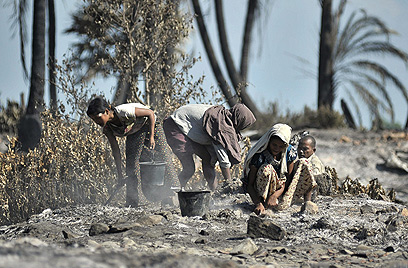
Myanmar after violent clashes (Photo: gettyimages)
The measure was enacted a week ago after a government-appointed commission investigating the violence issued proposals to ease tensions, which included family planning programs to stem population growth among minority Muslims, said Rakhine state spokesman Win Myaing. The commission also recommended doubling the number of security forces in the volatile region.
"The population growth of Rohingya Muslims is 10 times higher than that of the Rakhine (Buddhists)," Win Myaing said. "Overpopulation is one of the causes of tension."
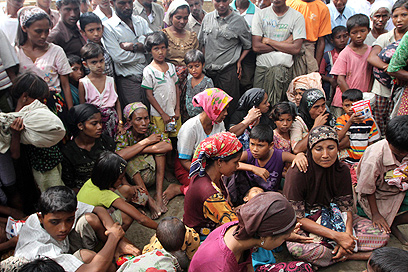
Myanmar refugee camp (Photo: AP)
Sectarian violence in Burma first flared nearly a year ago in Rakhine state between the region's Rakhine Buddhists and Muslim Rohingya. Mobs of Buddhists armed with machetes razed thousands of Muslim homes, leaving hundreds of people dead and forcing 125,000 to flee, mostly Muslims.
Since the violence, religious unrest has developed into a campaign against the country's Muslim communities in other regions.
Containing the strife has posed a serious challenge to President Thein Sein's reformist government as it attempts to institute political and economic liberalization after nearly half a century of harsh military rule.
It has also tarnished the image of opposition leader Aung San Suu Kyi, who has been criticized for failing to speak out strongly in defense of the country's embattled Muslim community.
Win Myaing said authorities had not yet determined how the measures will be enforced, but the two-child policy will be mandatory in Buthidaung and Maundaw. The policy will not apply yet to other parts of Rakhine state, which have smaller Muslim populations.
"One factor that has fuelled tensions between the Rakhine public and (Rohingya) populations relates to the sense of insecurity among many Rakhines stemming from the rapid population growth of the (Rohingya), which they view as a serious threat," the government-appointed commission said in a report issued last month.
Predominantly Buddhist Myanmar does not include the Rohingya as one of its 135 recognized ethnicities. It considers them to be illegal immigrants from Bangladesh and denies them citizenship. Bangladesh says the Rohingya have been living in Myanmar for centuries and should be recognized as citizens. Muslims account for about 4% of Myanmar's roughly 60 million people.
http://www.ynetnews.com/articles/0,7340,L-4384409,00.html