PREP CB Radios

Zulu Cowboy

Keep It Real...
Zulu Cowboy: I am surprised that your county DP would not have its own, discrete frequencies, typically in the 154-5 MHz range, frequencies you would not be authorized to use personally, rather than relying on ham frequencies to communicate.

Are you also saying that your amateur gear would be of more value to you than a scanner to monitor local emergency traffic, such as police and other responders?

You see, that is where I always reach a point of consternation when hams say their hobby-radio activities will be more important in a SHTF scenario than any other radio service. While 6-meter ham traffic, for example, would be useful to monitor in order to assess what is going on in my local area during an emergency, I would never regard it as having higher value than the informatoin I will gather by simply monitoring police, sheriff's dept, and other first-responders, and they will not be using ham radios to communicate. Ham radio will be one of the tools I would use to keep informed, but I fail to see how it is head-and-shoulders above all the other radio services in terms of its value.

Well, of course the local authorities have their own separate frequencies to operate on! They've also made arrangements to utilize the 2 meter band, so they can communicate with the local hospitals in my area, during a disaster. (Which is what I do...) Our hospital disaster net, here in Nashville (146.670 mHz) includes representatives from OEM, the Tennessee Health Dept., TEMA, FEMA, Fort Campbell, and 20+ hospitals in the middle TN area.

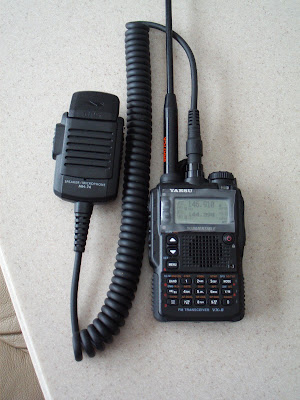
And yes, I'm saying that my particular radio...the Yaesu VX-8DR has the capability of monitoring all of the non-trunked local emergency traffic...Fire, Police, EMS, just like a scanner. Anything from 500kHz to 999.990MHz, continuous reception for Short-wave, FM/AM broadcasts, analog TV stations, audio aircraft, public service channels, NOAA weather, etc. It also picks up all of the Citizens band frequencies. And although I cannot transmit on CB frequencies with this radio; I CAN receive and transmit on the FRS/GMRS/MURS frequencies.

I'd call that head-and-shoulders above the others...(in terms of value), eh? :shr:
:crtmn:
Zulu Cowboy

(You can study for your ham radio license, here for free) ~ LINK

http://www.ebay.com/itm/Yaesu-VX-8D...994?pt=LH_DefaultDomain_0&hash=item2a05621742

FILE0158.JPG
 
Last edited:

cheesesteaks

Senior Member
CB's certainly have their place - especially driving on the interstate. But on day's like today where solar flares have pretty much shut down the the HF bands we can still find usable frequencies on 40 meters.. I doubt the cb bands are open since 10 meters has a S8 noise level so there won't be much ragchewing going on in my neck of the woods. VHF & UHF seem to be ok. With ham radio I can find a usable frequency because there are so many of them.
FEMA was trying to get a foothold in our area. When I was the ARES emergency coordinator for my county Fema wanted ARES & RACES to be one group. I told them hell no. The feds would control how and when ARES responded if they joined with RACES and I told them that won't happen on my watch.......so they fired me. As a result every ARES member resigned and hardly anyone is left for RACES. We started a new club and we handle most of the events in our county and ARES & RACES are no longer needed.
 

Double_A

TB Fanatic
Zulu Cowboy: I am surprised that your county DP would not have its own, discrete frequencies, typically in the 154-5 MHz range, frequencies you would not be authorized to use personally, rather than relying on ham frequencies to communicate.

Are you also saying that your amateur gear would be of more value to you than a scanner to monitor local emergency traffic, such as police and other responders?

You see, that is where I always reach a point of consternation when hams say their hobby-radio activities will be more important in a SHTF scenario than any other radio service. While 6-meter ham traffic, for example, would be useful to monitor in order to assess what is going on in my local area during an emergency, I would never regard it as having higher value than the informatoin I will gather by simply monitoring police, sheriff's dept, and other first-responders, and they will not be using ham radios to communicate. Ham radio will be one of the tools I would use to keep informed, but I fail to see how it is head-and-shoulders above all the other radio services in terms of its value.


This relates to my comment about FEMA requesting Help from Hams. I guess I failed to flesh out my argument and as a consequence never made my point clear.

Is it possible that Government communicators become limited by channelized radio?

If they only have specific bands & channels available on their gear, what happens if certain bands become unusable due to atmospherics or solar conditions? Can they switch to from Voice to Data to CW on a band or switch to an entirely different portion of the spectrum?

It was my understanding the point the FEMA people were making was that they often failed in their mission because their communication gear was set in stone, whereas ham's had multi-mode, multi-band gear that gave them enormous flexibility in an emergency to dynamically change methods of communicating in a way FEMA could not.

By the way most dual VHF/UHF Ham gear comes with extended receiver coverage so that while it can "Legally" only transmit in the Hams bands it can listen to 2mhz to 1000mhz, including all the local Public Safety bands Frequencies.


I see Zulu Cowboy responded with much of the point I was trying to make. Captain D, how current is your familiarity with Ham radio? Is it possible your arguing from a point of understanding that while it was valid years ago, is not valid anymore.


This Ham Radio Tranceiver can

Receive:
0.030 - 199.999 MHz*, 400 - 470 MHz*
Transmit:
1.8 - 1.999 MHz*
3.5 - 3.999 MHz*
5.3305, 5.3465, 5.3665, 5.3715, 5.4035 MHz USB (USA version)
7.0 - 7.300 MHz*
10.1 - 10.150 MHz
14.0 - 14.350 MHz
18.068 - 18.168 MHz
21.0 - 21.450 MHz
24.89 - 24.990 MHz
28.0 - 29.700 MHz
50.0 - 54.000 MHz*
144.0 - 148.000 MHz*
430.0 - 450.000 MHz*
* Varies according to version
Mode: USB, LSB, CW, RTTY (FSK), AM, FM, WFM (Rx only)
 

Attachments

  • 0700.jpg
    0700.jpg
    93.4 KB · Views: 115
Last edited:

NoDandy

Has No Life - Lives on TB
Double A

The radio you posted the picture of, please tell me: What Brand & Model, and approximate price. I only have CB's at the moment, but would like to increase my comm capabilities.

Thanks in advance ;)

Regards, NoDandy
 

Captain D

Senior Member
Guys, I'm aware that many ham transceivers are also general-coverage receivers. The ones shown above are lovely. However, being a ham doesn't make you able to listen to those frequencies any better than any other guy with a Bearcat or one of the above transceivers. All the ham ticket does is make it so you can transmit on certain assigned frequencies that are going to be used by other hams. I almost get the impression that some people think having some ham gear and a ham ticket will make them able to have direct comm with cops and firemen in a disaster scenario. I'm not saying you guys believe this, but I almost get that impression from some of the people who say how necessary it is to be a ham.
 

Captain D

Senior Member
I doubt the cb bands are open since 10 meters has a S8 noise level so there won't be much ragchewing going on in my neck of the woods.

You live in a noisy environment. I was in my Jeep for five hours today with the CB on ch 19. There was almost no noise, and nobody ever broke squelch. Here at home, I just hooked my CB base to my 18-foot vertical and checked all 40 channels with the squelch off. The S-meter was about zero all the way around. I did hear somebody on ch.6, but it was unreadable. All 40 channels were available for anybody who wanted to use them. I don't know about your area, but in Arizona the CB channels are almost as quiet as the VHF marine freqs out on the desert.
 

Captain D

Senior Member
I just can't help myself. I had to relate this.

A fire broke out in the Bradshaw Mountains over the weekend. It started in somebody's cabin on the edge of Crown King and spread to the surrounding forest. The town of Crown King was evacuated.

For two days now, there has been a wealth of traffic on the scanner related to this fire. The Prescott National Forest frequencies are getting heavy use during the daylight hours. The dispatcher who normally runs their net during business hours on weekdays has been at it all weekend, not signing off until 2300 hrs each evening. The sheriff's mobile command post has deployed to the area and taken control of the incident. There is a lot of traffic coming off the sheriff's Mingus Mountain repeater related to their operations. Also, 155.400, a freq I have been tracking for years, is getting use like I've never seen. In the past, I heard traffic about checkpoints and coords that worked out to our local area, but I never really knew for sure who the operators were. There's no question about it any more. They are discussing command post stuff and assignments of dudes patrolling the area on quads and manning checkpoints on various roads in the forest. This morning on an air freq I heard two pilots discussing the fire as they were looking down on it. There must be twenty frequencies that are busy with traffic related to this fire.

Meanwhile, what are the hams doing? Well, at 147.000 MHz a fellow on the Knobby Knee Net was telling everybody about the chicken enchiladas he and his wife enjoyed Saturday night at a place called Auntchiladas. And then there was the fantastic breakfast they went out to Sunday morning. Another ham chimed in and waxed poetic about the steaks at Outback Steakhouse, saying how much better they are than the steaks served at The Black Angus. I didn't stay on the freq long enough to learn about the recent surgeries they'd just had, but I am sure the subject was about to be discussed. I returned the ham freqs to lock-out, where I normally keep them. It's no wonder to me why our sheriff doesn't consider amateur radio to be an asset in an emergency.
 

NVBadBoy

PJ19VN99
Not one radio will properly work for every-day emergencies. What one needs to do is have several radios on hand. Not just CB (26-27MHz), but also one that covers the lower bands and does muti-modes, from 1.8MHz all the way to 54MHz. The antenna you select is the key factor, when it comes to receiving and transmitting signals. A top-notch radio will be of no use, if you tune a bed spring or a coat hanger for an antenna.
You also need to invest into some VHF and UHF radios. It can amateur radios, or it can be commercial rigs, such as the XTS-5000 or the Astro Sabers. You should have several extra batteries to go with each radio. If you can, install a mobile radio into each of your vehicles and buy a decent antenna that will work with your operating frequency, if licensed to do so.

NVBB
 

TerryK

TB Fanatic
Almost every county that conducts emergency operations drills in an integrated evironment using encrypted comms. Been that way for a couple of years now. You are not going to listen in.
Fema came out several years ago and offered every county that had a functioning Incident Command Structure and trained people assistance with hardware and training. It's kind of a nation wide thing.
As someone else said, for the average prepper you cant beat a good shortwave receiver/all band receiver.
Some FRS and maybe CBS for family/ metro area comms.
Only if you have a need to transmit long distances do you need a full compliment of expensive ham gear.
I can receive SW from around the world with both an old tube type all band console radio (weighs about 20 pounds and is 40 years old) and a small modern all band receiver that weighs about a pound.) I keep the modern one in a metal box.
FRS is for around the house and traveling in our 3 car caravan.
CB is for around the town and listening to the truckers :)
 

Double_A

TB Fanatic
Double A

The radio you posted the picture of, please tell me: What Brand & Model, and approximate price. I only have CB's at the moment, but would like to increase my comm capabilities.

Thanks in advance ;)

Regards, NoDandy


That is the Icom 7000 and the price is approx $1,300 this is a compact unit for mobile or base station use
 

Double_A

TB Fanatic
I just can't help myself. I had to relate this.

A fire broke out in the Bradshaw Mountains over the weekend. It started in somebody's cabin on the edge of Crown King and spread to the surrounding forest. The town of Crown King was evacuated.

For two days now, there has been a wealth of traffic on the scanner related to this fire. The Prescott National Forest frequencies are getting heavy use during the daylight hours. The dispatcher who normally runs their net during business hours on weekdays has been at it all weekend, not signing off until 2300 hrs each evening. The sheriff's mobile command post has deployed to the area and taken control of the incident. There is a lot of traffic coming off the sheriff's Mingus Mountain repeater related to their operations. Also, 155.400, a freq I have been tracking for years, is getting use like I've never seen. In the past, I heard traffic about checkpoints and coords that worked out to our local area, but I never really knew for sure who the operators were. There's no question about it any more. They are discussing command post stuff and assignments of dudes patrolling the area on quads and manning checkpoints on various roads in the forest. This morning on an air freq I heard two pilots discussing the fire as they were looking down on it. There must be twenty frequencies that are busy with traffic related to this fire.

Meanwhile, what are the hams doing? Well, at 147.000 MHz a fellow on the Knobby Knee Net was telling everybody about the chicken enchiladas he and his wife enjoyed Saturday night at a place called Auntchiladas. And then there was the fantastic breakfast they went out to Sunday morning. Another ham chimed in and waxed poetic about the steaks at Outback Steakhouse, saying how much better they are than the steaks served at The Black Angus. I didn't stay on the freq long enough to learn about the recent surgeries they'd just had, but I am sure the subject was about to be discussed. I returned the ham freqs to lock-out, where I normally keep them. It's no wonder to me why our sheriff doesn't consider amateur radio to be an asset in an emergency.

I'm not sure what you find surprising. Unless invited Ham's aren't going to get involved in an Emergency already well coordinated by Public Safety, if there no need, they're not needed.

Yes scanners can do a better job than a slow scanner Ham unit they are specifically optimized for that job. I'm not sure what your point here is other than what you've repeatedly said that Ham radio has no place in your SO's dept. Secondarily that the tone of your posts indicate that you consider yourself an expert in comms and have no use for Ham radio. Am I correct in my assessment?
 

Adino

paradigm shaper
Who makes a decent ssb cb?

My quick search yielded Cobra which some folks weren't too happy with (seems the "clarifier" hadn't been fiddled with by listeners).

And a Uniden BC980 that has yet to be released.
 

Double_A

TB Fanatic
Take a look at this SSB CB unit - Cobra 148 GTL They call their Clarifier "Voicelock" yep you've got to adjust it to clarify the speech. I see lots of amazon reviews where people give gear a poor rating because the user was not using the gear properly.
 

Captain D

Senior Member
Secondarily that the tone of your posts indicate that you consider yourself an expert in comms and have no use for Ham radio. Am I correct in my assessment?

Double A, If I had a compelling reason to talk to somebody half-way across the country, ham radio would be my first choice.

The problem with threads like this is that the subject of the thread was CB radios, but invariably a ham will chime in, dismiss the topic of the thread, take on a condescending attitude, and say the only way to go is ham. That's when I, in-turn, take on the tone I often do. Some hams on this board imply that CBs, FRSs, etc, are all toys or only used by a bunch of yahoos. Somebody in this very thread made the remark, "Breaker Breaker Good Buddy," when I haven't heard anybody say that over the air in thirty years. And even if they still talked like that on CB, are the conversations a person frequently hears on the ham bands, such as what I heard this morning, any less silly? If I had tuned in that traffic on two-meters to show somebody what ham radio is all about, do you think what was being discussed would have inspired that person to get his ham ticket? I realize hams are very proud of having gotten a license. That's a lot more effort than just buying a CB and firing it up, so I think hams deserve privileges in terms of all the bands at their disposal and the transmission types they can use. Hams are normally very enthusiastic about what they do, and they want others to share in their fun, so I kind of understand when they say something like, "Ham is the only way to go." even though I don't completely agree.

All I ask is that when somebody says, "Here's what I need to do. What is the most practical way to do it?" that we give people good advice. Ham radio requires a certain amount of effort in terms of training, testing and observing protocols, not to mention a bit of money to get on the air. Most people are not looking for a new hobby, they just want a consumer product they can turn on and use. If they are inclined toward getting into how radios function and how to do lots of gee-whiz stuff with them, then ham radio is a fine pursuit. But if the guy says I want to keep track of my kids when they are playing in the woods nearby, it seems a bit much to tell him to get some little VHF ham handhelds, take a test, and have all your kids do this, so they can keep track of each other. It seems to me that the clear choice would be some sort of simple, cheap handhelds like FRS. And I can't help but think that a group of people who wanted to have some sort of local radio net to talk mobile-to-mobile while they are out four-wheeling or on quads will be perfectly satisfied with some inexpensive CB units.

I would much prefer it if we could all peacefully discuss what types of comm gear a prepper may want to have around. From my perspective, in a natural disaster or SHTF scenario, the first thing I want to know is what is going on around me. I can find that out by listening to as many police, fire, utility, emergency-respone, ham, etc. frequencies as are active in my area. I also want to be aware of what people might be saying on their personal communication devices, such as FRS or CB. A few years back, two planes collided in mid-air, and I knew about it way before the first responders because I picked up transmissions from a nearly hysterical antelope hunter who had witnessed the whole thing and was calling his hunting buddies on his GMRS to tell them about it. There is a wealth of information to be gathered from the airwaves, and all it involves is listening. My first bit of advice to somebody interested in communication is to get some sort of scanning receiver and get very familiar with the type of traffic you will hear so you will know how to make use of it when the time comes. It may follow, once this person really gets into scanning, that he wants something more and decides to join the ham community. But let's not push the guy into swimming pool when he first asks us how to swim!

I love radio communications. I have been fascinated by radios since I was four or five years old. When we got our first TV set, about 1954, I asked my mom how the thing worked. She told me that little pictures went flying through the air, and the antenna picked them up. I immediately went out in the yard and stared up at the antenna, which looked something like a box kite, to try to see what I thought would be a string of black-and-white snapshots going through the air in a blur and into our antenna. As I got older, I built little transmitters and listened to shortwave radios and got into CBing. I was always putting up new antennas and playing around with radio gear. On my first tactical assignment in the Air Force, the first morning of my first deployment, I helped my radio operators assemble and raise their inverted Vs, and I was ecstatic that I was actually getting paid to do something I normally did at home as my hobby. I'm not interested in arguing with people about the subject I love. I prefer to exchange ideas and help others get the type of comm service they need.

I apologize for the tone I used in a few posts.

 

Captain D

Senior Member
That is the Icom 7000 and the price is approx $1,300 this is a compact unit for mobile or base station use

Oh, that makes my mouth water! And I agree on that Cobra 148GTL. I've had a couple of them. Talked bearfoot to Australia and Ireland while mobile with one, as well as all over the country in years past. They've been around a long time. You won't go wrong with one of those. Anybody that can't make that thing work just doesn't know how to use a radio.
 

bw

Fringe Ranger
Meanwhile, what are the hams doing? Well, at 147.000 MHz a fellow on the Knobby Knee Net was telling everybody about the chicken enchiladas he and his wife enjoyed Saturday night at a place called Auntchiladas. And then there was the fantastic breakfast they went out to Sunday morning. Another ham chimed in and waxed poetic about the steaks at Outback Steakhouse, saying how much better they are than the steaks served at The Black Angus.

We have constant trouble with some guy down in Port Orchard who can't shut up while we're trying to run nets and do events. We've got traffic going, answering calls, and this total loser is mumbling about people he's known or what he's having for dinner or whatnot.

There are lots of hams taking care of business, and there are lots of losers who have a ham license and nothing in the world to do except talk.
 

Beelbill

Inactive
Thanks for all the great information. I am trying to digest it all. If I understand correctly, the Yaesu VX-8DR Handheld Ham Radio Transceiver VX-8R VX8DR would pick up a wide range of frequencies but I would not be able to transmit on CB. It can transmit 5 watts FM on 50/144/430 MHz plus 1.5 watts on 222 MHz, which if I understand correctly is VHF and in the Ham range but doesn't need a license. The Icom 7000 transmits and recieves a wide range of frequencies but doesn't it require a Ham license? The Cobra 148GTL is CB only but is capable of using SSB to boost the range.

The farms around here all have CBs so I still think talking on those frequencies would be useful for local communication. I really don't care about talking to China. But, I will need to know what is going on around the world so listening farther distance would be good. It shoulds like talking on CB would be useful for local communications and listening to as wide of a range of AM, SW, VHF and UHF would be useful for intel gathering. Is there a unit that listens to a wide range of frequencies like the Icom 7000 or Yaesu VX-8DR, but transmits on CB?
 

Captain D

Senior Member
Hey Beelbill,

That ICOM radio is one gorgeous piece of equipment, but I advise against trying to find one radio that does it all. I would prefer to have an HF radio to tune HF and a scanner to monitor VHF/UHF. My feelings about it is that HF and VHF/UHF are quite different from each other, and it is better to have radios that were designed to do one or the other. You tune them different, and you will need different antennas.

Even if you buy something like the Yaesu or Icom with transmit capability, you aren't allowed to transmit on ham freqs until you are properly licensed. It's pretty easy to get started with ham these days, and the guys on here can tell you how to do it. You can only transmit on FRS or CB freqs without a license. GMRS freqs require a license, but unless you are in a crowded area that has a lot of licensed users, I don't think you'll get in any trouble if you transmit.

Ask more questions if there's anything you are wondering about.

Oh, and one last thing. If you want to talk on CB, get a 40-channel CB and connect it to a dedicated CB antenna that has been properly tuned with an SWR meter.

And one more thing about antennas: Today's receivers are so good that you can use just about anything for an antenna and pick up something, but to transmit you must have an antenna that has the proper impedance, or what some people might call load. This is accomplished by tuning the antenna to the proper physical dimensions as well as incorporating some other design considerations. You can't just hook your new ham radio to a random piece of wire and start transmitting, or you may quickly see smoke coming out the back of your radio!
 
Last edited:

Y2kO

Inactive
What LoupGarou said with regard to antennas. And the issue with any radio system is the batteries to power it and the ability to charge them.
 

Publius

On TB every waking moment
OK, I apologize from the beginning for my continued inability to get anything from the search function. I am sure this has been discussed before, but I can't find it and it seems like a good topic to discuss now again. When TSHTF, we may not have an easy way to communicate. When the tornado hit here in Joplin, one of the first things down were the cell phones. Many people have become so dependent on them that they don't even have land lines. Some people have prepped by getting HAM radio licenses and learning how to use them. But that is a tremendous expenditure of time, money and energy.

What about using CB radios to communicate in a post SHTF world? Currently there are regulations about range, but post SHTF, the CB's range could be easily extended. They are readily available and relatively inexpensive. Anyone can use one with minimal training. I remember when we used to all drive up and down the highway saying: "Breaker 19. This is roadrunner. You got your ears on good buddy?" With cell phones, the truckers are probably the only ones using CBs now. With 40 channels, we could even pick a channel that isn't used much and designate it the TB2K channel that we could monitor.


I have answered to a number of threads on this topic and may here are amateur/ham operators and nothing wrong with that, but many do not have what it takes to pass the tests or the money to get into. CB radios are not cheep either but much more affordable and some decent units available/found as used. The range for the most part works on Line of Sight and good for 20+ miles and there are things/factors that will affect the range of any given setup and to much to go into here. I have a number of these units here and three of them are 40 Channel with upper and lower Side Band and its much like having a 120 Channels and 80 of them have increased range because the power output jumps from 4 AM watts to 12 watts on the side band's and Side Band the best that I can describe it! It's kind of like a crude form of FM as opposed to AM broadcast that most common 40 channel CBs do.
 

Beelbill

Inactive
I have answered to a number of threads on this topic and many here are amateur/ham operators and nothing wrong with that, but many do not have what it takes to pass the tests or the money to get into. CB radios are not cheep either but much more affordable and some decent units available/found as used. The range for the most part works on Line of Sight and good for 20+ miles and there are things/factors that will affect the range of any given setup and to much to go into here. I have a number of these units here and three of them are 40 Channel with upper and lower Side Band and its much like having a 120 Channels and 80 of them have increased range because the power output jumps from 4 AM watts to 12 watts on the side band's and Side Band the best that I can describe it! It's kind of like a crude form of FM as opposed to AM broadcast that most common 40 channel CBs do.
Great explaination of SSB. Thanks. I was looking at CB radios today at the local truck stops. Several of them have SSB and also have "SWR" which I assume means short wave reception. I am sure they don't have the wide range of the Yaesu or Icom. Are they just for monitoring emergency stuff like weather or do they pick up some Ham signals?

Hey Beelbill,

That ICOM radio is one gorgeous piece of equipment, but I advise against trying to find one radio that does it all. I would prefer to have an HF radio to tune HF and a scanner to monitor VHF/UHF. My feelings about it is that HF and VHF/UHF are quite different from each other, and it is better to have radios that were designed to do one or the other. You tune them different, and you will need different antennas.

Even if you buy something like the Yaesu or Icom with transmit capability, you aren't allowed to transmit on ham freqs until you are properly licensed.

So, maybe get a Cobra 148GTL for local communication with my farmer neighbors and get the Yaesu for picking up Ham signals for news? After TSHTF, a license might not be so important, but in that situation it might be better to listen and not speak anyway.
 

Double_A

TB Fanatic
Hey Beelbill,

That ICOM radio is one gorgeous piece of equipment, but I advise against trying to find one radio that does it all. I would prefer to have an HF radio to tune HF and a scanner to monitor VHF/UHF. My feelings about it is that HF and VHF/UHF are quite different from each other, and it is better to have radios that were designed to do one or the other. You tune them different, and you will need different antennas.

Even if you buy something like the Yaesu or Icom with transmit capability, you aren't allowed to transmit on ham freqs until you are properly licensed. It's pretty easy to get started with ham these days, and the guys on here can tell you how to do it. You can only transmit on FRS or CB freqs without a license. GMRS freqs require a license, but unless you are in a crowded area that has a lot of licensed users, I don't think you'll get in any trouble if you transmit.

Ask more questions if there's anything you are wondering about.

Oh, and one last thing. If you want to talk on CB, get a 40-channel CB and connect it to a dedicated CB antenna that has been properly tuned with an SWR meter.

And one more thing about antennas: Today's receivers are so good that you can use just about anything for an antenna and pick up something, but to transmit you must have an antenna that has the proper impedance, or what some people might call load. This is accomplished by tuning the antenna to the proper physical dimensions as well as incorporating some other design considerations. You can't just hook your new ham radio to a random piece of wire and start transmitting, or you may quickly see smoke coming out the back of your radio!


I agree that it's best to get dedicated gear. While my Icom 7000 is very nice, it's like a Swiss Army knife it does many things good and if you have to only have ONE tranceiver it or the Yaesu 857 (or 897) would be it.... However it is better to have dedicated gear tailored for their specialities and extra features that can make a big difference.

If you just want to listen get, 1) a Scanner radio for local communications and 2) a Short Wave Receiver for monitoring distant comms. Get the scanner first and load in Public safety Frequencies, Public Works, Roads & Highways, Private Security. The likelihood of Pubic Safety Frequencies being encrypted is increasing as Capt D said in an earlier post. Even when not, local PD is likely to send confidential info via mobile data terminal/laptop or plain old cellphone. However lots of other radio users don't have the same radio discipline and you are more likely to get the scoop from them if say they have been requested to block off roads etc. By the way there are several new scanners that all you need is the zip code of the area you wish to monitor frequencies are loaded for you. Also several makers have a feature to automatically lock-on to unknown radio transmissions and load that frequency into your scanner, no need to find out what frequency they are using.

If you want to talk but not get a ham license get one or two pair of the FRS radios and a full featured CB with SSB capability. The limitation with both of these is the antennas. They are fixed on the FRS handhelds, but on a CB an good antenna up high can make a huge difference so don't scrimp in this area.

If you want to step up to more professional gear w/o taking a ham test, GMRS is the way to go. Higher power, ability to have repeaters, external antennas and a hefty License fee (if you wish to be legit)
 

Publius

On TB every waking moment
No! SWR is short for "Standing Wave Ratio" and it has to do with setting up the antenna and checking the antenna for proper adjustment/length and its good to have have that as built in. The Radios you were looking at are on the high end and have other built in options like RF Gain and many and my self too like the RF Gain better than using the squelch for cutting back some unwanted distant chatter and allowing the more local in a little clearer.
 

OldArcher

Has No Life - Lives on TB
OK, I apologize from the beginning for my continued inability to get anything from the search function. I am sure this has been discussed before, but I can't find it and it seems like a good topic to discuss now again. When TSHTF, we may not have an easy way to communicate. When the tornado hit here in Joplin, one of the first things down were the cell phones. Many people have become so dependent on them that they don't even have land lines. Some people have prepped by getting HAM radio licenses and learning how to use them. But that is a tremendous expenditure of time, money and energy.

What about using CB radios to communicate in a post SHTF world? Currently there are regulations about range, but post SHTF, the CB's range could be easily extended. They are readily available and relatively inexpensive. Anyone can use one with minimal training. I remember when we used to all drive up and down the highway saying: "Breaker 19. This is roadrunner. You got your ears on good buddy?" With cell phones, the truckers are probably the only ones using CBs now. With 40 channels, we could even pick a channel that isn't used much and designate it the TB2K channel that we could monitor.

Howdy, Beelbill!
I didn't know you were from Joplin! I lived there from 1962-2003, minus school and military time...
As to CB in the PAW, my greatest concern is being a beacon for those that don't have, wanting to take from those that do... OpSec goes out the window, when you have signals that can be triangulated, monitored, and used for intel... Call me paranoid, as you said, "that is a tremendous expenditure of time, money and energy."

I just got a "gently used" Yaesu FT897D on E-Bay this afternoon, and am in the process of getting the rest of the equipment I'll need for my PAW window on the world... I'll get lined-up with training for certification, and then go as far as I can- before the balloon goes up... Yes, it is expensive, but outside of carrier pigeon or shanks mare, this may be the best way to go in the PAW...

OldArcher, out...
 

Double_A

TB Fanatic
Let me editorialize on this topic. In a prep environment any method of communication that is effective is good, as long as it doesn't interfere and especially prohibit another users ability to use their gear.

I've been a Ham for over 20 years now and been the Radio system admin for several companies for not quite as long. Some systems fielded hundreds of units, both HT's and Mobiles, conventional & trunked. Some systems with complete multi-station Motorola Centracom dispatch stations involving as many as seven selectable repeater sites. That's where I'm coming from.

Use what you can afford, are trained and licensed to use. For many many years I used a mobile CB radio in AM mode only and really enjoyed it. Then I bought several Scanners Regency 1000 & 2000, Uniden mobile scanners, RS Pro-2006, AOR 8000. Then I bought an really nice Kenwood R5000 SW receiver. Right now I have Cobra CB, Motorola brand FSR and lots of Ham HT's, a couple of Dual Band (VHF/UHF) Mobile units and the ICOM 7000. While some people have modified Ham gear to transit on Pubic Safety bands and even used to initiate a rescue .... the FCC took a VERY dim view, even in light of the law which states in an Emergency Situation you can do so. So, if you do so know you will be in big trouble and follow your conscious.

Really good gear is expensive. Hi-end Professional Motorola Handhelds can cost several thousand each. I was buying MTX9000's 20 years ago in quantity and paying $1300 - $1600 each, submitting $100k+ PO's.

But you don't have to pay more than $200 for any one component (FSR or CB or Scanner) of a decent set up to be effective. So use what you have it's all good and all serves a purpose otherwise it would disappear and they wouldn't make it anymore.

So if anybody asks me what should they get at a minimum to prep I'd recommend this,

FSR Handheld transceivers ~$75/pair
Portable/Handheld Scanner receiver ~ $125-$200
Short Wave Receiver with SSB capability ~$120 for a portable
CB transceiver with SSB capability ~$200

Also consider getting a 12V 10A power supply to operate from a Base (fixed location) having multiple ways of powering gear is essential in an emergency.

This is based on my experience. Others may disagree for several equally legitimate reasons and I take no offense. But it would educate us all if you explained how your experience led you to a different conclusion.


Finally, thank you Captain D for explaining what got you a bit annoyed. I now understand completely the position you were coming from and agree with you.
 

Beelbill

Inactive
No! SWR is short for "Standing Wave Ratio" and it has to do with setting up the antenna and checking the antenna for proper adjustment/length and its good to have have that as built in. The Radios you were looking at are on the high end and have other built in options like RF Gain and many and my self too like the RF Gain better than using the squelch for cutting back some unwanted distant chatter and allowing the more local in a little clearer.
Good grief! You need to take a college course to even use a CB anymore.
If you just want to listen get, 1) a Scanner radio for local communications and 2) a Short Wave Receiver for monitoring distant comms. Get the scanner first and load in Public safety Frequencies, Public Works, Roads & Highways, Private Security. The likelihood of Pubic Safety Frequencies being encrypted is increasing as Capt D said in an earlier post. Even when not, local PD is likely to send confidential info via mobile data terminal/laptop or plain old cellphone. However lots of other radio users don't have the same radio discipline and you are more likely to get the scoop from them if say they have been requested to block off roads etc. By the way there are several new scanners that all you need is the zip code of the area you wish to monitor frequencies are loaded for you. Also several makers have a feature to automatically lock-on to unknown radio transmissions and load that frequency into your scanner, no need to find out what frequency they are using.

If you want to talk but not get a ham license get one or two pair of the FRS radios and a full featured CB with SSB capability. The limitation with both of these is the antennas. They are fixed on the FRS handhelds, but on a CB an good antenna up high can make a huge difference so don't scrimp in this area.

If you want to step up to more professional gear w/o taking a ham test, GMRS is the way to go. Higher power, ability to have repeaters, external antennas and a hefty License fee (if you wish to be legit)
Looked into a scanner before and everything in my area is encrypted so didn't think it was worth it. Anyone recommend a short wave receiver? Not interested in professional or license. Just want ears on the world.

As to CB in the PAW, my greatest concern is being a beacon for those that don't have, wanting to take from those that do... OpSec goes out the window, when you have signals that can be triangulated, monitored, and used for intel...
I just got a "gently used" Yaesu FT897D on E-Bay this afternoon, and am in the process of getting the rest of the equipment I'll need for my PAW window on the world... OldArcher, out...

Why would CB be easier to triangulate than Ham?
 

Beelbill

Inactive
So if anybody asks me what should they get at a minimum to prep I'd recommend this,

FSR Handheld transceivers ~$75/pair
Scanner receiver ~ $125-$200
Short Wave Receiver with SSB capability ~$120 for a portable
CB transceiver with SSB capability ~$200

Also consider getting a 12V 10A power supply to operate from a Base (fixed location).
That's what I am talking about! Got the FSR. Previously rejected the scanner because everything is encrypted now, but if you think it is still helpful would appreciate any recommendations. Liked the idea of just putting in my zip code.
Agree with the SW and CB and would appreaciate any recommedations of models that do well and don't require a PhD. Nice thing about protables is can put them in the microwave storage to protect against EMP.
 

Double_A

TB Fanatic
After TSHTF, a license might not be so important, but in that situation it might be better to listen and not speak anyway.

You betcha listening with be the utmost of importance. When I need information, I have to remind myself talking interferes with listening.
 

Double_A

TB Fanatic
That's what I am talking about! Got the FSR. Previously rejected the scanner because everything is encrypted now, but if you think it is still helpful would appreciate any recommendations. Liked the idea of just putting in my zip code.
Agree with the SW and CB and would appreaciate any recommedations of models that do well and don't require a PhD. Nice thing about protables is can put them in the microwave storage to protect against EMP.

Actually the scanner would still be my first purchase!

In my area, Silicon Valley, as far as I'm aware only certain Federal Agencies are regularly encrypted. Even Trunked (vs. Conventional) radio is not widespread. The one agency I listen to, Santa Clara PD, which uses Trunked- simulcasts on the old UHF frequencies it was assigned in the clear for scanner listeners. Some law enforcement agencies still believe that the public has a "general" right to know what's going on (I know some will roll their eyes at this) Of course I would expect in the most dire situations that would change. But my friends and family in law enforcement have used cell phones for confidential info for quite a while.


Check out GRE Scanners for handheld & mobile units that use a zip code. These are computer controlled and can be upgraded via computer to scanner connection. There is a downside as they do not have a keypad to program manually.

Loup recommended a portable SW receiver the Grundig G6 for ~$100. I bought it and think it's great, It's about 4"x6" and is very nice for the price

I like my Cobra 146 SSB/AM CB I'm waiting for Loup to chime in about making an antenna
 

Double_A

TB Fanatic
an advanced GRE scanner. Several tens of thousands of USA & Canadian Frequencies are pre-stored on a micro SD card straight from the factory. (I need to add this is not a $200 beginners unit)
 

Attachments

  • Picture 1.jpg
    Picture 1.jpg
    19.3 KB · Views: 42
Last edited:

Captain D

Senior Member
Beelbil--

The Cobra 148 is probably a lot more radio than you need for talking to the local farmers, and you can only use sideband if the other guys are SSB capable as well. But if you are looking for a really good radio right out of the box, the 148 is your radio. I really appreciate having a built-in SWR meter so I can check my antenna and transmissoin line at any time. If I remember correctly, it's got a modulation meter as well, so you have all the basic diagnostic capabilities built right in.
 

OldArcher

Has No Life - Lives on TB
Good grief! You need to take a college course to even use a CB anymore.

Looked into a scanner before and everything in my area is encrypted so didn't think it was worth it. Anyone recommend a short wave receiver? Not interested in professional or license. Just want ears on the world.


Why would CB be easier to triangulate than Ham?

Not necessarily easier, though the frequencies are more common. Range, too, is more limited, unless you use some of the tricks used by truckers back in the day... Some of their results were just flat spectacular... Not denigrating CB... Just wondering how it would fare if compared with data packets... Yeah, the Ham bands radios could, and would, be triangulated... If we can think of it, somebody else has already done it, or is on the verge of doing it... I was thinking of data packets combined with some variation of PGP, or individual one time pads, or book codes, using really obscured books, with odd releases... Anything to decrease the odds of being decrypted... My guess, somewhere around Joplin, or the environs thereof, there must be some former crypto guys that can get you on the right track... I do know that there are handhelds that are frequency agile, and can be encrypted... After the brown smelly stuff hits the oscillating rotary impeller, you may want to visit some abandoned sites, and pick-up some SINCGARS related equipment. Make sure to get the proper keys...

OA, out...
 

Double_A

TB Fanatic
AM, FM, Aircraft Band (117-137 MHz) and Shortwave (1711-30000 KHz)
Stop tuning system stops on next available frequency D5 tuning system
700 memories with 4 character page naming
Signal strength indicator
1.1 x 4.9 x 3 inches
uses alkaline or rechargeable AA cells. rechargeable AA's can be charged while installed via included AC powercord

about $100

tuning done by rotating tuning knob or by up/down buttons or by pushing preset button or by direct entry of the frequency by numeric keypad
 

Attachments

  • G6.jpg
    G6.jpg
    13.1 KB · Views: 40

Beelbill

Inactive
OK, how is this for a wish list:

Cobra 148 for base station CB $155
Cobra HH38 for mobile CB $68
Grundig Aviator G6 for SW reception $60
GRE PSE800 scanner $390

Total price on ebay $ $673
 

Captbill

Veteran Member
Back-in-the-day Cobra was top-notch---not anymore--very cheap components and Chinese made (well they all are now) but using the cheapest POTs (that get scratchy in a year--light bulbs that burn out in ---yep--a year--they are just junk now.
 

Captain D

Senior Member
Back-in-the-day Cobra was top-notch---not anymore

Wow! Sad to hear that. Mine dates back to 1979, so I guess I better hang onto it. I guess cheaping them out is the reason they cost no more today than they did back then! I think mine cost $149 in then-dollars, but that may have been after it came from the shop tweaked and with funny channels installed.
 

Captain D

Senior Member
Beelbil,

Your wish list looks good. The Aviator is good to start, but you may want to trade-up to something like the Grundig Satellit (around $250) that offers more antenna options and, therefore, the ability to connect antennas that could snag very weak signals the other radios can't.

The Cobra 29, the truckers' favorite, is an excellent AM CB unit for your mobile that you might trade-up to if you find CB worthwhile. Most people talk AM on CB, so it won't be necessary to have SSB on every CB you might own. If I were you, I would just start out with a cheaper, AM unit until you decide if CB is for you. If you like the results you are getting while mobile, then it will pay to also get something like the 148 for a base unit.

After all this talk about the Cobra 148GTL, I dug mine out of a dusty corner of my electronics shop. I see it was manufactured in Taiwan back then, and the parent company at the time was Dynascan, not Uniden or whoever owns the Cobra name now. I seem to recall buying it in 1979. It has been put away for probably ten years and actually hasn't had any extensive use in the last thirty. I connected it to my 18-foot vertical and a power supply. With the squelch turned off, the S-meter is at 1 on all channels with no activity at all. Leaving it on Ch 19 with the squelch off I can occasionally hear something from truckers on the interstate about thirty miles away, but the signals are too weak to be readable. The whole band is quiet and available for anybody who wants to use it. Is CB busier than that where some of you live? It seems like it would be a valuable resource here for anybody who wanted to set up a local net.

Oh, and Beelbil you will need to shell out for antennas for the CBs before you can transmit with them. Wilson and K40 put out some serious magnet mount antennas that work as well as permanent mounts.
 

Beelbill

Inactive
The local CB shop guy is recommending a Cobra 29 over the 148. He says unless I had a fleet using SSB, I don't need that and the 29 actualy tunes better for transmit. He may be right. Since I can't find a hand held that has SSB, I would be transmitting on the AM anyway. He is recommending the Striker 5K magnetic antenna which is about $90. I am still not wild about the police scanner. The person at Radio Shack says that the police sit with their fingers on the scramble button here and I am out so far, I wouldn't hear them most of the time anyway. There are a lot of differen Grundig SW radios here but I haven't found the Aviator locally. Did find one on ebay. We have a metal roof on our house. If I had the Cobra 29 installed in my truck and tuned there, then got a second antenna and put it on my roof, would it work just at well if I move it inside or would a base unit have to be tuned in place at home just like he is doing on the truck?
 
Top