I am posting this lengthy article because it tells the story of what the people are dealing with, behind the scenes. Fair use:
http://japanfocus.org/-Makiko-Segawa/3516
Fukushima Residents Seek Answers Amid Mixed Signals From Media, TEPCO and Government. Report from the Radiation Exclusion Zone
Makiko SEGAWA in Fukushima
Mistrust of the media has surged among the people of Fukushima Prefecture. In part this is due to reports filed by mainstream journalists who are unwilling to visit the area near the crippled Fukushima Daiichi nuclear power plant. But above all it is the result of contradictory reportsreleased by the media, TEPCO and the government.
On the one hand, many local officials and residents in Fukushima insist that the situation is safe and that the media, in fanning unwarranted fears, are damaging the economy of the region.By contrast, many freelance journalists in Tokyo report that the central government is downplaying the fact that radiation leakage has been massive and that the threat to public health has been woefully underestimated. While the government long hewed to its original definition of a 20 kilometer exclusion zone, following the April 12 announcement that the Fukushima radiation severity level has been raised from a level 5 event (as with Three Mile Island) to a level 7 event (as with Chernobyl), the government also extended the radiation exclusion zone from 20 kilometers to at least five communities in the 30-50 kilometer range.
In recent weeks, many Fukushima residents who fled in the first week of the nuclear crisis have begun returning home and attempting to resume normal activities. For example, some local people in Iwaki city, 40-50 km from the Fukushima Daiichi reactor, are convinced that it is now safe to return despite the high radiation levels recorded. Here is one example.
School Entrance Ceremony Amid Radiation Fear in an Exclusion Zone Near the Fukushima Daiichi Reactor
In Japan, April’s cherry blossoms signal a symbolic beginning, a new stage in life. On April 6th, along with school children across the nation, Iwaki City, within the 40 km radiation exclusion zone, held many school entrance ceremonies for elementary, middle and high schools.
Iwaki's Yumoto Daini Middle School’s ceremony was a bit different: not only were there 33 new students, but refugees living on the school grounds and some members of the Self Defense Force also attended. Overall 107 people participated in the ceremony.
Headmaster Sawai Shiro may have exceeded his authority in taking the humanitarian step of granting permission for the refugees to remain on campus as the school year begins, at the risk of being punished later for breaking rules.
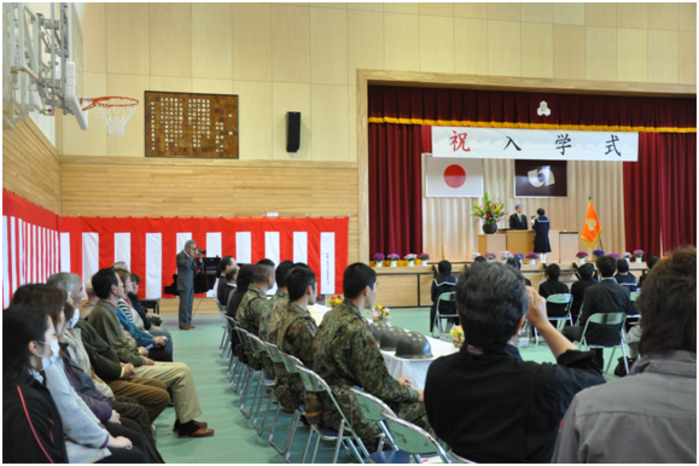
School Entrance Ceremony at Yumoto Daini Middle School, Iwaki City, Fukushima
Local sources report that in the first week or so after the nuclear crisis began, Iwaki City experienced difficulties in receiving supplies like food and fuel because many agents refused to deliver.Since early April, refugees who had evacuated outside the prefecture started returning. Restaurants in downtown Iwaki are reopening and many convenience stores boast reasonably well-stocked shelves, while gas, water and electricity have been restored. Iwaki City has repeatedly confirmed that “radiation is at a stable level which is not harmful to human health.” Iwaki officials explain that this judgment is based on figures provided by the Fukushima prefectural government regularly updated since March 11.
Principal Sawai began his welcome speech by saying, "I am glad to be able to confirm that all 33 new students are participating in this ceremony amidst a disaster that had forced many people to leave Yumoto.""In our district,” he continued,“some people survived by drinking water from their bath for weeks as there was no running water.
I want you to care for each other especially for anyone who is in trouble." He concluded, "You young students, are the future of Japan. Now, we should be bound as one beyond differences in ideas, position or self interest."
Though all the new students attended, not all teachers were there. As a result of the catastrophe, personnel for the school was frozen and new teachers were not dispatched to the school, Sawai explained. As a result of the lack of teachers, there will be only one class run by a teacher for each grade.
School Doctor Informs Children “The radiation problem is already finished.”
Following the principal’s speech, the school’s doctor in his white coat stated matter-of-factly that, based on science, people should know that the worst of the earthquake damage had passed and that radiation leakages from the Fukushima Daiichi plant
were decreasing and would soon fade away.“The radiation problem is already finished,” he told the children
and their parents. “You can go to school and go outside without any problem. You should not fear malicious gossip.”
While the doctor’s assurance that all major risks have ended would certainly raise eyebrows among most people outside the prefecture, many locals share this belief. We note the difference in perspective between radiation experts and people assessing the issues at a distance and those on the ground facing the destruction of their livelihood. While rumors of the dangers of radiation continue to swirl, many locals are even more afraid that rumors will destroy their businesses and any hope of securing their livelihood and rebuilding their communities.
Ikarashi Yoshitaka, 33, is one who is particularly keen on restoring his business and the local economy, a goal that leads him to downplay warnings of radiation risk.“It is just an emotional thesis that ours is ‘a city in danger!’” he insisted. Together with dozens of volunteers from across Japan, Ikarashi has visited many areas throughout the radiation exclusion zone. He confidently asserts that his $600 made in U.S "Geiger counter" has detected no abnormal amount of radiation.
Ikarashi is troubled by the fact that the milk business he manages suffered a 90% drop in sales as a result of radiation fears. Some farmers have been forced to throw away their milk, and at least one local farmer is rumored to have committed suicide over the ruin of his business.
Following the government announcement of level 7, Ikarashi observed that “residents will not listen; they don’t trust the government. The greatest concern for locals is to restore their towns and I’m doing my best to restore Iwaki City.”
Honma Hiroshi, 56, on patrol with the SDF in Iwaki comments: “I’m surprised that local people are so calm. Even within the 30 km radiation exclusion zone, they don’t even wear special anti-radiation clothes (Taibex). Even after the level 7 announcement, there has been no panic in the city."
Desperation over the destruction of the local economy appears to have provoked an unscientific optimism concerning radiation in some local communities struggling to get back on their feet.
Shortage of Information and Aid for Fukushima Citizens in the Radiation Exclusion Zone
Ikarashi points out that the reason for the absence of trustworthy information and the presence of baseless gossip is “lack of information”; the national media tend to avoid entering the radiation exclusion zone, fearing contamination and merely regurgitate the claims of the local government and officials obtained by telephone.
A more intense form of the same crisis struck Minami-Soma City, closer to the nuclear plant within the 20 km zone but on its northern side. For more than a week, the city was like an island bereft of food, water, and gasoline. Finally, in desperation, on March 24, Mayor Sakurai Katsunobu sent an SOS to the world through YouTube begging for support to his dying community.
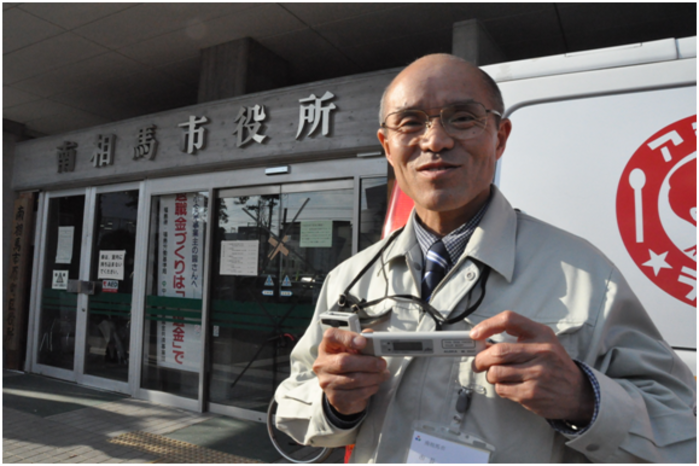
Mayor Sakurai Katsunobu
Mayor Sakurai explained that his gambit of airing a
Youtube call for help succeeded in drawing the attention of the central government, and Tokyo has taken seriously subsequent requests. However, Sakurai, said that as of April 6, only 20,000 residents remained of a population of 70,000. “We have to think of the means to save the remaining weak people (aged people and someone who do not have money to evacuate)", Sakurai said sadly.
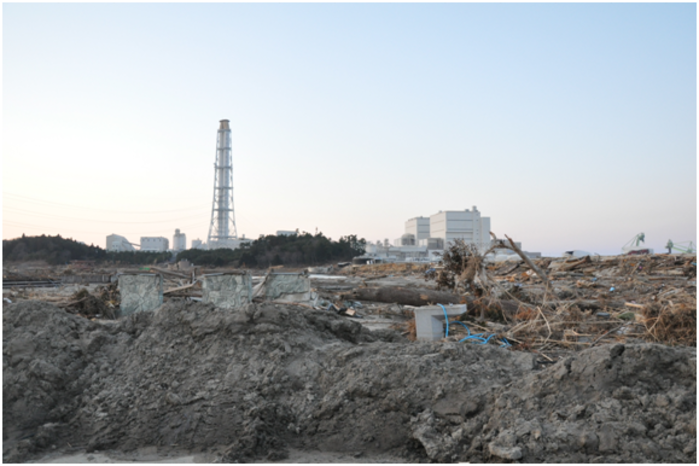
Minami Soma City
On April 7, the mayor made a second
Youtube, observing that "Many businesses had started operating. But, there is no reliable information on the nuclear reactor!"
In the nuclear radiation exclusion zone close to the plant, large numbers of people are out of work. The Fukushima Labor Bureau, on March 29, said that as a result of the East Japan Earthquake and Tsunami disaster, about 58,000 people in approximately 4,800 work places within the 30 km exclusion zone around the Fukushima Nuclear Reactor have lost jobs.
Local people voice concern that the jobless rate is being inflated as a result of pernicious rumors. At the same time that the school ceremony was being held, a long queue of people was lined up in front of the Public Employment Agency in Taira, Iwaki from 8 a.m. in hope of finding work.
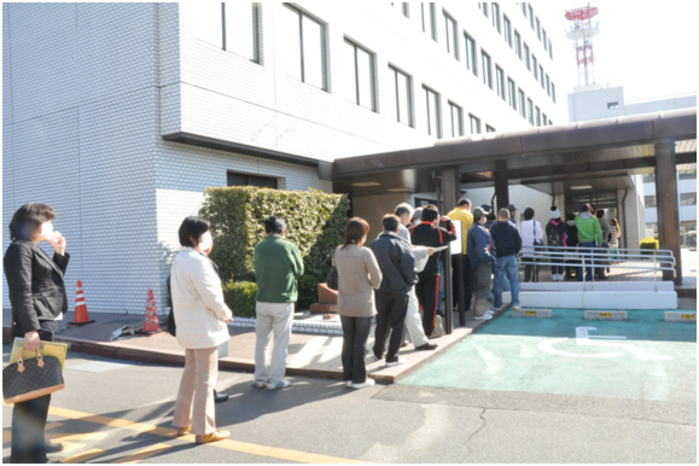
Public Employment Agency, Taira
"Before, people formed queues several kilometers long at gas stations; now people stand in a long line at the employment agency," Mori Akira, 63, pastor of the Global Mission Chapel, sighed.
Shimoyamada Matsuto, 50, director of public relations for Iwaki city Disaster Management Headquarters, explained, "Since harmful rumors are so powerful, not only are farming and fishing industries affected, even some industries have been damaged as a result of claims that even machines are contaminated!"
Fukushima provides one third of the electric power for the Tokyo Metropolitan Area, including both nuclear and thermal power plants. “If Fukushima goes down, the entire capital region will panic!" Shimoyamada warned.



