DISASTER Fukushima Reactor Disaster: MAIN THREAD - Five Year Anniversary

rafter

Since 1999
+ a gazillion!
I gave up on this thread for the same reason. Too many alarmists, doomers and tinfoil types showing little or no understanding and no desire to gain any. No technical information or links to same so I located a place where I CAN find good information (though certainly less than I would like) and now read there.

I'll let the handwringers rub all their hide off in peace - wouldn't want to offend them or spoil their enjoyment with any truth!


MM, don't go! Can you give us some clarity on what is going on over there now and what to expect?
 

mscoffee

Veteran Member
So that makes it better to just let them sit there and absorb enough radiation to die?
Dont get me wrong, I'm in no way supporting the government leaving them in harms way to die. I'm just stating from observation what many government operational plans seem to be.

And pointing out that if you yell fire in a crowded theater someones going to get hurt running for the door.
That's not a very big island for having 125 million + people living there.
 

LMonty911

Inactive
+ a gazillion!
I gave up on this thread for the same reason. Too many alarmists, doomers and tinfoil types showing little or no understanding and no desire to gain any. No technical information or links to same so I located a place where I CAN find good information (though certainly less than I would like) and now read there.

I'll let the handwringers rub all their hide off in peace - wouldn't want to offend them or spoil their enjoyment with any truth!

that's a big loss for us, MM. I for one appreciated your information and teaching. It has been helpful to me. Please consider sharing this haven you speak of for those of us who might be interested.
 

Cascadians

Leska Emerald Adams
Good Resource

http://www.zerohedge.com/article/googleearth-based-3d-map-real-time-radioactivity-distribution-japan
Submitted by Tyler Durden on 03/25/2011 20:24 -0400

GoogleEarth Based 3D Map Of Real-Time Radioactivity Distribution In Japan; Projected Global Radioactivity Dispersion

Confirming that in a time of instantaneous crowdsourced information distribution and analysis, any attempt by a government to institute an information blackout of any nature is doomed to failure, is the following amazing Google Earth-based 3D interactive map of Geiger readings from Japan. And if that is not enough, the Pachube community has released an extensive selection of crowd-sourced realtime radiation monitoring tools and widgets, focusing on as many Japanese territories as possible. Shortly we are confident all geographical holes will be filled, and every square mile of the affected territories will be mapped out surpassed the government's "Under Survey" blackout attempts.

Make sure to have the GoogleEarth API set up in advance of checking out the plugin.

http://community.pachube.com/node/611#3d

radiation2.png


Maps, Applications, Tutorials (click on link, amazing tools here)

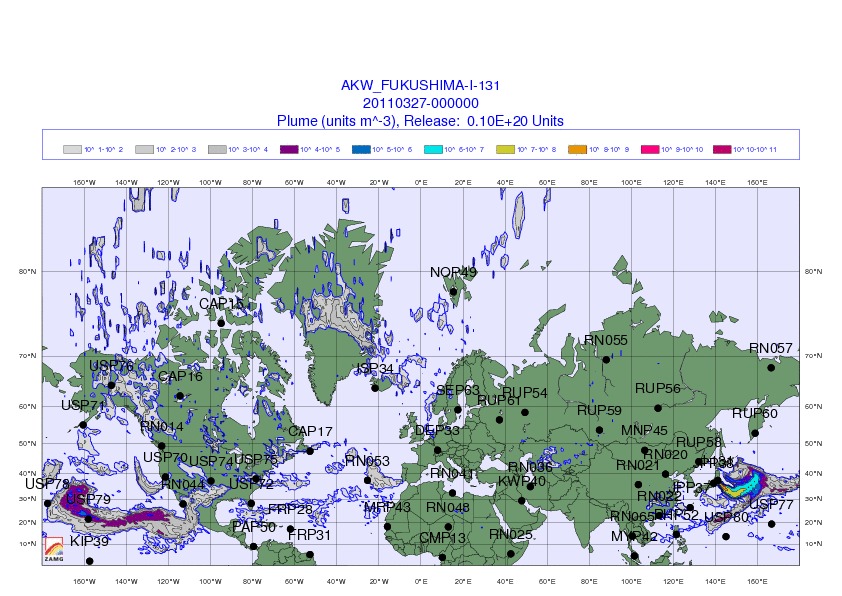
Additionally, here is the most recent updated global radioactive fallout per ZAMG.

20110325_Reanalyse-I131-Bild5_gr.jpg
 

Cascadians

Leska Emerald Adams
http://english.kyodonews.jp/news/2011/03/81252.html
TOKYO, March 26, Kyodo

Fears of radioactive seawater grow near nuke plant despite efforts

Japan continued efforts to restore power and enhance cooling efficiency at the crisis-hit Fukushima Daiichi nuclear plant Saturday, but fears of contamination intensified as levels of radioactive materials continued to skyrocket in the sea near the plant.

The plant's operator, Tokyo Electric Power Co., was able to turn on the lights in the control room for the No. 2 reactor the same day, leaving only the No. 4 reactor at the six-reactor plant without lighting in its control room.

The utility company, known as TEPCO, is analyzing water containing radioactive materials that was detected in the turbine buildings of the reactors at the plant in Fukushima Prefecture, around 220 kilometers northeast of Tokyo, and trying to remove the pools of water.

Abnormally high levels of radioactive materials have been found in the sea near the troubled plant, the government said, fanning concerns over the safety of fishery products in the region.

Japan's top government spokesman Yukio Edano said at a press conference Saturday that it was difficult to predict when the ongoing crisis at the plant -- triggered by the catastrophic March 11 earthquake and ensuing tsunami -- would end.

Asked about the prospects for the crisis, Edano described the current situation as ''preventing it from worsening,'' adding that ''an enormous amount of work'' is required before it will settle down.

The chief Cabinet secretary also urged TEPCO to disclose information in a more appropriate and timely manner, following the exposure Thursday of three workers at the plant to water containing highly radioactive materials.

Radioactive iodine-131 at a concentration 1,250.8 times the legal limit was detected Friday morning in a seawater sample taken around 330 meters south of the plant, near the drainage outlets of the four troubled reactors, the government's Nuclear and Industrial Safety Agency said Saturday.

The level rose to its highest so far in the survey begun this week, after remaining around levels about 100 times the legal limit. It is highly likely that radioactive water in the plant has found its way into the sea, TEPCO said.

Radioactive materials ''will be significantly diluted'' by the time they are consumed by marine species, the agency said, adding it would not have a significant impact on fishery products as fishing is not being conducted in the area within 20 kilometers of the plant because the government has issued a directive for residents in the zone to evacuate.

TEPCO is planning to inject fresh water into pools storing the spent nuclear fuel at the plant to prevent crystallized salt from seawater already injected from hampering the smooth circulation of water and thus diminishing the cooling effect. It has begun injecting fresh water into the reactor containers of the No. 1 and No. 3 as well as No. 2 reactors.

At the same time, the company is trying to remove the pools of water containing highly concentrated radioactive substances that may have seeped from either the reactor cores or the spent fuel pools.

On Thursday, three workers were exposed to water containing radioactive materials 10,000 times the normal level at the turbine building connected to the No. 3 reactor building.

On Friday, a pool of water with a similarly high concentration of radioactive materials was found in the No. 1 reactor's turbine building, causing some restoration work to be suspended.

Similar pools of water were also found in the turbine buildings of the No. 2 and No. 4 reactors, measuring up to 1 meter and 80 centimeters deep, respectively. Those near the No. 1 and No. 3 reactors were up to 40 cm and 1.5 meters deep, respectively.

While analyzing the radioactivity levels of the pools from the water found in the No. 2 and No. 4 reactors, TEPCO will remove the water in all four reactor units to reduce the risk of more workers being exposed to radioactive substances, it said.

The risk would hinder efforts to restore the plant's crippled cooling functions, which are crucial to overcoming the crisis, the government's nuclear safety agency said.

TEPCO's Fukushima office acknowledged Saturday that it had known earlier that the radiation in the underground level of the turbine building of one of the reactors was extremely high, but had not made the information available to pertinent parties.

Edano criticized the utility's handling of the data, saying unless it reports necessary information to authorities in a timely manner, ''the government will not be able to give appropriate instructions and (TEPCO) will make workers, and eventually the public, distrustful'' of the firm.

==Kyodo
 

Cascadians

Leska Emerald Adams
ap1103261903_enl.jpg


http://mdn.mainichi.jp/mdnnews/news/20110326p2a00m0na004000c.html
March 26, 2011

U.S. barges to provide fresh water to troubled nuclear reactor

The U.S. military will supply a water pump and two barges carrying fresh water to help cool nuclear reactors at the damaged Fukushima No. 1 Nuclear Power Plant, Defense Minister Toshimi Kitazawa told a news conference on March 25.

One of the barges departed the U.S. Navy's Yokosuka base on March 25 and another was due to leave on March 26. They will be used in collaboration with Japan Maritime Self-Defense Force supply vessels to cool fuel at the plant.

Self-Defense Forces (SDF) have been spraying seawater on damaged plant structures from fire trucks equipped with high pressure sprays, but after urging from U.S. officials to use fresh water to prevent equipment from corroding, Japanese officials have reconsidered their approach to the crisis. Plant operator Tokyo Electric Power Co. (TEPCO) has now decided it will try to supply fresh water rather than seawater to water injection pumps at the plant it is trying to bring back online.

The 50-meter-long barges can each store about 1,100 tons of fresh water, but since they travel slowly, they will be towed by SDF support vessels. It is expected that the first one will arrive as early as March 28.

The barges will be brought close to the shore near the nuclear power plant, and a pump supplied separately by U.S. forces will be used to deliver fresh water directly to a cooling tank that can hold about 3,500 tons of water. When the barges are out of fresh water, more will be retrieved from an SDF vessel, and the process will be repeated.

TEPCO is expected to handle the work to replenish the water supply, but SDF members will take part in training in case they are called on to carry out the work.
 

Red Baron

Paleo-Conservative
_______________
I am now questioning the authenticity of that photo with the black smoke. It is possible a burning oil refinery from earlier. It appears to be set back too far from the coastline. Nonetheless, the radiation release level are what they are.

You are correct. The fire is set much too far back from the coastline to be the reactors at Fukushima Daiichi.
 

Cascadians

Leska Emerald Adams
http://jen.jiji.com/jc/eng?g=ind&k=2011032600192

Honda May Halt N. American Production

New York, March 25 (Jiji Press)--Honda Motor Co. may suspend vehicle production in North America due to supply shortages of parts from Japan after the March 11 earthquake, company officials said Friday.

The major Japanese automaker told all workers at its assembly plants in the region the same day that chances cannot be ruled out that production there will be suspended, the officials said.
 

Red Baron

Paleo-Conservative
_______________
http://jen.jiji.com/jc/eng?g=ind&k=2011032600192

Honda May Halt N. American Production

New York, March 25 (Jiji Press)--Honda Motor Co. may suspend vehicle production in North America due to supply shortages of parts from Japan after the March 11 earthquake, company officials said Friday.

The major Japanese automaker told all workers at its assembly plants in the region the same day that chances cannot be ruled out that production there will be suspended, the officials said.

I wonder what parts are in short supply and I wonder if U.S. companies could fill the gap?
 

Kayak

Adrenaline Junkie
I wonder what parts are in short supply and I wonder if U.S. companies could fill the gap?

Listening to the radio the other day on the way to work, someone being interviewed said that for a new factory to start making a part they basically have to be certified to make that part. Anything going into an automobile that could remotely have anything to do with safety... the car maker can't just have anyone make it. Most of the factories who are capable of being certified to make that sort of thing are already certified, and they are going to be pretty busy making the things they are already able to make.
 

Hfcomms

EN66iq
+ a gazillion!
I gave up on this thread for the same reason. Too many alarmists, doomers and tinfoil types showing little or no understanding and no desire to gain any. No technical information or links to same so I located a place where I CAN find good information (though certainly less than I would like) and now read there.

I'll let the handwringers rub all their hide off in peace - wouldn't want to offend them or spoil their enjoyment with any truth!

Same here Mouse. I said from day one that this would not materially affect the U.S. mainland radiologically and I maintain that. I did my best to attempt to calm people down about this and was somewhat successful. This is a terrible event for Japan and under reported. I still maintain a suite of expensive monitoring equipment and I have seen nothing except for a very slight spike in background radiation which was what I was expecting. The military spent a lot of money on me years ago to train me in evaluating radiological threats, contamination avoidance and decontamination and because of that I have been fortunate to be able to evaluate this from the beginning as to the threat posed from a long distance away. While my heart is breaking for the Japanese people I'm sleeping very good at night with the knowledge that even in the worst case scenario people over here would still receive far less ionizing radiation than what would be received by a CT scan. I have not been posting on the thread recently not because my arguments are faulty but because it's not worth it to try to educate people who don't want to be educated. If this event was a real threat to us here I would of been one of the first people heading to the shelter and would of advised everyone else to do so also as loudly as I could.
 

Red Baron

Paleo-Conservative
_______________
Listening to the radio the other day on the way to work, someone being interviewed said that for a new factory to start making a part they basically have to be certified to make that part. Anything going into an automobile that could remotely have anything to do with safety... the car maker can't just have anyone make it. Most of the factories who are capable of being certified to make that sort of thing are already certified, and they are going to be pretty busy making the things they are already able to make.

Good point.

I also don't see the Japanese in a big hurry to lose their domestic suppliers and how many American suppliers would be willing to commit to what may be only be a short term contract from Japan.
 

Red Baron

Paleo-Conservative
_______________
IAEA Briefing on Fukushima Nuclear Accident (26 March 2011, 14:30 UTC)

On Saturday, 26 March 2011, Graham Andrew, Special Adviser to the IAEA Director General on Scientific and Technical Affairs, provided the following briefing on the current status of nuclear safety in Japan:

1. Current Situation

The situation at the Fukushima Daiichi plant remains very serious.

The restoration of off-site power is still progressing and instrumentation is being tested in Units 1, 2 and 4.

At Unit 1, the main change is the injection of freshwater to the Reactor Pressure Vessel (RPV). The temperature measured at the bottom of the RPV is stable at 144 °C. Pressure in the RPV, containment vessel and suppression pool have come back down after having increased from 22 to 24 March.

At Unit 2, the injection of freshwater to the RPV commenced at 01:00 on 26 March. The RPV temperature is stable at 100 °C at the bottom of the RPV. The pressure measured in the RPV and in the containment pressure vessel is stable at circa one atmosphere. Freshwater is also being injected in the RPV of Unit 3. Temperature measurement at the feed-water nozzle of Unit 3's RPV is still judged to be unreliable, but at the bottom of the RPV it is stable at 102 °C. White "smoke" continues to be emitted as of 23:00 UTC on 25 March from Unit 3, as it does from Unit 4. Unit 3 shows a consistently low containment drywell pressure of circa 1 atmosphere.

There have been high radiation readings in Units 1 and 3, the likelihood of damage to the containment integrity of Unit 3 is a cause for concern.

We understand that a total of 17 TEPCO workers and contractors have received doses between 100 and 180 millisievert. TEPCO measured the dose rate of 400 millisievert per hour above the surface of the water in the Unit 3 turbine building where 2 workers had been contaminated.

Units 5 and 6 are still in cold shutdown, with slight variations in RPV water temperatures (down a few degrees at Unit 5, up a few at Unit 6).

2. Radiation Monitoring

Deposition of radioactivity is monitored daily by Japanese authorities in all 47 prefectures. From 24 to 25 March, the daily level of deposition decreased in all but one prefecture. The highest value was observed in the prefecture of Ibaraki, where on 25 March a deposition of 480 becquerel per square metre for iodine-131 was observed; the highest value for caesium 137 was measured in Yamagata at 150 becquerel per square metre. For the Shinjyuku district of Tokyo, the additional deposition of iodine-131 and caesium-137 on 25 March was below 200 becquerel per square metre.

Monitoring of the marine environment has continued. New data for 21 to 25 March on radionuclide concentrations were made available for the discharge area 330 metres south of the pipeline of Fukushima Daiichi. The levels are generally quite high and vary significantly with time. The highest levels were detected at 25 March with, for example, 50 000 becquerel per litre of iodine-131, 7,200 becquerel per litre of caesium-137, and 7 000 becquerel per litre of caesium-134. Other short lived radionuclides were also reported. No new data has been reported by Japan from the monitoring stations located about 30 km offshore.

Monitoring of drinking water is on-going: iodine-131 in drinking water was detected on 24 March in 12 prefectures, whereas caesium-137 was detected in 6 of the 47 prefectures. In Tochigi, a value of 110 becquerel per litre was observed, which is above the recommended value for drinking water to be consumed by infants (i.e. 100 becquerel per litre). All other measurements were far below 100 becquerel per litre. All caesium-137 concentrations measured were lower than 10 becquerel per litre, which is significantly below the limit set by Japan of 200 becquerel per litre.

Environmental monitoring of soil, surface water, vegetation and air continues to be carried out in the Fukushima prefecture. The monitoring results indicate high levels of contamination. The values reported are generally consistent with measurements of gamma dose rates and beta-gamma contamination carried out by an IAEA monitoring team.

Two IAEA teams are currently monitoring in Japan. One team made gamma-dose rate measurements in Tokyo and the south of Tokyo in the prefecture of Kanagawa. Gamma-dose rates ranged from 0.05 to 0.2 microsievert. Another monitoring team made additional measurements at distances of 23 to 97 km (in a southerly and south westerly direction) from the Fukushima nuclear power plant. At these locations, the dose rates ranged from 0.73 to 8.8 microsievert per hour. At the same locations, results of beta-gamma contamination measurements ranged from 0.02 to 0.4 Megabecquerel per square metre.

Two prefectures (Ibaraki, Tochigi) reported iodine-131 in unprocessed raw milk, but the measurement results were below the regulation values set by the Japanese authorities. In addition, iodine-131 was not detected in any of the samples taken from the remaining four prefectures (Chiba, Gunma, Kanagawa and Saitama) and Tokyo. Caesium-137 was not detected in any of the samples.

For two prefectures (Ibaraki, Tochigi) iodine-131 and cesium-137 were reported in spinach and other leafy vegetables above the regulation values set by the Japanese authorities. However, iodine-131 and caesium-137 were either not detected or were below the regulation values, in all of the samples taken from the remaining four prefectures (Chiba, Gunma, Kanagawa and Saitama) and Tokyo. In all six prefectures and Tokyo, no iodine-131 and caesium-137 were detected in leeks, or measurements were well below the regulation values set by the Japanese authorities.


http://www.iaea.org/newscenter/news/tsunamiupdate01.html
 
http://english.kyodonews.jp/news/2011/03/81270.html

Police on Saturday arrested a 48-year-old Chinese man, who turned himself in to Nagasaki prefectural police seeking deportation due his fears about the nuclear accident at the Fukushima Daiichi power station, for illegally staying in Japan, police officials said.

Lin Jian Ming is suspected of remaining in Japan beyond the allowed period of 90 days after arriving on June 8, 2000, the officials said.

Silver linings and all...
 

Hansa44

Justine Case
+ a gazillion!
I gave up on this thread for the same reason. Too many alarmists, doomers and tinfoil types showing little or no understanding and no desire to gain any. No technical information or links to same so I located a place where I CAN find good information (though certainly less than I would like) and now read there.

I'll let the handwringers rub all their hide off in peace - wouldn't want to offend them or spoil their enjoyment with any truth!


Bye Bye
 

Cascadians

Leska Emerald Adams
Soil contamination already worse than Chernobyl

http://news.sciencemag.org/sciencei...s=1&utm_source=twitterfeed&utm_medium=twitter
by Jocelyn Kaiser on 25 March 2011, 6:14 PM

Japan Soil Measurements Surprisingly High

Concerns about radiation in Japan have now spread to the soil surrounding the crippled Fukushima Daiichi nuclear reactor. One level that was reported this week was high enough to suggest people in that area should be evacuated, an expert says. But he cautions that it's hard to draw conclusions about these spot measurements without more data.

Today, Japanese officials told the population living up to 30 kilometers from the plant that they should consider leaving the area, expanding the previous 20-kilometer radius evacuation zone. But according to news reports, the advice stems from difficulties in supplying the region with food and water, not radiation levels.

Meanwhile, on Wednesday the Japanese science ministry began to report measurements of cesium-137 in upland soil around the plant. The levels are highest from two points northeast of the plant, ranging from 8690 becquerels/kilogram to a high of 163,000 Bq/kg measured on 20 March from a point in Iitate about 40 kilometers northwest of the Fukushima plant.

The soil measurements are more significant for evacuation purposes than radioactivity in the air, says nuclear engineer Shih-Yew Chen of Argonne National Laboratory in Illinois, because cesium dust stays underfoot while air is transient. Levels of cesium-137 are also more important than soil readings of iodine-131, which is short-lived and more of a concern in milk and vegetables. "It's the cesium that would prompt an evacuation," says Chen.

Based on a rough estimate, a person standing on soil with 163,000 Bq/kg of cesium-137 would receive about 150 millisieverts per year of radiation, says Chen. This is well above the U.S. Environmental Protection Agency standard of 50 millisieverts per year for an evacuation. (Per day, it's 0.41 millisieverts, which is equivalent to four chest x-rays.) But Chen adds, "one point [of data] doesn't mean that much."

The hot spot is similar to levels found in some areas affected by the 1986 Chernobyl nuclear reactor accident in the former Soviet Union. Assuming the radiation is no more than 2 centimeters deep, Chen calculates that 163,000 Bq/kg is roughly equivalent to 8 million Bq/m2. The highest cesium-137 levels in some villages near Chernobyl were 5 million Bq/m2.
 

Countrymouse

Country exile in the city
Same here Mouse. I said from day one that this would not materially affect the U.S. mainland radiologically and I maintain that. I did my best to attempt to calm people down about this and was somewhat successful. This is a terrible event for Japan and under reported. I still maintain a suite of expensive monitoring equipment and I have seen nothing except for a very slight spike in background radiation which was what I was expecting. The military spent a lot of money on me years ago to train me in evaluating radiological threats, contamination avoidance and decontamination and because of that I have been fortunate to be able to evaluate this from the beginning as to the threat posed from a long distance away. While my heart is breaking for the Japanese people I'm sleeping very good at night with the knowledge that even in the worst case scenario people over here would still receive far less ionizing radiation than what would be received by a CT scan. I have not been posting on the thread recently not because my arguments are faulty but because it's not worth it to try to educate people who don't want to be educated. If this event was a real threat to us here I would of been one of the first people heading to the shelter and would of advised everyone else to do so also as loudly as I could.

(I know you were talking to Mickey Mouse, not me, hfcomms) I understand that, hfcomms, MM, and others--what is driving me nuts is hearing the Japanese officials lie not only to the rest of the world, BUT TO THEIR OWN PEOPLE, about the severity of the immediate and long-term effects of the levels of radiation they are experiencing close-up. They have already proved themselves to be UTTERLY UNRELIABLE in the information they are releasing--see their admission of this in Cascadians' post 2805 above.

If they are (finally) as much as ADMITTING they LIED about how bad the situation was several DAYS ago, then HOW can anyone--if they choose to depend only on "official" sources as being the only "credible" sources of info--say exactly WHAT is going on now there currently and how bad it is?

The only thing we have to rely on is anecdotal reports from "unofficial" sources--and I find it VERY telling that Japan has SHUT OFF that means of information to the rest of the world by shutting down You Tube and Tweet communications out of Japan--or the word of other "experts' even though they may not be directly involved on the ground in Fukushima right now.

IF (as I suspect) worst-case scenario is (or already has) rapidly becoming "real-time scenario", I am in anguish not only for the needless loss of life among the Japanese people themselves, but worry about the INDIRECT effect on the rest of the world. NOT in terms of radiation--I have read enough to be convinced that the radiation from this will NOT significantly DIRECTLY affect the U.S. (unless you eat seafood caught in the Sea of Japan right now), ....BUT....if the radiation "is" truly horrific, if it "is" truly slowly poisoning the population of Japan (especially in critical areas such as Tokyo)....well, to say, as an earlier poster did, that this may mean the end of Japan as a nation may be a bit extreme, but it certainly COULD mean the end of Japan as any sort of nation of consequence in world economic or political affairs--and THAT could spell HUGE problems for the rest of the world.

So, when I read of what's happening, I am not just thinking how it would effect me directly, but how it's affecting the people of Japan right now.

And THAT story we are NOT getting STRAIGHT, from ANY "official" source in Japan, in my opinion.
 

bw

Fringe Ranger
IF (as I suspect) worst-case scenario is (or already has) rapidly becoming "real-time scenario", I am in anguish not only for the needless loss of life among the Japanese people themselves, but worry about the INDIRECT effect on the rest of the world. NOT in terms of radiation--I have read enough to be convinced that the radiation from this will NOT significantly DIRECTLY affect the U.S. (unless you eat seafood caught in the Sea of Japan right now)

A large part of the danger is in the panic. Some people have accused some here of panicking when they are floating ideas or asking questions. But the msm-consumers out there have not yet realized that the Japanese PTB have been lying, and don't yet know how bad it is in Japan. Combine that with the fact that we have measured SOME increase here and you have the makings of a panic. If/when the story hits msm that Tokyo is being evacuated by those who can, or some other key info gets into the popular consciousness, and there is the potential for the same kind of store-clearing here.

So in addition to the JIT impact, the sale of Japanese UST, the reversal of the Japanese economic engine, there is also the potential for boots-on-the-ground impact here when the msm-consumers catch on to whatever chunk of malinformation leaks past Dancing With The Stars.
 

Hansa44

Justine Case
(I know you were talking to Mickey Mouse, not me, hfcomms) I understand that, hfcomms, MM, and others--what is driving me nuts is hearing the Japanese officials lie not only to the rest of the world, BUT TO THEIR OWN PEOPLE, about the severity of the immediate and long-term effects of the levels of radiation they are experiencing close-up. They have already proved themselves to be UTTERLY UNRELIABLE in the information they are releasing--see their admission of this in Cascadians' post 2805 above.

If they are (finally) as much as ADMITTING they LIED about how bad the situation was several DAYS ago, then HOW can anyone--if they choose to depend only on "official" sources as being the only "credible" sources of info--say exactly WHAT is going on now there currently and how bad it is?

The only thing we have to rely on is anecdotal reports from "unofficial" sources--and I find it VERY telling that Japan has SHUT OFF that means of information to the rest of the world by shutting down You Tube and Tweet communications out of Japan--or the word of other "experts' even though they may not be directly involved on the ground in Fukushima right now.

IF (as I suspect) worst-case scenario is (or already has) rapidly becoming "real-time scenario", I am in anguish not only for the needless loss of life among the Japanese people themselves, but worry about the INDIRECT effect on the rest of the world. NOT in terms of radiation--I have read enough to be convinced that the radiation from this will NOT significantly DIRECTLY affect the U.S. (unless you eat seafood caught in the Sea of Japan right now), ....BUT....if the radiation "is" truly horrific, if it "is" truly slowly poisoning the population of Japan (especially in critical areas such as Tokyo)....well, to say, as an earlier poster did, that this may mean the end of Japan as a nation may be a bit extreme, but it certainly COULD mean the end of Japan as any sort of nation of consequence in world economic or political affairs--and THAT could spell HUGE problems for the rest of the world.

So, when I read of what's happening, I am not just thinking how it would effect me directly, but how it's affecting the people of Japan right now.

And THAT story we are NOT getting STRAIGHT, from ANY "official" source in Japan, in my opinion.


I agree with you CM. My concern has not been with radioactive fallout coming to this country, but the economic fallout that may happen because of it. When a new person comes to this board and finds the rest of us unworthy of his presence because we talk about all things and not just his area of expertise then he his correct in saying he'd be happier elsewhere.

HFC is not like that and is way more flexible, but MM basically said everyones point of view is worthless but his own so I will never beg someone like that to stay.

Leska is posting an amazing amount of material and so are others.

But my biggest concern is our rather delicate economy AFTER my No.1 concern of what is happening to the Japanese people.
 

Hfcomms

EN66iq
I agree with you CM. My concern has not been with radioactive fallout coming to this country, but the economic fallout that may happen because of it.

I would certainly agree that the economic 'fallout' of this will be a lot more drastic to us than the radiological threat which is almost nil over here. I am willing to cut the jap government a little bit of slack on this though. They are between a rock and a hard place. A 9.0 earthquake or a tsunami alone would be enough to totally overwhelm the resources of a small nation like Japan. But they have the earthquake, tsunami AND multiple nuclear reactors in major peril all at the same time.

The problem they have is where can they evacuate all the people around the plant to when there are already so many other refugees who also need food and shelter from the earthquake and tsunami? I would imagine this would of been handled a little differently if it was a stand alone event. Even in this country one major nuclear reactor problem would strain the resources of the geographical area it was taking place in let alone several reactors plus earthquake and flood damage on top of it.

The very worst thing a government can do is to let people think that a situation is out of control (even if it is). Once the population begins to panic the result is very bad. Let this be a lesson to all of us on this side of the pond. If we didn't already realize that the government is going to lie, well they are going to lie! We should take this as an opportunity to learn about radiological issues, sheltering and decontamination. It's not a death sentence even for those nearby the affected area. This is one area of prepping that many have ignored and the lack of education in these areas shows itself by the rank fear that many on these threads have shown in the past few weeks. It's natural to fear what we don't understand. Once we learn that there are things we can do to mitigate the event then the fear backs off and takes it's rightful place.
 

Sysman

Old Geek <:)=
Let's say the reactor is cracked, do we just throw in the towel?

Corium is the thousands of degrees hot, lava like remains of a meltdown. It consists of melted uranium, plutonium, and all of the other nasty radioactive fission elements. It also contains the melted fuel rod casings, melted control rods, and all the melted "framework" that was holding the components in place. It mixes with steel and molten concrete, as it burns thru the reactor containment, where it finally enters the environment. Some parts of this final blend could be "critical" and allow fission to restart. Unshielded Corium in the environment is the worst possible case...

But I don't think we've seen any signs of leaked Corium yet. There are reports that the reactor is cracked. There are reports of neutron beams, which could certainly come from a crack. There are reports of radioactive water, leaking from the crack. This is all bad news indeed, but we're still not looking at the "ultimate doom" of runaway Corium...

It's hard to be positive in situations like this, but I think the "hot" water is a good sign. It means there is at least some water still in the reactor, which means we don't have a "runaway" situation. Not yet at least...

If it is cracked, is there any way to "patch" that crack, while the steel is still "cold"? Maybe "weld" or "cement" something over it, just enough to keep the water in?

As long as we can keep the beast covered in water, it hasn't won. Relatively speaking... :D

.
 

LoupGarou

Ancient Fuzzball
The question that keeps coming up in my mind is that if we ARE looking at the strong possibility of a meltdown, and the possibility of the Corium escaping downward, why don't we force the issue quicker and let it dump it's energy in a very short period. That way it can cool down and we can clean up the problem easier.

Just move out all of the people for say, 30 miles, and then force the stack to go critical (and even slightly supercritical). Yes, there will be a FLOOD of radiation in the local area, but not fallout (just like what happened to Harry Daghlian). If we can get remoted robots into place, they can do the deed while we monitor from a safe distance. Once the pile has lost most of it's energy, it won't be able to keep liquid or semi-liquid and trying to escape. Then cleanup is a LOT easier.

Just thinking...

Loup
 

It'sJustMe

Deceased
CNN's report on Tepco's apology. Although I have preferred to follow this elsewhere, this article does have some useful quotes and information. Fair use:

http://www.cnn.com/2011/WORLD/asiapcf/03/26/japan.nuclear.reactors/index.html?hpt=T2

Company apologizes, says radiation exposure could have been prevented


Tokyo (CNN) -- A power company apologized Saturday and said the exposure of three workers at the Fukushima Daiichi power plant to highly radioactive water might have been avoided with better communication.

The Thursday incident has spurred questions about the source of the radioactive contamination in water, its potential to taint seawater nearby, and the prospect it might be evidence of a leak in at least one of the facility's six reactor cores.

It also prompted further criticism of the Tokyo Electric Power Co., which runs the plant, and how well it is safeguarding the nearly 500 people working to prevent more emission of potentially cancerous radioactive materials about two weeks after a 9.0-magnitude earthquake and subsequent tsunami rocked the facility.

On March 24, three workers laying electrical cable in the basement of the No. 1 reactor's turbine building stepped in tainted water, exposing themselves to high levels of radiation. Two suffered direct exposure on their skin.

Hideyuki Koyama, the company's associate director, said the pooled water had been discovered six days earlier, but a sample wasn't taken for analysis until the 24th, after the workers were exposed.

The company started draining the water that evening and has continued draining it ever since, he said.

Such incidents threatened to undermine the public's trust in Tokyo Electric, Japanese Chief Cabinet Secretary Yukio Edano told reporters.
Japan's nuclear emergency
Children swept away from school
How long will radiation remain in Japan?
Anderson family aims to help Japan
RELATED TOPICS

* Japan
* Nuclear Energy
* Earthquakes
* Tsunamis

He added the Japanese government "would like to give stronger instructions" to the company that it fully disclose as much information as possible about conditions at the plant.

"Every piece of information must be provided accurately and swiftly" to Japan's nuclear and industrial safety agency, Edano said. "Without this communication, it's very difficult for the government to (establish) proper safety measures."

As important, the chief secretary said, was the need for Tokyo Electric to be upfront with the Japanese -- millions of whom get power from the company, and millions more of whom have been affected by radioactive emissions stemming from the crisis.

"We need to be sure that (Tokyo Electric) isn't going to act in a way that will create distrust," Edano said.

Koyama told reporters that radiation alarms went off while the three men were working, but they continued with their mission for between 40 and 50 minutes after assuming it was a false alarm.

Later, they were hospitalized after it was determined they had been exposed to between 173 and 181 millisieverts of radiation -- two of them with direct exposure on their skin.

By comparison, a person in an industrialized country is naturally exposed to 3 millisieverts per year, though Japan's health ministry has said that those working directly to avert the nuclear crisis could be exposed to as much as 250 millisieverts before they must leave the site.

Hours before the apology, a Tokyo Electric official told reporters that water samples from the turbine buildings for the No. 1 and 2 reactors had high levels of radiation, though not as high as in the basement of the No. 3 building.

Later Saturday, Tokyo Electric amended its assessment of the level of radiation in water in the No. 1 building, saying it was not nearly as dangerous as first reported. The water radiation levels were 60 millisieverts per hour -- compared to 200, as had been stated earlier -- while atmospheric radiation was 25 millisieverts per hour.

The issue of possible leakage of such material gained urgency Saturday after Japan's nuclear and industrial safety agency reported the amount of radioactive iodine in seawater recorded 330 meters from the plant was 1,250 times above normal.

A Tokyo Electric official speculated water runoff or leakage from the turbine buildings may have caused the sudden increase, though he said other factors might have contributed as well.

Friday, Hidehiko Nishiyama of Japan's Nuclear and Industrial Safety Agency said the contaminated water suggests "some sort of leakage" from the No. 3 reactor's core -- signaling a possible breach of the containment vessel that houses the core.

These developments come despite indications from the International Atomic Energy Agency that the level of airborne radiation around the plant, which is 240 kilometers (150 miles) north of Tokyo, "continues to decrease."

Tokyo Electric reported on its website that at 7 a.m. Saturday, radiation at the plant's main gate was 0.219 millisieverts per hour -- a fraction of the 400 millisieverts per hour measured between Units 3 and 4 on March 15.

The measurements are a significant drop from readings taken at the same gate over the past week.

The presence of highly radioactive water in buildings at reactors Nos. 1, 2 and 3 has halted some efforts to curb the release of further emissions. Still, others continued and there have been recent signs of progress.

"We can comfortably say that we are taking measures so that the situation has not deteriorated," said Edano. "We've been able to take some steps forward. But still, vigilance is required."

Fresh water was being being pumped Saturday at reactors 1, 2, and 3. That replaced the seawater that had previously been used, with the aim of fresh water being simultaneously to cool down nuclear fuel and also flush out accumulating salt that might hinder the reactors' existing cooling systems.

The No. 3 reactor has been of particular concern, experts have said, because it is the only one to use a combination of uranium and plutonium fuel, called MOX, considered more dangerous than the pure uranium fuel used in other reactors.

The Japan Atomic Industrial Forum, an industry trade group that is tracking official accounts of the effort at the Fukushima Daiichi plant, said the pressure of the No. 3 reactor's containment vessel has been upgraded to "stable."

Whereas the group had stated Friday that damage was suspected in the reactor, on Saturday its assessment changed to "unknown" -- a further acknowledgment of uncertainty as to whether the contaminated water was the result of a leak in the nuclear reactor core or had some other cause.

Efforts also continue at the No. 4, 5 and 6 reactors -- each of which has less pronounced concerns because the units were on scheduled outages when the quake struck.

None of these three units had nuclear fuel inside their reactors, though efforts are ongoing to control temperatures inside the spent fuel pools.

 

BlueNewton

Membership Revoked
They are CONTINUING to drain that water, huh? Guess that would be all the water that is leaking out of the crack in the reactor.

Anyone know if the Japanese are still barred from Youtube and Twitter? Can't have them know how bad it is, can they?

M.Mouse, you won't find a better source for the news on this matter than here, although you might encounter a site with more experts giving their opinions. We try to discuss the opinions of experts on BOTH sides of the issue, not just yours. Yo0ur input was very helpful, as is that of many members posting here.
 

MickeyMouse

Inactive
that's a big loss for us, MM. I for one appreciated your information and teaching. It has been helpful to me. Please consider sharing this haven you speak of for those of us who might be interested.

(And you 2, Rafter!!)

Ok, Rafter & LMonty911, I’ll try.

Here is a link for good info: http://www.ar15.com/forums/topic.html?b=1&f=5&t=1161884&page=83

A lot of good links on the thread such as: http://www.jaif.or.jp/english/news_images/pdf/ENGNEWS01_1301110327P.pdf which is a simple summary of conditions.

http://www.nisa.meti.go.jp/english/files/en20110325-2-2.pdf
Note that reactor water injection may now be fresh vs seawater. This is important to reduce corrosion of systems never designed for seawater! Different materials would have been specified for seawater use.

Report from NISA (NOT Tepco!): http://www.nisa.meti.go.jp/english/files/en20110325-2-1.pdf

I can’t find the report right now indicating details of how the two workers got beta burns in the water of turbine basement by being idiots. They were working in an area of known contamination (entire plant grounds) and were NOT wearing appropriate footwear (tall boots). Bad enough but FAR WORSE they were equipped with dosimeters YET when the alarms sounded, the morons thought the INSTRUMENTS were wrong and kept working!! If they had received a lethal dose (VERY unlikely) they surely should be nominated for Darwin Awards!!

Report of what the potential Darwin awardees were standing in: http://www.nisa.meti.go.jp/english/files/en20110325-6.pdf

Lest someone think I am a shill for Tepco: http://english.kyodonews.jp/news/2011/03/81252.html
Cotton-pickers KNEW of the turbine building water problem and did not reveal it as they should!!

For those who like the NY Times: http://www.nytimes.com/interactive/2011/03/16/world/asia/reactors-status.html


There is still zero threat to the US from radioactive contamination, even the Left coast! Anyone with unwarranted concerns should already own a Geiger counter – or believe the various publicly available monitoring points. Being prepared one would already OWN a Geiger counter and know how to use it as well as interpret the results. I have more than one, including an electronic Dosimeter that has been recording since 12 Mar. My average background was 0.31mR per day before any of the “cloud arrived. It increased to .5 mR per day upon first arrival. Today it has dropped slightly to .4 mR per day as of 9:00 AM.

For those who prefer @#%^&**! SI units, 0.5 mR = 5 uSievert. Obviously, my measured BG is EXTREMELY low. But then, it usually is at this location. Clearly, a miniscule amount of fallout from Japan has made it to Ohio.

I have measured rates with more than one Geiger Counter (one of which is currently in calibration by a professional lab) and they are in keeping with the recorded dose. All measurements to date taken indoors, SO I felt a small field trip was in order! Measured my carpet in normal walkways, my boots, firewood that has been exposed continuously to any fallout particles. Result was identical to what I read at my normal sampling location.

For those who believe the readings from various monitoring sites are being falsified or part of some grand conspiracy, I would be MOST interested in the readings YOU have taken and the methodology. Those who failed to prepare and have NO instruments yet do not wish to believe the monitoring sites – shame on you!! Hopefully you will fill in that gap in your preps.

Following is speculation. If you are a doomer just ignore it.

The turbine building water in question recently COULD have come from damaged piping or leaky valves in reactor piping. However, all reports to date that I have seen shows pressure in the reactor. (Not that I fully trust ANY readings in that plant after what it has been through!!) . In building 4 that would be VERY strange indeed as there is NO FUEL in that reactor!

Consider, however, all the water that has been sprayed on the spent fuel pools! Does ANYONE think ALL of it went where it was needed? What missed would flow down the sides and into the damaged buildings, picking up whatever contaminated particles it encountered. Some has gone to the sea where contamination levels have increased. Doesn’t it seem plausible that much of it also wound up in the turbine basements?? I suspect it did. Now, as to the source of that contamination, the reactors or the spent fuel, I wish I knew and so do they! I suspect there has been damage of spent fuel and cleaning that up will be a real PIA. Bad news but not as bad as a reactor breach at this point, IMHO.

As for the “crack” in the RPV of #3, I believe that to be alarmist hokum. NO WAY for a person to get in there to look. Any cameras in that location would be likely to have “issues” due to heat, radiation and seawater. Would a cracked vessel still hold pressure? I suspect not. Even if a leak DID exist in that area, it would remain inside primary containment and would show up in the discharge from the suppression pool and CV – not just flow freely to the turbine basement (condenser room).

For those who wish to learn more about RPV breach, here is a technical article on the subject:
http://www.osti.gov/bridge/purl.cover.jsp?purl=/6124656-R8y05j/

That report refers, in part, to a bone dry reactor which is not the current conditions at Fukushima. Unit 4, of course, contains no fuel so would not be subject to RPV failure.

Enjoy!
 

BlueNewton

Membership Revoked
M.Mouse:
The turbine building water in question recently COULD have come from damaged piping or leaky valves in reactor piping. However, all reports to date that I have seen shows pressure in the reactor. (Not that I fully trust ANY readings in that plant after what it has been through!!) . In building 4 that would be VERY strange indeed as there is NO FUEL in that reactor!

Consider, however, all the water that has been sprayed on the spent fuel pools! Does ANYONE think ALL of it went where it was needed? What missed would flow down the sides and into the damaged buildings, picking up whatever contaminated particles it encountered. Some has gone to the sea where cAbout the crack--seems an official or an expert who had heard an official report--and who isn't an expert in the news these days--confirmed that there was without question a crack. Maybe I can find that somewhere.ontamination levels have increased. Doesn’t it seem plausible that much of it also wound up in the turbine basements?? I suspect it did. Now, as to the source of that contamination, the reactors or the spent fuel, I wish I knew and so do they! I suspect there has been damage of spent fuel and cleaning that up will be a real PIA. Bad news but not as bad as a reactor breach at this point, IMHO.

It does seems plausible that some of the seawater runs into the lower levels and I sure hope that is what it is. Good assessment.
 

Sysman

Old Geek <:)=
why don't we force the issue quicker and let it dump it's energy in a very short period. That way it can cool down and we can clean up the problem easier.
This idea is included in some designs. They put a "plate" under the reactor, made of a substance "very resistant" to the hot mass. The idea is to spread the Corium out, into a thin layer, which allows it to cool and solidify faster. Hopefully it cools enough before it burns thru that final plate...

Don't know if this feature is included in Japan. I doubt it since they are so old...

.
 
D

Dazed

Guest
So that makes it better to just let them sit there and absorb enough radiation to die?

Given what I remember of Cherynobyl (and an article above places this, currently, at TWICE as bad as that), it wasn't a matter of "years later" that results were seen.


People in the town itself, exposed to the radiation---many of those were DEAD within 5-10 years from various cancers. That's not a huge span of time.

People who lived further away, and got out before getting a lethal dose---well, have you read of the epidemic rates of leukemia in children born to these people, IMMEDIATELY AFTER their exposure at Chernobyl?

Also, the brain damage and birth defects---I've watched documentaries of ENTIRE ORPHANAGES filled with people now in their teens who are mentally retarded, have horrific and GROSS body deformities due to DNA damage done to their PARENTS due to Chernobyl radiation.

We will NOT have to wait YEARS to see this. They didn't at Chernobyl.

Countrymouse:

Can you give me any link or documentation of your claims????I can't seem to find anything that is even remotely mainstream on this, or any credible site.

I am NOT calling you a liar, nor am I really doubting you, but I haven't seen anything like what you describe.

Please, if you have a valid link, post it here.
 

Kent

Inactive
They were working in an area of known contamination (entire plant grounds) and were NOT wearing appropriate footwear (tall boots). Bad enough but FAR WORSE they were equipped with dosimeters YET when the alarms sounded, the morons thought the INSTRUMENTS were wrong and kept working!! If they had received a lethal dose (VERY unlikely) they surely should be nominated for Darwin Awards!!

I was wondering how two operators could have been in the building without monitoring equipment. TWO units giving bad readings at the same time, they would have to be crazy to ignore them.
 

packyderms_wife

Neither here nor there.
Countrymouse:

Can you give me any link or documentation of your claims????I can't seem to find anything that is even remotely mainstream on this, or any credible site.

I am NOT calling you a liar, nor am I really doubting you, but I haven't seen anything like what you describe.

Please, if you have a valid link, post it here.

I googled "chernobyl birth defects" and came up with these:

http://www.reuters.com/article/2010/03/24/us-defect-chernobyl-idUSTRE62N4L820100324

http://www.youtube.com/watch?v=4fCCVU4y7oE

http://en.wikipedia.org/wiki/Chernobyl_disaster_effects

http://www.ippnw-students.org/chernobyl/research.html

http://therearenosunglasses.wordpress.com/2009/10/31/chernobyl-birth-defects/

All about the after effects of the nuclear accident
 

LMonty911

Inactive
Thank you MM! I had followed that AR thread last weekend, but lost the link and kept forgetting about it. I did like the level of posting and found Mongo particularly knowledgeable, so I'm glad to get it back. I'll be checking out those others tonight.
 

Wildweasel

F-4 Phantoms Phorever
... "The idea is to spread the Corium out, into a thin layer, which allows it to cool and solidify faster. Hopefully it cools enough before it burns thru that final plate...."

Do not forget that as the Corium melts its surroundings, that material joins the mass of Corium and dilutes the reactive content of the mass. That ends up causing the Corium to cool and will help bring an end to the mess.

Hopefully before the mass does melt its way thru the containment vessel floor.

WW
 
D

Dazed

Guest

And I asked for credible sites.


The Reuters article didn't give much, the ippnw-students site is hardly credible (and has an agenda if you look at their main web page). Therearenosunglasses is just a bunch of pictures (seriously) with no way to point them to anything or any disaster.

And what I was referring to was this:
"People who lived further away, and got out before getting a lethal dose---well, have you read of the epidemic rates of leukemia in children born to these people, IMMEDIATELY AFTER their exposure at Chernobyl?

Also, the brain damage and birth defects---I've watched documentaries of ENTIRE ORPHANAGES filled with people now in their teens who are mentally retarded, have horrific and GROSS body deformities due to DNA damage done to their PARENTS due to Chernobyl radiation
"

I'd like to see something (even something as credible as a Wikipedia article) that corroborates this.

Because I can't find anything from many place which has any credibility. Or anything which is in any way verifiable, or corroborated by anyone without an agenda.
 

packyderms_wife

Neither here nor there.
And I asked for credible sites.


The Reuters article didn't give much, the ippnw-students site is hardly credible (and has an agenda if you look at their main web page). Therearenosunglasses is just a bunch of pictures (seriously) with no way to point them to anything or any disaster.

And what I was referring to was this:
"People who lived further away, and got out before getting a lethal dose---well, have you read of the epidemic rates of leukemia in children born to these people, IMMEDIATELY AFTER their exposure at Chernobyl?

Also, the brain damage and birth defects---I've watched documentaries of ENTIRE ORPHANAGES filled with people now in their teens who are mentally retarded, have horrific and GROSS body deformities due to DNA damage done to their PARENTS due to Chernobyl radiation
"

I'd like to see something (even something as credible as a Wikipedia article) that corroborates this.

Because I can't find anything from many place which has any credibility. Or anything which is in any way verifiable, or corroborated by anyone without an agenda.

Google the phrase I gave you and check out the scientific sites. I don't have the money to pay for the articles at those sites but they do provide a brief snyopsis of the articles.

K-
 

Be Well

may all be well
Seems like to some here, a biased agenda is one that recognizes the dangers of Chernobyl or Fukushima. Straight truth is pro-nuke plant stuff. Seems pretty clear to me.
 
Top