

You are using an out of date browser. It may not display this or other websites correctly.
You should upgrade or use an alternative browser.
You should upgrade or use an alternative browser.
Space Weather
- Thread starter RJC
- Start date

Heliobas Disciple
TB Fanatic
Solar Storm in process.
Not associated with any CME or solar flare; currently there is only one sunspot on the surface and it is just rotating into view.
It could be from a coronal hole and the resulting solar wind.
Here are the reports:
http://www.solarcycle24.com/
(fair use applies)
http://www.swpc.noaa.gov/
(fair use applies)
For those who follow GRB, and are wondering if there is a connection to this solar storm, there was one yesterday.
GRB 20100823A
Mission: Swift
2010/08/23 17:25:35 UTC
Right ascension 01:22:48
Declination 05:50:31
Galactic Lon. 137.04°
Galactic Lat. -56.17°
Constellation of Pisces
See these links for more info on the GRB:
http://grblog.org/grblog.php?get=GCN11136
http://grblog.org/grblog.php?get=GCN11135
The charts:
From: http://www.n3kl.org/sun/noaa.html
(fair use applies)
In this order: Electron Flux, Kpindex, Magnometer and Proton Flux (nothing happening there)
Not associated with any CME or solar flare; currently there is only one sunspot on the surface and it is just rotating into view.
It could be from a coronal hole and the resulting solar wind.
Here are the reports:
http://www.solarcycle24.com/
(fair use applies)
Prepared jointly by the U.S. Dept. of Commerce, NOAA,
Space Weather Prediction Center and the U.S. Air Force.
Updated 2010 Aug 24 2201 UTC
Joint USAF/NOAA Report of Solar and Geophysical Activity
SDF Number 236 Issued at 2200Z on 24 Aug 2010
IA. Analysis of Solar Active Regions and Activity from 23/2100Z
to 24/2100Z: Solar activity has been at very low levels for the past
24 hours. No flares were observed during the period. New Region 1101
(N12E79) was numbered today and is magnetically classified as an
alpha group.
IB. Solar Activity Forecast: Solar activity is expected to be at
very low levels for the next three days (25-27 August).
IIA. Geophysical Activity Summary 23/2100Z to 24/2100Z:
The geomagnetic field has been at unsettled to active levels for the
past 24 hours. The increased activity was associated with a
recurrent coronal hole high speed stream (CH HSS) moving into
geoeffective position. ACE solar wind readings indicated an enhanced
interplanetary field (IMF) intensity (peak 22 nT at 2241Z) combined
with intermittent periods of southward IMF Bz (maximum deflection
-14 nT at 0104Z) with an increase in velocities from 358 km/s to 709
km/s.
IIB. Geophysical Activity Forecast: The geomagnetic field is
expected to be at unsettled to active levels on day one (25 August),
at mostly unsettled levels on day two (26 August), and at quiet to
unsettled levels on day three (27 August) as the effects of the CH
HSS subside.
http://www.swpc.noaa.gov/
(fair use applies)
Top News of the Day: Aug 24, 2010: Last night saw the expected arrival of a co-rotating interaction region (abbreviated CIR) and the subsequent high speed solar wind. The wind speeds have exceeded 700 km/s (or 1.5 million miles/hour), which is approaching the fastest speeds seen for these types of events. The high winds are coming from a large coronal hole in the northern hemisphere of the Sun, which can be seen as a dark patch in the SXI image below. These high speed winds should continue for at least 2 more days, buffeting the Earth and giving us some chances of minor geomagnetic storming.
For those who follow GRB, and are wondering if there is a connection to this solar storm, there was one yesterday.
GRB 20100823A
Mission: Swift
2010/08/23 17:25:35 UTC
Right ascension 01:22:48
Declination 05:50:31
Galactic Lon. 137.04°
Galactic Lat. -56.17°
Constellation of Pisces
See these links for more info on the GRB:
http://grblog.org/grblog.php?get=GCN11136
http://grblog.org/grblog.php?get=GCN11135
The charts:
From: http://www.n3kl.org/sun/noaa.html
(fair use applies)
In this order: Electron Flux, Kpindex, Magnometer and Proton Flux (nothing happening there)
Attachments


packyderms_wife
Neither here nor there.
Solar Storm in process.
Not associated with any CME or solar flare; currently there is only one sunspot on the surface and it is just rotating into view.
It could be from a coronal hole and the resulting solar wind.
Here are the reports:
http://www.solarcycle24.com/
(fair use applies)
http://www.swpc.noaa.gov/
(fair use applies)
For those who follow GRB, and are wondering if there is a connection to this solar storm, there was one yesterday.
GRB 20100823A
Mission: Swift
2010/08/23 17:25:35 UTC
Right ascension 01:22:48
Declination 05:50:31
Galactic Lon. 137.04°
Galactic Lat. -56.17°
Constellation of Pisces
See these links for more info on the GRB:
http://grblog.org/grblog.php?get=GCN11136
http://grblog.org/grblog.php?get=GCN11135
The charts:
From: http://www.n3kl.org/sun/noaa.html
(fair use applies)
In this order: Electron Flux, Kpindex, Magnometer and Proton Flux (nothing happening there)
Going on day five of a deep ear tone. But hey no rain/flooding here this week!
A somewhat radical storm, Thanks for the graphic HD, can you copy and post this graphic. http://www.swpc.noaa.gov/rt_plots/Electron.gif
I am brain dead tonight.
I am brain dead tonight.
Heliobas Disciple
TB Fanatic
A somewhat radical storm, Thanks for the graphic HD, can you copy and post this graphic. http://www.swpc.noaa.gov/rt_plots/Electron.gif
I am brain dead tonight.
here it is:
http://www.swpc.noaa.gov/rt_plots/Electron.gif
(fair use applies)
Attachments

Heliobas Disciple
TB Fanatic
Space weather is 'unsettled' tonight - I'm guessing from the same coronal hole.
From http://www.solarcycle24.com/
(fair use applies)
Graphics from:
http://www.n3kl.org/sun/noaa.html
(fair use applies)
From http://www.solarcycle24.com/
(fair use applies)
IB. Solar Activity Forecast: Solar activity is expected to be at
very low levels for the next three days (25-27 August).
IIA. Geophysical Activity Summary 23/2100Z to 24/2100Z:
The geomagnetic field has been at unsettled to active levels for the
past 24 hours. The increased activity was associated with a
recurrent coronal hole high speed stream (CH HSS) moving into
geoeffective position. ACE solar wind readings indicated an enhanced
interplanetary field (IMF) intensity (peak 22 nT at 2241Z) combined
with intermittent periods of southward IMF Bz (maximum deflection
-14 nT at 0104Z) with an increase in velocities from 358 km/s to 709
km/s.
IIB. Geophysical Activity Forecast: The geomagnetic field is
expected to be at unsettled to active levels on day one (25 August),
at mostly unsettled levels on day two (26 August), and at quiet to
unsettled levels on day three (27 August) as the effects of the CH
HSS subside.
Graphics from:
http://www.n3kl.org/sun/noaa.html
(fair use applies)
Attachments


Persistent high Electron Flux
For the record
Space Weather Message Code: ALTEF3
Serial Number: 1727
Issue Time: 2010 Aug 30 0500 UTC
CONTINUED ALERT: Electron 2MeV Integral Flux exceeded 1000pfu
Continuation of Serial Number: 1726
Begin Time: 2010 Aug 25 1555 UTC
Yesterday Maximum 2MeV Flux: 7570 pfu
For the record
Space Weather Message Code: ALTEF3
Serial Number: 1727
Issue Time: 2010 Aug 30 0500 UTC
CONTINUED ALERT: Electron 2MeV Integral Flux exceeded 1000pfu
Continuation of Serial Number: 1726
Begin Time: 2010 Aug 25 1555 UTC
Yesterday Maximum 2MeV Flux: 7570 pfu
Heliobas Disciple
TB Fanatic
Some updates I found in my email inbox.
Back in March they were talking about a filament on the sun and saying how rare it was and warning of hydra flares as a result.
There were a few threads about it, I can only find one right now in search, but you can refresh your memory of how rare they thought they were if you read the first few posts:
http://www.timebomb2000.com/vb/showthread.php?t=356516
Here we are in September and it seems like a few times a month we get notice of another filament, and this is the 2nd time since that story first ran that one erupted. I guess it's now the norm
HD
Space Weather News for Sept. 9, 2010
http://spaceweather.com
SPECTACULAR ERUPTION: Just as sunspot 1105 was turning away from Earth on Sept 8th, the active region unleashed a spectacular eruption of plasma and extreme ultraviolet radiation. Earth was not in the line of fire--this time. Must-see movies from the Solar Dynamics Observatory and other spacecraft are highlighted on today's edition of http://spaceweather.com.
Space Weather News for Sept. 12, 2010
http://spaceweather.com
ARCTIC AURORA WATCH: A magnetic filament on the sun erupted during the late hours of Sept. 10th, hurling a bright coronal mass ejection (CME) into space. The CME is not heading directly for Earth, but the cloud's southern flank could deliver a glancing blow to our planet's magnetic field on Sept. 12th or (more likely) Sept. 13th. People in Alaska, Canada, Iceland, Greenland and Scandinavia should be alert for Northern Lights in the nights ahead. Check http://spaceweather.com for updates and movies of the eruption that prompted this alert.
Back in March they were talking about a filament on the sun and saying how rare it was and warning of hydra flares as a result.
There were a few threads about it, I can only find one right now in search, but you can refresh your memory of how rare they thought they were if you read the first few posts:
http://www.timebomb2000.com/vb/showthread.php?t=356516
Here we are in September and it seems like a few times a month we get notice of another filament, and this is the 2nd time since that story first ran that one erupted. I guess it's now the norm
HD

Hansa44
Justine Case
Some updates I found in my email inbox.
Back in March they were talking about a filament on the sun and saying how rare it was and warning of hydra flares as a result.
There were a few threads about it, I can only find one right now in search, but you can refresh your memory of how rare they thought they were if you read the first few posts:
http://www.timebomb2000.com/vb/showthread.php?t=356516
Here we are in September and it seems like a few times a month we get notice of another filament, and this is the 2nd time since that story first ran that one erupted. I guess it's now the norm
HD
There are so many things happening that are predicted by Cliff High and Patrick Geryl. These spectacular eruptions are just one of them. Part of the cycle. That's how they are doing this.
Thanks for posting this HD. I would have missed it.
Heliobas Disciple
TB Fanatic
Another euption:
http://www.spaceweather.com/
(fair use applies)
http://www.spaceweather.com/
(fair use applies)
GLOBAL ERUPTION: On Sept. 22nd between 0230 UT and 0600 UT, the northern hemisphere of the sun erupted in a tumult of activity. At least two dark magnetic filaments became unstable and lifted off the stellar surface, a B8-class solar flare flashed from sunspot 1109, and a bright coronal mass ejection billowed into space (SOHO movie
http://www.spaceweather.com/swpod2010/22sep10/cme.gif?PHPSESSID=eamfqibesumnrqvum1e5k4kp01 ). Click on the image to play a time-lapse movie from Solar Dynamics Observatory--and pay attention to the circled regions:
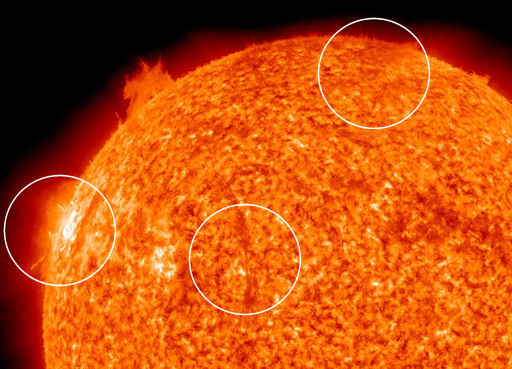
http://www.spaceweather.com/swpod20...ion3.gif?PHPSESSID=eamfqibesumnrqvum1e5k4kp01
The eruption is reminiscent of the global event of August 1st, which hurled a CME toward Earth and sparked Northern Lights in the United States as far south as Iowa. This time, however, the CME will miss Earth (unless it veers off course) so there should be no resulting geostorms.

Caplock50
I am the Winter Warrior
And just the other day, I read an article where the 'solar scientists' said those CMEs can change directions in mid course. So, just because it isn't aimed at us at the moment of 'lift-off' doesn't mean we can't get hit by it.
Yep, they are preparing us for a bad hit...and I think it'll be soon, too.
Yep, they are preparing us for a bad hit...and I think it'll be soon, too.

almost ready
Inactive
Interesting stuff -- please keep it coming.

bobpick
Inactive
An honest theory:
1. Oct 27 and Geryl is proven right, a Class M flare hits the earth but does a bit more damage than originally conceived - we lose communications for an hour or so.
2. Nov 8 and we get that X flare/Carrington event. Bob is going to be dancing in the streets with the demise of Farmville! <Don't ask>.
3. With the grid down we are unable to learn of the next one coming. This time, it will be in March of 2011. Bigger than the Nov event, it will overwhelm already taxed "hardened" systems. Hello China Syndrome.
1. Oct 27 and Geryl is proven right, a Class M flare hits the earth but does a bit more damage than originally conceived - we lose communications for an hour or so.
2. Nov 8 and we get that X flare/Carrington event. Bob is going to be dancing in the streets with the demise of Farmville! <Don't ask>.
3. With the grid down we are unable to learn of the next one coming. This time, it will be in March of 2011. Bigger than the Nov event, it will overwhelm already taxed "hardened" systems. Hello China Syndrome.
packyderms_wife
Neither here nor there.
Did you watch the live feed and see the huge tsunami go across the face of the sun? It was spectacular!!!
K-
Heliobas Disciple
TB Fanatic
Did you watch the live feed and see the huge tsunami go across the face of the sun? It was spectacular!!!
K-
Yes it was. And once again, solar events that were once said to be 'extremely rare' are happening once a month.
HD
packyderms_wife
Neither here nor there.
Yes it was. And once again, solar events that were once said to be 'extremely rare' are happening once a month.
HD
Oh AND did you see today's spaceweather announcement that though they once thought CME"S and Solar storms to travel in ONLY a straight line is NOW a fallicy???
K-
Heliobas Disciple
TB Fanatic
Oh AND did you see today's spaceweather announcement that though they once thought CME"S and Solar storms to travel in ONLY a straight line is NOW a fallicy???
K-
I saw the announcement on the 21st. Here's the article I saw earlier this week:
http://science.nasa.gov/science-news/science-at-nasa/2010/21sep_zigzag/
(fair use applies)
Solar Storms can Change Directions, Surprising Forecasters
Sept. 21, 2010: Solar storms don't always travel in a straight line. But once they start heading in our direction, they can accelerate rapidly, gathering steam for a harder hit on Earth's magnetic field.
So say researchers who have been using data from NASA's twin STEREO spacecraft to unravel the 3D structure of solar storms. Their findings are presented in today's issue of Nature Communications.
(snip)
packyderms_wife
Neither here nor there.
As if we didn’t have enough to worry about, now we add stealthy stalking solar storms.
From where I sit straight out of scripture. I'm waiting for the Sun to shut off!
K-

Rastech
Veteran Member
Anyone else seeing the 'bubbles' on the Sun?
The closer I look (greater magnification and clarity), the more I see.
There's some clearly visible in that picture.
Take a look at this - 11:30 PDT 10/31/2010
http://www2.nict.go.jp/y/y223/simulation/realtime/
http://www2.nict.go.jp/y/y223/simulation/realtime/
Tom McDowell
BAMN

Yes, have you ever seen that before?
Bz was consistently near +10 (a good thing to me) and there seems to be no tail even though the solar winds are or were near 400.
Look how far out the magnetic field is.
I don't have a screen shot to capture the real time frames.
Bz was consistently near +10 (a good thing to me) and there seems to be no tail even though the solar winds are or were near 400.
Look how far out the magnetic field is.
I don't have a screen shot to capture the real time frames.
Tom McDowell
BAMN
RJC wrote: have you ever seen that before?
No that's another first - good catch. Although I've been happily observing many firsts since we collectively began observing.
To capture the image hover over with the mouse, right click and chose save image as. Once saved locally then manipulate image in processing software. In the future make note of the UTC time as the images are usually (heh-heh) archived, and can make for easy retrieval.
Back to the topic:
I wonder if perhaps it's an anomaly within the simulator itself and hence - fiction.
OTOH if accurate, it would, appear as there's a stronger force than the sun at work.
Then again, could be some type of magnetic eddy we (planet Earth) wandered into to.
I'm tempted to send the image off to the folks at the .jp lab and ask WTH.
Consideration:
I've often thought the reverse forces of the solar wind may be more influential than we suspect. IOW - the periods of extreme calm exert their unknown influences as well. I have noticed there are usually quite active periods following the inactive. Similar to the snap back paper presented a while back.
To follow on with that particular train of thought, here's three hours of poor quality video titled:
Sacred Living Geometry -Enlightened Environmental Theories of Viktor Schauberger
Presented as an alternate perspective the video goes well beyond the following description. Although slightly off topic one can see the similarities and dynamics in play, both terrestrial and and beyond. This is likely one of the fullest presentations regarding his works. In other words don't be fooled by the description, be prepared to have some expanded horizons.
http://video.google.com/videoplay?docid=-5643559434275921302#
Description:
The research of Callum Coats takes us on a journey through the life and inventions of Austrian ecologist Viktor Schauberger (1885-1958). Now, for the first time, you can view the evidence in this detailed, three-hour illustrated lecture presentation on this two video set.
Viktor Schauberger was a genius whose ideas were far ahead of his time. He worked as a "forest-master" in the Austrian Alps when they were still a true wilderness. This experience was to influence his entire life's work.
Schauberger prophesied the environmental crises we are seeing today, predicting that unless we start to cherish rather than exploit our world, we would surely destroy ourselves. He demonstrated how deforestation would deplete the world of water, causing deserts and climatic chaos. Asked about our technology, "How else should it be done?" His answer was "exactly in the opposite way that it is done today!"
His maxim: "Comprehend and Copy Nature!"
From his precise observations of the processes of Nature, Schauberger pioneered a completely new understanding of the nature of water as the most important life-giving and energy-empowered substance on the planet.
This led him to develop a radical new science which flew in the face of conventional scientific thinking but which, today, is being increasingly recognized for its highly-relevant implications for civilization.
Viktor Schauberger might have made a career as a brilliant inventor. Forced, for a time, to develop radical new forms of propulsion for the Third Reich , he went on to work on devices utilizing the principles of implosion -- hundreds of times more powerful than conventional power sources. Even in the weeks just before his death, US government and commercial interests were exerting pressure on him to reveal his secrets.
Schauberger's deep insights in the special properties of water and nature hold immense implications for future technology and ecology.
===
.
No that's another first - good catch. Although I've been happily observing many firsts since we collectively began observing.
To capture the image hover over with the mouse, right click and chose save image as. Once saved locally then manipulate image in processing software. In the future make note of the UTC time as the images are usually (heh-heh) archived, and can make for easy retrieval.
Back to the topic:
I wonder if perhaps it's an anomaly within the simulator itself and hence - fiction.
OTOH if accurate, it would, appear as there's a stronger force than the sun at work.
Then again, could be some type of magnetic eddy we (planet Earth) wandered into to.
I'm tempted to send the image off to the folks at the .jp lab and ask WTH.
Consideration:
I've often thought the reverse forces of the solar wind may be more influential than we suspect. IOW - the periods of extreme calm exert their unknown influences as well. I have noticed there are usually quite active periods following the inactive. Similar to the snap back paper presented a while back.
To follow on with that particular train of thought, here's three hours of poor quality video titled:
Sacred Living Geometry -Enlightened Environmental Theories of Viktor Schauberger
Presented as an alternate perspective the video goes well beyond the following description. Although slightly off topic one can see the similarities and dynamics in play, both terrestrial and and beyond. This is likely one of the fullest presentations regarding his works. In other words don't be fooled by the description, be prepared to have some expanded horizons.
http://video.google.com/videoplay?docid=-5643559434275921302#
Description:
The research of Callum Coats takes us on a journey through the life and inventions of Austrian ecologist Viktor Schauberger (1885-1958). Now, for the first time, you can view the evidence in this detailed, three-hour illustrated lecture presentation on this two video set.
Viktor Schauberger was a genius whose ideas were far ahead of his time. He worked as a "forest-master" in the Austrian Alps when they were still a true wilderness. This experience was to influence his entire life's work.
Schauberger prophesied the environmental crises we are seeing today, predicting that unless we start to cherish rather than exploit our world, we would surely destroy ourselves. He demonstrated how deforestation would deplete the world of water, causing deserts and climatic chaos. Asked about our technology, "How else should it be done?" His answer was "exactly in the opposite way that it is done today!"
His maxim: "Comprehend and Copy Nature!"
From his precise observations of the processes of Nature, Schauberger pioneered a completely new understanding of the nature of water as the most important life-giving and energy-empowered substance on the planet.
This led him to develop a radical new science which flew in the face of conventional scientific thinking but which, today, is being increasingly recognized for its highly-relevant implications for civilization.
Viktor Schauberger might have made a career as a brilliant inventor. Forced, for a time, to develop radical new forms of propulsion for the Third Reich , he went on to work on devices utilizing the principles of implosion -- hundreds of times more powerful than conventional power sources. Even in the weeks just before his death, US government and commercial interests were exerting pressure on him to reveal his secrets.
Schauberger's deep insights in the special properties of water and nature hold immense implications for future technology and ecology.
===
.

onelove
Inactive
That ornery rascal, keeps sneaking back and forth from behind the sun.

And TY OP..good find!
Tom McDowell
BAMN

Tom you're right on top of this news
SUMXM5
Serial Number: 73
Issue Time: 2010 Nov 06 1554 UTC
SUMMARY: X-ray Event exceeded M5
Begin Time: 2010 Nov 06 1527 UTC
Maximum Time: 2010 Nov 06 1536 UTC
End Time: 2010 Nov 06 1544 UTC
X-ray Class: M5.4
Optical Class: sf
Location: S18E47
NOAA Scale: R2 – Moderate
Space Weather Message Code: SUM10R
Serial Number: 482
Issue Time: 2010 Nov 06 1623 UTC
SUMMARY: 10cm Radio Burst
Begin Time: 2010 Nov 06 1533 UTC
Maximum Time: 2010 Nov 06 1534 UTC
End Time: 2010 Nov 06 1535 UTC
Duration: 2 minutes
Peak Flux: 100 sfu
Latest Penticton Noon Flux: 83 sfu
It'll be interesting to see how long until it affects the Geomagnetic.
SUMXM5
Serial Number: 73
Issue Time: 2010 Nov 06 1554 UTC
SUMMARY: X-ray Event exceeded M5
Begin Time: 2010 Nov 06 1527 UTC
Maximum Time: 2010 Nov 06 1536 UTC
End Time: 2010 Nov 06 1544 UTC
X-ray Class: M5.4
Optical Class: sf
Location: S18E47
NOAA Scale: R2 – Moderate
Space Weather Message Code: SUM10R
Serial Number: 482
Issue Time: 2010 Nov 06 1623 UTC
SUMMARY: 10cm Radio Burst
Begin Time: 2010 Nov 06 1533 UTC
Maximum Time: 2010 Nov 06 1534 UTC
End Time: 2010 Nov 06 1535 UTC
Duration: 2 minutes
Peak Flux: 100 sfu
Latest Penticton Noon Flux: 83 sfu
It'll be interesting to see how long until it affects the Geomagnetic.
Hansa44
Justine Case
Tom you're right on top of this news
SUMXM5
Serial Number: 73
Issue Time: 2010 Nov 06 1554 UTC
SUMMARY: X-ray Event exceeded M5
Begin Time: 2010 Nov 06 1527 UTC
Maximum Time: 2010 Nov 06 1536 UTC
End Time: 2010 Nov 06 1544 UTC
X-ray Class: M5.4
Optical Class: sf
Location: S18E47
NOAA Scale: R2 – Moderate
Space Weather Message Code: SUM10R
Serial Number: 482
Issue Time: 2010 Nov 06 1623 UTC
SUMMARY: 10cm Radio Burst
Begin Time: 2010 Nov 06 1533 UTC
Maximum Time: 2010 Nov 06 1534 UTC
End Time: 2010 Nov 06 1535 UTC
Duration: 2 minutes
Peak Flux: 100 sfu
Latest Penticton Noon Flux: 83 sfu
It'll be interesting to see how long until it affects the Geomagnetic.
Is this considered a big flare?
Tom McDowell
BAMN
Is this considered a big flare?
Not really.
BTW -
No data available on C2 and C3 for the 6th.
Another high C class a few minutes ago.
Will be interesting to watch if and when the images are released.
===
.

packyderms_wife
Neither here nor there.
 Oh fark that is very different that what I posted at 5:30ish pm central time!!! I read that the cme hit sometime around 8 central standard time.
K-
They were predicting the hit about 4:30, however it seems to be a little later then that. It first peaked about 9:30 PST and there will likely be updates.
Space Weather Message Code: ALTK04
Serial Number: 1496
Issue Time: 2011 Feb 18 0528 UTC
ALERT: Geomagnetic K-index of 4
Threshold Reached: 2011 Feb 18 0526 UTC
Synoptic Period: 0300-0600 UTC
Station: Boulder
Active Warning: Yes
Space Weather Message Code: ALTK04
Serial Number: 1496
Issue Time: 2011 Feb 18 0528 UTC
ALERT: Geomagnetic K-index of 4
Threshold Reached: 2011 Feb 18 0526 UTC
Synoptic Period: 0300-0600 UTC
Station: Boulder
Active Warning: Yes
packyderms_wife
Neither here nor there.
They were predicting the hit about 4:30, however it seems to be a little later then that. It first peaked about 9:30 PST and there will likelly be updaates.
Space Weather Message Code: ALTK04
Serial Number: 1496
Issue Time: 2011 Feb 18 0528 UTC
ALERT: Geomagnetic K-index of 4
Threshold Reached: 2011 Feb 18 0526 UTC
Synoptic Period: 0300-0600 UTC
Station: Boulder
Active Warning: Yes
NOTE that spaceweather.com for whatever reasons is behind a bit today. Even NOAA is leaving them in the dust.
We were hit with a K4 about 24 hours ago, thereafter the solar wind speed was up the density increased, the Bz component went way south, big time bad. A few minutes ago, the Real Time Magnetosphere simulator went down. I don’t know what the solar activity was the prompted this geomagnetic storm, however it may be the massive backside flare DS posted about recently.