A/Swine/4/Mexico/2009/(H1N1) from April 2009 has been
uploaded to genbank
it has 1+5+6+10+6+9+4+2 mutations in the 8 segments {see below}, 9 of which are mixed signals
{T678K(1),G715R(4),A716R(4),A719R(4),T102N(6),C435M(6),C1326Y(6),T552Y(7),T614K(7)}
0+2+0+0+2+2+1+1 of these mutations are seen in mexflu-(pig-) ancestors
T678K(1),
G377A(2),T1722C(2),A1803C(2),A1907G(2),T2022C(2),
C666A(3),G1219A(3),C1392T(3),A1521G(3),A1578T(3),C1680T(3),
T598C(4),G640A(4),G715R(4),A716R(4),A719R(4),A729G(4),T873C(4),C991T(4),A1278G(4),G1623A(4),
T159G(5),A230G(5),A387G(5),C792T(5),C1002T(5),C1272A(5),
T102N(6),A103G(6),C108T(6),C377A(6),C435M(6),T849C (6),C864A(6),A903G(6),C1326Y(6),
A315G(7),T552Y(7),T614K(7),T760C(7),
A408G(8),C418A(8),
K: T or G
R: A or G
N: A or C or G or T
M: A or C
Y: C or T
T1722C(2),A1803C(2),T159G(5),C792T(5),C108T(6),C377A(6),A315G(7),A408G(8)
are from swine-triple-reassortant (1,2,3,5,8) classical swine (4) or Eurasian swine (6,7)
The pig has none of the early human-mexflu markers, only 11 out of 833 human mexflu
genomes at genbank on Nov.25 had this property.
the calculated probability (p-value) is 1:250 that ancestors of this pig
virus had replicated in humans
there are 3309 different mexflu mutations until Nov.26 since creation in early 2009.
158 of these coincide with the calculated best recent ancestor of mexflu rom known
viruses, which is more then 10 years back.
the probability of success in 7 or more cases out of 43 trials
with single success-probability 158/3309 is ~0.004
with ~40 mutations the estimated common ancestor of mexflu
and this pig-virus is ~Sept.2008
(unless the mutations are created in the lab, as was apparantly
the case with the Alberta-pigs)
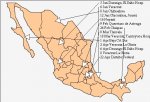
see here where the pig was sampled
http://magictour.free.fr/panflu/mexst.JPG
red the state where the pig was sampled in April
blue the state with the first confirmed case (baby
on Feb.24)
uploaded to genbank
it has 1+5+6+10+6+9+4+2 mutations in the 8 segments {see below}, 9 of which are mixed signals
{T678K(1),G715R(4),A716R(4),A719R(4),T102N(6),C435M(6),C1326Y(6),T552Y(7),T614K(7)}
0+2+0+0+2+2+1+1 of these mutations are seen in mexflu-(pig-) ancestors
T678K(1),
G377A(2),T1722C(2),A1803C(2),A1907G(2),T2022C(2),
C666A(3),G1219A(3),C1392T(3),A1521G(3),A1578T(3),C1680T(3),
T598C(4),G640A(4),G715R(4),A716R(4),A719R(4),A729G(4),T873C(4),C991T(4),A1278G(4),G1623A(4),
T159G(5),A230G(5),A387G(5),C792T(5),C1002T(5),C1272A(5),
T102N(6),A103G(6),C108T(6),C377A(6),C435M(6),T849C (6),C864A(6),A903G(6),C1326Y(6),
A315G(7),T552Y(7),T614K(7),T760C(7),
A408G(8),C418A(8),
K: T or G
R: A or G
N: A or C or G or T
M: A or C
Y: C or T
T1722C(2),A1803C(2),T159G(5),C792T(5),C108T(6),C377A(6),A315G(7),A408G(8)
are from swine-triple-reassortant (1,2,3,5,8) classical swine (4) or Eurasian swine (6,7)
The pig has none of the early human-mexflu markers, only 11 out of 833 human mexflu
genomes at genbank on Nov.25 had this property.
the calculated probability (p-value) is 1:250 that ancestors of this pig
virus had replicated in humans
there are 3309 different mexflu mutations until Nov.26 since creation in early 2009.
158 of these coincide with the calculated best recent ancestor of mexflu rom known
viruses, which is more then 10 years back.
the probability of success in 7 or more cases out of 43 trials
with single success-probability 158/3309 is ~0.004
with ~40 mutations the estimated common ancestor of mexflu
and this pig-virus is ~Sept.2008
(unless the mutations are created in the lab, as was apparantly
the case with the Alberta-pigs)
see here where the pig was sampled
http://magictour.free.fr/panflu/mexst.JPG
red the state where the pig was sampled in April
blue the state with the first confirmed case (baby
on Feb.24)