WAR 07/07 to 07/14 ***The***Winds***Of***WAR***

=


(16)06/07 to 06/14 ***The***Winds***of***WAR***
http://www.timebomb2000.com/vb/showt...***of***WAR***

(17)http://www.timebomb2000.com/vb/showt...nds***of***WAR

(18)06/23 to 06/29 ***The***Winds***0f***WAR***
http://www.timebomb2000.com/vb/showt...***0f***WAR*** ~:siren:

(19)06/30 to 07/06 ***The***Winds***of***WAR***
http://www.timebomb2000.com/vb/showthread.php?407702-06-30-to-07-06-***The***Winds***of***WAR***


===========​


U.S. warns of ‘dangerous’ confrontation as
Iranian exiles balk at moving from Iraqi base


By Joby Warrick, Friday, July 6, 6:12 PM
http://www.washingtonpost.com/world...2/07/06/gJQAu34dSW_story.html?wprss=rss_world

State Department officials warned Friday of the potential for renewed violence between Iraqis and an Iranian dissident group living north of Baghdad, citing stalled efforts to relocate the Iranians to a new, temporary home.

Leaders of the Mujahedin-e Khalq, or MEK, have refused since early May to allow additional convoys to travel from the group’s current Iraqi headquarters, dubbed Camp Ashraf, to a new facility on the grounds of a former U.S. military base near Baghdad, the officials said.


U.S. officials have been encouraging the move as part of a negotiated plan to end a standoff with Iraqi authorities, who contend that the group’s members are in the country illegally. MEK officials, however, have complained about poor conditions at the new camp, ranging from inadequate electricity to poisonous snakes.

While acknowledging logistical problems at the new base, State Department officials on Friday issued an unusual appeal to MEK leaders to end the standoff before a July 20 deadline set by the government of Prime Minister Nouri al-Maliki.

“It is past time for the MEK to recognize that Ashraf is not going to remain an MEK base in Iraq,” Daniel Benjamin, the State Department’s coordinator for counterterrorism, told reporters. “The Iraqi government is committed to closing it, and any plan to wait out the government in the hope that something will change is irresponsible and dangerous.”

MEK officials blame Iraq for the stalemate. After more than two-thirds of Ashraf’s residents moved to the new camp, Iraqis harassed MEK members and deprived them of necessities, a spokesman, Shahin Gobadi, said in an e-mail.

The Iraqi government “aims to make life so intolerable for the residents to coerce them into surrendering to the Iranian regime,” Gobadi said.

The Obama administration has joined U.N. officials in seeking to facilitate the removal of about 3,200 MEK members from Camp Ashraf in what State Department officials say is an effort to prevent a humanitarian crisis. The camp, which was under U.S. protection after the overthrow of Saddam Hussein’s regime, has been attacked twice by Iraqi security forces in clashes that left several MEK members dead.

The State Department has officially designated the MEK as a terrorist organization. Secretary of State Hillary Rodham Clinton is under court order to decide whether to lift the designation by Oct. 1, and she has publicly linked her decision to the MEK’s willingness to complete the move from Ashraf.

Benjamin said that MEK leaders appear to falsely believe that the court order compels the State Department to remove the terrorist designation, and that the misconception perhaps gives the group an opening for retaining its claim on Ashraf. “That conclusion is quite plainly wrong,” he said.

State Department officials acknowledged hearing from MEK supporters — including many powerful U.S. politicians and former national security officials — on the issue but said no amount of outside pressure would sway the department’s decision.

“Any decision, one way or the other, will be made entirely on the merits,” Benjamin said.


=
 
=


The Hate Grows Tiresome

July 6, 2012:
http://www.strategypage.com/qnd/israel/articles/20120706.aspx

Both Hamas and Fatah are facing more popular resistance to their rule. Neither group will allow fair elections. In effect, Fatah and Hamas are self-perpetuating political parties that live off the populations they control. This is the sort of thing that got the Arab Spring uprisings going last year. Fatah and Hamas felt they were immune to that sort of unrest because for decades Palestinians had been bombarded with "Israel must be destroyed before anything else" propaganda.


A growing number of Palestinians are questioning these priorities. While most Palestinians still want to destroy Israel and kill lots of Jews, they also feel that their leaders are corrupt and exploitative and holding them back more than the Israelis. Hamas and Fatah are fighting back, arresting and jailing political activists and accusing them of working for Israel. Meanwhile, the Arab states that provide most of the money to keep the Hamas and Fatah bureaucracies going are cutting back.

The donor states are fed up with the Palestinian's self-destructive tendencies, as well as the corruption that sees so much of the aid money disappear into foreign bank accounts. This cash shortage is making Fatah and Hamas even more unpopular because one of their most effective ways of maintaining power was to carefully distribute government jobs to those best able to rally popular support (or at least suppress disruptive activity) for the corrupt leadership.

Israel has developed a new sensor technology for detecting tunnels. The system passed tests and the first ten kilometers of the Gaza border is being equipped. Hamas builds tunnels under the Israeli border in order to get terrorists or kidnapping teams into Israel.

A terrorist group fired a rocket into Israel, causing no damage.

July 5, 2012: A mortar shell was fired from Gaza into Israel, causing no damage.

On the sixth anniversary of the war with Hezbollah, Israeli army commanders revealed that the Israeli military had undergone many changes since then in order to defeat Hezbollah more rapidly the next time around. Even so, Hezbollah has received a lot more rockets from Iran and there will initially be more damage to Israel than in 2006. There will also be more damage to Lebanese villages that serve as rocket storage and launching sites.

July 3, 2012: The Syrian dictator Hafez Assad expressed regret for Syrian guns or missiles shooting down a Turkish F-4 jet on June 22nd, explaining that the aircraft was believed to be Israeli. In southern Lebanon, Hezbollah claimed that three Israel eavesdropping devices, which tapped landline telephones, blew up when they were discovered. Hezbollah has, for years, claimed that Israeli agents plant all manner of eavesdropping devices in southern Lebanon. Increasingly these are built to self-destruct, usually by remote control.

July 2, 2012: Israeli warplanes made two attacks in Gaza, against terrorists preparing to launch rockets into Israel.

Hamas "temporarily" suspended voter registration in Gaza. A new election to determine who would rule the Palestinians was part of a peace deal between Hamas and Fatah. Some Hamas leaders apparently believe Fatah is more skilled in manipulating elections and has an unfair advantage.

July 1, 2012: Hamas has shut down nearly all the rocket and mortar firing by more radical terrorist groups in Gaza. More than 150 rockets and mortar shells were fired into Israel in June. In response to Hamas calming things down, Israel has resumed the ceasefire that was agreed to in April, 2011. Hamas controlled media still backs the eventual destruction of Israel. But for the moment Hamas has more pressing problems. The Gaza economy is a mess, largely because of attacks on Israel. Fatah is still a threat, as is the growing number of smaller, but more radical, terrorist groups. Then there is Egypt, which sort-of has a new government which might be willing to provide much more support for the Hamas plan to destroy Israel.

June 30, 2012: The newly elected president of Egypt, Mohamed Morsi, was sworn in. But in the weeks before that happened, the army (in the form of an interim government) unilaterally enacted laws that deprived the presidency of most of its powers. The military backed Supreme Court also ruled the newly elected, pro-Morsi parliament illegal. An Islamic conservative, Morsi is backing away from earlier promises to impose Islamic law and assume a hostile stance against Israel. Morsi has also stopped saying nice things about Islamic terrorists.

Morsi has to deal with the military first, one of the most corrupt institutions in the country and one not prepared to surrender any of its wealth and power. Morsi has an opportunity to use his office and access to Egyptian media to organize an effective military reform movement. He has to do this before the army suspects it is in danger, gets desperate, and tries to kill him.

June 29, 2012: Near the Libyan border, Egyptian police seized 138 122mm rockets (with a range of about 20 kilometers) and some other weapons, that were smuggled in from Libya and apparently headed for a buyer in Gaza.

June 28, 2012: Hamas revealed that another one of their leaders (Kamal Hussein Ghannaja) was killed yesterday, in Syria, by what was described as assassins. Most Hamas leaders have left Syria because Hamas refused to join Shia Iran in backing the Shia Assad dictatorship in Syria. Iran is at war with many Sunni factions. Sunni Islam is the dominant form (about 80 percent of Moslems) and many conservative Sunni consider Shia (about ten percent of Moslems) to be heretics.

Although Iran was a major supporter (weapons, cash, and terrorist training) of Hamas, other Sunni Moslem nations provided more cash and Hamas had to choose sides in Syria. The dead Hamas man in Syria was in charge of smuggling Iranian weapons into Gaza. Ghannaja had lots of enemies in Syria but Hamas blamed Israel for his death.


=
 
=


Saturday, July 7, 2012

'Incredible damage' in war on
Hizbullah, Israeli general warns


MARK WEISS in Jerusalem
http://www.irishtimes.com/newspaper/world/2012/0707/1224319602322.html

A SENIOR Israeli general has warned of devastating consequences if another war breaks out between Israel and the Shia Hizbullah group in Lebanon.

Speaking ahead of next week’s sixth anniversary of the second Lebanon war, Brig Gen Herzi Halevi, the commander of the Israeli army’s Galilee division, warned that a future conflict with Hizbullah would involve a large Israeli ground operation and “incredible damage” to Beirut and towns and villages in southern Lebanon.


“We will fight in a very aggressive way. Any village from which rockets are fired will be destroyed,” Brig Gen Halevi warned. “The Israel Defence Forces need to strike where the enemy is situated, and Hizbullah chose to hide in the heart of the civilian population, so that this would not be punitive destruction. But it will cause enormous damage to Lebanon; far more than the second Lebanon war.”

He admitted that despite the turmoil in the region, the Israeli-Lebanon border remains relatively stable, and the six years since the last Lebanon war have been “the quietest in Lebanon’s history”. However, Israel is concerned over Hizbullah’s grip on power, combined with ongoing instability in Syria and the possibility Hizbullah may drag Lebanon into a confrontation between Israel and Iran.

The commander said the army was ready for any scenario on the northern border, including a war against Hizbullah and, if necessary, the Lebanese army.

The military’s assessment is that in the event of a renewed conflict, the impact on Israel’s home front will be more damaging than in any of Israel’s previous wars. It is believed Hizbullah now has 60,000 projectiles aimed at northern and central Israel.

“The next war will be different. We’ll have to attack with more force, more violently, to halt any assault of the home front as quickly as possible.”


=
 
=


Assad’s ‘inner circle disintegrating’: Sunni general’s
defection may reflect growing sectarian divide in Syria


Khaled Yacoub Oweis, Reuters
Jul 6, 2012 9:26 PM ET
Al Arabiya
http://news.nationalpost.com/2012/0...old-friends-he-wanted-out-before-he-defected/
.
He is a Republican Guard brigadier and son of Syria’s longest-serving defence minister. But most of all Manaf Tlas is a friend of President Bashar al-Assad, a member of his inner circle and a prominent figure in the Damascus “young guard.”

Or he was. Rebels and a news website with links to the Syrian security apparatus said Thursday Brig. Tlas had fled to Turkey. If confirmed, he would be the first real insider to defect from the embattled elite fighting off a revolt against the Assad clan.


Tlas has long been a rare Sunni name within a ruling clique dominated by Mr. Assad’s fellow Alawites; the brigadier’s flight may reflect a growing sectarian divide and eroding support for the dynasty among richer Sunnis, who have been slow to join a revolt launched by poorer sections of the majority population.

A handsome man in his 40s with a beautiful wife, Brig. Tlas cut a dashing figure on the Damascus social scene, entertaining diplomats, artists and journalists, and rooting for what he saw as reformist policies of his president friend.

An enthusiast of fancy cars, he smokes cigars and his favourite holiday spot is the French Riviera.

But he grew increasingly disillusioned with the system that awarded his family rank and privilege.

His playboy father, Mustafa Tlas, attended military academy with Hafez al-Assad and remained his friend, confidant — and defence minister — through his three decades in power.

When Hafez died in 2000, Mustafa Tlas helped arrange a smooth transition for his son Bashar; at the same Baath party congress that anointed the younger Assad, Mr. Tlas’s son Manaf was elevated to the Central Committee of Syria’s ruling party.

The elder Tlas and another son have both left Syria since the revolt against Mr. Assad began last year. Mustafa Tlas left for France for what he described as medical treatment some months ago. Opposition sources say he is still there, though his whereabouts could not be independently confirmed. His son Firas, a business tycoon, left for Egypt; he is now thought to be in Dubai.

Like their fathers, Manaf Tlas and Bashar al-Assad are old friends and underwent military training together. Brig. Tlas helped introduce Bashar, now 46, to the Sunni Damascus social scene when he was being groomed for power in the 1990s.

In the decade that followed, Brig. Tlas spoke of reform but defended its cautious, some said glacial, pace under the Assads: “You need time. You need years,” he told The Washington Post in 2005. “There’s a generation you have to push forward.”

But the 2011 uprising rocked his cosy world. His father’s home town Rastan, about 160 kilometres north of Damascus, was among the first to rise up against Mr. Assad — and get hammered by the army for its defiance.

Peaceful demonstrations were silenced by the gun, prompting Rastan’s residents, many of whom served in the army and had the patronage of the Tlas family, to take up arms.

Brig. Tlas was privy to the inner working of the military crackdown by the core Alawite forces. As a senior officer in the Republican Guard, he would have been in regular contact with its commander, Bashar’s feared younger brother Maher, an architect of repression.

A destroyed Syrian army tank is abandoned after fighting with rebels on the side of a highway between Aleppo and Damascus Wednesday.
.
He did not like what he saw, and tried to do something to ease the crackdown, friends and opposition sources say. They credit him with intervening to negotiate local ceasefires.

“Manaf has been growing increasingly frustrated for months,” one friend said. “Being from Rastan, he felt increasing dishonour as his hometown was being leveled and hundreds of his relatives fell dead or injured.

“He started to tell people he trusted that he wanted out, and that he has respect among the Free Syrian Army,” the friend said, referring to the rebel force that has attracted many Sunni officers and soldiers from Rastan.

Manaf has been growing increasingly frustrated for months​

A Western diplomat who served in Damascus said Brig. Tlas, with his boyish good looks and fluent English and French, a taste for paintings and concerts, stood out among an officer corps drawn largely from the historically disadvantaged Alawite minority and often poorly educated.

He and his wife Tala regularly spent weekends in Paris, where his sister Nahed, widow of billionaire Saudi arms dealer Akram Ojjeh, is a prominent socialite.

“Manaf does not give the impression that he is a thug,” the diplomat said.

“But he mattered in the military. His defection is big news because it shows that the inner circle is disintegrating.”

Others take a different view.​

“If his defection is confirmed I do not think it will have any impact. The Tlas family has distanced itself for some time from what is happening,” said a Lebanese official close to the Damascus government.

“It will not change anything in the balance of power inside the country. They do not have any influence on the ground. They have made promises that they did not deliver.

“The main goal for this defection will be to cause a moral shock. The Americans will try to use it to the maximum.”

Syriasteps, the website with Syrian security links that reported Brig. Tlas’s defection, quoted a security official for Assad’s administration saying, “His desertion means nothing.”


=
 
=


Syrian defector explains why there aren't more

5:45 AM, July 6, 2012
Abby W. Schachter
http://www.nypost.com/p/blogs/capitol/new_twist_in_sad_syria_tale_GF9fEUvoWcClmfVfMHAGiI

A Syrian brigadier general has defected to France -- the highest ranked military official from Bahar Assad's dictatorship to openly flee the regime. But reports suggest that Manaf Tlass was desparate to save his own skin rather than having some serious ideological disagreement with the Assad dictatorship, which is now it its 18th-month of a brutal and bloody crackdown on the civilian opposition movement.


Meanwhile, a "Friends of Syria" conference is going in Paris to try -- again-- to stop the slaughter in Syria. There are foreign ministers and Secretary of State Hillary Clinton and a six-point plan for the conference itself, but there doesn't seem to be much of a change from previous conferences or previous strategy.

Most of what the conference participants are promising is to back up UN Special Envoy Kofi Annan in his so-far completely failed efforts to wave a magic wand and bring peace to Syria.

In a revealing interview with the Wall Street Journal, the highest ranking civilian Syrian leader to flee his homeland, a former deputy oil minister, explains why he thinks there haven't been more defectors like himself.

"Safe passage out of the country is becoming increasingly tricky, [Abdo] Husameddin said, and there are few incentives to risk uprooting families and livelihoods to join a fragmented opposition."

But whose fault is that "fragmented opposition"?

To scan the list of "Friends of Syria" priorities as they meet today, the only item about the Syrian opposition comes dead last.

"Increase support for the opposition," it reads. And the UK has pledged more money to the effort.

Perhaps a little more "support" for the opposition, like a no-fly zone for Syria maybe, would do a lot more to spur civilian defections from Assad's grip than all the hugs and kisses for Annan's diplomacy.


Read more: http://www.nypost.com/p/blogs/capit...ria_tale_GF9fEUvoWcClmfVfMHAGiI#ixzz1zthUkGyI


=
 

OldArcher

Has No Life - Lives on TB
You and the membership who reads them; are certainly welcome Col..

I concur with the above sentiment, Colonel and Dutch...

I've been on the road for a month, and if it weren't for the intel from the faithful posters here, I'd be totally in the dark... Bless you all...

OA, out...
 

Housecarl

On TB every waking moment
For links see article source.....
Posted for fair use.....
http://www.ft.com/cms/s/0/8185dd5c-c5c0-11e1-a5d5-00144feabdc0.html#axzz1zuVzT29j

July 7, 2012 4:18 am
Egypt: A toxic mix of tradition and religion

By Abeer Allam

In the run-up to the Egyptian presidential election, Mohamed Morsi, the Muslim Brotherhood candidate who became president last month, was asked on television to comment on the state-imposed ban on female genital mutilation. He said it was a private issue between mothers and daughters, adding that families, not the state, should decide.

His response caused uproar, particularly among children’s and women’s rights advocates who have been working for years to change the perception of the procedure in the society.

Human rights groups are increasingly concerned that Islamist parties are seeking to roll back women’s rights and reverse laws passed under the former regimes to appease their ultraconservative base.

While this is true, Mr Morsi’s views are commonly held across the country. A law banning female genital mutilation, or FGM, was passed five years ago after several girls who bled to death after the cutting of their clitoris, but FGM is still rampant among rural and lower socioeconomic classes.

The practice is passed down from one female generation to the next. Mothers who were forced by their mothers and grandmothers to undergo the cutting before they reached puberty do the same to their daughters.
President Mohamed Morsi©AFP

President Mohamed Morsi's attitude to FGM caused uproar

For them, tradition and custom overrides the law, even religion. They believe FGM curbs sexual desire and “purifies” the girl and prepares her to be a chaste wife, a “treasure” much sought after by eligible grooms.

Although support for FGM is still widespread there has been considerable change since the mid-1990s. In 1995, 82 per cent of women aged (15-49) believed FGM should continue. This dropped to 75 per cent in 2000 and to 62.5 per cent in 2008, according to Unicef.

Meanwhile, those who try to challenge the practice, eventually succumb to societal pressure. “I didn’t want to circumcise my younger daughter because I felt it was an outdated custom from my mother’s time, not hers. “But her father insisted,” says Iman Attar, 38, a housekeeper who lives in a working class Cairo neighbourhood. “Everybody told me it was unfair to leave her like this.”

The practice is often performed without girls’ consent. But female relatives portray FGM as rite of passage to womanhood and marriage.

About 90 per cent of all women of child-bearing age in Egypt have undergone female genital mutilation, according to the 2008 Egypt Demographic and Health Survey.

Years of campaigns in which religious scholars preached against the practice (the Grand Mufti issued a fatwa in 2009) have resulted in a drop from 77 per cent to 74 per cent in the number of girls who underwent FGM between 2005 and 2008. The survey suggests that the FGM will eventually decline to 60 per cent among girls currently under three.

“It’s difficult to end, because it’s rooted in a toxic mix of culture and religion,” says Mona Eltahawy, a feminist writer. “As much as many Muslims deny it has anything to do with Islam, you’ll find many clerics advocating it. When parliament criminalised it in 2007, some of the fiercest opponents of the law were from the Muslim Brotherhood.”

In May, the Brotherhood’s Freedom and Justice Party (FJP) was accused of launching a medical campaign for FGM in the southern governorate of Minya. The party denied the report, but human rights groups filed a complaint to the attorney-general and governor of Minya to stop the campaign.

Doctors, however, complain that most people ignore the ban and perform the procedure anyway.

One public hospital doctor says: “It is impossible to change tradition overnight. At least they should allow only doctors to perform it to control the damage and avoid death. Sometimes parents ask me to circumcise their daughters and I know when I say ‘no’, they will go straight to any untrained paramedic to do it for them anyway.”

It is usually performed on girls between the ages of nine and 12. In the past, it involved removing the clitoris, together with labia minora. The operation was frequently performed using knives or razors. In recent years, however, more than 60 per cent of circumcisions have been performed by physicians and nurses, Unicef says.

Besides the psychological scars, the practice leads to difficulties with menstruation, intercourse and childbirth. Activists are worried by lukewarm attitudes to the law among newly-elected officials.

Azza el-Garf, one of the few Brotherhood’s Freedom and Justice female parliamentarians, described the procedure as “plastic surgery or a form of “beautification” that women are entitled to do if they opt to, attracting harsh criticism.

Copyright The Financial Times Limited 2012.
 

Housecarl

On TB every waking moment
For links see article source....
Posted for fair use......
http://articles.boston.com/2012-07-05/news/32553758_1_islamist-three-men-face-trial

Egypt police deny Islamists behind student murder
July 05, 2012|Associated Press

Egypt’s Interior Minister on Thursday tried to downplay the backgrounds of three men suspected of fatally stabbing a university student sitting with his fiance, saying they are not affiliated with Islamist parties or ideology.

Interior Minister Mohammed Ibrahim told reporters in Cairo that the men are simply “religious,’’ stopping short of calling them ultraconservatives or extremists.

However, photographs of the suspects show that one of the men has the mustache-less beard of ultraconservative Salafi Muslims, who follow a strict interpretation of Islam.

Since the ouster of Hosni Mubarak from power last year in a popular uprising, the Salafi Nour Party has emerged as a powerful political player, winning a quarter of the seats in parliament before the legislature was dissolved last month.

The June 25 attack has alarmed Egyptians concerned that the rise of Islamists may be emboldening vigilantes trying to enforce strict religious mores in the streets, including separation of the sexes.

Ibrahim said that police detained and questioned the three men, who range in age from 26 to 32 years old, on Thursday. He said they admitted attacking 20-year-old Ahmed Hussein Eid during a scuffle over how he was sitting with his fiance in a quiet park in the Red Sea city of Suez.

Separately, a former Salafi lawmaker who police say was caught “violating public decency’’ while with a woman in a car will face trial Sunday, according to state prosecutors.

Ali Wanees, who is also a religious cleric, has been charged with failing to show up for interrogation and giving a false statement to police about the nature of his relationship with the woman.

Wanees had said that the woman was his niece, but police say she is not.

The allegation is especially embarrassing for Salafis, who advocate a strict interpretation of Islam and the segregation of unrelated men and women.
 

Housecarl

On TB every waking moment
Hummm......

For links see article source.....
Posted for fair use......
http://www.nytimes.com/2012/07/07/opinion/israel-egypt-and-peace-treaties.html

July 6, 2012
Israel, Egypt and Peace Treaties

Thomas Friedman’s July 5 article, “Morsi and Israel” ignores the key issue facing Israel in dealing with the Morsi-led Muslim Brotherhood victory in Egypt, namely the very real possibility that Morsi will tear up the Egyptian-Israeli peace treaty.

Notwithstanding, Mr. Friedman takes the Israeli prime minister, Benjamin Netanyahu, to task for his cautious approach to this change in government while ignoring the real possibility that Egypt will join the Arab rejectionist front. He lauds the Brotherhood victory as a victory for democracy and Western values as opposed to the previous brutal and corrupt regime.

Israel’s reliance on peace treaties with Egypt and Jordan has brought nonbelligerency — and that is worth its weight in gold. We all know that democracy works when the people have democratic values and rights. Is this the norm in the Middle East?

It should be clear to Mr. Friedman that Israel will enter into peace treaties with its neighbors, dictatorships or otherwise, irrespective of their parliamentary systems, and that this approach will dominate until the Middle East changes its tenor.

Michael Dorian Goldberg, Rehovot, Israel

_____


For links see article source.....
Posted for fair use......
http://www.nytimes.com/2012/07/04/opinion/what-does-morsi-mean-for-israel.html

July 3, 2012
What Does Morsi Mean for Israel?
By THOMAS L. FRIEDMAN
Comments 240

Is the election of Mohamed Morsi, the Muslim Brotherhood candidate, as president of Egypt the beginning of the end of the Camp David peace treaty between Israel and Egypt? It doesn’t have to be. In fact, it could actually be the beginning of a real peace between the Israeli and the Egyptian peoples, instead of what we’ve had: a cold, formal peace between Israel and a single Egyptian pharaoh. But, for that to be the case, both sides will have to change some deeply ingrained behaviors, and fast.

First, let’s dispense with some nonsense. There is a mantra you hear from Benjamin Netanyahu’s government in Israel and various right-wing analysts: “We told you so.” It’s the idea that somehow President Obama could have intervened to “save” President Hosni Mubarak of Egypt and he was just too naïve to do so, and the inevitable result is that the Muslim Brotherhood has taken power. Sorry, naïveté is thinking that because it was so convenient for Israel to have peace with one dictator, Mubarak, rather than 80 million Egyptians, that this dictator — or some other general — would and could stay at the helm in Egypt forever. Talk about naïve.

I truly appreciate the anxiety Israelis feel at seeing their neighborhood imploding. But it is also striking that a people for whom the Exodus story of liberation is so central — and who for so long argued that peace will happen only when the Arabs become democratic — failed to believe that the liberation narrative might one day resonate with the people of Egypt and now proclaim that the problem with the Arabs is that they are becoming democratic. This has roots.

“In their relations with power, Jews in exile have always preferred vertical alliances to horizontal ones,” notes Leon Wieseltier, the Jewish scholar and literary editor of The New Republic. “They always preferred to have a relationship with the king or the bishop so as not to have to engage with the general population, of which they were deeply distrustful — and they often had reason to be distrustful. Israel, as a sovereign state, reproduced the old Jewish tradition of the vertical alliance, only this time with the Arab states. They thought that if they had a relationship with Mubarak or the king of Jordan, they had all they needed. But the model of the vertical alliance only makes sense with authoritarian political systems. As soon as authoritarianism breaks down, and a process of democratization begins, the vertical model is over and you enter a period of horizontality in which the opinions of the people — in this instance, ordinary Arabs — will matter.” As a result, Israel will have to make the man on the street “not only fear it, but also understand it. This will not be easy, but it may not be impossible. Anyway, nostalgia for dictators is not a thoughtful policy.”

I don’t know whether the current Palestinian leadership can be a partner for a secure, two-state peace with Israel, but I do know this: Israel needs to be more creative in testing whether that is possible. Because the alternative is a one-state solution that will be the death of Israel as a Jewish democracy and deadly for peace with a democratic Egypt.

And what are Morsi’s obligations? Have no illusions: the Muslim Brotherhood at its core holds deeply illiberal, anti-pluralistic, anti-feminist views. It aspires to lock itself into power and exploit a revolution it did not initiate. I just don’t think it is going to be so easy. Iran is political Islam in power with oil — to buy off all the pressures and contradictions. Saudi Arabia is political Islam in power with oil. Egypt will be political Islam in power without oil. Egypt can’t survive without tourism, foreign investment and aid to create the jobs, schools and opportunities to satisfy the Egyptian youths who launched this revolution and many others who passively supported it. Also, the U.S. cannot, will not and should not give the Muslim Brotherhood the same deal it gave Mubarak — just arrest and torture the jihadists we want and you can have a cold peace with Israel and no constitutionalism at home.

As the analyst Hussein Ibish wrote in Now Lebanon, with the Muslim Brotherhood in power, it is now vital for liberals in Egypt and abroad to focus on ensuring that Egypt’s new constitution is built on laws that constrain “the powers of government and ensure ironclad, inviolable protection for the rights of individuals, minorities and women.”

So Morsi is going to be under enormous pressure to follow the path of Turkey, not the Taliban. Will he? I have no idea. He should understand, though, that he holds a powerful card — one Israelis would greatly value: real peace with a Muslim Brotherhood-led Egypt, which could mean peace with the Muslim world and a true end to the conflict. Of course, that’s the longest of long shots. Would Morsi ever dangle that under certain terms? Again, I don’t know. I just know this: The Mubarak era is over — and with the conservative Muslim Brotherhood dominating Egypt and with conservative religious-nationalists dominating Israeli politics, both will either change their behaviors to make Camp David legitimate for both peoples or it will gradually become unsustainable.


Related News

Judge Helped Egypt’s Military to Cement Power (July 4, 2012)

Related in Opinion

Latitude: In the Army Now (July 4, 2012)
Latitude: The Folly of Israel’s Settlement Policy (July 4, 2012)
Times Topics: Mohamed Morsi | Muslim Brotherhood (Egypt)
 

Housecarl

On TB every waking moment
For links see article source.....
Posted for fair use......
http://www.nytimes.com/2012/07/07/w...power-has-become-a-way-of-life.html?ref=world

July 6, 2012
Afghan Conflict Losing Air Power as U.S. Pulls Out
By C. J. CHIVERS
Comments 68

Death stopped Abdul Qayum, a Taliban commander in Afghanistan’s Zabul Province, in a fiery flash and roar.

It was an evening in October last year, and Mr. Qayum was meeting several Afghans in a field. Though he did not know it, a Navy F/A-18 strike fighter was circling high overhead more than five miles away, summoned by an American Special Operations team. Its engines were out of earshot, the pilot said, “so we didn’t burn the target.”

Mr. Qayum led a platoon-size Taliban group and was plotting to bomb an Afghan government office, an American intelligence officer said. Under Western rules guiding the use of deadly force, the pilot was barred from trying to kill him while he stood in a group of unidentified men.

Then came a chance. The meeting ended, and Mr. Qayum approached a man who had pulled up on a motorcycle, the pilot and the intelligence officer said. Soon the two men were riding together on a dirt road, illuminated on the screen of the aircraft’s targeting sensor.

The pilot, Lt. Cmdr. Brian Kesselring, released an AGM-65E laser-guided missile. Visible on a video recording declassified and released to The New York Times, the missile struck the pair head-on, exploding with such energy that only fragments of Mr. Qayum’s remains were found.

The killing of Mr. Qayum and his driver, confirmed by the Taliban and reviewed by The New York Times as part of an examination of operations in Afghanistan by 44 F/A-18s from the aircraft carrier John C. Stennis, was a demonstration of the extraordinary technical and tactical abilities of American air power. For both better and worse, that power has become a defining facet of the Afghan conflict and the American way of waging war.

But the tight integration and expense of air missions, which in Navy crews’ case can cost up to $20,000 an hour, also raise questions about the prospects for the continuing fight against the Taliban.

Weary of the costs of a long war, Western military forces have already begun withdrawing and handing greater security responsibility to Afghan forces. One worry, several officers said, is that these air operations have become essential, necessary for ground units that are operating in contested areas of Afghanistan and hoping to maintain influence, or even survive. And the Afghan government has nothing to match the role they play.

Drawing from the experiences of more than a decade of fighting, and after repeatedly refining training and rules of engagement to address concerns about civilian casualties, aircrews work in close coordination with ground controllers more fully, and usually more precisely, than ever before.

In carefully choreographed killings of tactical commanders like Mr. Qayum, use of heavier ordnance to beat back Taliban attacks, and efforts to keep roads clear of improvised fertilizer bombs, conventional American warplanes are integrated into the finest details of ground war. These missions, distinct from the C.I.A.-run drone program, have allowed a relatively small Western combat force, with just tens of thousands of troops actually patrolling each day, to wage war across a sprawling nation of 30 million people.

The tactics for air-to-ground war have greatly evolved since the war’s start in 2001. One pilot, saying that he dropped just a single 1,000-pound bomb during a six-month deployment, recalled that at the war’s outset, planes would take off with more bombs than they were allowed to return with for landings. “When this kicked off, they were launching aircraft with unrecoverable loads,” said the pilot, Lt. Cmdr. Peter Morgan. “Basically, you had to drop. That’s all changed.”

A Sophisticated Balance

F/A-18 strike fighters are among the world’s most advanced military aircraft, with a price of roughly $100 million each and operating costs estimated at $18,000 to $20,000 per flight hour. Their sorties from the Stennis, each often lasting eight hours round-trip, almost always passed without violence.

Part of this was the nature of an experienced foe. The Taliban have spent years learning to mask their movements and intentions from aircraft, making themselves hard to spot.

Another part was the nature of the rules. Even when Taliban fighters were visible, Western military restrictions devised to prevent harm to civilians and minimize damage to infrastructure, codified after prominent and deadly mistakes that fueled Afghan public outrage, sometimes limited a pilot’s options. Just last month, commanders again tightened the rules for use of air power in civilian areas, after Afghans said a NATO airstrike killed 18 civilians in an eastern village.

In all, Navy pilots released missiles or bombs, or fired their aircrafts’ 20-millimeter cannon, on 41 of the 892 F/A-18 sorties from the Stennis to Afghanistan in late 2011 and early 2012, the carrier air group’s data shows.

This roughly aligns with the use of air power in the recent war. In 2011, for example, the data shows that NATO fixed-wing aircraft dropped ordnance or strafed on 5.8 percent of 34,286 combat sorties flown.

None of the air-to-ground attacks from the carrier stirred up allegations of causing civilian or friendly casualties, which, statistically, have been rare over all.

For the pilots, who live far from the infantry soldier’s daily physical grind and away from the dread of hidden improvised bombs, these strikes and strafing runs hit a personally satisfying chord. They know they are protecting fellow service members and punishing those trying to kill them.

Lieutenant Commander Kesselring said as much after killing the men on the motorbike. That flight was a welcome contrast to the bad days on job, he said, because often “you arrive to a smoking hole and guys calling for a medevac, and you feel pretty helpless.”

Still, the current practices and sophisticated equipment were not flawless. On a few occasions the strikes missed. On another, a 500-pound bomb appeared to break apart upon hitting the ground and failed to explode.

Once a suspected Afghan bomb maker heard the approaching aircraft and sprinted madly for a dirt wall, narrowly eluding a strafe as the rounds struck nearby. The blast wave from a heavier bomb most surely would have killed him, officers said, though it would have put other villagers and their homes at greater risk.

On other days the pilots and the controllers on the ground were not entirely sure of what was happening in a fast-moving firefight. In these cases officers held fire in favor of restraint or nonlethal displays of presence and power.

Although these were the sorts of decisions that some American ground troops have generally resented, American officers say caution and proportionality are essential to maintain support both in Afghanistan and the United States.

A senior Marine officer with command experience in Afghanistan said troops on the ground needed to be wary of impulses to “swat flies with hammers” and risk having airstrikes create more problems then they solve.

Then there were days when all of the elements for a strike or gun run came together, and the nature of the campaign’s air-to-ground violence emerged. Often these were made when ground troops were imperiled, a few times when the situation was grave.

Pushing the Taliban Back

One use of force was on Nov. 10, not long after nightfall in Kandahar Province. Two F/A-18s patrolling over the steppe were told by a ground controller that a combat outpost crowded with Afghan National Army soldiers was under attack.

From the air, the pilots in each aircraft, Lt. Travis Hartman and Lt. Paul Oyler, could see the gunfight on the infrared targeting sensors in their cockpits. They could also sense the confusion. Three Afghan outposts were soon under simultaneous fire, and a sole American ground controller, who was at a fourth post, was trying to gather information by radio and relay instructions to the fighter jets.

“It was the biggest firefight I had ever seen,” Lieutenant Oyler said. “For the next two and a half hours we were overhead and doing our best to track it.”

The Taliban, the pilots said, were under trees and in gullies. The Afghan soldiers could not fight back effectively, and seemed to fire sporadically and erratically. At one point, Taliban fighters had almost reached the walls of one outpost, which was in danger of being breached. “They were in an east-west running tree line, and were basically using that as cover and concealment to move close,” Lieutenant Hartman said. “I’d say they were within 50 meters.”

Two more F/A-18s showed up from the Stennis. Under older rules, the pilots would probably have been cleared to drop a series of bombs, at least several hundred pounds of weaponry. But with the situation not fully clear, the pilots said, and without a ground controller on scene to direct it with care, the aircraft held back their heavy weapons. “A bomb?” Lieutenant Oyler said. “We wouldn’t know where to put it.”

Instead, the pilots were cleared to strafe near the most imperiled outpost with their cannons — each F/A-18 has a large, electrically powered Gatling-style gun in its nose that shoots 20-millimeter rounds.

Lieutenant Oyler and Lieutenant Hartman strafed; then two other F/A-18s strafed, too. Each strafe was roughly 150 to 200 rounds. “We basically worked it in sections, from west to east, and cleared the whole thing,” Lieutenant Hartman said. As the F/A-18s ran low on fuel, a pair of A-10 ground-attack jets arrived to take over, and the Navy pilots headed for a tanker.

The attacks subsided. The outposts held — without the risks of dropping heavier ordnance into the confusion and darkness.

Split-Second Calibration

Similar confusion greeted Lt. Cmdr. Thomas E. Hoyt when Marines called him for help in Helmand Province last October. A Navy medical corpsman had been shot through the left arm in a complex ambush, and Taliban gunmen were still firing from several directions, preventing most of the patrol from reaching the wounded man.

“He and two other Marines were cut off from the others,” said Capt. Michael J. Van Wyk, a Marine pilot serving on the ground as a forward air controller and who was pinned down by a Taliban sniper in another part of the patrol.

Upon arriving overhead, Lieutenant Commander Hoyt did not like what he heard and saw. Captain Van Wyk, he said, asked him to drop a 500-pound bomb on one of the buildings that the Marines were taking fire from. The situation was what was known as “danger close,” with Marines right beside the area to be hit.

The Marines said that the nearest friendly forces were 100 yards away. Lieutenant Commander Hoyt’s view told him the distance was shorter — the two sides were almost intermingled.

He offered his targeting sensor’s infrared video feed to Captain Van Wyk, accessible via a laptoplike device known as a Rover. This would allow the Marines to see what Lieutenant Commander Hoyt saw, to be certain he was looking at the right place before he strafed or released a bomb.

The patrol had been out already 12 hours; Captain Van Wyk’s Rover battery had just died.

To buy time and to get oriented, Lieutenant Commander Hoyt descended for a pass 500 feet over the firefight at about 550 miles per hour, a maneuver known as a “show of force” intended to intimidate Taliban fighters. As he roared by, he released a flare over the building to mark it. Captain Van Wyk confirmed he was looking at the right place.

Lieutenant Commander Hoyt made two more shows of force. But the Taliban fighters stayed put and kept firing. Marines on the ground fired a purple, a green and a yellow smoke grenade to mark where the Taliban fighters were hidden. The pilot’s confidence rose. “As soon as we confirmed where we can and can’t hit, then we could start shooting,” he said. “There were friendlies all over the place.”

Lieutenant Commander Hoyt suggested strafing instead of releasing a 500-pound bomb, and the controller agreed. The F/A-18 then made two passes, firing 460 rounds — one long burst into a canal, the other into a courtyard next to the building where the Marines had first asked for a bomb.

Part of the firefight started to subside, allowing Captain Van Wyk and the Marines to plan a landing zone for a helicopter to evacuate the wounded medic. A pair of Super Cobra attack helicopters showed up, freeing the F/A-18 to climb back to elevation.

The fight lasted perhaps another hour, and the corpsman was evacuated before its end. “Air power kept Marines from having to die that day,” Captain Van Wyk said. “They were willing to run across that open field to get Doc, and shed their blood. But air power made it so they didn’t have to.”

In the quiet after the gunfire died down, Captain Van Wyk watched as Afghan civilians stepped from hiding and began to survey the village. Then a sequence unfolded that filled him with alarm, then relief. As many as 20 of them, including women and children, came from the house he had initially wanted struck with a 500-pound bomb. Marines had been taking fire from there.

Watching the villagers who would have also been killed, he realized that Lieutenant Commander Hoyt had made the better decision. Everyone involved had been spared what might have been years of doubt and regret.

“I talked to him after and said, ‘Thank you for talking me out of that 500-pounder,’ ” he said. “I don’t have to think about that the rest of my life.”

A Complex Network

A few weeks later, another pair of F/A-18s was flying at night over the mountains of eastern Afghanistan. One of the planes was watching over a five-vehicle American convoy as it passed through a canyon and suddenly began taking fire — Taliban guerrillas shooting down from higher ridges in a classic ambush.

The drivers tried to return to their outpost, but were ambushed again. They called to say they could not see all the places the gunfire was coming from.

F/A-18s shifted the dynamic. “We had a pretty good God’s-eye view and could see where the fire was coming from,” said Lt. Kyle Terwilliger, a weapon system officer flying back-seat in one of the jets.

The aircraft shined an infrared marker onto the ridge where the officers saw firing. A ground controller with the convoy, using night-vision goggles, saw the beam and confirmed that it pointed to one of the Taliban’s firing positions.

Its target identified and determined to be away from a populated area, the aircraft was cleared by the ground unit to drop a GBU-12, a 500-pound laser-guided bomb. The strike would not be simple.

There was a low cloud cover, and the ridge was almost against the border; the pilots had to be sure that neither the ordnance nor their aircraft entered Pakistan. “We had to circle around to the south and fly back north, parallel to the border so we didn’t go in,” said Cmdr. Vorrice Burks, the lead pilot, who is also VFA-41 squadron commander.

The bomb struck, and the Taliban firing stopped, he said. The convoy drove on.

In its way, this strike was a model of what air power can do. It was timely, precise and effective, and it neatly integrated communications, logistics, tactics and firepower, freeing American troops from danger in a remote canyon halfway around the world.

It was also so complex — with the assistance of an aerial tanker from the Air Force that allowed Navy aircraft to loiter above a battlefield, the use of an infrared marker for a trained controller with night-vision equipment to confirm a target, the release of a laser-guided bomb near a friendly convoy and an off-limits international border — that almost nothing about it was replicable by Afghan forces.

Asked how Afghan soldiers or police officers might manage a similar tactical problem in the same canyon, Commander Burks gave a knowing frown. “It’s the Wild, Wild West, and the Afghans don’t have these assets to put in the air,” he said. “I don’t know, but they’re not going to do this.”
 

Housecarl

On TB every waking moment
Anyone else hear echos out of some statement in the past uttered in Saigon?.....

For links see article source....
Posted for fair use.....
http://www.nytimes.com/aponline/2012/07/06/world/asia/ap-as-clinton-afghanistan.html?ref=world

Published: July 6, 2012
Updated: July 7, 2012 at 12:44 AM ET
U.S. Declares Afghanistan a Major Non-NATO Ally
By THE ASSOCIATED PRESS

KABUL, Afghanistan (AP) — The Obama administration on Saturday declared Afghanistan the United States' newest "major non-NATO ally," an action designed to facilitate close defense cooperation after U.S. combat troops withdraw from the country in 2014 and as a political statement of support for Afghanistan's long-term stability.

U.S. Secretary of State Hillary Rodham Clinton announced that President Barack Obama had designated Afghanistan as a major non-NATO ally shortly after arriving in the country for talks with Afghan President Hamid Karzai.

"We see this as a powerful commitment to Afghanistan's future," she said at a news conference in the grand courtyard of Kabul's Presidential Palace. "We are not even imagining abandoning Afghanistan."

Clinton insisted that progress was coming incrementally but consistently to the war-torn nation after decades of conflict. "The security situation is more stable," she said. Afghan forces "are improving their capacity."

At the news conference, Karzai welcomed Clinton to Kabul and thanked the U.S. for its continued support.

Clinton repeated the tenets of America's "fight, talk, build" strategy for Afghanistan. The goal aims first to defeat dangerous extremists, win over Taliban militants and others willing to give up violence and help in the long reconstruction of Afghanistan ahead.

Reconciliation efforts haven't gained steam, but Clinton said she was pleased to be meeting the foreign ministers of Afghanistan and Pakistan together in Tokyo — a three-way relationship seen as key to stabilizing Afghanistan.

From Kabul, Clinton was heading later Saturday to Japan for an international conference on Afghan civilian assistance. Donors are expected to pledge around $4 billion a year in long-term civilian support.

Clinton stressed the importance of the pledges for civilian aid. Afghanistan's cash-strapped government is heavily dependent on foreign largesse, and any significant drop-off in financial assistance after 2014 could set back the country's development.

Asked about the systemic corruption that has plagued the Afghan government, Clinton said the U.S. was working hard with Afghan authorities to eliminate fraud, mismanagement abuse. She said the meeting in Tokyo would include accountability measures to ensure that money sent to Afghanistan benefits the Afghan people.

"This is an issue the government and the people of Afghanistan want action on, and we want to ensure they are successful," Clinton said.

Nations that once gave more generously to Afghanistan are now seeking guarantees that their taxpayer money will not be lost to corruption and mismanagement.

In Tokyo, representatives from some 70 countries and organizations will establish accountability guidelines to ensure that Afghanistan does more to improve governance and finance management, and to safeguard the democratic process, rule of law and human rights — especially those of women.

On the major non-NATO ally designation, Clinton said Afghanistan would have access to U.S. defense supplies and training and cooperation.

"This is the kind of relationship that we think will be especially beneficial as we plan for the transition," she said. "It will help the Afghan military expand its capacity and have a broader relationship with the United States."

Designating Afghanistan as a major non-NATO ally was part of a Strategic Partnership Agreement signed by Presidents Obama and Karzai in Kabul at the beginning of May.

On July 4, the U.S. ambassador to Afghanistan, Ryan Crocker, and the country's foreign minister announced that the two countries had completed their internal processes to ratify the agreement, which has now gone into force.

The declaration allows for streamlined defense cooperation, including expedited purchasing ability of American equipment and easier export control regulations. Afghanistan's military, which is heavily dependent on American and foreign assistance, already enjoys many of these benefits. The non-NATO ally status guarantees it will continue to do so.

Afghanistan becomes the 15th such country the U.S. has declared a major non-NATO ally. Others include Australia, Egypt, Israel and Japan. Afghanistan's neighbor Pakistan was the last nation to gain the status in 2004.

Clinton arrived in Afghanistan from Paris, where she attended a 100-nation conference on Syria.
 

Housecarl

On TB every waking moment
For links see article source.....
Posted for fair use.....
http://timesofindia.indiatimes.com/...no-fly-zone-in-Syria/articleshow/14729402.cms

Russia opposes introduction of no-fly zone in Syria
IANS | Jul 7, 2012, 09.47AM IST
Comments 5

MOSCOW: Russia has termed the introduction of no-fly zone in Syria as "counter-productive" and "unilateral" step.

On Friday, the West-led Friends of Syria group called in Paris the introduction of a no-fly zone in Syria, the crisis-torn country.

"We repeatedly pointed out at the counter-productiveness of various unilateral steps, such like proposals about the creation of the humanitarian corridors and safety zones," Xinhua reported Deputy Foreign Minister Gennady Gatilov as saying here Friday.

"These ideas have not been supported by the international humanitarian organisations working in Syria. These dubious ideas are not needed," he said.

The diplomat stressed that the UN Security Council did not make the decision on imposing of a no-fly zone over Syria and was unlikely to agree with the idea, "especially after what had happened in Libya".

The no-fly zone in Libya "had been introduced in contradiction to the UN resolutions and it was actively used by the NATO countries and some of their allies to support one of the sides in the conflict," Gatilov said.

The no-fly zone in Libya resulted in heavy damage to the country's infrastructure and civilian casualties, he told reporters.

"It is the time not for urging the introduction of the no-fly zone, but for actively implementing the declaration adopted at the Geneva meeting on June 30, which envisages the immediate stop of violence by all parties and the launch of a comprehensive political process," he said.
 

Housecarl

On TB every waking moment
Hummm.....it's starting to look link it's time to start re-populating all of those old Nike sites with new gear....IMHO the "Peace Dividend" looks to have been more squandered with every passing day and that doesn't even touch upon the currently brewing Defense budget mess....

For links see article source......
Posted for fair use.....
http://freebeacon.com/putins-july-4th-message/

Putin’s July 4th Message
Russian nuclear-capable bombers intercepted near West Coast in second U.S. air defense zone intrusion in two weeks
Email Us
BY: Bill Gertz - July 6, 2012 8:13 pm

Two Russian strategic nuclear bombers entered the U.S. air defense zone near the Pacific coast on Wednesday and were met by U.S. interceptor jets, defense officials told the Free Beacon.

It was the second time Moscow dispatched nuclear-capable bombers into the 200-mile zone surrounding U.S. territory in the past two weeks.

An earlier intrusion by two Tu-95 Bear H bombers took place near Alaska as part of arctic war games that a Russian military spokesman said included simulated attacks on “enemy” air defenses and strategic facilities.

A defense official said the Pacific coast intrusion came close to the U.S. coast but did not enter the 12-mile area that the U.S. military considers sovereign airspace.

The bomber flights near the Pacific and earlier flights near Alaska appear to be signs Moscow is practicing the targeting of its long-range air-launched cruise missiles on two strategic missile defense sites, one at Fort Greely, Alaska and a second site at Vandenberg Air Force Base, Calif.


In May, Russian Gen. Nikolai Makarov, the chief of the Russian General Staff, said during a Moscow conference that because missile defense systems are destabilizing, “A decision on pre-emptive use of the attack weapons available will be made when the situation worsens.” The comments highlighted Russian opposition to planned deployments of U.S. missile defense interceptors and sensors in Europe.

The U.S. defense official called the latest Bear H incident near the U.S. West Coast “Putin’s Fourth of July Bear greeting to Obama.”

Retired Air Force Lt. Gen. Thomas McInerney, a former Alaska commander for the North American Aerospace Defense Command, said the latest Bear H intrusion appears to be Russian military testing.

“It’s becoming very obvious that Putin is testing Obama and his national security team,” McInerney told the Free Beacon. “These long-range aviation excursions are duplicating exercises I experienced during the height of the Cold War when I command the Alaska NORAD region.

McInerney said the Bear H flights are an effort by the Russians to challenge U.S. resolve, something he noted is “somewhat surprising as Obama is about to make a unilateral reduction of our nuclear forces as well as major reductions in our air defense forces.”

“Actions by Russia in Syria and Iran demonstrate that Cold War strategy may be resurrected,” he said.

“These are not good indications of future U.S. Russian relations.”

Pentagon spokesman Capt. John Kirby said the incident occurred July 4. He said the “out-of-area patrol by two Russian long range bombers … entered the outer [Air Defense Identification Zone]” and the bombers “were visually identified by NORAD fighters.”

Kirby said the bombers did not enter “sovereign airspace.” He declined to identify the specific distance the aircraft flew from the United States due to operational security concerns. He also declined to identify the types of aircraft used to intercept the bombers.

In last month’s intercept of two Russian Tu-95 bombers, U.S. F-15s and Canadian CF-18s were used. The most likely aircraft used in Wednesday’s intercept were U.S. F-15 jets based at Elmendorf Air Force Base, Alaska.

Kirby and U.S. Northern Command spokesmen, apparently in line with the Obama administration’s conciliatory reset policy toward Russia, sought to play down both bomber intrusions.

The Pentagon spokesman said the latest Pacific intrusion was “assessed as another training activity.”

Rather than using traditional military terminology common during the Cold War to describe the meeting of the violating bombers as an “intercept,” Kirby said that the bombers were “visually identified” by jets described only as joint U.S.-Canadian North American Aerospace Defense Command (NORAD) jets.

“NORAD is postured to ensure air warning and control for the continental United States, Canada, and Alaska,” Kirby said. “NORAD maintains an extensive radar system around North America and has aircraft located throughout the United States and Canada that can respond quickly to any unidentified flights approaching the Air Defense Identification Zone (ADIZ).”

Kirby said the ADIZ is extends about 200 miles from the coast and is “mainly within international airspace.”

“The outer limits of the ADIZ goes well beyond U.S. sovereign air space which only extends 12 nautical miles from land,” he said. “As part of its mission, NORAD tracks and identifies all aircraft flying in the ADIZ in advance of any aircraft entering sovereign airspace.”

The Free Beacon reported June 28 that two Bear H’s intruded into the Alaska ADIZ during war games that ended June 27.

A Northern Command spokesman later disputed the Free Beacon’s assertion that the bombers violated U.S. airspace and said the air defense zone is not the same as sovereign airspace since it includes international airspace.

However, the ADIZ is defined by the military as a nation’s declared area within which “the ready identification, the location, and the control of aircraft are required in the interest of national security.”

Canadian Navy Lt. Al Blondin also said in an email that the Russian bombers during the air defense intrusion last month did not violate U.S. airspace.

“NORAD will track and identify all aircraft flying in the ADIZ prior to those aircraft entering sovereign airspace,” Blondin said.

“It is important to note the Russian flights followed international flight rules and conducted their flight in a professional manner,” Blondin said. “As is their right, the Russian Air Force continues to fly in international airspace.”

Earlier, in response to questions about the Alaska Bear H intrusion, Marine Corps Col. Frank H. Simonds, Jr., deputy chief of staff for NORAD-U.S. Northcom, also defended the Russian bomber intrusion as nonthreatening.

“NORAD does not consider these flights a threat,” Simonds said, noting “Russia and NORAD routinely exercise their capability to operate in the North.”

Simonds identified the Alaska defense zone intruders as Tu-95MS bombers that were met by U.S. F-15s and Canadian CF-18s.

“Interaction between NORAD fighters with these types of aircraft are carried out routinely,” Simonds said. “As part of its responsibilities to identify all aircraft in its area of operation, which includes the ADIZ, NORAD has visually identified more than 50 Russian long range bomber aircraft over the last 5 years and NORAD fighters have been interacting with Russian aviation for over 50 years.”

Simonds said NORAD and Russian aircraft since 2010 take part in an exercise called Vigilant Eagle aimed at building cooperation on identifying and intercepting hijacked aircraft that cross international boundaries.

Last week, Rep. Michael R. Turner (R., Ohio), chairman of the House Armed Services Strategic Forces Subcommittee, said the Bear H intrusions near Alaska showed Russia’s response to the administration’s reset policy. He said air incursions, along with threats to attack U.S. missile defense sites preemptively, were signs of Putin’s aggression in the face of President Obama’s promised flexibility in talks with Moscow.

The Alaska bomber flights coincided with a summit between Obama and Putin in Mexico June 18.

According to U.S. officials, some 30 bombers and support aircraft took part in the war games, including the Bear Hs and Tu-160 Blackjack bombers.

Russian Air Force spokesman Lt. Col. Vladimir Deryabin, told reporters in Moscow last month that the arctic strategic war games “practice destruction of enemy air defenses and strategic facilities.”
 

Housecarl

On TB every waking moment
Then I find this......

For links see article source.....
Posted for fair use......
http://www.flightglobal.com/blogs/the-dewline/

Guess who's coming to Red Flag? If you said the Russians, you're right...
By Dave Majumdar
on July 6, 2012 12:28 AM | Permalink | Comments (7) | TrackBacks (0)

The Russian Federation Air Force will be coming to Nellis AFB, Nevada, to participate in the US Air Force's Red Flag (13-1) exercise. How the world has changed... This would have been absolutely unthinkable even a few years ago. It's actually kinda bizarre now... But at the same time, kinda awesome.

The questions I have are: Will the Russians play the part of Red Air? It will certainly be interesting to see how the Russians react to the US interpretation of their tactics and doctrine... Also, I have to wonder how the Russian play-acting/dress-up the 64th and 65th Aggressors do will go over...

SU27SM.jpg

Anyways, here is an excerpt from the Voice of Russia article--they kinda buried the lede...

"In spring of 2012 it became known that the Russian Air Force is to participate in the Red Flag training exercise in the fall of 2012 together with Americans. From 8 until 19 of October, Red Flag Air Combat Exercise 13-1 will be held at Nellis Air Force Base, Nevada (the exercises are numbered in accordance with the fiscal years, and exercise in the fall will be number one in the 2013 fiscal year). Like India, who participated in the Red Flag several years earlier using its Russian-made SU-30 MKI, Russia will get a chance this year to test its aircraft in realistic combat maneuvers with USAF aircraft. This chance is very important, since up until now the only Russian aircraft of the fourth generation which fought in a real combat situation against western aircraft has been the MIG -29, but the possibility of deploying it in the conditions of very specific wars of 1991 and 1999 was limited. Under such circumstances, the chance to test modernized Russian aircraft such as the SU -27 SM, SU-30M2, MIG -29SM and other strike aircraft - despite simulations, they are still against real western aircraft and pilots - is too attractive to be miss out on."

UPDATE: The USAF confirms the Russians are going to be attending Red Flag 13-1 at Nellis AFB, Nevada, this October.

5551009866_1a0383eca3_b.jpg

Maybe at Farnborough someone will unveil a genetically-engineered flying pig...
 

Housecarl

On TB every waking moment
For links see article source.....
Posted for fair use......
http://blogs.voanews.com/breaking-news/2012/07/06/suspected-us-drone-strike-kills-24-in-pakistan/

Suspected US Drone Strike Kills 24 in Pakistan
Posted Friday, July 6th, 2012 at 3:30 pm

Pakistani officials say a U.S. drone strike has killed at least 24 suspected militants in the country's northwest.

Friday's strike took place near Miran Shah, the main town in the North Waziristan tribal region — a known hub of Taliban and al-Qaida-linked militants.

Officials told VOA that foreigners were among those killed when missiles hit a compound in the area. It was one of the deadliest reported U.S. strikes and the first such attack since Pakistan re-opened NATO supply lines into Afghanistan following a seven-month shutdown.

Pakistan closed the routes after a coalition airstrike mistakenly killed 24 Pakistani troops near the Afghan border last November.

After the cross-border attack, Pakistan's parliament reviewed the country's terms of future engagement with the United States and demanded an end to drone strikes on its territory, as well as an unconditional apology for the attack that killed Pakistani troops.

U.S. Secretary of State Hillary Clinton issued a statement on Tuesday, saying the United States “is sorry for the Pakistani military's losses.” Pakistan later reopened the supply routes.

On Friday, hundreds of Islamists in the Pakistani capital, Islamabad, and the southern port city of Karachi protested the reopening of the supply lines.

Members of the Jamaat-e-Islami party chanted anti-American slogans and marched along the roadway in Karachi, where many of the shipments originate.

The head of the JI party in Karachi, Mohammad Hussain Mehnati told reporters “we will prove to Pakistani rulers, America and the world that the decision is against Pakistan, the restoration of NATO supplies is against Muslims. And the people of Pakistan reject this decision and we vow to continue our struggle until the reversal of the decision.”

The demonstrations came a day after the first NATO supply trucks crossed into Afghanistan from Pakistan.

Drivers continue to express concerns about their security, demanding that the government provide additional protection. The Pakistani Taliban has vowed to attack the convoys.

Elsewhere in Pakistan, suspected rebels in the southwestern province of Baluchistan opened fire on a bus in the Turbat district, killing at least 18 passengers.

Officials say the bus was carrying people bound for Iran when it was attacked on Friday.
 

Housecarl

On TB every waking moment
For links see article source.....
Posted for fair use......
http://www.voanews.com/content/syria-conflict-how-much-longer-will-assad-last/1364324.html

July 06, 2012
Syria Conflict: How Much Longer Will Assad Last?
by David Arnold
Comments 6

9AC1F3A1-2AC3-42FB-9D94-E6499276D6D3_w640_r1_s.jpg


Street demonstrations to bring an end to the Assad family’s 42-year rule over Syria have turned into a bloody conflict, now in its 15th month, between one of the Middle East’s best-equipped fighting forces and a growing insurgency of protesters and militia largely comprised of government soldiers who defected in support of the armed rebellion. How much longer this conflict – and President Bashar al-Assad as its apparent cause - will last is a question pondered by many today, but not easily answered.

The success of the rebels’ guerilla tactics against Assad’s larger and more formidable military and security forces have surprised many experts. Observers following recent advances by the Free Syrian Army (FSA) and other rebel militias have discovered new leadership among these disparate fighting units. Given the situation on the ground, they wonder not only who will win, but how long the conflict will last.

“If you look at the battlefield, Bashar [al-Assad] is not president of all of Syria anymore, because he has lost control of so much of Syria, even his own suburbs,” said Ken Katzman, a Middle East Affairs specialist with the Congressional Research Service, in an interview this week with alHurra TV.

“Even without foreign intervention, these rebels are making significant progress,” said Katzman. He cautioned, however, that he does not believe that FSA units are “about to march on the presidential palace.”

The rebels’ success is not assured, but even if they did win, some say Syria would suffer a power vacuum and be entrenched in internal strife for years to come.

​​“Any expectation of a short-term outcome, for example, an escalation with Turkey or the Assad regime being somehow magically whisked away through force or a political outcome doesn’t change the reality of the underlying social, economic political and communal pressures…” said Aram Nerguizian of the Center for Strategic and International Studies,

A diplomatic solution to Syria’s crisis may be remote. It remains to be seen if Assad, who has all but ignored a six-point peace plan put forward by joint U.N.-Arab League envoy Kofi Annan, will honor his latest commitment to end the violence less than three weeks before the mandate of 300 U.N. monitors in Syria is set to expire. Even Russia agreeing recently in Geneva to an Action Group for Syria road map toward the formation of a “transition government” in which Assad would play a role offers no end to the fighting as Syrian opposition leaders have unanimously rejected the agreement.

​​The first 15 months of the conflict, according to some sources, have resulted in more than 16,000 deaths – mostly civilians. Thousands more have been detained and tortured, according to a Human Rights Watch investigation released July 3. The Syrian Observatory for Human Rights reports an average of a 100 killings in Syria per day.

Rebel military councils dominate in crucial rural areas

Military offensives on both sides are changing the strategic landscape of Syria daily. The government’s heavy weapons have destroyed rebel-held neighborhoods in at least a half dozen cities with rebel forces fading into the countryside only to return and attempting to reclaim positions lost.

Joseph Holliday, author of ”Syria’s Maturing Insurgency,” a report released in mid-June by the Institute for the Study of War, writes that the Assad regime “retains the capacity to clear whatever it chooses through the use of overwhelming firepower” but did little in the first year of the conflict to try to capture and hold several urban rebel strongholds. In major engagements over the past few weeks, Assad’s security forces have retaken three urban centers – Idlib, Homs and Zabadani – and established large military garrisons for their defense. However, Holliday added that the regime does not have the forces necessary to pursue rebel divisions that now prosper in the countryside.

“Neither side has the strength to defeat the other,” Holliday writes.

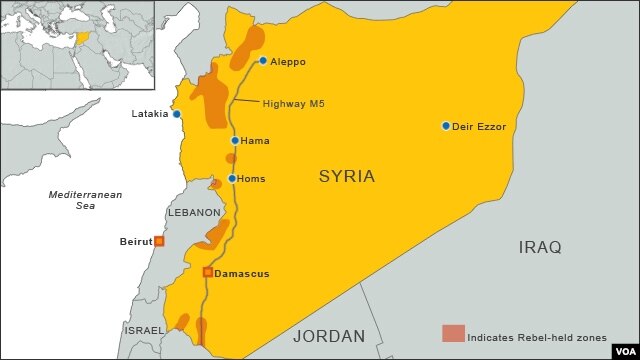
Holliday’s report provides a graphic look at the positions of rebel forces listing political and military structures of the opposition inside Syria, as well as the names of leaders and battalion strengths of military councils in Homs, Hama, Deraa and Idlib. A map identifies enclaves in rural areas within striking distance of all major cities along the Route M5 corridor that links all major inland population centers along a western corridor from Lebanon to Turkey, including Damascus, the capital, and the major commercial city of Aleppo.

Nerguizian said the Holliday report “is accurate to the point that you have an Assad regime which has largely failed in implementing a security response over the early months of 2012.” The regime tried to retake the rebel-held rural areas around Aleppo and Idlib, but “those have been largely unsuccessful efforts so far,” he said.

Many of the government advances were “short-term successes” in cities closer to Damascus such as Hama and Homs, Neeguizian said. He pointed to sizeable pockets of rebel autonomy in Idlib and on the Lebanese frontier that “reflect a decision by the Assad regime that it’s far more important to maintain support and over-watch in Damascus and… Aleppo.”

Riad Khawaji of the Institute for Near East and Gulf Military Analysis in Dubai believes the Holliday report is “a bit out-dated.”

“Most of the rural areas and especially the major urban centers of Idlib and Aleppo in the north are now under the control of the rebels,” Khawaji said. He added he had seen reports that FSA forces had taken control of two Syrian military airfields. Khawaji said Turkish jets that were scrambled recently along the Syrian border to prevent another downing of a Turkish jet by Syria have, in effect, created a no-fly zone that gives the rebels air cover for their advances in the north.

Looking for new leadership in Syria

“An alternative source of authority and security in Syria may be emerging,” writes Josh Landis, director of the Center for Middle East Studies at the University of Oklahoma and author of the Syria Comment blog. Following the Geneva agreement of last weekend, Landis speculates that, in time, the militias of the FSA that can effectively cooperate with the revolutionary councils and can deliver field successes “will rise to the top, pulling the smaller brigades into their ranks.”

Experts attribute the successes of the FSA and its array of militias to several factors: growing popular support among majority Sunnis who see no government reforms coming from Damascus; increasing defections from Assad’s forces to the anti-government militias; a government and national economy weakened by global sanctions; and increasing FSA access to better weapons and communications systems smuggled across the Turkish and Lebanese borders.

Despite the early summer stalemate, the regime refuses to order many battalions into action to reduce defections by predominantly Sunni divisions, said Khawaji. Instead, it seems to rely on four Alawite divisions of known loyalists, supplemented by intelligence services and non-uniformed militia knows as the shabiha.

“Today they are over-stretched and they focus on Damascus,” Khawaji said.

Provincial military councils of the FSA have also coordinated closely with the three major organizations of the civilian opposition within Syria, said Elizabeth O’Bagy of the Institute for the Study of War. In addition to staging the protests that sparked the revolution, revolutionary councils organized a number of general strikes in several cities. In her “Syria’s Political Struggle: Spring 2012” backgrounder,” O’Bagy describes a three-week commercial strike in May in Hamadiya, the major marketplace in central Damascus where 70 percent of the shops shut down.

“Even after government forces ordered the shops to open, about 50 percent of them remained shut” for the entire three-week period, O’Bagy said.

O’Bagy said rebels have created alternative civic institutions in areas they control. In the Homs and Idlib countrysides under militia control, she said, “they are training teachers for the upcoming school year, opening medical services, food and aid distribution, sending representatives to Turkey and Lebanon to solicit aid.”

Experts believe that cooperation between protesters and the FSA militias may eventually produce a new type of Syrian political leadership, one more promising than the mostly expatriate Syrian National Council which seems unable to garner the support of rebel forces and the political opposition inside the country.

Signs of strength within FSA forces and the revolutionary councils that drive the revolution do not, however, assure an end to the conflict any time soon. And a possible alternative political structure coming either from a power-sharing agreement crafted by the Action Group for Syria, or competition for power from within a successful rebel leadership would also not promise a quick end to the crisis either, experts say.

“We don’t talk in terms of an Arab Spring in Syria, anyway,” said Nerguizian. “It was always going to be a decade.”


Related Articles

Syrian Activist Says Top General Defects
Clinton: Russia, China Blocking Progress on Syria 'Intolerable'
Syrian Defection Prompts Calls for Sanctions
 

Housecarl

On TB every waking moment
For links see article source.....
Posted for fair use.....
http://www.voanews.com/content/dr-congo-rebels-take-town-near-uganda-border/1364255.html

DR Congo Rebels Take Town Near Uganda Border
July 06, 2012

A U.N. peacekeeper has been killed in the eastern Democratic Republic of Congo, where rebels fought government troops and seized a key border crossing Friday.

A spokesman for the U.N. mission in Congo says a peacekeeper from India was hit and killed during fighting in the town of Bunagana, which the rebels, known as M23, seized Friday morning.

Reports from the area say Bunagana's population has fled across the border to Uganda, along with about 600 Congolese soldiers.

The rebels seized a nearby village, Jomba, during fighting with government troops on Thursday.

Congo's government has tried for years to integrate various rebel groups into the army in hopes of calming the volatile eastern provinces.

Hundreds of soldiers mutinied against the government and formed M23 earlier this year, after complaining about their treatment in the army.

They are believed to be led by Bosco Ntaganda, a militia leader wanted by the International Criminal Court on war crimes charges.

Rwanda has denied charges, contained in a recent United Nations report, that it is providing material and financial support to the M23 movement. Last week, the United States called on Rwanda to end such support to the rebels.
 

Housecarl

On TB every waking moment
For links see article source....
Posted for fair use.....
http://www.voanews.com/content/mali-focus-of-west-african-leaders-meeting-ecowas/1364359.html

Mali Focus of West African Leaders' Meeting
VOA News
July 06, 2012

Several West African leaders meet Saturday to review the situation in Mali and discuss ways of retaking the north from Islamist militants.

Malian military officers and political parties have been invited to the meeting, hosted by regional bloc ECOWAS in Burkina Faso's capital, Ouagadougou.

ECOWAS director of external relations, Abdel Fatau Musah, said participants will discuss broadening the interim government in southern Mali to give it greater legitimacy.

Fatau Musah noted that the government will not include the Islamists in the north.

"ECOWAS has made it very clear that we are not going to negotiate with terrorist organizations," Fatau Musah said. "We are determined to flush them out of the northern part of Mali. The broad-based government we are talking about is basically to be anchored around the existing political parties, identifiable civil society organizations, and respected technocrats in the country."

ECOWAS has asked the United Nations to authorize a regional military force to fight the Islamists. The U.N. Security Council said this week it would consider the request but asked for more information about the mission's objectives and means.

A Malian army spokesman said that the army is "preparing to go north," but added that there was no specific date for when they would do so.

Mali's interim government was established soon after soldiers toppled President Amadou Toumani Toure in a March 22 coup. Tuareg separatists and Islamists seized control of northern Malian cities the following week.

The three major cities are now under control of the Islamists. Members of the militant group Ansar Dine drew international condemnation when they destroyed historic Muslim shines in the city of Timbuktu this week.

ECOWAS invited interim president Dioncounda Traore to come to Saturday's meeting, but Mali's communications ministry said Friday that Traore will not attend.

Traore has not returned to Mali since going to Paris for medical treatment following an attack by a pro-military junta mob in May.

Some information for this report was provided by AP, AFP and Reuters.

Related Articles

Malian Army Says Mission is to Fight Northern Rebels
ECOWAS Seeks Broad-based Malian Interim Government
UN Security Council Delays Decision on Mali Force
 

Housecarl

On TB every waking moment
For links see article source.....
Posted for fair use.....
http://www.voanews.com/content/clin...ng-progress-on-syria-intolerable/1364246.html

Clinton: Russia, China Blocking Progress on Syria 'Intolerable'

Comment (10)
Scott Stearns
July 06, 2012

PARIS — U.S. Secretary of State Hillary Clinton says it is "intolerable" that Russia and China continue to block a peaceful resolution of the crisis in Syria by backing President Bashar al-Assad. Secretary Clinton told a Paris meeting of governments supporting Assad opponents that the United Nations should impose economic sanctions against Damascus.

Secretary Clinton says it is not enough for the so-called Friends of the Syrian People to support Assad opponents when Russia and China are "holding up progress."

"I ask you to reach out to Russia and China and to not only urge, but demand that they get off the sidelines and begin to support the legitimate aspirations of the Syrian people," Clinton said. "It is frankly not enough just to come to the Friends of the Syrian People because I will tell you very frankly, I don't think Russia and China believe they are paying any price at all, nothing at all, for standing up on behalf of the Assad regime."

Russia and China have repeatedly vetoed tougher U.N. Security Council action against Syria. But they have agreed to the authority of an eventual transitional governing body for the country, something that Secretary Clinton says should be part of a new resolution demanding implementation of a U.N./Arab League peace plan.

"We now have them on record supporting a transition," Clinton added. "And we should go back and ask for a resolution in the Security Council that imposes real and immediate consequences for non-compliance, including sanctions under Chapter 7."

Senior U.S. officials traveling with Secretary Clinton say that Chapter 7 resolution will not include U.N. troops, but will focus instead on unified international economic sanctions. Past enthusiasm for a weapons embargo is waning amid questions about enforcing compliance by Russian and Iran as well as concern about its potential impact on the armed opposition.

Russia and China are not part of these talks in Paris, which include representatives from nearly 100 countries, including some 40 foreign ministers.

Since Russia and China agreed to the authorities of a transitional government at a meeting in Geneva last week, there have been conflicting interpretations about whether that deal means President Assad must give up power.

Russian Foreign Minister Sergei Lavrov says the Geneva agreement imposes nothing on the Syrian people as it puts no preconditions on national dialogue and excludes no one from the process.

Speaking in Paris Friday, Turkish Foreign Minister Ahmet Davutoglu said President Assad and some of the countries who met in Geneva are mistakenly interpreting his future.

"Transition involves change," said Davutoglu. "Why do we need a transition government? We need a transition government because the existing government is not legitimate, is not efficient to control the country and to lead a transitional process."

Davutoglu says delaying the process increases the danger and allows the Assad government to kill more people.

The United Nations says there are more than one million Syrians in need of urgent humanitarian assistance. Reading a statement from U.N. Secretary General Ban Ki-moon, assistant secretary general for political affairs Oscar Fernandez-Taranco says the Syrian conflict is at a critical stage.

"Killings, abductions, and kidnappings have also become increasingly inter-communal, threatening to erode the very fabric of Syrian society," noted Fernandez-Taranco. "A sectarian civil war in Syria would be devastating for Syria and for the region."

The head of the U.N. monitoring mission in Syria, Major General Robert Mood, says violence has reached "unprecedented" levels and there must a cease-fire before unarmed observer teams can resume their mission.
 

Housecarl

On TB every waking moment
For links see article source.....
Posted for fair use......
http://www.voanews.com/content/mexico-presidential-vote-recount-shows-pena-nieto-win/1364208.html

Mexico Presidential Vote Recount Shows Pena Nieto Win
VOA News
July 06, 2012

Results from an official vote recount in Mexico are confirming a presidential election victory for Enrique Pena Nieto, but his rival still refuses to concede because of allegations of fraud.

With over 99 percent of the votes tallied late Thursday, Pena Nieto, of the Institutional Revolutionary Party (PRI), held a nearly seven point lead over leftist Andres Manual Lopez Obrador.

The figures, which included a recount of nearly half of Mexico's ballot boxes, were largely unchanged from the initial results of Sunday's election. If confirmed, the results would set up a return to power for the PRI, which ruled the country for seven decades until 2000.

But Lopez Obrador, who wanted a full recount, continues to accuse the PRI of vote buying and coercion. He gave a press conference Thursday in front of a wall of gift cards he says were given to voters before Sunday's balloting.

"They are giving cash, basic food items, construction materials, electric household items," said Lopez Obrador. "All of this was part of a well-designed and deliberate operation, a dishonest, anti-democratic buying of votes."

In 2006, Lopez Obrador demanded a recount after losing the presidency to Felipe Calderon by slightly more than half a percentage point. His requests were refused, triggering protests by the candidate's supporters that choked Mexico City for weeks.

Lopez Obrador's latest accusations were fueled by scenes of thousands of people rushing to grocery stores to redeem pre-paid gift cards they said the PRI had given them ahead of the vote. Several recipients told reporters they had been told to bring a photocopy of their voter identification card in order to receive the gift certificates.

The PRI has denied any irregularities and has threatened to open an investigation into what it says are false accusations.

The apparent third-place finisher, Josefina Vazquez Mota of the ruling conservative National Action Party, also says campaign spending violations had marred the vote, but she did not challenge the legitimacy of the outcome.
 

Housecarl

On TB every waking moment
For links see article source.....
Posted for fair use.....
http://www.moneycontrol.com/news/wo...negotiate-policies-not-targets-pm_727158.html

Greece wants to renegotiate policies, not targets: PM

Published on Sat, Jul 07, 2012 at 11:30 | Source : Reuters
Updated at Sat, Jul 07, 2012 at 12:07

Greece will meet targets set by international lenders, but needs more time and wants to renegotiate policies that make its fiscal situation worse by preventing a return to economic growth, Prime Minister Antonis Samaras said on Friday.

In his first policy speech since taking office, Samaras outlined his government's priorities before a confidence vote on Sunday. Samaras said his aim was not to demand a change of the goals set in the 130 billion euro bailout deal keeping Greece afloat, but in the austerity policies imposed to meet them.

"We don't want to change the targets," Samaras told parliament. "What needs to change is that which is hampering us from attaining the targets. We want to fight the recession."

The ruling coalition of Samaras's centre-right New Democracy party and two centre-left groups which emerged after June 17 elections wants to change austerity measures that have hit the poor hardest and stifled an economy shrinking for a fifth year.

Samaras, who was laid low by eye surgery days after being named prime minister, conceded that Greece had missed targets included in its bailout programme but promised to do everything to keep the country in the euro.

He outlined an agenda of growth-boosting measures - ranging from speeding up privatisations to tax reform and battling bureaucracy to making the country investment-friendly.

But he lashed out at euro zone partners who have openly said Greece risks leaving the euro if it fails to keep its pledges, saying it was difficult to move ahead with privatisations while foreign leaders publicly discuss such options.

"We can't have foreign officials speaking publicly about Greece returning to the drachma," he said. "They can't undermine what we are trying to achieve.... This must stop."

Greece, which is due to run out of cash in weeks without support from the troika of EU, International Monetary Fund and European Central Bank lenders, has fallen behind agreed targets partly due to a two-month political limbo of repeat elections.

It was due to come up with an additional 11.7 billion euros of cuts in June to merit the next loan instalment.

Need more time

Samaras said it was clear fiscal adjustment would take more than two years, as initially agreed with lenders, repeating a pre-election call to lessen the pain of austerity by getting the troika to extend the period to four years.

"The adjustment must not take place over two years, but longer. And the programme misses its targets because of the recession, this is no reason to take more fiscal measures as we have done so far. Recession must be stopped, not continuously deepen," he said.

"With this uncontrolled recession, the programme's funding needs are rising. We want this to stop and to start getting out of this dead end," he said. "This is the subject of our 'renegotiation'."

European leaders have made clear there is little room to manoeuvre and Greece must catch up with lost time on its commitments if it is to receive any more cash. A total of 240 billion euros have been pledged to Greece so far in a rescue effort aimed at stopping its debt crisis from spreading to the rest of the euro zone.

Samaras's conservative government has stumbled off to a rocky start, with its initial pick for finance minister resigning over health problems and the prime minister himself unable to travel to an EU summit because of his eye surgery.

On Thursday he met top officials from the troika, on their first meet-and-greet visit since the new government emerged. Government officials said the talks focused on where Greece had fallen behind and what areas needed quick implementation.

Finance Minister Yannis Stournaras, who also met the troika, said the officials told him he faced a tough time at a meeting with euro zone counterparts on Monday.

Government officials said the top priority was to convince partners Greece now had a government that was determined to take on the huge task, regain credibility and then start discussing changing parts of the deal.

Opposition parties criticised the government for not pushing for an immediate renegotiation of the bailout.

"They promised the Greek people a renegotiation but they are promoting a tough implementation of the bailout instead," the main opposition radical leftist Syriza party's spokesman Dimitris Papadimoulis said in a statement.
 

Housecarl

On TB every waking moment
For links see article source....
Posted for fair use.....
http://www.focus-fen.net/index.php?id=n282468

Greece's illegal economy at 24% of GDP
07 July 2012 | 07:50 | FOCUS News Agency
Home / Southeast Europe and Balkans

Athens. The shadow economy in Greece accounted for an estimated EUR 52.2 billion last year, according to a European Commission report published this week, Greek eKathimerini writes.

Greece therefore ranks fourth among the 17 eurozone members in terms of the size of each country’s illegal economy, and ninth in the whole of the 27-member European Union. It is also rock bottom in the collection of value-added tax revenues, according to 2010 data.

The country’s black market amounts to 24.3 percent of its gross domestic product, while Austria is the country with the smallest illegal economy, estimated at just 7.9 percent.

This statistics show that despite the efforts to combat tax evasion, the problem remains as serious as ever in Greece, at a time when the country desperately needs to reduce its illegal economy so as to bolster public revenues and lighten its austerity program.

Meanwhile, along with three other EU states, Greece failed to submit data regarding the cost of its tax collection mechanism.
 

Housecarl

On TB every waking moment
For links see article source....
Posted for fair use....
http://au.news.yahoo.com/world/a/-/world/14157560/romania-lawmakers-vote-to-impeach-president/

Romania lawmakers vote to impeach president
AFP Updated July 7, 2012, 4:01 pm

BUCHAREST (AFP) - Romania's parliament has voted to impeach President Traian Basescu in a spiralling political crisis, with the US warning that the EU country's democracy is under threat.

A total of 256 lawmakers out of 432 voted on Friday in favour of the move against the centre-right Basescu, according to an official count, and he could be definitively ousted from power after a national referendum to be held within 30 days.

In the meantime Crin Antonescu, 52, of the ruling Liberal Social Union (USL) has been appointed interim president.

The bitter feud between Basescu and his arch-rival, the centre-left Prime Minister Victor Ponta, 39, has thrown Romania into its worst crisis since it emerged from communist dictatorship just over two decades ago.

This week, Ponta's USL coalition fired the speakers of both houses of parliament and the ombudsman and threatened to sack judges of the Constitutional Court, the nation's highest court.

The United States led Western concern that Ponta's coalition government, which took office only in May, has been eroding democratic checks and balances in its campaign to oust the 60-year-old Basescu, who first took office in 2004.

"We are concerned about recent developments occurring in Romania, our NATO ally and partner, which threaten democratic checks and balances and weaken independent institutions, such as the courts," State Department spokeswoman Victoria Nuland said in a statement.

"As the government contemplates the serious step of removing Romania's head of state, we urge that the process be conducted in a fully fair and transparent manner, with scrupulous respect for the rule of law and democratic ideals," Nuland said.

"The United States stands with our EU partners and urges that Romania uphold and protect the common values and principles that unite the European and trans-Atlantic community of nations," she added.

The European Union as well as France, Germany, the Council of Europe and several rights groups, including Freedom House and the Helsinki Committee, also expressed concern at events in Romania.

"The rule of law, the democratic checks and balances and the independence of the judiciary are cornerstones of the European democracy and indispensable for mutual trust within the European Union," warned the European Commission.

The turmoil comes only days after a scandal involving Ponta who was found to have plagiarised parts of his PhD thesis.

It also follows a bitter feud between the premier and the president over which one should represent Romania at European summits.

In a sign of the heightened political tensions, Ponta said after the vote Friday that "my family, my children have been threatened". He added that he had asked for help from the authorities and did not feel in danger.

The political crisis in one of Europe's poorest countries has seen the the currency nosedive in recent days.

Ponta has sought to allay Western fears over the health of its democracy, pledging to visit Brussels next week to "give assurances" to the bloc which Romania joined in 2007 under Basescu.

Lawmakers in the early evening voted to impeach Basescu, a former sea captain, over claims he improperly assumed the powers of the prime minister when he announced drastic austerity cuts in 2010.

At that time Romania, badly hit by recession, agreed to tough belt-tightening including public sector wage and benefit cuts in return for a multi-billion-dollar bailout from the European Union and IMF.

In parliament ahead of the Friday's impeachment vote, Basescu rejected the charges and said the campaign against him had violated the rule of law and put at risk "the stability and reputation of the country".

Ponta, a lawyer, and the new interim president Antonescu, a historian and former museum curator, first joined forces in 2011, when some commentators likened their alliance to that between a camel and an ostrich, a Romanian byword for "improbable".

Ponta's cabinet sparked widespread concern with a decree Wednesday barring the Constitutional Court from ruling on parliamentary decisions -- removing what could have been an obstacle to Basescu's impeachment.

The court in a rare statement this week complained of "virulent attacks" against some of its judges whom the government was threatening to sack.

The government withdrew its complaints against the judges but then adopted an emergency order curbing the court's powers.

Other controversial moves have included sacking the opposition speakers of both houses of parliament and replacing the ombudsman -- who has the sole power to contest decrees and emergency orders -- with a USL member.

The Constitutional Court judged Friday that Basescu had indeed committed some breaches of his prerogatives but no violations of the constitution.

Germany has voiced "deep concern" over the developments, saying the Constitutional Court's "independence and ability to take action must not be questioned".

Chancellor Angela Merkel's spokesman Steffen Seibert said Berlin would "closely consult" with its EU partners on Romania's bid for full membership of the visa-free Schengen zone, which is up for review in September.
 

Housecarl

On TB every waking moment
China - Argentina Military Deal
Started by mzkitty‎, Yesterday 12:14 PM
http://www.timebomb2000.com/vb/showthread.php?408199-China-Argentina-Military-Deal
____

Dutch posted this piece in last week's thread but not all of it so I'm reposting it here...Housecarl

For links see article source....
Posted for fair use.....
http://www.washingtontimes.com/news...pons-on-americas-doorstep/?page=all#pagebreak

HUMIRE: Iranian weapons on America’s doorstep
Ahmadinejad pursues joint military ventures in Latin America
By Joseph M. Humire - The Washington Times
Wednesday, July 4, 2012

While many of the world’s leaders traveled to a Mexican seaside resort in Los Cabos for the annual Group of 20 meeting a couple weeks ago, Iranian President Mahmoud Ahmadinejad traveled a little farther south, to Rio de Janeiro, for another meeting of world leaders - the Rio+20 United Nations Conference on Sustainable Development. This was Mr. Ahmadinejad’s sixth visit to Latin America since 2007 and his second this year.

In addition to Brazil, Mr. Ahmadinejad visited President Evo Morales in Bolivia and took time to stop by Venezuela to confer with his ideological bedfellow, Hugo Chavez, rounding up a three-nation tour of South America before heading back to Tehran on June 22.

On the surface, these visits produce press releases filled with pledges of solidarity, and the occasional signing of commercial agreements, but once the pageantry is over, such commercial agreements rarely materialize and the pledges of solidarity are revealed as little more than political posturing. All these unfulfilled promises and the lack of voluminous trade or business leave one to wonder what really lies beneath the surface in Iran’s foray into Latin America.

While we can only speculate as to what goes on behind closed doors, recent reports shed light on some of the more nefarious dealings regarding the military-to-military exchange between the aforementioned countries.

A few days before Mr. Ahmadinejad’s visit, Venezuela’s ailing President Chavez unveiled the newest addition to his military arsenal: unmanned aerial vehicles, or UAVs. These Iranian-designed, Venezuelan-built drones were reported on earlier this year by the head of U.S. Southern Command, Air ForceGen. Douglas Fraser, who stated that they were of “fairly limited capacity” and most likely were to be used for “internal defense.” Perhaps Gen. Fraser is right, but a Spanish media outlet recently reported that the drones could be a cover for a more threatening program in Venezuela, one that involves missile engineers and front companies that are part of Iran’s missile and weapons-of-mass-destruction (WMD) programs.

One such company is Kimia Sanaat, an alias for the Iranian firm Qods Aviation (or Aeronautics) Industries. Kimia Sanaat is sanctioned by the United Nations for its involvement in Iran’s missile and WMD programs. However, this has not stopped it from doing business in Venezuela, as it is suspected of being involved in shipping more than 70 containers to a joint Iran-Venezuela auto manufacturer, Venirauto, located in Maracay, Venezuela. Known locally as a military-industrial hub, Maracay also is home of the joint Iran-Venezuela UAV program, located just a few miles from Venirauto.

In January 2011, another military site in Maracay went up in flames when an unusual explosion rocked the city and damaged the UAV facilities. This explosion was more characteristic of a blast that might have happened in the petrochemical town of Moron, less than 100 miles away. In fact, it is in Moron that Iran is helping build various chemical plants alongside CAVIM, the industrial arm of Venezuela’s armed forces.

Suspected of being involved in these joint chemical projects is the notorious Iranian front company Parchin Chemical Industries (PCI). PCI is a subsidiary of the Defense Industries Organization, a branch of the Iranian Ministry of Defense Armed Forces Logistics (MODAFL), all entities heavily sanctioned by the international community for aiding and abetting Iran’s missile and WMD programs.

This might explain why Venezuela and Iran set up a weekly Caracas -Tehran flight operated jointly by Conviasa, Venezuela’s national airline, and Iran Air, Iran’s state airline. This also might offer some insight into what Mr. Ahmadinejad and Mr. Chavez discussed in their closed-door meetings a couple weeks ago.

This Caracas-Tehran flight, dubbed “Aero-Terror” by Western intelligence agencies, is rumored possibly to extend to Santa Cruz, Bolivia, in the near future, coincidentally just a few miles away from another joint military venture, the Iran-sponsored Regional Defense School of the Bolivarian Alliance for the Americas (or ALBA), a 1 1/4-acre facility located in Warnes, Bolivia, (approximately eight miles from Santa Cruz) that was inaugurated last year with the attendance of Iranian Defense Minister Ahmad Vahidi.

Just last week, a prominent Spanish newspaper reported that there are no fewer than 145 credentialed Iranian diplomats living and operating in Bolivia, some of whom are trainers from the feared Revolutionary Guards of Iran. Moreover, the Simon Wiesenthal Center recently denounced the presence of this regional defense school before the Organization of American States (OAS) in Washington and urged that multinational body to initiate an investigation of the school.

If that is done, the investigators would have to dig beneath the surface because the school has been dormant since its inauguration, which suggests that its presence may have more than one purpose. The acquisition by Iran of dual-use minerals from resource-rich Bolivia, such as tantalum and lithium, is perhaps a clue. Both minerals have military-grade missile applications.

Because of Mr. Chavez’s deteriorating health and the political instability within Venezuela, Iran could be in a holding pattern as it calculates the implications of a power shift within the regime of its closest ally - an ally that has served so far as Iran’s gateway to the region.

With all these military ventures in play, Mr. Ahmadinejad well may have used his most recent trip to assess what Latin America would look like in a post-Chavez world. In such a case, Iran definitely would want to woo Brazil into a similar military orbit, a feat the largest and most economically powerful country in the region has resisted thus far. Given the likelihood of this happening, it is safe to assume that Iran is not hedging its bets and is continuing to work with Venezuela, Bolivia and the rest of its ALBA allies - countries that have been willing to roll out the diplomatic red carpet.

In the wake of Mr. Ahmadinejad’s meetings in South America, we already know that a new confidential military agreement was signed with Bolivia to add to the several secret military agreements on the books with Venezuela.

The truth is that very little is known about the military-to-military cooperation between Iran and several Latin American countries. However, on the surface, Iran, Venezuela and Bolivia will acknowledge only the joint military activities they want us to know about, such as UAVs and regional defense schools. Nevertheless, as more information comes to light, we must scratch beneath the surface and examine the more troubling military activity in the region - activity that can be a game-changer if Iran is able to develop missile-strike capability from Latin America.

Joseph M. Humire is a consultant with the Cordoba Group International LLC and the executive director of the Center for a Secure Free Society.

____

For links see article source....
Posted for fair use.....
http://lewis.armscontrolwonk.com/archive/4462/iran-venezuela-explosives-cooperation

Iran-Venezuela Explosives Cooperation

By Jeffrey | 21 June 2012 | 7 Comments

Yesterday, I blogged about a pair of Spanish-language news stories that provide new details about Iran’s export of Unmanned Aerial Vehicles (UAVs) to Venezuela. One of the minor details relates to cooperation between the two countries as it relates to explosives. ABC.es reported that Iran had set up an explosives factory with the assistance of a company that made fuel for Iran’s rocket program.

I think the rocket-fuel claim is a bit of a stretch, but there is some explosives cooperation, which is sort of fascinating in and of itself.

1.

Venezuelan President Hugo Chavez, when Iranian President Mahmoud Ahmadinejad visited in September 2006, announced that Iran would help Venezuela build an explosives factory. The wire stories make only brief references to the facility, but Iran and Venezuela signed 29 accords, 5 MOUs, and a Joint Statement — so none of the agreements are mentioned in more than passing.

Yesterday, I mentioned a series of leaked State Department cables (not work safe) about an impending transfer of UAVs from Iran to Venezuela. The cable also described a January 2009 shipment, interdicted in Turkey, of drums of nitrate and sulphite chemicals and dismantled laboratory instruments to Venezuela from Iran. That interdiction was widely reported at the time, which would seem to confirm that Iran and Venezuela had begun to make good on any September 2006 agreement.

The ABC.es story makes clear that the destination would have been CAVIM’s facility near Morón.

2.

CAVIM’s facility near Morón, which is a German-designed facility for handling explosives, is in fact the obvious candidate for an Iranian explosives facility.

That facility is located at: 10°30’24.00″N, 68°12’11.00″W. I assess the location with high confidence. CAVIM’s website has a large number of ground-truth photographs of the facility, including the entrance, the nitric-acid plant, and the explosives-testing area.

The entrance (left image) is a dead ringer (notice the little green sign? That’s a signature of the facility) for the sign at: 10°30’5.96″N, 68°11’41.82″W. The two tall structures at the nitric-acid plant (middle image) appear only as shadows in the satellite images available in Google Earth. (The image in Bing is not better.) Still, the tanks and buildings at 10°30’49.03″N, 68°12’25.21″W match up and there is no ground-truth image that would exclude the site. There is even a nice clearing at 10°30’39.41″N, 68°13’6.76″W in which to blow things up (right image).

What clinched it for me was this description of the location of the facility:

En las instalaciones de Compañía Anónima Venezolana de Industrias Militares en Morón, se elaboran productos químicos y explosivos que son destinados en 98% a la industria nacional y el restante 2% para la militar. Se trata de una enorme instalación militar con siete plantas topográficamente localizadas entre montañas y cerros que sirven de protección y seguridad a sus trabajadores. Su diseño fue realizado con asesoría alemana.

Cavim surgió de la fusión de las instalaciones del antiguo Instituto Venezolano de Petroquímica y el Ministerio de la Defensa. Aún una de sus estructuras está ubicada en las adyacencias del Complejo Pequiven-Morón, cercano también a las empresas Tripoliven y Ferralca.

Allí funcionan las plantas de artificios militares, de agentes de voladura, nitrocelulosa, ácido nítrico, Ansol, servicios básicos, Anfo y Anfoal, según indicó una fuente cercana a la empresa que está ubicada en el kilómetro 1 la carretera Morón-Coro, entrando a la avenida Falcón, en la zona de El Jabillo.

Obviously, the statement that it looks like an explosives handling facility, with buildings separated by hills and mountains, eliminates anything else in the vicinity. So does the description of the location, which notes that it is adjacent to the Pequiven-Morón complex. (Indeed, it was once part of the complex, along with the two industrial enterprises mentioned, Tripoliven and Ferralca.) There are plenty of old maps showing Pequiven-Morón.

Finally, the description resolved the one thing that was holding me back — although the address is listed as 1 Carretera Morón-Coro, the actual entrance is off Avenida Falcon, just before it feeds on to Cr. Morón-Coro. The explanation that the entrance is at the conjunction of the two roads excludes any other facility.

After I went through all this, the municipal website posted a photo and location marker titled “Entrada a Cavim y paso de los rieles.” Now you tell me!

This is probably where those explosives interdicted in Turkey were headed.

3.

There is also some evidence that CAVIM has been involved in explosives exports to Iran. Yep, Venezuela exported explosives to Iran in 2010.

Venezuelan newspaper El Nacional reported that, based on customs data, Venezuela had exported a significant amount of explosives in 2010. I used my schoolboy español to go through the Venezuelan export statistics — it turns out it was 4,556 kilograms of explosives worth $376,527 (1,615,299 in Venezuelan Bolivars). There is so little Iran-Venezuela trade, it was pretty easy to cross-compare codes. I knew that 73 percent of non-oil trade in 2010 was explosives. So I just looked for a ~$375,000 entry in the right customs category, and there it was.

The customs data also included the port of exit, which was very, very interesting.

(A few time-savers if you try this at home: the site doesn’t like Firefox and Iran is filed under R — for the “Republica Islamica de Iran.”)

4.

Another report on the explosives shipment, by Reportero24, used Foreign Ministry documents to indicate that CAVIM used a rather infamous Caracas-Damascus-Tehran flight to export the explosives.

“Oh, come on,” I thought.

Conviasa, Venezuela’s state airline, ran a code share with Iran Air that stopped over in Damascus from 2007-2010. (A direct flight from Caracas to Damascus resumed shortly after the end of the Iran Air code-share.)

The Conviasa-Iran Air code share made people crazy. El Pais wrote the least alarmist narrative, raising concerns about how terrorists might use the flight, after the US picked up one unsavory fellow trying to get to Caracas to make his connection to Tehran. The State Department observed that “Passengers on these flights were reportedly subject to only cursory immigration and customs controls at Simon Bolivar International Airport in Caracas.” Fox News decided to play it classy, going with “Terror Flight.”

Aviation enthusiasts, by the way, provide at least three trip reports on what the flight was like (1, 2, and 3). The best part about the pictures are the passengers giving the photographer the “stink eye” for taking pictures.

Man, it takes real stones to snap pictures on the Caracas-to-Tehran flight.

The port of exit for the explosives was Maiquetia, which is the Simon Bolivar International Airport in Caracas. Well.

The Reportero24 story, by the way, was based on a document recording meetings that the Foreign Ministry submitted to the National Assembly. I didn’t understand why CAVIM would be involving the Foreign Ministry in this effort, until I noticed another little detail reported by El Pais — there was no cargo agreement for the CONVIASA flight, so anything more than baggage traveled as diplomatic pouch. Hence the need to talk to the Foreign Ministry.

Now, I still don’t know why Venezuela declared the value of the export nor why Iran was interested in importing CAVIM’s products.

But one thing I do know: I would have no interest in taking a Caracas-Damascus/Tehran flight laden with explosives.

4.

Because the crates were labeled as “tractor parts,” suspicion has focused not on the explosives facility near Morón, but on a tractor factory near Ciudad Bolivar.

Conspiracy theories abound concerning an Iranian-Venezuela joint venture to manufacture tractors. I wasted more time on this stupid tractor factory than just about anything else. Roger Noriega, in a piece that really should shame the editors at Foreign Policy entitled Chávez’s Secret Nuclear Program, neatly presents the theory that something nefarious is afoot:

Operated since 2006 by a Venezuela-Iran joint venture, the facility produces few tractors and is housed in a military-style compound protected by Venezuelan National Guard troops, according to two eyewitnesses who have visited and videotaped the facility in recent years. Deep suspicions about the actual purpose of that facility were raised in December 2008 when Turkish customs authorities intercepted a shipment sent from Iran to the “tractor factory” in Venezuela.

According to the media reports regarding the 2009 interdiction in Turkey, drums of nitrate and sulphite chemicals and dismantled laboratory instruments were labeled as “tractor parts.” A lot of anti-Chavez sites, thinking they were putting 2 and 2 together, started pointing at the tractor factory like it was the end of the world.

I actually think it’s a tractor factory. Here is an overhead.

The overhead image is from 2003, which predates the agreement to start the joint venture by Khatami and Chavez in 2005. (The facility is apparently named after Khatami.) Veniran took over the facility from a defunct tractor manufacturer called Fanatractor. Still, looking at an exterior shot of the building, I am tentatively able to conclude that it is the correct location.

Obviously the tractor/flag display is of post-2005 vintage, but the shape of the building (dog-legged), location of the parking lot, and road configuration (s-curve) are all consistent with the overhead image from 2003. And the size of the building matches the description of the old Fanatractor facility, as having 20,360 square meters of covered area, including the main assembly hall and a 2,500 square meter administration building.

Also on the side of the “tractor factory” hypothesis, there are a bunch of pictures from inside the factory showing tractor assembly. There also seems to be some indication of labor strife, which strikes me as unlikely for a secret military installation. (Apparently, the Iranians are not progressive employers.)

Continued.....
 

Housecarl

On TB every waking moment
Continued.....

On the other side of the ledger, Noriega claimed the factory produces “few” tractors and is a “military style compound.” I am not so sure about either claim. The Venezuelan government claims they have assembled 7,500 tractors since 2005, which is well below the original target of 5,000 a year, but hardly a null result. (“Hey, watch where you go with that tractor, compadre, I am trying to mix up some explosives here!”)

The site does not, actually, look like a military-style compound for handling explosives, especially when compared to the CAVIM Morón site which is, you know, a military-style compound for handling explosives.

If Roger Noriega showed up at the VENIRAN site demanding the see the nuclear reactor or explosives laboratory, I am sure security would escort him away — but that doesn’t really tell us anything interesting. If Roger Noriega showed up in my office demanding to see either one, I would call security too.

On the whole, it just looks like an inefficient tractor factory that does a lot of kit assembly of Iranian parts. That’s pathetic, but not particularly siniestro.

The fact that Turkish officials claim the explosives shipment was listed on the manifest as “tractor parts” is an insufficient basis on which to conclude that the parts were bound for VENIRAN, let alone this specific facility. Indeed, were there evidence that VENIRAN was engaged in armaments trade in violation of UNSC 1747, I would have expected it to be sanctioned along with CAVIM and PDSVA. It was not.

If I had to make a guess, the “tractor factory” claim is a red herring.

Not that Chavez doesn’t delight in this. Two reporters in the Guardian described the purpose of the tractor factory rather wittily, noting the facility was “designed to produce three things: tractors, influence, and angst.” (I sometimes see this quote attributed to Fars News, or a “Farsi News Agency,” but I have never seen that attribution accompanied with a citation.)

Mission accomplished.

Update | 2:22 pm

The link showing the little green signs all over the CAVIM facility at Morón is dead, leaving me to wonder if I still have the images saved some place. I’ll keep looking.

In the course of looking around, I discovered that a reporter for Univision, Casto Ocando, posted two images of documents he claims are related to the construction of an Iranian gunpowder factory at Morón, including a document from Parchin Chemical Industries (PCI), a listed entity under UNSC 1737.

Twitter
Facebook
7

_____

For links see article source.....
Posted for fair use......
http://lewis.armscontrolwonk.com/archive/5390/venezuela-iran-uavs

For links see article source.....
Posted for fair use......
http://lewis.armscontrolwonk.com/archive/5390/venezuela-iran-uavs

Venezuela-Iran UAVs
By Jeffrey | 20 June 2012 | 13 Comments

Remember how I had that massive series of Venezuela-Iran posts all queued up? Well, this is convenient.

There are two separate stories in Spanish-language media based on leaks from the United States providing lots of gory details about Iran-Venezuela cooperation on Unmanned Aerial Vehicles (UAVs).

Here is what happened: Conservative Spanish news outlet ABC.es (not to be confused with the American Broadcasting Company) reported that the New York Attorney General is investigating the sale of UAVs from Iran to Venezuela.

The Attorney General of New York? As best I can make out with my schoolboy Spanish, the US is interested in a pair of financial transactions. Compañía Anónima Venezolana de Industrias Militares (CAVIM) — Venezuela’s state-controlled defense firm — paid $28 million to Iran’s Aerospace Industries Organizations (AIO) through a bank in Frankfurt. The Iranians kicked back $2.8 million to a Venezuelan company called COMARVEN, which purportedly constructed two hangers and control center somewhere near the Venezuelan city of Maracay. The documents also indicate, according to ABC.es, some sort of shipment to CAVIM from Kimia Sanaat, a front-company for a sanctioned entity, that previously attempted to procure sensitive items in Germany for Iran’s UAV program (Wikileaks cable).

There are some questions about the remaining $25 million, given the small number (6-12) of UAVs. Did Venezuela buy something else? The sources seem to imply that perhaps the contract was for more than UAVs, based on the funds and the large number (70) of shipping containers on site. ABC.es mentions an Iranian side project of restricted access. More on that thought at the end.

El Nuevo Herald — the Miami Herald’s Spanish-language sister publication — received a second leak, presumably of the same documents. (The story references a Venzuelan subcontractor, presumably COMARVEN.) El Nuevo Herald emphasized different details — focusing on an Iranian national, Ramin Keshavarz, who purportedly manages the Venezuelan UAV effort. El Nuevo Herald, too, quotes a “source” referring to “other teams” of Iranians entering the country. El Nuevo Herald also published four interesting images.

As a result of the media coverage, Chavez confirmed the UAV program and arranged for CAVIM to host a little dog-and-pony show in Maracay (video above).

The flood of little details are very helpful in filling out a picture of Iran’s activities in Venezuela, starting with Maracay.

1.

CAVIM Maracay

CAVIM has two major industrial facilities — one for metalworking (small arms, ammunition and so on) at Maracay and the other for chemicals and explosives at Morón. (We’ll probably talk about Morón tomorrow.)

Of the two, Maracay is the likely location for the UAVs, given the type of enterprises located there and the fact that Maracay is the “cradle of Venezuelan aviation.”

In January 2011, several CAVIM ammunition depots in Maracay caught fire and exploded in the middle of the night. The next day, Hugo Chavez called the fire “strange,” then explained “It’s the least that I can say about a fire that takes place at 4 am.”

The explosion was awfully useful to pinpoint the CAVIM site at Maracay. Javier Serrat, our Scoville Fellow, and I spent an afternoon playing around with this. I triangulated CAVIM’s Maracay location in Google Earth using the line of site in these three videos: One looking over the Coliseo de Limón, another looking over three towers, and a third from a nearby neighborhood.

Maracay, which hosts neighboring arsenals for CAVIM and the Venezuelan military, sticks out like a sore thumb with pretty classic military signatures (backed against a mountain, tunneling, sports fields, and so on.) It even has the requisite signage on the entrance to the arsenal (below left) and CAVIM logo on the hillside (below right).

Once I located the site, I was able to use aerial video released by Venezuelan TV to survey the damage. There is a particularly nice aerial shot from a helicopter that, when integrated with Google Earth, makes lots of things clear. One thing that jumped out in the line-of-sight footage, especially over the Coliseo de Limón, was that there seemed to be two fires, marked in Areas 1 and 2.

As far as I can tell, the fire started in Area 2 — officials said the fire started in “sector D of the old arsenal” which was located “between” the Arsenal and CAVIM. That describes Area 2. (CAVIM occupies the western portion of the facility, while the military is located along the road that runs up the east side of the site.)

The four contiguous structures in Area 2 are completely obliterated in the helicopter footage, with the two structures to west looking severely damaged by a blast (notice how the damage is concentrated on the side that used to face the other, now destroyed buildings). When you watch the arsenal explode on YouTube (for example at 1:20 in this clip), it isn’t hard to believe that virtually nothing of the structures where the fire started survived.

Officials have also said that the fire started in depot B-11, ultimately consuming depots B-12, B-13, and 14. That also sounds like the four contiguous buildings in Area 2 to me, but I could be wrong.

Area 1 is about 500 meters from Area 2, but it is possible that ejecta from the initial fire fell on Area 1, initiating a second blaze. Officials found debris as much as a kilometer from the explosions. One woman was killed by shrapnel. According to one report, she lived on Avenida Una, which is at least 800 m from from Area 2 of the buildings that exploded. It seems strange to me that the warehouses in between did not catch fire, but perhaps they were empty.

I had initially thought that two fires might suggest deliberate sabotage, but the clips of debris falling all over Maracay clearly demonstrate the plausibility of secondary fires resulting from the first. Really, I am sort of surprised that even more buildings weren’t damaged.

Chavez strongly implied foreign sabotage, presumably by the United States. Some Chavez critics have suggested the explosion was to cover up the transfer of munutions to FARC before an audit of the arsenal. (FARC does appears to have acquired weapons from the arsenal at Maracay. In 2001, a demobilized FARC fighter told Andy Webb-Vidal in Jane’s Intelligence Review that rifles and other equipment came from a “supplier” in Maracay. One possible explanation of “supplier” is suggested by a July 2009 police raid in Mario Briceño Iragorry, which is a suburb of Maracay. Police raided an empty house stocked with military items, uniforms, and ammunition — including a Bofors AT4. They arrested two Colombian nationals, including a woman who had employed, er, various means to infiltrate military units, acquire the goods, and move them. Why, yes, she was a honey trap.) Although the Venezuelan government has a relationship with FARC, the emails and other information captured after the killing of a FARC commander suggests it is a complicated one, something also suggested by the 2009 police raid.

No one seems to like the accident explanation, though I usually blame Señor Murfi first. If munitions are not stored properly, they can be very, very dangerous. I don’t see much reason to imagine conspiracy when simple carelessness suffices as an explanation.

2.

The Dog-And-Pony Show

I suspect that the Dog-and-Pony Show (up at the top of this post, remember?) occurred at the same CAVIM facility that suffered the explosion–but that Venezuela’s UAV program is based elsewhere (though nearby).

Venezuelan television described the location of the dog-and-pony show as Maracay. As it turns out, Russia is building a rifle factory at the CAVIM site in Maracay. The Russian firm Energomash built a really large, new facility west of the site damaged by the explosions in 2010-2011. Notice how the ground gets cleared and foundations get placed in the ground in these two images from Google Earth?

You can see in this image that construction has continued since the explosion, in this image from (about) June 2011:

I was initially interested in this picture because it showed the post-explosion damage at Maracay, but then I realized the guy who posted it was one of the Russian engineers working on the factory for Energomash. He even kept a LiveJournal on his time in Maracay.

Let me say that again: One of the Russian engineers kept an online journal of his activities on site, including pictures of the buildings under construction. There are a bunch of pictures of the site under construction, here and here, as well as the Russian worker housing (which looks pretty miserable) in the southeast corner of the site.

I am pretty sure this steel-frame building will house the rifle factory. I also think this is the same building where the dog-and-pony show occurred. First, compare the construction shots provided by the Russian engineer to the video. Notice how the cross-pieces are the same, and the internal supports have arms on the left and right at different heights?

Second, the steel-frame building is clearly different from the two hangars and a control facility that ABC.es alleges COMARVEN built in 2010. The timing and description just don’t match. My guess is that the Venezuelans didn’t feel like showing off the actual site where UAV work occurs. Chavez, apparently, talked about both UAVs and rifle production in his comments. I can’t speak Spanish, but showing off the UAV in the still-to-be-completed rifle factory would allow Chavez to brag about both, which I gather he did.

That leaves the question of where the COMARVEN-constructed UAV hangars and control facility are located. I suspect the hangars and the control facility would be located across the highway, on El Libertador Air Base and near the School of Military Aviation. More on that in a moment.

3.

Iran-Venezuela UAV Cooperation

ABC.es is overdoing it a bit by claiming their reporting forced Chavez to reveal the UAV program. The Venezuelans weren’t keeping it a secret that they were importing UAVs like the Mohajer-2 (above, right) from Iran.

Venezuela announced the agreement to purchase UAVs from Iran in 2007, which the Defense Minister claimed would provide “muchos beneficios” for Venezuela. Lo and behold, the partner on that transaction was CAVIM. “Our goal is [for] Venezuela to be capable of manufacturing its own units in the next three to four years. We have to consider the percentage of parts to be imported, such as engines and electronic components,” Gustavo Ochoa, President of CAVIM said, according to El Universal. “We want Venezuelans to have the skills to manufacture the airplane frame and install the control command board -which are land equipment to guide the units.”

Venezuela actually debuted the Mohajer UAV in a much more restrained way — at a November 2011 air show at El Libertador Air Base. (El Nuevo Herald claims it got this photograph from “sources in Venezuela.” That sounds very cloak-and-dagger until you realize that one of the images was taken at an air show and placed on the internet. I am unsure of the source(s) of the other pictures, which may have a rather more interesting provenance.)

Chavez clearly delights in the panic incited by his various endeavors with Iran. It would be more accurate to say that ABC provided Chavez an opportunity to show off his Iranian UAVs (and to brag a bit about his rifle factory).

US State Department cables, published by Wikileaks, reveal an Iranian shipment of UAVs in violation of UNSC 1747 bound for Venezuela via Turkey (then via Germany) sometime before May 2009. There are actually three cables about this shipment, none of which are work-safe if you handle classified information:

SHIPMENT OF UAVS FROM IRAN TO VENEZUELA (March 24, 2009)
ADDITIONAL INFORMATION ON SHIPMENT OF UAVS FROM IRAN TO VENEZUELA (April 14, 2009)
GERMANY INFORMED ABOUT POSSIBLE IRANIAN UAV SHIPMENT THROUGH HAMBURG (April 16, 2009)


According to one of the cables, the shipment contained Mohajer-2 unmanned aerial vehicles. The Arkenstone, a blog devoted to the Iranian military, has a nice rundown on the Mohajer family of cruise missiles.

From the cables, it is not clear whether that particular shipment made it through — although they were bound to achieve that sooner or later. The US imposed sanctions on CAVIM in May 2011, citing “credible information indicating that [it] had transferred to or acquired from Iran … equipment and technology listed on multilateral export control lists (Australia Group, Chemical Weapons Convention, Missile Technology Control Regime, Nuclear Suppliers Group, Wassenaar Arrangement) or otherwise having the potential to make a material contribution to WMD or cruise or ballistic missile systems.”

Although the State Department did not indicate what CAVIM was alleged to have done in particular, then-Deputy Secretary of State Jim Steinberg gave a presser in which he noted that the “majority of these entities or individuals were sanctioned because of proliferation activity involving Iran.” (This was the same round of sanctions in which the US sanctioned Syria’s Scientific Studies and Research Center (SSRC), most likely for Iran’s transfer of Fateh-100 ballistic missiles.)

The Wasenaar Arrangement lists UAVs, which would be enough to trigger sanctions under the Iran North Korea Syria Nonproliferation Act. Between the Venezuelan statements, the leaked cables, and the announcement of sanctions, I was sort of wondering when we’d see an Iranian UAV show up in Venezuela.

4.

UAV Facility is Probably at El Libertador Air Base

The answer was November 2011, at the 91st Anniversary of the Venezuelan Air Force (above) at El Libertador Air Base.

The image of the UAV suggests, to me, that the UAV program is based at El Libertador Air Base. I know that aircraft usually fly in for air shows, but look at the poster — the poster states that Venezuelan UAVs are flown Grupo Aereo Nº8 — which just happens to be based at El Libertador Air Base, next to a major CAVIM facility. The three other images released by El Neuvo Herald are an interesting contrast — two show terrain with a clear view of the horizon unobstructed by trees, while a third shows many trees. Assuming they were taken at the same spot, El Libertador Air Base is one of the few places that has both sorts of terrain.

I am going to go ahead and guess that post-2010 images from El Libertador Air Base will reveal the new hangars. Until then, feel free to crowd-source in the comments.

5.

A Conclusion. Sort of.

None of this gets at the real question implied by the UAV sale. The concern about 70 shipping containers? The $25 million balance on CAVIM’s payment to AIO? A mention of “other teams” of Iranian experts and side-projects? Explosives work at Morón? The real question is whether the UAV program is a harbinger of a future ballistic missile sale from Iran to Venezuela.

When ABC.es mentions an “otro proyecto militar,” they mean a ballistic missile program. I don’t know why they won’t quite say it.

At lunch last year, a friend of mine — let’s call her Lisa Simpson — got a mischievous look in her eye and asked what I thought about the reports that Iran was building a ballistic missile base in Venezuela. “Damn you,” I howled, “now I am going to be obsessed about this for days.”

“That’s why I asked,” she said, smiling.

She was referring to a pair of stories in the German newspaper Die Welt (Iran plant Bau einer Raketenstellung in Venezuela and Iranische Raketenbasis in Venezuela in Planungsphase) alleging that Iran is planning a missile base in Venezuela. You can either plug the two Die Welt articles into a translation engine or get them from the Open Source Center if you are so fortunate. The short version is this:

Western security sources told reporter Clemens Wergin in November 2010 that Venezuelan President Hugo Chavez and Iranian President Mahmud Ahmadinejad signed an agreement on 19 October 2010 to construct a joint missile base in Venezuela and co-develop ballistic missiles. Iranian and Venezuelan military personnel would man the base, according to Wergin, at which Iran would deploy Scud B (Shahab 1), Scud C (Shahab 2) and Shahab 3 ballistic missiles, as well as “four mobile launchers” (possibly a reference to either the Fateh or the new solid-fueled MRBM). Wergin also claimed that Iran and Venezuela would be begin construction, at a location to be determined, by the end of 2011. In the interim, Venezuelan officers would begin training at Sharif University in Tehran.

In May 2011, Wergin published a second story in Die Welt, also based on Western security sources, in which he made two additional claims. First, Wergin stated that a group of engineers from the IRGC-affiliated company, Khatam al-Anbia, visited a site in the Peninsula de Paraguana in February 2011. Second, Wergin stipulated that the to-be-developed missile would be a medium-range ballistic missile, which I am calling the Sin Pene. (That is Spanish for No Dong.)

The State Department seemed skeptical. “We have no evidence to support this claim and therefore no reason to believe the assertions made in the article are credible,” it said in a statement quoted by CNN. It doesn’t help that “Western intelligence sources” is a sketchy attribution, even if the author of the story — Clemens Wergin — claims his sources are totally reliable and that new sources have come forward. (Don’t they always?)

The idea that Iran might deploy missiles in Venezuela dates back to a September 2006 DEBKAfile item that claimed “Ahmadinejad also talked persuasively to Chavez about making a show of deploying a few Iranian-made 2,000-km range Shahab-3 missiles – first in Venezuela then in Cuba – as a menace to the United States.” DEBKAfile is a complicated source, as suggested by its slogan: We start where the media stop. Of course, there is a reason the media, at a certain point, stop. Beyond that point lie rumor, conjecture, and just plain paranoia — DEBKAfile’s bread and butter.

So I can’t tell you whether the rumors are true. All I can tell you is that, bad as UAVs might be, the concern about Iranian ballistic missile exports is the real context for all interest in the shady activities down south.

Twitter
Facebook
13
 

Housecarl

On TB every waking moment
For links see article source....
Posted for fair use.......
http://www.npr.org/2012/07/06/156367047/yemen-airstrikes-punish-militants-and-civilians

Yemen Airstrikes Punish Militants, And Civilians

Twitter (27)
Facebook (63)
Share
Comments (40)

by Kelly McEvers
July 6, 2012

The destruction is total. In Jaar, a town in southern Yemen, an entire block has been reduced to rubble by what residents say was a powerful airstrike on May 15.

For the first time in more than a year, the sites of the escalating U.S. air war in southern Yemen are becoming accessible, as militants linked to al-Qaida in the Arabian Peninsula have withdrawn from the area. This retreat follows the sustained American air campaign and an offensive by the Yemeni government forces on the ground.

And it also means that for the first time, the casualty figures and the reactions of local residents can be checked against the official version of events.

They don't always match up.

At this particular site, witnesses say the strikes rocked the town in the morning, just as many residents of Jaar were out buying breakfast. Residents say they heard a plane, and a house on the main street was flattened. One man inside died instantly. Dozens of people rushed to the scene.

Residents say the plane circled back and came in low.

"We didn't think it would come back," says a witnesses who runs a nearby car repair shop. "Suddenly we see it come back ... and shoot again."

The witness says the second strike killed at least 12 people instantly. "They were cut ... in pieces," he says. A wall where the second strike hit is still covered with blood.

The witnesses claim the plane that did this was American. We ask them how they know it was American, and not part of the Yemeni Air Force.
Some of the 26 children of Saleh Qaid Toayman, who was killed with one of his sons in an airstrike on Oct. 14, 2011. The family says the eldest son, Azzedine, has joined an al-Qaida-affiliated group to avenge the father's death. The group's black banner hangs in the family's home. The family says the militant group gives them a monthly stipend.
Enlarge Kelly McEvers/NPR

Some of the 26 children of Saleh Qaid Toayman, who was killed with one of his sons in an airstrike on Oct. 14, 2011. The family says the eldest son, Azzedine, has joined an al-Qaida-affiliated group to avenge the father's death. The group's black banner hangs in the family's home. The family says the militant group gives them a monthly stipend.

The plane was gray, says one man. "It looked like an eagle. We don't have planes like that," he says.

U.S., Yemen Both Conduct Strikes

In the escalating air war in Yemen, it's extremely difficult to figure out who is responsible for any given strike. There are four possibilities: It could be a manned plane from the Yemeni Air Force or the U.S. military. Or it could be an unmanned drone flown by the U.S. military or the CIA.

All are being used in the fight against al-Qaida and other militant groups in Yemen. But no matter who launches a particular strike, Yemenis are likely to blame it on the Americans. What's more, we found that many more civilians are being killed than officials acknowledge.

Neither the Yemeni government nor the U.S. military will say much about the strikes.

When asked about this story, a Pentagon spokesman, Lt. Col. Jack Miller, said, "While we acknowledge that the U.S. conducts targeted strikes against al-Qaida terrorists, we cannot confirm specific counterterrorism operations. We take great care to avoid civilian casualties. Our counterterrorism operations are precise, lawful and effective."

The Yemeni government does acknowledge its role in airstrikes, though it typically provides only limited and piecemeal information. The casualty figures given by the government are often lower than those that residents or journalists find at the scene of attacks, particularly when it comes to civilian casualties.

Conflicting Casualty Counts

In the mid-May strike in Jaar, for example, Yemeni officials said two militants and eight civilians were killed. According to residents we spoke with, no militants were killed, but there were 17 to 26 civilian deaths. That was just one of more than 40 documented strikes this year alone.

At a hospital where some victims are treated, entry to the facility is highly restricted. We sit and wait for a boy named Abdullah. He survived the second strike on May 15. A tall, thin, ghost of a boy limps into the room.
More On Yemen
Anwar al-Awlaki was killed in a U.S. drone strike in Yemen. "The United States is doubling down on its use of air power and drones, which are swiftly becoming the primary focus of Washington's counterterrorism operations," writes Jeremy Scahill.
Why The U.S. Is Aggressively Targeting Yemen

Investigative reporter Jeremy Scahill explains what's happening on the ground in Yemen.
A Yemeni army tank fires at positions of al-Qaida militants near the coastal town of Shaqra, Yemen, last week, in a photo provided by Yemen's Defense Ministry. Yemen's army says it has pushed al-Qaida fighters out of towns in the south.
Al-Qaida Takes To The Hills Of Yemen's Badlands

Militants linked to al-Qaida retreat, but it may be more a tactical decision than a defeat.
Yemeni residents walk past vehicles and houses which were destroyed during recent fighting between the army and militants on a road leading to the city of Zinjibar on Thursday.
Militant Territory Cleared In Yemen, For Now

In one southern town, residents who sympathize with the militants are simply awaiting their return.

Huge pink blotches cover Abdullah's legs, arms, face and head. He's been badly burned and is now undergoing painful skin grafts. We tell him Yemeni officials said the first house that was hit that day was a haven for militants. He says the man in the house was just an ordinary citizen.

We ask if the government distributed fliers warning people to stay away from places known to house militants — as Yemeni officials claimed to have done a few days before the strike. Abdullah says he saw no such thing.

We ask Abdullah how the attacks make him feel about the people responsible?

"How would it make you feel?" he says.

In the next room, a man named Ali Al Amoudi lets out a sigh as he tells us how the strike hit his house and three others just a few weeks ago in the town of Shaqra, just down the road from Jaar. His 4-year-old son and 6-year-old daughter were hit. They died in his arms on the way to the hospital.

Four other children and one woman died that day. No militants were killed, according to witnesses. Amoudi says the strike was fate.

"What can we do?" he says. "All justice is from God."

Militants Hide In Civilian Buildings

Many strikes do hit their targets, including one on a hospital in Jaar that residents say was being used by the militants. As part of the same strike, a house in Jaar was hit, and neighbors say militants were renting it.

That strike came about a month ago on a hot night as Adnan Ahmed Saleh stepped out for some fresh air.

"I got back inside, closed the door, and then the first rocket hit," he says. He calls them rockets, but all he really knows is that there were explosions — and that the house next to his was flattened. Five al-Qaida-linked militants who lived there were killed.

Saleh says the next day, more militants came and took the bodies and most of the rubble away. Then they paid the owner of the house several thousand dollars in compensation.

Saleh says he's mostly glad the militants are gone. He just wishes he could get something for the damage that the strike also caused to his house — not to mention regular electricity.

Yemeni lawyer Haykal Bafana says al-Qaida does much to win the hearts and minds of poor Yemenis.

"The people who the Americans are terming as collateral damage, they are the poorest of the poor in Yemen," he says. "There is, as far as I know, no attempt by the Americans to go in and do a proper battlefield damage assessment."

Bafana says at the very least, Yemeni or American officials could investigate civilian deaths, acknowledge mistakes were made, and perhaps offer compensation. Or, even better, help build hospitals and schools, so local residents aren't encouraged to join the militants.
Azzedine Saleh Qaid, 15, witnessed the killing of his father and brother in an airstrike last Oct. 14. Azzedine says he now wants revenge against America for the deaths.
Enlarge Kelly McEvers/NPR

Azzedine Saleh Qaid, 15, witnessed the killing of his father and brother in an airstrike last Oct. 14. Azzedine says he now wants revenge against America for the deaths.

Instead, he says, the air campaign to kill militants sometimes only creates more militants.

Motivated By Revenge

Inside the dingy sitting room of a mud-brick house in the poor desert province of Marib, we're greeted by a wall of children whose father, Saleh Qaid Toayman, was killed in a strike on Oct. 14, 2011.

One of the boys, Azzedine, was there when the strike hit. He says he and his father and his brother were grazing camels in an area known to be controlled by al-Qaida. Night fell. The men slept outside a mosque. The first strike hit their car. Azzedine ran one way, his father and brother ran the other way.

Then came a second strike.

"I heard a huge explosion. But I stayed where I was, hidden under a tire. I did not move until the morning. Then, when I woke up, I was scared. I went to see my father and my brother. They were scattered into pieces."

Azzedine says his father fought in Afghanistan in the 1980s with men who would later join al-Qaida. The family says the father recently renounced ties with the group. They say he was even at one time on the payroll of Yemeni intelligence.

"If they wanted to arrest him — or even kill him — they knew where he lived," one relative says. "Why did they have to kill him like this?"

Now Saleh's sons have just one thing on their minds — revenge. Azzedine and the others say they want to fight against those who killed their father, namely against America.

In fact, they say Saleh's eldest son has already joined the al-Qaida-linked group, Ansar al Sharia. Hanging on the wall of the sitting room is the group's signature black banner. The family says the group bought them a new car, to replace the one destroyed by the airstrike. They say the group even pays them a monthly salary.

Another son is sitting to my right. He stares at me, hard. His name is Osama. He pulls out a crumpled piece of paper that he keeps in his pocket. He nudges me, urging me to look.

It's a picture of an American plane.
 

Housecarl

On TB every waking moment
For links see article source.....
Posted for fair use.....
http://www.eurasiareview.com/07072012-somalia-kenyan-troops-join-amisom/

Somalia: Kenyan Troops Join AMISOM
By: MISNA
July 7, 2012

More than 4,600 soldiers in Kenya are now under the command of General Andrew Gutti of Uganda, head of the African Union peacekeeping mission in Somalia, AMISOM.

According to the Kenyan Broadcasting Corporation (KBC), the ceremony for the transfer of command took place in Nairobi at the headquarters of the Ministry of Defence. Ambassador Boubacar Diarra, High Representative of the African Union Commission, thanked the “Kenyan brothers” and claimed that Al Shabaab insurgents are “a threat not only for Somalia but for the whole region.”

With the integration of Kenyan troops, AMISOM will have about 17,000 troops. The troops from Uganda, Burundi and Djibouti in the future could be joined by a battalion sent from Sierra Leone.

Since 2007, AMISOM has backed the transitional government in Mogadishu against the al-Shabaab and smaller armed groups that control much of southern and central Somalia. Kenya launched its own offensive in October, pointing to the strategic port of Kismayo.
About the author:

MISNA

MISNA, or the Missionary International Service News Agency, provides daily news ‘from, about and for’ the 'world’s Souths', not just in the geographical sense, since December 1997.
 

Housecarl

On TB every waking moment
Hummm.....

For links see article source......
Posted for fair use.....
http://www.eurasiareview.com/07072012-from-rhetoric-to-target-the-islamic-state-of-iraq-analysis/

From Rhetoric To Target: The Islamic State Of Iraq – Analysis
By: The Henry Jackson Society
July 7, 2012
By Robin Simcox

In June 2012, terrorist attacks in Iraq led to at least 237 deaths. This included a series of co-ordinated bomb attacks across Iraq on 13 June, which killed 75 and injured 300. Such attacks are now common in Iraq.

Most bombings are carried out by the Islamic State of Iraq (ISI – and formerly known as al-Qaeda in Iraq). Already, July has seen another co-ordinated bomb attack – likely carried out by the ISI – which killed a civilian in Tikrit.

As opposed to the likes of Yemen and Somalia, the situation in Iraq is now largely an afterthought in the War on Terror. However, the al-Qaeda offshoot in Iraq remains extremely operationally capable. The following analysis looks at the group’s strategy and effectiveness in Iraq; the issues that are main focus of their public rhetoric; and those who they target for attack.
Iraq

Iraq

The Islamic State of Iraq (ISI) was officially created in October 2006 out of the remnants of al-Qaeda in Iraq (AQI). It carries out large bomb attacks every four to six weeks and is believed to have 800 to 1000 individuals as part of the network, ranging from fighters to financiers to media operators.[1]

Despite this, war with the US in Iraq has militarily weakened the ISI. As a result of ISI’s degradation in capability, it is now an underground group that focuses on high impact attacks.[2] It has shown no ambition in attacking Western targets and is regarded as an afterthought in terms of AQ franchises that carry a global threat.

For this reason, there has been little thought given to how ISI’s strategy has developed since the death of its former leader, Abu Musab al-Zarqawi in 2006. There is scarce data about the priorities of Abu Du’a, the ISI’s current emir, whose modus operandi even eluded Osama Bin Laden..[3]

This article therefore aims to understand what ISI’s priorities are and what its current overall strategy may be by statistically analysing ISI’s public statements released under Abu Du’a’s leadership as well as the intended targets of the attacks the group has conducted over the past year.
BACKGROUND

When Abu Musab al-Zarqawi was leader of AQI, he believed it would take civil war to unite the Sunnis into a Salafi jihadist force. Zarqawi’s strategy was to commit waves of attacks primarily against Shia targets and coalition forces.[4] Zarqawi’s terrorism had an international element, as evidenced by the AQI suicide bombing of a Jordanian hotel in November 2005. As well as becoming notorious for the brutality of his killings – especially beheadings – Zarqawi was creative. He began to use female suicide bombers, becoming the first known AQ affiliate to do so.[5] This use of female attackers saw Zarqawi – a man with Jordanian roots – borrow from tactics more closely associated with Palestinian militant groups.

However, Zarqawi’s attacks on fellow Sunni insurgents and tribal leaders inadvertently alienated AQI from regular Iraqis. As Iraq descended into a civil war he had helped create, AQI was not strong enough to deliver protection to Sunnis being targeted by Shiites in retaliation.[6] It was also not strong enough to hold territory and govern in the way it had aspired.[7] With Zarqawi’s strategy backfiring, two members of al-Qaeda Central’s (AQC) shura council intervened. Ayman al-Zawahiri[8] and Attiya al-Jaza’ri[9] wrote to Zarqawi on two occasions, in 2005 and 2006, to question his tactics and urge him to pay more attention to harnessing support for AQ within Iraq.

Zarqawi was killed in a US missile strike in June 2006 and the subsequent leader, Abu Ayyub al-Masri, weakened AQI’s strategic position further.[10] The Anbar Awakening of late 2006 coincided with the American troop surge of January 2007 to massively degrade AQI’s capabilities militarily and strategically, Abu Ayyub’s declaration of an Islamic State of Iraq – when it was patently clear no such state existed – was a significant misstep which one AQ member regarded as leading to ‘divisions among jihadis and their supporters inside and outside Iraq’.[11] A March 2007 document discovered in bin Laden’s compound described ISI as ‘extremists’, and the speeches of Abu Ayyub as ‘repulsive’ and ‘lacking wisdom’.[12]

Abu Ayyub was killed in a US missile strike in April 2010,[13] and replaced by Abu Du’a.

Abu Du’a is the first Iraqi emir of ISI.[14] He currently has a $10m bounty on his head making him, after Zawahiri, one of the most wanted terrorists in the world. Before becoming emir, Abu Du’a oversaw religious courts in Qaim, accusing local citizens of supporting the Iraqi government and coalition troops. He kidnapped and publicly executed individuals and even entire families; recruited fighters mainly from Saudi Arabia and funnelled fighters from Syria into local terrorist cells.[15] In October 2005, the Department of Defense announced that it had ‘likely’ killed Abu Du’a in an air strike (something specifically referred to in a President Bush speech).[16] Yet by December 2006, this assessment was deemed by the US to be faulty.[17]

Little is known about Abu Du’a as an individual, so his leadership can only be analysed by studying both ISI’s words and actions.
RHETORIC

By analysing 46 ISI press releases posted to Ansar al-Mujahideen, a jihadist website, between May 2010 and May 2012, ISI’s rhetorical focus becomes clear.[18] The following selected examples are some of the most frequently used words.
Word Frequency
Explosive 449
Device, devices 448
Army 401
God, Allah 394
Apostate, apostates 379
Detonate, detonated 345
Destruction, destroy, destroyed 333
Iran, Iranian, Safavid, Safavids, Safavi 312
Kill, killing 282
Criminal 220
Police 212
Security 178
Assassination 176
Weapons 175
Wounding 174
Islam, Islamic 119
Hypocrisy 118
Mujahid, mujahidin, mujahideen 97
Military 91
Iraq, Iraqi 85
Baghdad 75
Mosul 63
Pagan 53
Muslim, Muslims 52
Green Zone 50
Antichrist, dajjal 49
Martyr, martyrs, martyrdom 35
Shiites, Shiite, Rafida, Rafidi, Rafidiyah[19] 30
Crusader, crusaders 24
Infidel, infidels 23
Jihad 20
America, American, Americans 8

In total, 31 ISI press releases (67%) focused on terrorist attacks. Unsurprisingly, the most commonly used words are practical ones that relate to bomb attacks.

At a more ideological level, the frequent references to apostasy are also unsurprising, as the phrase can be used by the ISI to refer to its perceived enemies throughout the country. It is also a demonstration of takfir – a way of legitimising killing other Muslims and a concept central to AQ ideology. That other common phrases – ‘God’, ‘Allah’, ‘Islam’ – are amongst the most used words is unsurprising for a group that says it acts in the name of religion. They are also used by every AQ franchise, and are not specific or unique to ISI.

More significant is the obsession that ISI has with Shia dominated Iran, a subject specific to this franchise. ISI describes the Iranians as Safavid in 284 (91%) of its mentions of Iran. This is a reference to the Shia Persian Empire that covered all of Iran and parts of Turkey and Georgia between 1501 and 1772; ISI is attempting to link this dynasty with modern day attempts by Iran to increase its influence in the region, seeking to persuade Muslims that Iran is attempting to recreate its empire. This is not solely an ISI worry within AQ. The perception of an increasingly influential Iran is something that Ayman Zawahiri has been warning of for several years.[20]

This focus on Iran is also interesting in relation to its concern with the US, which barely figures in the analysis. While this does not tell the entire story – references to the ‘Government of the Green Zone’ are by implication a reference to the US presence and involvement in Iraq – but in terms of official ISI press statements, it is clearly Iran that is the primary concern. This suggests ISI regards Tehran as a greater strategic threat than the US – perhaps another consequence of the early US withdrawal in 2011. It is also an attempt to create further divisions between Sunni and Shia in Iraq.
OPERATIONS

This is supported by analysis of intended targets of attacks over the past year, where operationally the Shia population were of primary concern.

The table below shows ISI’s most successful (in terms of losses of life) co-ordinated bomb attacks, suicide operations or shootings against state targets[21] or civilians[22] between May 2011 and April 2012.
Date Location Death toll Primary target of attack Sectarian focus?
5 May 2011 Hillah 24 State Shia
15 August 2011 Baghdad, Saadiya, Kut, Khan Bani Saad, Tikrit, Najaf, Hindiya, al-Wajehiya, Kirkuk, Iskandariya, Taji, Baquba, Balad, Mosul, Kanaan Over 70 State Shia
12 October 2011 Baghdad, Diwaniya, Shirqat, Daquq, Garma 28 State None
13 October 2011 Sadr City 16 Civilians Shia
27 October 2011 Baghdad 38 Civilians Shia
28 August 2011 Baghdad 28 Civilians Sunni
5 December 2011 Hillah, Baghdad 32 Civilians Shia
22 December 2011 Baghdad Over 70 Civilians Shia
5 January 2012 Nasiriya, Baghdad 78 Civilians Shia
14 January 2012 Zubair 53 Civilians Shia
23 February 2012 Mosul, Baghdad, Taji, Tikrit, Hillah, Baquba, Kirkuk, Balad, Tuz, Mandili 83 State/civilians Shia
5 March 2012 Haditha, Barwanah 27 State Sunni
20 March 2012 Baghdad, Balad, Bayji, Daquq, Dhulu’iyah, Hillah, Karbala, Latifiyah, Mosul, Muqdadiyah, Ramadi, Samarra, Tikrit, Tuz 52 State None
19 April 2012 Baquba, Baghdad, Fallujah, Balad, Kirkuk, Mosul, Ramadi, Samarra, Taji, Tarmiyah 30 State Shia

In terms of terrorist attacks, civilians and government targets are almost equally at risk. Civilians have been specifically the main target in seven out of 14 major ISI attacks (50%). Government targets have been specifically the main target in six out of these 14 (43%). In one incident, the attack on 23 February, both the state and civilians were specific targets, as both were heavily hit (7%).

Of the 14 attacks, 10 (71%) have specifically targeted Shia majority areas, with two specifically targeting Sunni areas (14%). Two attacks did not have a specific Sunni or Shia focus, hitting both areas heavily. Therefore in total, in 12 out of the 14 attacks, at least some Shia areas were bombed (86%). Baghdad was bombed in 71% of these 14 attacks – often receiving multiple attacks on the same day.

Of those attacks that mainly focussed on civilian targets, nearly all (six out of the seven, or 86%) were focussed on Shia areas of Iraq. Only once were Sunni civilians targeted when Baghdad’s largest Sunni mosque was attacked on 28 August 2011.

When state institutions were singled out for attack, the sectarian focus was more evenly spread. Shia areas were overwhelmingly focused on in three out of the six major attacks (50%). Sunni areas were targeted once (16%), and a generally even mix of both Sunni and Shia in two out of six (33%). While Sunnis are more likely to be targeted in state attacks than they are in civilian attacks, this is little consolation to the Shia. Overall, in five of the major six attacks on state targets (83%), at least some Shiite areas have been targeted.

Therefore, while ISI targets all civilians, the vast majority of their attacks will have a specific sectarian focus. When civilian areas are being targeted, ISI will almost always attack Shia neighbourhoods. However, when ISI attacks the state, they are much less discerning about whom they kill, showing less willingness to discriminate between Sunni and Shia areas.
ISI – AQC RELATIONSHIP

Ideologically, ISI views Shiism as a theological schism within Islam—making them disbelievers who can be legitimately killed. This ISI hatred of the Shia is certainly reflected in core AQC ideology. In AQ training camps in the 1990s, students were taught that there were four ‘enemies of Islam’ – heretics, America, Israel and Shiites.[23] However, in reality, bin Laden and other members of AQ advocated reconciling their difference with Shiite terrorist groups, sending fighters to Lebanon to receive training from Hizbollah.[24] Therefore AQC had a degree of flexibility that ISI appears not to possess.

This is an example of the ideological and tactical differences between ISI and AQC, of which the recent release of 17 documents discovered in bin Laden’s Abbottabad compound provides further insight. In May 2010 bin Laden tasked a key aide, Attiyah Abdul Rahman, with providing him with ‘detailed information’ on Abu Du’a.[25] He regarded this as a fresh opportunity for Sunni insurgents in Iraq to unite behind a fresh leadership, asking Attiyah to ‘put forward your maximum effort to achieve unity and resolve any conflicts between all of the Jihadi entities in Iraq’, a reference to how divisive ISI had proven to be within jihadist movements.

Despite bin Laden’s intervention, little progress was made in improving relations between ISI and AQC. If anything, they seem to have deteriorated. In a January 2011 letter found at the bin Laden compound and released last month, Adam Gadahn, the American AQ spokesman, went as far as to say that while the group was, ‘like it or not’, an AQ franchise, ‘it is necessary that [AQ] publicly announces that it severs its organizational ties with the [ISI]’. While a public split would have been a significant moment in fracturing public perception of cohesiveness and unity within AQ, it would have had little impact operationally on either organisation. Gadahn’s letter confirms that relations between AQC and ISI ‘have been practically cut off for a number of years.’[26]

While there may have only been nominal coordination between the groups, that did not stop bin Laden from requesting updates on ISI’s progress. On 26 April 2011, he was still requesting that Attiyah update him on why there was such a ‘scarcity’ of correspondence with the ‘brothers in Iraq’.[27]

Abu Du’a appeared to have been no more interested in taking direction from AQC than his predecessors. While ISI issued a public statement in support of Zawahiri after bin Laden’s death, there is no evidence that the two groups are more integrated.[28] ISI is focussing on stoking sectarianism via attacks in Iraq with no obvious ambitions beyond its own borders. This does not suit the AQC global jihadist model.
Conclusion

ISI is overwhelmingly concerned with sectarian issues and subversion emanating from Tehran. Its rhetoric and the majority of its terrorist operations reflect this. In this regard, Abu Du’a has not progressed ISI at all since Zarqawi and Abu Ayyub’s leadership period. In fact, ISI has regressed – Zarqawi was able to launch attacks beyond Iraq, as the November 2005 Jordanian suicide bombing showed. There is no evidence that ISI is capable of doing so anymore, or that it even intends to. There is also no evidence that Abu Du’a has reconciled ISI with any of the Sunni jihadi groups alienated in previous years.

With the Shiite central government in Baghdad currently repressing Sunnis across Iraq, the Sunni tribes instrumental in AQI’s original downfall will be more inclined to give ISI a freer hand. However, the fact that the US has now withdrawn all combat troops allows ISI to focus its operations even more on the perceived ‘Safavid’ threat. The ISI are subsequently focussing their attacks on the co-religionists of those that they perceive as offering an external, existential threat.

If ISI is to become a genuinely global threat in the way that, for example, AQAP has become, it does not appear likely to do so under Abu Du’a. A group that has remained focussed purely on internal or solely regional issues for the amount of time ISI has can only be of limited use to AQC’s global ambitions.

From a Western policymaker perspective, such an operationally capable AQ franchise should be of great concern. However, while the ISI is so inwardly focussed, and unless it broadens its ambitions to attack targets outside Iraq, it is unlikely that Western policymakers will want to prioritise the issue. One legacy of the divisive Iraq war means that it is still an extremely toxic issue for Western politicians to involve themselves in. However, with violence in Iraq so prevalent and the ISI still so lethal, it would be a significant mistake to ignore the issue entirely.

NOTES:

[1] ‘Leaving Iraq, U.S. Fears New Surge of Qaeda Terror’, New York Times, 5 November 2011, available at

http://www.nytimes.com/2011/11/06/w...urge-of-qaeda-terror.html?_r=1&pagewanted=all

[2] Brian Fishman, ‘Redefining the Islamic State’, New America Foundation, 18 August 2011, available at http://newamerica.net/publications/policy/redefining_the_islamic_state

[3] Letter – Osama bin Laden (assessed) to Shaykh Mahmud, unknown date, Combating Terrorism Center at West Point, available at http://www.ctc.usma.edu/wp-content/uploads/2012/05/SOCOM-2012-0000019-Trans.pdf

[4] ‘U.S. Says Files Seek Qaeda Aid In Iraq Conflict’, New York Times, 9 February 2004, available at http://www.nytimes.com/2004/02/09/w...in-iraq-conflict.html?pagewanted=print&src=pm

[5] Houriya Ahmed, ‘The Growing Threat of Female Suicide Attackers in Western Countries’, CTC Sentinel, 3 July 2010, available at http://www.ctc.usma.edu/posts/the-growing-threat-of-female-suicide-attacks-in-western-countries

[6] Brian Fishman, ‘Dysfunction and Decline: Lessons from Inside Al-Qa’ida in Iraq’, Combating Terrorism Center at West Point, 16 March 2009, available at http://www.ctc.usma.edu/wp-content/uploads/2010/06/Dysfunction-and-Decline.pdf

[7] Fishman, ‘Redefining the Islamic State’

[8] Bill Roggio, ‘Dear Zarqawi: A Letter from Zawahiri, and a Constitutional Compromise’, Long War Journal, 12 October 2005, available at http://www.longwarjournal.org/archives/2005/10/dear_zarqawi_a.php#ixzz1zTZwXwRM

http://www.longwarjournal.org/archives/2005/10/dear_zarqawi_a.php#ixzz1saVLhkOO

[9] Bill Roggio, ‘Harmony: The Attyia – Zarqawi Letter’, Long War Journal, 27 September 2006, available at

http://www.longwarjournal.org/archives/2006/09/harmony_the_attyia_z.php#ixzz1saUJa9FQ

[10] Bill Roggio, ‘Letters from al Qaeda leaders show Iraqi effort is in disarray’, Long War Journal, 11 September 2008, available at http://www.longwarjournal.org/archives/2008/09/letters_from_al_qaed.php#ixzz1zTab0QnI

[11] Letter – Adam Gadahn to unknown recipient, January 2011, Combating Terrorism Center at West Point, available at http://www.ctc.usma.edu/wp-content/uploads/2012/05/SOCOM-2012-0000004-Trans.pdf

[12] Letter – Unknown author to Hafiz Sultan, 28 March 2007, Combating Terrorism Center at West Point, available at http://www.ctc.usma.edu/wp-content/uploads/2012/05/SOCOM-2012-0000011-Trans.pdf

[13] QI.A.299.11. Ibrahim Awwad Ibrahim Ali al-Badri al-Samarrai, United Nations Security Council Committee pursuant to resolutions1267 (1999) and 1989 (2011) concerning Al-Qaida and associated individuals and entities, available at http://www.un.org/sc/committees/1267/NSQI29911E.shtml

[14] He is officially referred to as Abu Bakr al-Baghdadi al-Qurashi. Quraysh was Islam’s Prophet Mohammed’s tribe, symbolically linking Abu Du’a with ashraf, or noblemen. See Omar Ashour, ‘Al-Qaeda in Iraq: Eliminating Leaders Will Not Necessarily Cut Lifelines’, Carnegie Endowment, 30 June 2010, available at http://www.carnegieendowment.org/20...aders-will-not-necessarily-cut-lifelines/6blp

[15] ‘Al Qaeda Facilitator Likely Dead in Coalition Air Strike’, US Department of Defense Information, 26 October 2005

[16] ‘Remarks By President George W. Bush On The War On Terror’, Federal News Service, 28 October 2005

[17] Iraq Operational Update Briefing; Briefer: Major General William Caldwell, USA, Spokesman, Multinational Force-Iraq; Location: Combined Press Information Center, Baghdad, Ira1, Federal News Service, 5 December 2006

[18] The press releases were filtered through a software utility that allows analysis of the most frequent phrases and words used. Words such as ‘a’, ‘and’, ‘of’, ‘the’, ‘in’, ‘to’, ‘an’ and which were excluded from the analysis.

[19] Rejectionists – a term used by Sunni jihadis refer to the Shia

[20] For example, see ‘Al-Qaeda in Iraq: Still Striving to Undo al-Zarqawi’s Damage to Mujahideen Unity’, Jamestown Foundation, 30 April 2008, available at http://www.jamestown.org/programs/g..._news]=4894&tx_ttnews[backPid]=246&no_cache=1

[21] State targets are defined as government buildings, political targets, soldiers, police, or military checkpoints

[22] Civilian targets are: marketplaces, commercial streets, mosques, shopping areas, cafes

[23] Lawrence Wright, The Looming Tower: Al-Qaeda and the Road to 9/11 (Knopf, 2006), p.303

[24] United States of America v Usama bin Laden et al. – Indictment, United States District Court – Southern District of New York, available at http://cns.miis.edu/reports/pdfs/binladen/indict.pdf

[25] Letter – Osama bin Laden (assessed) to Shaykh Mahmud

[26] Letter – Adam Gadahn to unknown recipient

[27] Letter – Osama bin Laden to Attiyah, Combating Terrorism Center at West Point, 26 April 2011, available at http://www.ctc.usma.edu/wp-content/uploads/2012/05/SOCOM-2012-0000010-Trans.pdf

[28] Bill Roggio, ‘Al Qaeda in Iraq praises appointment of Zawahiri to emir’, Long War Journal, available at http://www.longwarjournal.org/archives/2011/08/al_qaeda_in_iraq_pra.php#ixzz1zTfKCDSY

[29] http://www.longwarjournal.org/archives/2011/08/al_qaeda_in_iraq_pra.php#ixzz1uUDU8Dcq
About the author:

The Henry Jackson Society

The Henry Jackson Society: Project for Democratic Geopolitics is a cross-partisan, British-based think-tank. Its founders and supporters are united by a common interest in fostering a strong British and European commitment towards freedom, liberty, constitutional democracy, human rights, governmental and institutional reform and a robust foreign, security and defence policy and transatlantic alliance.

 

Housecarl

On TB every waking moment
For links see article source.....
Posted for fair use.....
http://www.criticalthreats.org/pakistan-security-brief/pakistan-security-brief-july-6-2012

Pakistan Security Brief - July 6, 2012

Pakistan to scan all containers on NATO supply routes; ”No new agreement signed” over reopening NATO supply routes; U.S. expected to release $1.5 billion in aid to Pakistan through Coalition Support Fund; Religious parties protest decision to reopen NATO supply lines; Pakistan not to push for end to U.S. drone strikes; Pakistani Foreign Minister Hina Rabbani Khar to meet with U.S. Secretary of State Hillary Clinton in Tokyo next week; PPP leaders meet to discuss bill providing immunity for national and provincial officials from contempt charges; Police in Kohat foil potential terrorist attack; Two members of anti-Taliban militia found dead in Lower Dir.

NATO Supply Routes

On Friday, Karachi customs spokesman Qamar Thalho announced that Pakistani customs officials will now scan all containers transiting along the NATO supply routes to Afghanistan. While customs officials randomly scanned containers in the past, they say they will now scan every container to ensure that lethal supplies are not being transported along the Ground Lines of Communications (GLOCs). According to Thalho, the decision was made in response to opposition from parties and religious groups that are protesting against the government’s decision to reopen the supply routes on Tuesday. NATO subcontractors are paying $6,000 compensation per vehicle to the owners of 1,500 trucks containing NATO supplies that have been stuck in Karachi since November, according to the All Pakistan Goods Carrier Association.[1]

Deputy Chief of Mission at the U.S. Embassy in Islamabad Richard Hoagland said that U.S. and Pakistani officials had not signed a new agreement on the reopening of NATO supply routes to Pakistan. Speaking to reporters on Thursday, Hoagland said there was “no need to sign a new agreement as we have resumed out relations from the point where we had left in November last year.” While Hoagland affirmed that no agreement was planned in the future, he noted that officials are regularly discussing issues related to Shakil Afridi, the doctor who helped the CIA locate Osama bin Laden, and alleged harassment of U.S. diplomats by Pakistani security officials.[2]

Speaking to Reuters on Thursday, Pakistani Ambassador to the U.S. Sherry Rehman said Pakistan’s agreement to reopen closed NATO supply routes into Afghanistan will pave the way for talks on other issues including security cooperation, militant threats and aid. Though Ambassador Rehman noted that there is “a long road ahead,” she said the two countries had made a “good faith agreement” to continue talks on many issues. Rehman’s statements come as the U.S. is expected to release about $1.5 billion to Pakistan through the Coalition Support Fund (CSF), according to the Pakistani Foreign Office statement on Thursday. A portion of the other $1 billion in fiscal aid that the U.S. plans to send to Pakistan will be distributed through the Pentagon’s foreign military financing program.[3]

On Thursday, U.S. Senator John McCain praised Hillary Clinton for her diplomatic efforts in reopening the NATO supply routes in Pakistan. In a statement issued on the Senator’s official Twitter account, McCain said “Secretary Clinton did a great job negotiating the re-opening of supply routes from Pakistan to Afghanistan.”[4]

Religious parties staged rallies across Pakistan on Friday to protest the Pakistani government’s decision to reopen NATO supply routes. Jamaat-i-Islami (JI) and Jamaat-ud-Dawa (JuD) staged protests in Karachi while other groups set up demonstrations in Lahore. Demonstrators called political leaders “slaves of the U.S.” and burned U.S. flags, according to The Express Tribune.[5]

Drone Strikes

According to an unnamed official, Pakistani authorities are not pushing for an end to U.S. drone strikes in Pakistan’s tribal regions but rather are seeking to control the gathering of human intelligence on the ground. Control of human intelligence would enable Pakistani officials to select which targets would be hit by drone strikes, a way for Pakistani military officials to limit the targeting of militants whose primary focus is beyond Pakistan. The Express Tribune reports that military and intelligence officials on both sides are reluctant to cede ground on the issue.[6]

U.S.-Pakistan Relations

Pakistani Foreign Minister Hina Rabbani Khar is scheduled to meet with U.S. Secretary of State Hillary Clinton on the sidelines of an international conference on Afghanistan in Tokyo on Sunday. The two government officials will likely discuss future avenues for bilateral and regional cooperation, particularly in regards to Afghanistan.[7]

Domestic Politics

Pakistan Peoples Party (PPP) leaders met on Thursday to discuss how to gain support for proposed legislation that would provide immunity for national and provincial leaders from contempt of court charges. The meeting, presided over by President Zardari and Prime Minister Ashraf, occurred ahead of a National Assembly session that will consider a constitutional amendment that seeks to protect dual national Pakistanis from being disqualified from ministerial positions. The proposed bill would protect Prime Minister Ashraf from being charged with contempt of court should he refuse to reopen an old corruption investigation against President Asif Ali Zardari. While the bill seeking immunity for national and provincial leaders from contempt of court charges is likely to be tabled in the National Assembly today, some officials speculate that the bill may be voted on by next weekend.[8]

President Asif Ali Zardari directed all prisons to halt the sentencing of prisoners on death row until September 30, according to media reports. The Law Ministry sent a letter containing President Zardari’s directives to all prisons in the country.[9]

Militancy

Police in the Khushal Garh area of Kohat in Khyber-Pakhtunkhwa foiled a potential terrorist attack after seizing a vehicle-based improvised explosive device (IED) on Thursday. The vehicle’s two passengers were subsequently arrested.[10]

Two members of an anti-Taliban militia, who had reportedly been kidnapped by militants last week, were found dead in the Binshahi area of Khyber-Pakhtunkhwa’s Lower Dir district on Thursday. Members of another anti-Taliban militia publicly executed a man on Thursday allegedly involved in a roadside blast that recently killed two militia members. The man was executed in the Shinkamar area of Tirah valley, Khyber agency.[11]

Eight people died following incidents of violence across Karachi on Thursday. Three civilians, including a political activist, were shot dead in the Landhi, New Karachi, and Garden areas. Meanwhile, in Machchar Colony, an incident of “target killing” left four people dead and two others injured. Additionally, a man was killed by unidentified gunmen in North Karachi. Police arrested three suspects with alleged links to a Lyari gang.[12]

In separate incidents on Thursday, armed men gunned down two civilians in the Pakhtunabad and Faizabad areas of Quetta. Meanwhile, in Balochistan’s Hub area and Barkhan district, three people disappeared following two incidents of kidnapping. On Wednesday, police arrested three suspected target killers in Quetta’s Jinnah Town for their alleged involvement in the killings of “seven important religious” figures and other “personalities” in the area.[13]

On Thursday, President Zardari ordered the adviser on interior to conduct an official inquiry into the burning alive of a man in Bahawalpur district. A mob beat and burnt to death a man being held in police custody for allegedly burning a copy of the Quran in public on Wednesday.[14]

International Relations

On Thursday, Pakistani Prime Minister Raja Pervez Ashraf issued a message to Chinese Prime Minister Wen Jiabao congratulating China on the successful launch of the Shenzhou-IX spacecraft and its subsequent docking with the Tiangong-I space lab module. In the message, Prime Minister Ashraf also thanked China for the country’s assistance in helping Pakistan launch the PAKSAT-IR satellite and reiterated Pakistan’s desire for future cooperation with China in the field of space technology.[15]

Speaking at a meeting with the outgoing ambassadors of Turkmenistan, Oman, and Belgium on Thursday, President Zardari emphasized Pakistan’s “strong resolve” to promote regional peace and stability. President Zardari reiterated Pakistan’s desire for stronger bilateral relations with Turkmenistan, lauded Oman’s Sultan for his visionary leadership, and expressed hope that the Five-Year Engagement Plan and Strategic Dialogue with EU would enhance bilateral cooperation with Belgium.[16]

[1] “Pakistan to scan all NATO containers,” AFP, July 6, 2012. Available at http://news.yahoo.com/pakistan-scan-nato-containers-112025552.html
[2] Peer Muhammad, “No new agreement signed on NATO supply route: US diplomat,” Express Tribune. Available at http://tribune.com.pk/story/404507/no-new-agreement-signed-on-nato-supply-route-us-diplomat/
[3] “Long road ahead in US-Pakistan ties after NATO deal: Sherry Rehman,” Express Tribune, July 6, 2012. Available at http://tribune.com.pk/story/404257/...-pakistan-ties-after-nato-deal-sherry-rehman/
Kamran Yousef, “US expected to partly clear war on terror bills,” Express Tribune, July 6, 2012. Available at http://tribune.com.pk/story/404367/us-expected-to-partly-clear-war-on-terror-bills/
Tony Capaccio, “Pentagon Freeing $1.1 billion Withheld from Pakistan,” Bloomberg, July 5, 2012. Available at http://www.bloomberg.com/news/2012-07-05/pentagon-freeing-1-1-billion-withheld-from-pakistan.html
[4] Carlo Munoz, “McCain praises Clinton for handling of Pakistan supply routes,” The Hill, July 5, 2012. Available at http://thehill.com/blogs/defcon-hil...inton-for-handling-of-pakistan-supply-routes-
[5] “NATO supply resumption: Religious parties protest across Pakistan,” Express Tribune, July 6, 2012. Available at http://tribune.com.pk/story/404520/nato-supply-resumption-religious-parties-protest-across-pakistan/
[6] Zia Khan, “Pakistan not pushing for end to US drone strikes,” Express Tribune, July 6, 2012. Available at http://tribune.com.pk/story/404368/pakistan-not-pushing-for-end-to-us-drone-strikes/
[7] Muhammad Saleh Zaafir, “Hina scheduled to meet Hillary in Tokyo on Sunday,” The News, July 6, 2012. Available at http://www.thenews.com.pk/Todays-News-13-15846-Hina-scheduled-to-meet-Hillary-in-Tokyo-on-Sunday
[8] Zia Khan, “PPP leaders meet ahead of crucial NA session today,” Express Tribune, July 6, 2012. Available at http://tribune.com.pk/story/404372/ppp-leaders-meet-ahead-of-crucial-na-session-today/
[9] “President stops death sentencing till Sept 30,” Daily Times, July 6, 2012. Available at http://dailytimes.com.pk/default.asp?page=2012\07\06\story_6-7-2012_pg7_6
[10] “Explosives seized in Kohat, two held,” The News, July 6, 2012. Available at http://www.thenews.com.pk/Todays-News-2-118904-Explosives-seized-in-Kohat,-two-held
[11] “2 kidnapped lashkar men found dead in Lower Dir,” The News, July 6, 2012. available at http://www.thenews.com.pk/Todays-News-7-118852-2-kidnapped-lashkar-men-found-dead-in-Lower-Dir
“Lashkar publicly executes man in Tirah,” The News, July 6, 2012. Available at http://www.thenews.com.pk/Todays-News-7-118849-Lashkar-publicly-executes-man-in-Tirah
[12] “MQM-H activist among eight killed in Karachi violence,” Daily Times, July 6, 2012. Available at http://www.dailytimes.com.pk/default.asp?page=2012\07\06\story_6-7-2012_pg7_2
[13] “2 killed in Quetta, 3 kidnapped,” Daily Times, July 6, 2012. Available at http://www.dailytimes.com.pk/default.asp?page=2012\07\06\story_6-7-2012_pg7_7
“Killers of clerics held in Quetta,” Dawn, July 5, 2012. Available at http://dawn.com/2012/07/06/killers-of-clerics-held-in-quetta/
[14] “President Zardari orders probe into burning alive of man,” The News, July 6, 2012. Available at http://www.thenews.com.pk/Todays-Ne...ardari-orders-probe-into-burning-alive-of-man
[15] “PM Ashraf pushes for greater space cooperation with China,” The News, July 6, 2012. http://www.thenews.com.pk/Todays-News-13-15854-PM-pushes-for-greater-space-cooperation-with-China
[16] “Zardari reiterates Pakistan’s resolve to promote regional peace,” The News, July 6, 2012. Available at http://www.thenews.com.pk/Todays-Ne...Pakistan''s-resolve-to-promote-regional-peace
Archive

Daily News Briefs

Iran News Round Up July 6, 2012
Gulf of Aden Security Review - July 6, 2012
Pakistan Security Brief - July 6, 2012

more
Recent Publications

Courtroom Chaos: Pakistan’s Supreme Court Sacks Prime Minister Gilani
Yemen Crisis Situation Reports: Update 141
Yemen Crisis Situation Reports: Update 140

more
 

Housecarl

On TB every waking moment
For links see article source.....
Posted for fair use.....
http://mwcnews.net/news/africa/20014-nigerian-city.html

Nigerian city rocked by explosions

Friday, 06 July 2012 20:24
By Agencies

Explosions and gunfire have rocked an area of northeastern Nigeria plagued by repeated attacks from Boko Haram fighters, police said.

"There have been huge explosions and sporadic gunfire around [the] Shagari Low Cost area of the city," said Gbadegesin Toyin, police spokesman, said on Friday."In fact the explosions and the shootings are still ongoing."

The attacks happened in the city of Damaturu, the capital of Yobe state.

Though Boko Haram has launched waves of attacks in the city, typically targeting the security services, some of the violence has been intiated by a specialised army unit, who often raid suspected hideouts of the group.

"We still don't have details of what is going on but we have alerted our men to confront any eventuality," the police spokesman said.

Damaturu, which is near Boko Haram's base of Maiduguri, is also under curfew, with residents forced to be in their homes from dusk to dawn following running clashes between troops and fighters last month.

"For more than an hour now we have been besieged by loud explosions and shootings in this neighbourhood and we still can't figure out what is going on because of the curfew," said Babagana Abdullahi, a resident of the affected neighbourhood.
 

Housecarl

On TB every waking moment
For links see article source.....
Posted for fair use......
http://www.hindustantimes.com/world...renches-itself-in-Africa/Article1-884536.aspx

Al Qaeda entrenches itself in Africa
AFP
Dakar, July 07, 2012
First Published: 00:52 IST(7/7/2012)
Last Updated: 00:55 IST(7/7/2012)

From East to West Africa, a rise in Islamic extremism has led to a surge in deadly attacks and kidnappings by groups linked to al-Qaeda, sparking fears of a new "arc of terror" on the continent. While these groups are mostly occupied with domestic issues, their anti-western rhetoric and targeting of foreigners pose a wider challenge. So too does growing evidence of ties between armed groups from the Sahel and east Africa and Nigeria, observers say.

The three main al Qaeda-linked groups are Somalia's Shebab in the Horn of Africa. Al-Qaeda in the Islamic Maghreb (AQIM) which is active across the Sahel and Boko Haram, which has sharply increased its attacks in Nigeria since 2010.

"We do have enough evidence of some communication between Boko Haram and AQIM and affiliated groups," a Washington DC-based analyst focused on the Sahel told AFP.

However while both Boko Haram and AQIM had claimed support or training from Shebab, this had not been confirmed, he added.

General Carter Ham, head of US African command AFRICOM, warned in September 2011 that the various Islamist groups had said they wanted to "more closely collaborate and synchronize their efforts" in training and operations.

"If left unaddressed, you could have a network that ranges from East Africa, through the centre and into the Sahel and Maghreb, and I think that would be very, very worrying."

The seizure by hardline Islamists of northern Mali has also stoked fears abroad.

Long a base for AQIM, involved in drug trafficking and the kidnapping of westerners for ransom, the region is now in the hands of Islamists intent on installing sharia law, who have openly allied with the Al-Qaeda franchise.

Former colonial power France has repeatedly raised concerns that the vast desert could become a new breeding ground for terrorism.

AQIM grew out of the Algerian Salafist Group for Preaching and Combat which linked with Al-Qaeda in 2006.

"We pray to God that they will be a thorn in the side of the American and French crusaders and their allies," Al-Qaeda's then number two and now leader Ayman al-Zawahiri said at the time.

In January a United Nations report said ties had been established between Boko Haram in Nigeria and AQIM, along with its splinter group, the Movement for Oneness and Jihad in West Africa (MUJAO) – and the Islamist fighters Ansar Dine (Defenders of Faith), who currently control Timbuktu in Mali.

Northern Mali lawmaker Abdou Sidibe has said "a good one hundred" Boko Haram fighters had been seen in Gao, which is controlled by MUJAO. They are believed to be attending a MUJAO-run camp.

In Nigeria, Boko Haram has drammatically stepped up attacks on churches, government installations and other targets since resurfacing in 2010 after being crushed in an offensive a year earlier.
 

Housecarl

On TB every waking moment
For links see article source....
Posted for fair use.....
http://www.ft.com/intl/cms/s/0/200c0ae8-b485-11e1-bb2e-00144feabdc0.html#axzz1zuVzT29j

July 7, 2012 4:21 am
China: Doing it all yourself has its drawbacks
By Kathrin Hille

When, in January 2011, China publicised the first test flight of the stealth fighter it is developing, the fact that the J-20 was advanced enough to get off the ground surprised many in the aviation world.

Since then, the Chengdu-made aircraft has had more practice. According to Chinese state media the first prototype completed its 60th test flight late last year and the second of four prototypes started test flights this year.

In addition, military experts in China say the country is developing a second lighter-weight stealth fighter, the J-60.

Without doubt, these projects are powerful symbols of China’s emerging military might.

“It puts China in the company of very few nations that have the wealth and the determination to develop such a programme,” says Tim Huxley, head of the International Institute for Strategic Studies (IISS) in Asia.

The only potential rivals for the J-20 are the Lockheed Martin-produced F-22 Raptor and a stealth fighter under joint development by Russia and India.

But, while the January 2011 surprise showed the risk of underestimating China’s military development programmes, experts now say they should not be overestimated either.

The Pentagon has said it expects the J-20 to be operational no sooner than 2018 – in line with an estimate given by the Chinese deputy air force chief in 2009.

Tai Ming Cheung, an expert on the Chinese military’s technological development at the University of California in San Diego, says: “Whether the Pentagon’s estimate that the J-20 will go into service by 2018 is accurate is anyone’s guess, but my sense is that is wildly optimistic.”

Pointing to the gap of more than a decade between the first flight of the US F-22 fighter and its coming into service, he argues the J-20 will have at least a decade of testing and evaluation before it is ready for production.

“Finding the right engines remains a major obstacle. The [domestically made] WS-10 is still plagued by problems, especially of high quality manufacturing, and there appears to be no quick fix in sight,” he says. “The J-20 is a leading priority in the 12th Five Year defence development plan, so will require plenty of funding and high leadership attention.”

Industry sources agree that engine development remains the soft spot in the Chinese military air power.

An executive at a western aerospace company says: “In missile and satellite technology, China has managed greatly to narrow the gap with the US. But aircraft engines are an area where, despite decades of reverse engineering of licensed technology, they are still far behind.”

Avic, the state-owned aerospace conglomerate, plans to invest Rmb10bn ($1.6bn) over the next five years in the development of the high-end turbofan engines needed in an aircraft of the J-20 type. Meanwhile, the People’s Liberation Army Air Force remains dependent on Russian and Ukrainian supplies.

The J-10 and J-11, China’s fourth-generation fighters, are powered by Russian Salyut AL-31 FN engines.

In July 2011, Beijing ordered another 123 of those engines, bringing total orders of this engine model since 2001 to more than 1,000.

Beijing this year requested 48 Sukhoi Su-35 fighters from Russia, a deal still being delayed because of Moscow’s concerns that China could copy its technology.

But the request could reflect China’s desire to insure itself against the risk of relying only on domestic development.

But, despite the challenges, China’s growing air power has already thrown its large shadow ahead.

James Hardy, Asia-Pacific editor at IHS Jane’s Defence Weekly, says: “China’s military modernisation over the past decade and its more assertive posture, for example in the South China Sea since 2008, has driven south-east Asian countries such as the Philippines to step up fighter procurement.

“US allies in the region, such as, Japan, South Korea, Singapore and Australia are buying – or thinking of buying – F-35s to maintain interoperability with US forces and stay at the cutting edge of combat aircraft technology.”

Copyright The Financial Times Limited 2012.
 

Housecarl

On TB every waking moment
For links see article source.....
Posted for fair use.....
http://www.philstar.com/Article.aspx?articleId=825041&publicationSubCategoryId=200

West Phl Sea disputes to get spotlight at Asean meet
(philstar.com) Updated July 07, 2012 03:15 PM Comments (0) View comments

MANILA, Philippines (PNA) - The territorial disputes in the strategic West Philippine Sea would likely steal the spotlight in next week’s Association of South East Asian Nations Regional Forum (ARF) that would be attended by US Secretary of State Hillary Clinton and 26 other foreign ministers despite China’s objections.

Clinton and Southeast Asian nations at odds with China over disputed territories in the resource-rich South China Sea, or West Philippine Sea to Manila, plan to tackle the issue at the ARF, Asia’s largest security forum, to be held July 8 to 12 in the Cambodian capital of Phnom Penh.

The Philippine delegation led by Foreign Secretary Albert del Rosario is expected to raise the recent conflicts between Manila and Beijing over the Bajo de Masinloc and the Spratly Islands during the discussions under the topics, which, according to a Department of Foreign Affairs statement, include “maritime security” and “regional and international issues.”

China, which claims the sea nearly in its entirety including in areas that overlap with Philippine territories, has objected to efforts to bring the sea disputes to any international arena.

Chinese Foreign Ministry spokesman Liu Weimin said that next week’s ASEAN meetings should not be used as a pulpit by claimant countries to ventilate the issue, which it wants to be discussed bilaterally with each claimant country like the Philippines and Vietnam.

“The Chinese side believes that ARF Foreign Ministers Meetings is an important platform for enhancing mutual trust and strengthening cooperation, not the right place to discuss South China Sea issue,” Liu said in Beijing.

In contrast, Philippine Foreign Affairs spokesman Raul Hernandez said “the objective of the ARF is to allow member states to discuss and consult on political and security issues of common interest and concern of members states” such as the South China Sea disputes.

“And this issue is a regional issue. It’s a regional and political issue,” Hernandez told PNA.

US State Department officials also plan to discuss the territorial conflicts, expressing interest in pushing for a legally binding regional code of conduct that would discourage aggression and prevent possible armed confrontations in the South China Sea.

Although not a party to the territorial row, Washington has declared that it is in its national interest to ensure the conflicts are resolved peacefully and that there is freedom of navigation in the busy waters, a strategic shipping route where a large bulk of world trade passes through.

Vietnam is also seen to raise the issue after it protested China’s plan to offer oil and gas exploration service contracts to investors in nine areas Hanoi says fall well within Vietnamese territory.

The crowded ASEAN agenda in Phnom Penh also include non-proliferation, human rights, protection of migrant workers, human trafficking, climate change, disaster management, biodiversity, ASEAN community and connectivity, trade and investments and micro small-medium enterprises, and renewable energy.

But the long-simmering territorial rifts have alarmed the rival countries as well as other Asian and western nations which fear the conflicts could turn nasty and restrict free access to the vital waters, also coveted for their potential oil and gas deposits and abundant fish stocks.

At least three major island groups are being contested by China and five other claimants – the Philippines, Vietnam, Malaysia, Brunei and Taiwan.

The disputed territories include the Spratly Islands and Bajo de Masinloc, where China and the Philippines have had recent confrontations.

Host Cambodia, a key Chinese ally in Asia, has been criticized for allegedly towing Beijing's position, but its officials have given assurances they would serve as an impartial chairman of this year’s meetings.

Philippine officials, however, say Cambodia does not have much choice because any member country can speak out and raise any issue when ASEAN ministers meet informally during the so called "retreat sessions."

Many fear the disputed South China Sea could spark Asia's next major armed conflict but analysts predict major players like China and the US would not risk starting an economically devastating armed confrontation.

The proposed code of conduct in the South China Sea could keep things under control and buy time for rival claimant countries to build trust, perhaps, undertake joint development while the territorial disputes remain unresolved.

But China and rival claimants like the Philippines are divided as well on how the code should be shaped. The meetings in Cambodia are aimed at sorting out those differences and striking an elusive consensus.

The threat of a looming conflict, uncertainties and unsettling tensions in the disputed waters may force the rival nations to forge a consensus and agree on a code of conduct to foster trust and cooperation in the contested areas while the territorial disputes hang indefinitely. Or as they often say in ASEAN - they can agree to disagree.
 

Housecarl

On TB every waking moment
For links see article source.....
Posted for fair use......
http://www.newstrackindia.com/newsd...India-in-solving-South-China-Sea-dispute.html

Vietnam envisages greater role by India in solving South China Sea dispute
Hanoi, Sat, 07 Jul 2012 ANI

Hanoi, July 7 (ANI): Vietnamese Assistant Minister of Foreign Affairs Nguyen Van Thao has hoped that India would echo a strong voice in the region to help Vietnam resolve the South China Sea dispute peacefully and as per international laws.

China is involved in long-running disputes with Vietnam and the Philippines about ownership of the South China Sea and its myriad, mostly uninhabited, islands and atolls. Taiwan, Malaysia and Brunei also have claims.

Speaking to mediapersons in Hanoi, Nguyen Van Thao thanked the Indian government for supporting the peaceful dialogue process, initiated by the Vietnamese government, to resolve this dispute.

"On this occasions and on this matter we would like to thank the (Indian) government for your agreement with the ways that we handle the dispute in South China sea, which is through diplomatic channels, through peaceful dialogues, through peaceful measures and most importantly, based on the international and legal documents and law," Thao said.

Thao also claimed that all the moves made by China on the issue was in violation of International Laws because the areas under dispute belonged to the exclusive economic zone of Vietnam, around 200 nautical miles from Vietnam's territory.

Vietnam maintains that it wishes to resolve the dispute within parameters of International Laws and on the basis of legal documents.

Earlier, Indian Ambassador to Vietnam, Ranjit Rae said that India dealt with countries on the basis of bilateral issues separately and advertised the peace dialogue undertaken to resolve the South China Sea dispute.

"As far as the territorial disputes of different countries in this area are concerned, we believe that this dispute should be resolved by these countries through peaceful dialogue and it should be resolved as per the norms of the International law," said Rae.

He however conceded that India had a huge energy requirement with its growing economy growth and had hence signed an agreement with Vietnam to not only explore but also producing blocks of gas in from the sea.

"Even our companies are active in the South China Sea and its like they have come just yesterday, our companies have been active from late 1980's. Not only in exploration, they are active in producing blocks of gas as well. In October last year an agreement was signed between ONGC International limited and Petro Vietnam, when the honourable President of Vietnam visited India that agreement was signed. According to that agreement both companies will increase cooperation not only in Vietnam but also other countries," Rae added.

The South China Sea issue has picked up momentum ahead of ASEAN Summit scheduled to begin in Combodia later this week. By Ajitha Menon (ANI)
 

Housecarl

On TB every waking moment
For links see article source....
Posted for fair use.....
http://www.jamestown.org/single/?no_cache=1&tx_ttnews[tt_news]=39588&tx_ttnews[backPid]=7&cHash=cbee95ac386f49b38c86dc9ae819deda

Developing a Framework for PLA Precision Operations
Publication: China Brief Volume: 12 Issue: 13
July 6, 2012 03:50 PM Age: 12 hrs
By: Kevin McCauley

Inside a Command Tent during Lianjiao-2012 Queshan

The Chinese People’s Liberation Army (PLA) has examined U.S. military precision operations (jingque zuozhan) in local wars with limited objectives since the 1990’s, believing that precision operations have become the basic pattern of joint operations and will become a key capability for integrated joint operations. Both remain largely aspirational, but the PLA currently is developing a doctrinal foundation for precision command and operations [1]. The recent “Joint Teaching 2012 Queshan” (Lian Jiao-2012 Queshan) exercise supported the development of qualified joint operations officers with training in a joint command post and linking command colleges and other military educational institutes with exercises, while testing operational concepts such as joint firepower strikes.

Information technology is a focal point and key requirement for both integrated joint operations and precisions operations, and developing a system of systems operational capability (tixi zuozhan nengli) and operational system (zuozhan tixi)—i.e. a robust Command, Control, Communications, Computers, Intelligence, Surveillance and Reconnaissance (C4ISR) system—that integrates military forces will form the foundation for both types of operations [2]. The integrated system must exhibit rapid flow and efficient use of information to support precision command and precision operations, representing a revolution in systems and methods (PLA Daily, October 7, 2011) [3].

According to one of the basic PLA works on the subject, Precision Operations, the benefits of a precision operations capability include the following: reduced combatant and civilian casualties; minimized destructiveness of combat, including collateral damage; improved operational effectiveness and efficient force employment; control of the scale of conflict; and affecting the enemy psychologically.

The PLA is fielding modern communications, reconnaissance, and precision strike equipment and weapons to support the evolving theory; however, significant problems impede operationalization of the doctrine. The goal is to develop fully integrated joint operations with precision operations capabilities, which will provide the PLA greater flexibility to concentrate and release combat power with high efficiency, potentially employing smaller, modular force groupings during contingencies along China’s periphery or to support new missions. These developments also will support and promote the execution of non-contact and non-linear operations. Both of these terms have come into usage by the PLA and other armed forces primarily in response to precision strike capabilities. Non-contact war has been used to describe the NATO Allied Force Operation using precision strikes against the Serbian military without ground force commitment. Non-linear operations, relying on high command and intelligence capabilities, seek to intermingle forces rapidly on the battlefield in part to mitigate the effects of the enemy’s precision strikes. This article will discuss key elements of the PLA’s aspirational precision operations theory: command and communications, intelligence, modular force groupings, precision strikes as well as key impediments.

Command and Communications

A networked command information system integrating joint and combined-arms forces into an organic entity and supporting decision-making in integrated joint operations and precision operations capabilities (PLA Daily, November 18, 2010; “The PLA’s Three-Pronged Approach to Achieve Jointness in Command and Control,” China Brief, March 15) [4].

The integrated information system represents a transition from the traditional communications architecture—the PLA often describes this as a tree command system—to a mesh or matrix network that is integrated horizontally and vertically linking all command entities, units, personnel and weapons with the following capabilities: a common operating picture, real-time command and control, dynamic mission planning, precision strike, full-dimensional defense and focused logistics support. The system of systems operational capability is intended to support both complex combined arms operations by a single service and joint operations by multiple services and branches [5].

The command organization also will transition from the traditional centralized configuration to a geographically dispersed deployment based on the integrated information command environment. Command staffs will conduct virtual meetings to develop, adjust, or synchronize operational plans. The dispersion of the command components also will provide greater survivability. The PLA still prefers centralized command and advanced planning with branch and follow-on plans. They do intend to balance this with the ability for subordinate commanders to take the initiative during combat to deviate from operational plans as new situations arise and to take advantage of fleeting opportunities on the battlefield.The overall operational goals and superior commander’s intent, however, must be fully understood and followed. Higher-level headquarters will closely monitor the course of operations and be prepared to skip command echelons to intervene directly if required [6].

A matrix command system will feature a highly-integrated command organization based on modular functions with centers for command and control, intelligence information, and firepower coordination as well as departments for information systems, political works and logistics and equipment support. A recent press article describes a group army headquarters transitioning to a joint duty room composed mainly of four centers: mapping center, meteorology center, operational data center and information network center (PLA Daily, February 28). These two descriptions of command organization do not necessarily conflict, but also could represent either an evolution or experimentation with command organization.

Intelligence and Reconnaissance

Integrated intelligence and reconnaissance capabilities are required to assess changes rapidly on the dynamic battlefield in a timely and accurate manner. Intelligence collection, analysis and dissemination will be critical to executing precision command and combat missions, providing intelligence support to precision strikes and other operations. The PLA plans to develop a real-time awareness with a common operating picture for operational forces. It is working on the theoretical basis for intelligence procedures in order to provide actionable intelligence to headquarters at various echelons. However, not all units will receive the same information. Higher-level units will have access to all available reporting [7]. Information will be filtered as it passes to lower echelons based on information requirements to successfully complete assigned mission objectives [8]. A primary consideration appears to be the desire not to overburden units with irrelevant information.

Modular Force Groupings

The integrated information system represents a dynamic network linking operational forces and weapons platforms with precision command, which will allow for flexibly organizing and restructuring of modular joint or combined arms task forces based on changing requirements according to the operational phase or battlefield situation. This theoretically will allow the PLA to field the correct force mix with precise capabilities for a given battlefield mission [9].

The matrix communications architecture capable of lateral information flow between services and branches will support joint task force command and control which has been an area of experimentation in PLA exercises ( “PLA Developing Joint Operations Capability (Part One): Joint Task Force Experimentation, China Brief, May 20, 2011). A joint campaign juntuan/formation is a task force that can comprise service-level units and joint tactical bingtuan/formations that are tactical-level task forces [10].

Precision Strike

The PLA believes precision firepower strikes will be an important aspect of precision operations. Improved command and control supported by the networked information system and rapid collection, fusion, analysis and dissemination of intelligence will facilitate precision strikes on key enemy targets. As such, precision strikes will support non-contact and non-linear operations [11].

Precision strikes in the context of precision operations with limited objectives are not intended to cause widespread destruction, but to control and paralyze the opponent. The goal of precision strikes is to deliver a direct blow to the enemy’s center of gravity in order to gain a quick victory. In Precision Operations published by the National Defense University, the PLA has identified the following key enemy targets to strike in order to cause paralysis: command network and automation system; main and elite forces vital to the enemy’s operations; firepower system; and logistics bases and supply lines. Battle damage assessments are an important task during precision operations, facilitated by modern reconnaissance architecture to assess the damage effect by firepower strikes on the targets to determine whether pre-planning and operational requirements are achieved and support decision-making to determine future courses of action.

Impediments

Key impediments to operationalizing PLA theory are fielding a force-wide integrated C4ISR architecture (the operational system plus a system of systems operational capability) and training joint command personnel with the required skills and education [12]. The PLA has been experimenting with joint command, communications and task force organization in exercises, although problems, particularly in C4ISR integration are apparent. The PLA press continues to provide examples of problems integrating the services and branches, particularly their lateral communications (PLA Daily, January 19).

Likewise, commanders and staff officers with information technology and joint operations skill sets are required. The PLA’s focus on developing quality personnel and reforming the military education institutes is directed at providing future joint commanders and staff officers. A recent article on reform of military education stated the quality of personnel still cannot meet the requirements of winning informationized wars (PLA Daily, June 5). The “Joint Teaching 2012 Queshan” (Lian Jiao-2012 Queshan) exercise, held in Jinan Military Region in early June 2012, focused on the issue of developing military talents. Nineteen military academies and colleges participated in the joint exercise, which included the establishment of a joint command post employing a command information system that appeared to test some of the theoretical concepts for integrated joint operations and precision operations (PLA Daily, June 7) [13].

PLA plans for developing military talent extend to 2020, coinciding with the second phase of its long range modernization plan scheduled for completion in 2020. It is likely that the PLA planning to establish a cadre of qualified personnel and operationalize some form of integrated joint operations and precision operations capability within key units by that time.

Conclusions

The PLA describes itself as in an early stage of informationization, but recognizes this should not deter it from doctrinal development for future operations as it continues to advance modernization and transformation efforts. The PLA clearly is developing a detailed theoretical basis for a precision operations capability.

There is some capability in this area now with the fielding of precision weapons and supporting systems that will help develop a strong precision operations capability and provide greater control of forces and efficiency during operations. This should allow the PLA to strike the enemy’s center of gravity to gain a quick victory with less material consumption, destruction and casualties.

If successful in developing a precision operations capability, the PLA will gain greater flexibility and control to conduct operations with modular force groupings designed to meet specific operational requirements during conflicts along China’s periphery. Once the current hurdles are overcome and these capabilities are achieved fully throughout the force, the promise of quick victory with minimal losses—combined with a belief in the ability to control the scale of a conflict—could make the use of military force in a potential crisis with limited objectives appear manageable with limited risk.

Notes:

Precision Operations. Beijing: National Defense University Press, 2011.
Information system-based system of systems operational capability (jiyu xinxi xitong tixi zuozhan nengli), translated in Military Terms, Academy of Military Sciences. Beijing: Military Science Publishing House, 2011, p. 79, as system warfighting capabilities based on information systems, is described as a link between the command information system, units and operational systems providing real-time situational awareness, efficient command, precision strike, rapid maneuver, full dimensional protection, and comprehensive support integrated into an organic whole and having a multiplier effect on operational capabilities. This integration and enhancement of capabilities will support combined arms or joint operations. Military Terms (2011, p. 63) also contains a definition of operational system (zuozhan tixi) as a network information system that integrates forces into an organic whole. The PLA, in discussing system of systems operational capabilities, includes the requirement for quality personnel to employ the C4ISR system, as well as unit training in order to achieve the optimal capabilities of the integrated C4ISR system. Tixi zuozhan and zuozhan tixi are requirements for integrated joint operations.
Precision Operations Command, Shijiazhuang Army Command College. Beijing: PLA Publishing House, 2009 pp. 1–17, 25–50.
Study on Information System-Based System of Systems Operational Capability, Vol. 1 Operations, Nanjing Army Command College. Beijing: Military Yiwen Press, 2010, pp. 1–24.
Study on Information System-Based System of Systems Operational Capability, Vol. 1 Operations, Nanjing Army Command College. Beijing: Military Yiwen Press, 2010, pp. 1–24; Study on Information System-Based System of Systems Operational Capability, Vol. 2 Operational Command, Nanjing Army Command College. Beijing: Military Yiwen Press, 2010, pp. 13–24.
Study on Information System-Based System of Systems Operational Capability, Vol. 2 Operational Command, Nanjing Army Command College. Beijing: Military Yiwen Press, 2010, pp 41–78.
Presumably the General Staff Department and possibly theater (Military Region [MR], PLAN, PLAAF, Second Artillery Force) headquarters would receive all available reporting, although it could be argued, for example, that the Nanjing theater might not need information relevant to Chengdu or Lanzhou MRs. As intelligence flows down echelon, according to PLA theory, it will become more restricted and specifically focused on supporting the unit’s assigned mission objectives.
Precision Operations Command, Shijiazhuang Army Command College. Beijing: PLA Publishing House, 2009, pp.41–115, 124–180.
Study on Information System-Based System of Systems Operational Capability, Vol. 1 Operations, Nanjing Army Command College. Beijing: Military Yiwen Press, 2010; Study on Information System-Based System of Systems Operational Capability, Vol. 2 Operational Command, Nanjing Army Command College. Beijing: Military Yiwen Press, 2010, pp. 15–24.
Juntuan and bingtuan refer to a range of units at a particular echelon. Juntuan, translated as large formation or formation, refers to campaign level units such as Group Army, Military Region Air Force (MRAF), or fleet, with a joint campaign formation/juntuan representing a PLA version of a task force. Bingtuan, translated as formation, refers to tactical level units such as division or brigade, and can form a joint tactical formation/bingtuan which would represent a PLA tactical level task force. Study on Information System-Based System of Systems Operational Capability, Vol. 2 Operational Command, Nanjing Army Command College. Beijing: Military Yiwen Press, 2010, pp. 15–24.
Study on Information System-Based System of Systems Operational Capability, Vol. 1 Operations, Nanjing Army Command College. Beijing: Military Yiwen Press, 2010 pp. 23-25 and 41–51; Study on Information System-Based System of Systems Operational Capability, Vol. 2 Operational Command, Nanjing Army Command College. Beijing: Military Yiwen Press, 2010, pp. 52–61.
Study on Information System-Based System of Systems Operational Capability, Vol. 2 Operational Command, Nanjing Army Command College. Beijing: Military Yiwen Press, 2010, pp. 1–40.
These PLA academies and colleges included command colleges (but not National Defense University or Academy of Military Sciences), with the Shijiazhuang Army Command College, which writes on future doctrinal trends, providing the executive director for the training.

<//span>
 

Housecarl

On TB every waking moment
For links see article source....
Posted for fair use.....
http://www.jamestown.org/single/?no_cache=1&tx_ttnews[tt_news]=39593&tx_ttnews[backPid]=13&cHash=2a1750f495eed875e5179e68c1c1bc21

China and NATO: Grappling with Beijing’s Hopes and Fears
Publication: China Brief Volume: 12 Issue: 13
July 6, 2012 03:57 PM Age: 12 hrs
By: Richard Weitz

NATO Secretary General in His Recent Xinhua Interview

On July 4, NATO Secretary General Anders Fogh Rasmussen said he hoped to expand the alliance’s dialogue with China, because “NATO needs to better understand China and define areas where [the two] can work together to guarantee peace and stability” as part of the transformation of NATO into “an alliance that is globally aware, globally connected and globally capable” (Xinhua, July 5). The speech followed a reassuring interview with Xinhua where Rasmussen told the Chinese press NATO had no intentions of establishing a military presence in the Asia-Pacific and that he appreciated China’s willingness to expand military-to-military and political contacts (Xinhua, June 30). Although the absence of Chinese representatives from the NATO Summit in Chicago show the relationship is under-developed, Beijing has evinced a growing comfort in meeting with NATO as long as ties proceed deliberately.

Chinese analysts have viewed NATO’s expanding global role with a mixture of hopes and fears. Their immediate desire is that NATO will help manage a peaceful transition in Afghanistan that ensures the safety of China’s investments in that country as well as prevents Afghan territory from again becoming a safe haven for anti-Beijing Islamic miltitants. China’s longer-term aspirations are for NATO’s other members to limit the use of U.S. military power in East Asia and elsewhere. Conversely, Chinese fears reside in concerns that Washington will use NATO as yet another partner to contain Beijing’s growing global influence.

Yet, NATO interest in engaging China derives precisely from Beijing’s rising potential to shape the international security environment in both benign as well as adverse ways from Brussels’ perspective. NATO officials see opportunities to cooperate with China in promoting security in Afghanistan, Pakistan and Central Asia, countering maritime piracy in the Gulf of Aden and curtailing nuclear weapons proliferation in Iran and North Korea. But they also complain about cyber espionage and cyber attacks on NATO countries believed to come from China as well as Beijing’s limited support for NATO logistical efforts in Afghanistan and Pakistan (The Guardian, March 10).

History

China and NATO had little interaction during the six decades following the Alliance’s creation. The first direct contact between NATO and China occurred in 1999, when U.S. bombers struck the Chinese Embassy in Belgrade during Operation Allied Force, NATO’s air campaign over Kosovo and Serbia. NATO said the incident, which killed three Chinese citizens, was an accident due to an outdated map, but Chinese officials suspected that it was deliberate. The incident kept Sino-NATO relations frozen and still grates on Beijing, as evident by the cutting remark of Ma Xiaotian, deputy chief of China’s general staff, to U.S. officials after NATO killed 25 Pakistani frontier soldiers in an incident last November: “Were you using the wrong maps again?” (German Marshall Fund, May 23).

This act triggered sharp Chinese denunciations about NATO’s perceived illegitimate interference in the domestic affairs of non-member countries without the approval of the UN Security Council [1]. Chinese commentators since have expressed the opinion that NATO was an unnecessary Cold War relic that is used to pursue “egoistic interests under dignified disguises” (Xinhua, May 20).

Informal political discussions between Beijing and Brussels began in 2002, after NATO developed a military presence in Afghanistan, which borders China and has served as a source of anti-Beijing Islamist terrorism in the past. The Chinese Ambassador to Belgium initiated consultations with the NATO Secretary General at NATO’s political headquarters about the alliance’s operations in Afghanistan as well as the alliance’s general organization and activities (NATO.int, November 10, 2009). The Chinese Minister of Foreign Affairs later visited NATO Headquarters in 2007, launching a sustained political dialogue between senior staff members of both institutions [2].

It was not until recently, however, that the political dialogue has become more institutionalized. In 2009, NATO Deputy Secretary General Claudio Bisogniero visited Beijing for the highest level talks in Beijing to date (NATO.int, November 10, 2009). Senior PRC and NATO representatives—including the Chinese ambassador to Belgium, the NATO Secretary General and the NATO Assistant Secretary General for Political Affairs and Security Policy—now meet regularly twice a year to exchange views and information. Chinese representatives also participate in several NATO seminars and conferences, such as NATO’s annual conferences on WMD Arms Control, Disarmament, and Non-Proliferation [3].

Military-to-military interactions, though still unstructured, are also increasing. In June 2010, a group of senior PLA officers visited NATO headquarters. Since then, Chinese and NATO commanders have conducted reciprocal visits of each other’s flagships on anti-piracy patrols in the Gulf of Aden. In February, a NATO delegation led by Lieutenant General Jürgen Bornemann, the NATO International Military Staff Director, conducted the first official visit by a NATO military delegation to China. The parties discussed military cooperation, defense reforms, NATO operations in general and the Asia-Pacific security environment. The Chinese and NATO delegations agreed to deepen counter-piracy training and education as well as to hold annual staff talks between NATO and the PLA (NATO.int, February 15, February 12, January 19).

Global Partners

Secretary General Rasmussen has tried to establish the alliance as a leading global actor, contributing to peace and security beyond its traditional North Atlantic area of operations through a network of “partners across the globe” (NATO.int, March 19). In a speech at the February 2010 Munich Security Conference, Rasmussen said NATO should become “a forum for consultation on worldwide security issues.”In April 2011, NATO foreign ministers in Berlin adopted a new partnership policy to help the alliance make better use of partnerships while offering greater incentives for countries to cooperate with NATO.

Rasmussen has cited China’s global power and influence as reasons why NATO needs to engage more directly with that country. He and other NATO representatives have argued that China and NATO have common security concerns regarding transnational terrorism, nuclear proliferation, cyber threats, regional stability, energy security and maritime piracy (Xinhua, September 17, 2011; November 23, 2010). Facing major budgetary and economic problems, NATO governments are eager to share international security burdens in the face of major budgetary problems, but China’s ability to harm NATO countries through its cyber activities, support for rogue states, or other actions also drives Brussels to engage with Beijing.

Chinese officials have reciprocated cautiously NATO’s interest in dialogue and possible collaboration on international terrorism and maritime security. PRC representatives have expressed a desire to work with NATO on the basis of “mutual trust, mutual benefit, equality and coordination” (China Daily, May 21).

Chinese and NATO representatives both see Afghanistan as an obvious area where NATO and China share security interests and can work jointly. Most obviously, NATO can provide the benign security environment needed to attract Chinese investment into Afghanistan, helping develop the country’s natural resources. A stronger Afghan economy can in turn help generate the revenue the Afghan government needs to support the large security forces NATO is training. It also can provide alternative employment for Afghans who might otherwise turn to the drug trade or the insurgency.

Countering Somali-based piracy in the Gulf of Aden has become another important area of cooperation. Chinese and NATO warships have both been operating in the area in independent but proximate operations. NATO’s anti-piracy operations off the Horn of Africa began in December 2008, disrupting pirate attacks through direct actions and building the capacity of local countries to fight piracy independently (NATO.int, January 19). The Chinese decision in late 2008 to send a naval task force to join the multinational mission in the Gulf of Aden meant that Chinese naval vessels would be operating regularly in the same area as NATO warships. Chinese and NATO coordinate their operations in this mission under the Shared Awareness and De-confliction (SHADE) forum for maritime security.

In September 2011, China joined some other NATO partners—Saudi Arabia, Pakistan and Japan—at a meeting in Brussels to discuss countering piracy in the Indian Ocean. Chinese and NATO representatives have been discussing expanding this cooperation because they share a large stake in maintaining freedom of global sea lanes (Xinhua, September 17, 2011).

Global Rivals

China is the only UN Security Council permanent member without institutional contacts with NATO. In fact, one major Chinese concern is how NATO has relied on self-legitimization, citing humanitarian justifications such as the responsibility to protect threatened civilians, for its military actions when the Security Council fails to authorize them—such as in Kosovo and Libya (Xinhua, May 20).

Chinese officials profess to have learned from the Libyan experience that they cannot offer the Western powers anything that could justify armed intervention, because of their “preoccupation with armed might” (Xinhua, May 20). In their view, NATO exploited a Chinese and Russian decision to abstain on a Security Council resolution authorizing the modest use of force to protect civilians in Libya to expand its air campaign and eventually help organize a rebel ground force. “Libya offers a negative case study,” cautions an authoritative commentary, adding ”NATO abused the Security Council resolution about establishing a no-fly zone, and directly provided firepower assistance to one side in the Libyan war” (People’s Daily, February 6).

Chinese officials now often block NATO-supported resolutions in the UN Security Council, joining with Russian officials who share Chinese concerns about giving NATO a free license. Another official commentary after the June 2012 Shanghai Cooperation Organization (SCO) summit censored NATO for its proclivity to engage in military interventions over the years (China Daily, June 8; Xinhua, June 8). The SCO summit, held in Beijing, also published a declaration critical of NATO’s ballistic missile defense plans.

A major consideration driving Chinese interest in engaging with NATO is the negative concern to prevent the alliance from harming China’s security interests through its military and other actions. For instance, Chinese analysts worry that NATO efforts to negotiate the relocation away from Europe of Russia’s large stockpile of tactical nuclear weapons could result in Moscow simply relocating these weapons closer to China [4].

There is also an argument that NATO offers the PRC another avenue to influence foreign policies of the European Union. Correspondingly, the PRC has made a point to increase communication, cooperation engagement with the EU and its individual countries. Some PRC experts hope that collaboration between the PRC and EU will push the United States to act less unilaterally and adopt a less confrontational policy towards the PRC in correspondence with Europe’s desire not to harm the PRC economy and lower interest in East Asian military affairs [5].

Unsettled Reservations

Chinese representatives are uneasy about the alliance’s increased emphasis on global partnerships that extend into Asia. A particular concern is that Washington may be using NATO to help construct a global alliance network to contain China. Chinese writers have noted growing cooperation between NATO and India, Japan, Australia and other Asian states that may want to balance the growth of Chinese military power.

These concerns contribute to Chinese ambivalence about the U.S. and NATO military presence in Afghanistan and Central Asia. Chinese analysts perceive NATO’s Afghan mission as struggling but worry that it might establish an enduring NATO military presence on China’s border (China Daily, May 21). The People’s Daily stated NATO “should make efforts to strike a balance among security, governance, and development in Afghanistan, prevent its counter-terrorism efforts from producing the opposite results, and avoid leaving Afghanistan in a mess like the Soviet Union did” (People’s Daily, February 27).

For their part, NATO officials are eager to secure additional financial support to help pay for the alliance’s costly plans to build large Afghan security forces to preserve security even after NATO removes its combat troops from the country in 2014 (Reuters, April 19). Beijing however has been seeking to avoid tying its fate too closely to the Afghan government in Kabul. Helping build the Afghan security forces could antagonize the Taliban insurgents, who might turns their guns on China directly or, more likely, be less eager to suppress Uighur separatists and other Chinese Muslim groups opposed to Beijing’s religious policies.

The U.S. pivot to Asia also has heightened Beijing’s concerns about NATO, Qu Xing, Director of the Foreign Ministry-related China Institute of International Studies, termed the debut appearance of Australia, Japan, South Africa and North Korea at the Chicago summit as reflecting “the U.S. desire to expand NATO into Asia or to establish closer ties with allies in the region to handle the challenges that the US mentioned in Asia, especially East Asia.” Another senior government-affiliated scholar suggested NATO planned “to set up some strategic strongholds in the Asia-Pacific region” (China Daily, May 21). NATO’s engagement with Mongolia has further exacerbated these concerns, which probably prompted Rasmussen’s recent downplaying of NATO’s support to the pivot (Xinhua, June 30; China Daily, May 17; NATO.int, March 19).

Other constraints on stronger Chinese-NATO ties include Beijing’s official position of nonalignment and aversion to military alliances, the different values between China and NATO and the traditional lack of interest in many European governments about China’s growing military potential in Asia. Beijing also wonders why NATO still exists as shown by a People’s Daily commentary that warned the alliance “should not maintain its unsustainable life by exaggerating others' military threats, pulling new members into it and establishing expansive missile defense systems” (People’s Daily, May 23).

Future Steps

NATO’s efforts to expand its global role, combined with China’s growing security engagement in regions to its west—Afghanistan, Central Asia, Gulf of Aden and the Mediterranean—seem destined to require further political dialogue with NATO. Next steps could include joint anti-piracy exercises between their parallel missions in the Gulf of Aden. Similarly, China could participate in NATO-led natural emergency relief exercises, such as those held in many of the former Soviet republics [6].A longer term goal might include institutionalizing their relationship by creating a NATO-China council or commission similar to the ones NATO has established with Russia and other select partners.

Afghanistan is likely to be the main driver for the next few years. Both China and NATO want to see a peaceful and prosperous Afghanistan, but NATO’s ongoing military pullout could worsen hitherto largely latent tensions over burden sharing and buck passing. Rasmussen told the Chinese press that Afghanistan’s neighbors would need to provide more support for that country as NATO curtails its mission there (Xinhua, September 17, 2011).

Beijing remains uncomfortable with NATO’s growing ties with other Asian countries, so joint projects in East Asia will be difficult to achieve. NATO members need to discuss more with one another their perspectives on China’s security priorities and policies. The United States—as NATO’s sole member with major military assets in the Pacific—will need to lead efforts to inform its Asian allies about NATO’s evolving approach toward China. In most cases, “shared awareness and de-confliction” seems an appropriately modest but still achievable and useful goal for issues of mutual concern between NATO and China.

Notes:

Pan Zhenqiang, “China and NATO in the Future,” Foreign Affairs Journal [Beijing], No. 75, 2005.
Assen Agov, “The Rise of China and Possible Implications for NATO,” NATO, Spring 2011, http://www.nato-pa.int/default.asp?SHORTCUT=2395.
Christina Lin, “NATO-China Cooperation: Opportunities and Challenges,” testimony before the U.S.-China Economic and Security Review Commission, Hearing: China-Europe Relationship and Transatlantic Implications, April 19, 2012.
Paul Haenle and Shi Zhiqin, “The Second Chinese Scholars-NATO Dialogue Series,” Carnegie Endowment Beijing, March 3, 2011, http://carnegietsinghua.org/events/?fa=3444.
Pan, “China and NATO in the Future.”
“The Rise of China and Possible Implications for NATO,” NATO, Spring 2011.
 
Top